
This paper below is a translation of a paper originally published in Korean. The translated content may differ from the actual content of the paper or the author’s intent. Therefore, if you wish to cite this paper, please refer to the original text of the publication.
Korean Journal of Gerontological Social Welfare vol. 78(1), pp.41-65 https://doi.org/10.21194/kjgsw.78.1.202303.41
Hansol Kim (Pusan National University),
Jisoo Kim (Pusan National University),
Kiyoung Lee (Pusan National University)
Abstract
Due to the 4th industrial revolution and COVID-19, our society began to see a surge in digital-based policies. In such a situation where information and communication technology-based policies and services have become common, the elderly’s access to and use of information is relatively weak, which has negatively affected depression and life satisfaction by excluding and isolating the elderly from society. On the other hand, social participation has been verified as an important factor in enhancing the life satisfaction of the elderly as a protective factor. Therefore, this study aims to verify the moderated mediating effect of social participation in the relationship between the influence of the digital utilization on life satisfaction of the elderly through depression. For this purpose, 8,664 people aged 65 years or older were selected for analysis using the 2020 national survey of the living conditions and welfare needs of the elderly, and the moderated mediating effect was verified using SPSS 23.0 and PROCESS Macro. The main findings are as follows. First, depression of the elderly partially mediated the effect of digital utilization on life satisfaction. Second, social participation showed a moderating effect on the relationship between depression and life satisfaction of the elderly. Third, social participation of the elderly moderated the indirect effect of digital utilization on life satisfaction through depression. Based on the results of this study, policies that can promote digital utilization to improve life satisfaction of the elderly and practices and policy implications to encourage social participation are proposed.
I. Introduction
In the midst of the Fourth Industrial Revolution, contemporary society is formulating various policies based on digitalization, capturing the movement of change for digital transformation. Simultaneously, the COVID-19 pandemic has shifted our society to a contactless mode, accelerating the adoption of untact (contactless) digital device usage, particularly through remote medical services and online communication in the face of the pandemic.
This shift not only allowed access to diverse digital services such as remote healthcare and mobile financial services but also facilitated maintaining family and social connections through virtual meetings during the COVID-19 situation. The use of digital devices is evolving from a mere means for specific purposes to a global trend, viewed as a fundamental right. The importance of skills in reading, analyzing, and utilizing digital technology, data, and media in the modern information society has been emphasized, contrasting with the past where knowledge was primarily acquired through written sources (Korea National Research Institute for Educational Policy Development, 2022).
However, according to the 2021 survey on the digital information gap, the elderly are identified as part of the four major information vulnerable groups, including people with disabilities, low-income individuals, and farmers, with the elderly exhibiting the highest level of information vulnerability (National Information Society Agency, 2021). Specifically, their digital access and competency levels, based on the national average informationization level (100%) of the general population, are 95.4% for low-income individuals, 81.7% for people with disabilities, 78.1% for farmers, and 69.1% for the elderly. The digital competency gap in the elderly population not only diminishes their quality of life but also poses negative challenges for social participation (Kim Haksil, Shim Junseop, 2020; Im Juhee, Kim Eunkyung, Kim Munhee, 2020).
This digital divide has led to difficulties in accessing remote healthcare services for the elderly during the COVID-19 pandemic, prompting institutions that traditionally provided in-person human services to face significant constraints in transitioning to remote services (Park Sangmi, Kim Hansol, Park Haegyeong, 2022). Furthermore, the pandemic has brought meaningful changes to communication with friends and neighbors, as well as participation in formal social activities for the elderly (Kim Youngbum, 2021).
The natural decline in cognitive functions during the aging process results in a slower reaction and understanding of new stimuli. However, it is crucial to focus on the elderly’s digital utilization abilities due to their significant impact on convenience in daily life, expanding communication opportunities, information acquisition, and overall life satisfaction in modern society. Particularly in an information-driven society, the use of information and communication technologies, such as mobile phones, the internet, and PCs, is a key component for enhancing the quality of life for the elderly (Selwyn, Furlong & Madden, 2003).
In summary, the elderly’s use of information and communication technologies through online activities positively influences self-esteem, enhances life satisfaction, prevents social isolation, and strengthens social relationships. On the contrary, a lack of digital utilization leads to social isolation, diminished self-esteem, and negatively affects mental health, including conditions like depression (Kim Myeongyong, Jeon Hyejeong, 2017; Park Sooyoung, Jung Sundol, 2019). Therefore, the digital engagement of the elderly is crucial for reducing depression, establishing a mediating relationship that can enhance life satisfaction (Oh Jianne, Yoo Jaewon, 2018).
Meanwhile, a low level of information can have negative impacts such as emotional distress and a decrease in quality of life. However, the patterns of recovery may vary depending on the extent of social engagement, serving as a protective factor. Particularly in old age, a time when social networks and roles may shrink due to retirement, family, or friends’ deaths, social participation becomes crucial. On the other hand, there is a growing interest in how to make the extended elderly years more fulfilling through considerations of social activity participation (Nam Kimin, Park Hyunjoo, 2010).
In this context, activity theory, a prominent theory among the elderly, emphasizes that increased participation in social activities leads to more intimate thoughts, contributing to higher psychological well-being and life satisfaction in the elderly (Lemon, 1972). Numerous prior studies have also demonstrated that social participation reduces elderly depression and has positive effects on daily life and overall well-being (Kim Saebom, 2018; Shin Heejeong, Lee Hyekyung, 2019). Furthermore, Jeong Jaeyeon, Go Subin, and Nam Seokin (2022) stress the importance of meaningful, multifaceted activities in old age, focusing on contact with the external world, relationships, and social contributions from an integrated perspective. In essence, social activity participation in old age is seen as a crucial factor in exploring the meaning of life, extending beyond personal activities like leisure to encompass a comprehensive approach to societal activities, including economic activities (Nam Hyojin, Kang Sujin, Nam Seokin, 2018).
Therefore, the involvement of elderly individuals in social activities during old age can serve as a protective factor, helping to overcome crises and losses in a rapidly changing society, positively impacting their quality of life and happiness (Joo Kyunghui, 2011; Jeong Jaeyeon et al., 2022). In line with the above, the utilization of digital technology by the elderly can influence various aspects such as depression, life satisfaction, and moderated mediating effects through social participation. Hence, a comprehensive approach is needed to understand the factors influencing and regulating elderly life satisfaction (Lee Hyeonggwon, 2016). This approach is expected to play a crucial role in proposing various intervention methods and implications to enhance elderly life satisfaction. Therefore, this study aims to examine how the level of digital technology utilization among the elderly influences life satisfaction through mediating depression. Additionally, we seek to explore the moderated mediating effects of social participation in this relationship, investigating social participation as a protective factor. The research questions are as follows: First, does the elderly’s digital technology utilization mediate life satisfaction through depression? Second, does social participation moderate the relationship between elderly depression and life satisfaction? Third, does social participation moderate the mediating relationship among the elderly’s digital technology utilization, depression, and life satisfaction?
II. Theoretical Background
1. Relationship between Elderly Digital Usage, Depression, and Life Satisfaction
As our society rapidly advances, the everyday use of digital devices is closely related not only to daily life but also significantly to the quality of life. The concept of digital usage has expanded beyond the ability to read and write, encompassing the creation of new information from acquired data, as well as strategies for practical problem-solving through information analysis and utilization (Lee Cheolhyun, Jeon Jongho, 2020). In this context, discussions about digital information usage capacity use the concept of digital literacy, which is further divided into instrumental literacy and representational literacy (Tyner, 2014). Instrumental literacy relates to the ability to use technology, such as computers, while representational literacy includes understanding and interpreting information, involving critical thinking and creative production (Kim Sijeong, Choi Sangok, 2019). In this study, digital literacy is defined in terms of instrumental literacy, focusing on the ability to operate software or hardware of digital devices.
While digital technology was initially an auxiliary tool enhancing convenience in daily life, it has now become an essential competency as it centralizes life. However, it is crucial to note that the elderly exhibit a relatively low level of digital accessibility and utilization compared to other demographics. The elderly face challenges as a socially vulnerable group due to economic poverty, communication disruption, loss of social roles, and health deterioration. Exposure to such social challenges can lead to various stresses, subsequently increasing the levels of depressive symptoms (Kang Donghoon, 2021; Im Jungmi, 2021; Choi Go Eun, Kim Junsu, 2022). Furthermore, societal changes towards advanced digital environments complicate the maintenance and formation of social relationships for the elderly, deepening their sense of social exclusion (Oh Jianne, Yoo Jaewon, 2018). Previous research suggests that lower digital information accessibility and utilization skills in the elderly are associated with higher levels of depression and loneliness (Kim Myeongyong, Jeon Hyejeong, 2017; Park Sooyoung, Jung Sundol, 2019; Jung Sundol, 2019; Kim Sejin, Kwak Yunhee, Nam Seokin, 2020).
On the other hand, with the advancement of medical technology and increased life expectancy, it is essential to view the elderly stage not merely as an extension of lifespan but to engage in profound discussions about the quality of life. Life satisfaction encompasses a broad range of factors, including health status, economic conditions, family relationships, social, leisure, and cultural activities, and community relationships. Among these diverse factors, recent attention has been directed towards the digital competency of the elderly. This is because the positive effects of digital device usage on personal emotions are more pronounced in the elderly compared to other generations (Kim Myeongyong, Jeon Hyejeong, 2016; Cotten et al., 2012).
Specifically, elderly individuals with physical limitations can fulfill basic needs such as internet banking and online shopping through digital devices without leaving their homes. Additionally, they can maintain and expand their social networks through messages and online networks. Therefore, the appropriate use of digital devices, including smartphones, PCs, and tablets, is predicted to have a positive impact on the emotional stability and life satisfaction of the elderly (Lee Hongjae, Park Mikyung, 2020; Choi Hyeongim, Song Inwook, 2020; Lee Seoyeon, 2021; Morris et al., 2014; Hasan & Linger, 2016). In relation to this, Oh Jianne and Yoo Jaewon (2018) have demonstrated the mediating effect of psychological well-being as a variable in the relationship between digital literacy and life satisfaction.
In summary, by synthesizing previous research, it can be predicted that elderly digital usage can alleviate negative emotions such as depression and have a positive impact on life satisfaction through a mediating relationship. Therefore, this study aims to examine the influence of elderly digital usage on life satisfaction, confirming whether depression mediates this relationship.
2. Moderating Effects of Social Participation
Old age is a period where individuals experience ego integrity and susceptibility to despair, marked by the deterioration of physical and mental health, experiences like the death of a spouse or friend, and retirement, which increase the likelihood of falling into despair. This may lead to a reduction in the elderly’s social activities, resulting in the weakening of social networks and a potential increase in depressive feelings. On the other hand, one of the most frequently discussed solutions to address these issues is the engagement of the elderly in social activities (Kim Saebom, 2018; Won Seojin, 2020).
Palmore (1981) defined social participation as “activities and thoughts related to reciprocal exchanges with others, characterized by certain rules or forms in social relationships.” These social activities include both informal activities such as club activities and social gatherings and formal activities like religious and volunteer work. However, recent research has adopted a comprehensive perspective, encompassing economic activities as a sub-element of social participation (Lee Jeongeun, 2020; Jung Jaeyeon et al., 2022).
Social participation has been identified as a key factor in enhancing overall life satisfaction in old age (Lee Boram, Lee Jeonggyu, 2016; Jeon Hyejeong, Kim Myeongyong, 2015). This relationship can be explained by theories such as activity theory and continuity theory, emphasizing that through social participation, negative emotions arising from reduced social roles can be minimized, and positive self-concept can be restored, particularly crucial for the elderly. Numerous previous studies have reported that successful aging is significantly associated with social participation, reducing elderly depression (Kim Saebom, 2018; Kim Youngbum, 2015; Heo Wongu, 2017), impacting overall life, including physical and mental aspects (Shin Hijung, Lee Haekyoung, 2019; Lee Boram, Lee Jeonggyu, 2016; Cho Sunghui, Yoo Yongsik, 2016).
In an information-oriented society, the negative emotions experienced by the elderly, such as feelings of isolation, decreased self-esteem, and depression, can show variations through alternative activities like social participation. In other words, while negative emotions may decrease overall satisfaction in daily life, elements like social participation act as protective factors in these relationships. Previous studies have shown that the social participation activities of the elderly play a significant mediating role in alleviating depression in the relationship between depression and life satisfaction (Kim Namhyun, Jung Minsuk, 2017; Lee Wonsik, 2018; Heo Junsu, Cho Seungho, 2017). There are also studies proving the moderating effect of social participation on the relationship between elderly depression and life satisfaction (Kim Sohyun, Jung Mungyeong, 2020).
Lastly, Nam Gimin and Jung Eunkyung (2011) demonstrated that social activity, an environmental system factor, can alleviate depression and improve the quality of life for elderly women living alone. This emphasizes the ecological perspective, highlighting that internal factors of the elderly are influenced by ecological environments.
Given the rapid digitization and the increasing importance of social participation, the Ministry of Education in 2021 expressed its commitment to promoting ways to enhance the social engagement of the elderly in the digital society. Moreover, as we enter the era of the Fourth Industrial Revolution, the concept of ‘digital aging’ has emerged, underlining the significance of social participation. Active engagement in social activities remains a crucial element for successful aging, providing a potential solution to mitigate negative emotions that the elderly may experience in an information-driven society.
III. Research Methodology
1. Survey Participants and Data Collection
This study conducted its analysis utilizing the 2020 Elderly Survey. The Elderly Survey, conducted every three years since 2008, is based on Article 5 of the Elderly Welfare Act. The data used in this analysis is from the fifth iteration of the survey, conducted in the year 2020.
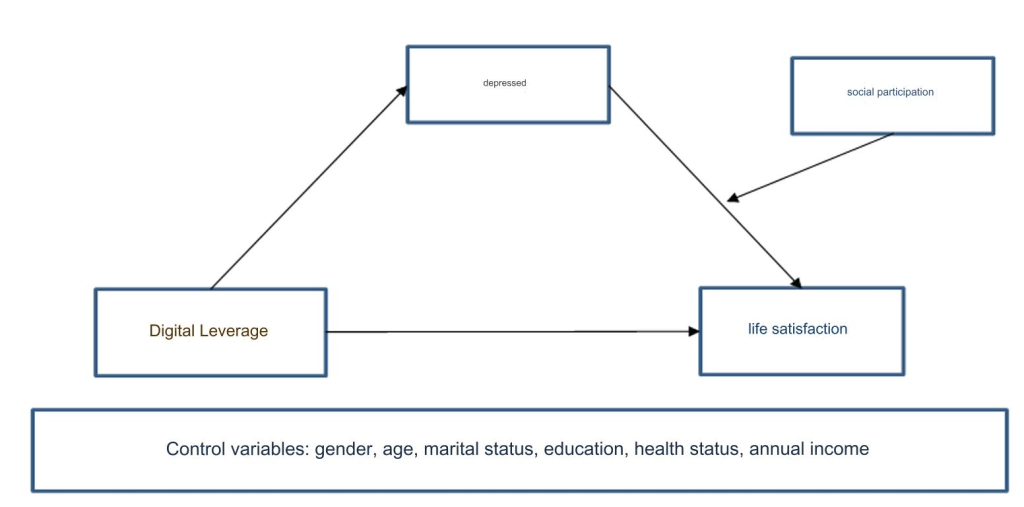
The basic direction of the 2020 Elderly Survey utilized in this study is composed of survey items aimed at maintaining continuity with previous surveys. Additional items were included to assess the elderly’s adaptation to the social environment and their lifestyle characteristics. The analysis focused on 8,664 individuals aged 65 and above, excluding those with missing values for key and control variables. The research model, as illustrated in <Figure 1>, aims to verify the mediating effect of elderly digital utilization on life satisfaction through the mediation of depression. Additionally, the study intends to examine the moderating effect of social participation in this relationship.
2. Measurement Tools
1) Independent Variable: Digital Utilization
The independent variable, digital utilization, was assessed through survey items related to elderly digital activities. These items include activities using electronic devices such as mobile phones, tablet PCs, the internet, TV, etc. The activities encompass receiving and sending messages, information search and retrieval, photo or video shooting, listening to music, playing games, watching videos, engaging in social networking services, e-commerce, financial transactions, application search and installation, and others, totaling 12 items. The items measuring the level of digital utilization were constructed as nominal variables (‘Yes,’ ‘No’). To utilize them as variables, each item was converted into a count and then summed. The reliability (α) of the 12 items measuring digital utilization was .884.
2) Dependent Variable: Life Satisfaction
The dependent variable, life satisfaction, includes seven items related to health status, economic status, relationship with spouse, relationship with children, social, leisure, and cultural activities, friendships and community relationships. However, items related to the relationship with a spouse and children were excluded in cases where the individual was unmarried or had missing values. The final life satisfaction variable was derived by averaging the five items related to health status, economic status, social, leisure, and cultural activities, friendships, and community relationships. The reliability (α) of the five items measuring life satisfaction was .843.
3) Mediating Variable: Depression
Depression, the mediating variable, consists of 15 items such as current life satisfaction, decreased enthusiasm, feelings of futility, boredom, freshness, anxiety, etc. For items that needed reverse interpretation, such as current life satisfaction and freshness, reverse coding was applied. The composition of depression items, categorized as nominal variables (‘Yes,’ ‘No’), was converted into dummy variables, summed, and then utilized. The reliability (α) of the 15 items measuring depression was .845.
4) Moderating Variable: Social Participation
Social participation, the moderating variable, was assessed using seven items related to club activities, social gatherings, political and social organizations, volunteer activities, senior centers, elderly welfare centers, and economic activities. Participation was categorized as ‘Yes’ or ‘No’ and converted into counts for analysis. However, due to the often non-applicable nature of religious activities, this variable was not utilized in the analysis.
5) Control Variables
Control variables include gender, age, marital status (presence of a spouse), education level, health status, and annual income. Gender was dummy-coded (1=male, 0=female), marital status was dummy-coded with exclusion of individuals with a spouse (1=unmarried, 0=without a spouse), age was used as a continuous variable, education level (1=illiterate to 5=college and above) indicated higher education as the score increased, health status (1=very healthy to 5=very unhealthy) was reverse-coded, and annual income was logarithmically transformed after dividing by the square root of the number of household members.
3. Data Analysis Method
For this study, we analyzed the relationship between the elderly’s digital utilization and life satisfaction, examining the mediating effect of depression in the relationship and the moderating effect of social participation on the relationship between depression and life satisfaction. Additionally, we investigated the moderated mediation effect where the mediating effect is moderated by social participation. The analysis was conducted using SPSS 23.0 and SPSS PROCESS 3.4.1.
Initially, basic frequency analysis, descriptive statistics, and correlation analysis were performed to understand the characteristics of the variables. The model validation proceeded through three stages. First, we verified the mediating effect of depression in the relationship between the elderly’s digital utilization and life satisfaction using the bootstrapping method. Second, to explore the moderating effect of social participation on the relationship between depression and life satisfaction, we conducted moderation analysis after mean centering. Finally, we examined the moderated mediation effect, where the mediating effect of depression in the relationship between digital utilization and life satisfaction is moderated by social participation. The moderated mediation effect implies that the indirect effect through the mediating variable on the dependent variable is contingent upon the moderating variable, known as conditional indirect effects (Yum, Jo, 2021; Preacher, Rucker & Hayes, 2007). All analyses were performed with a significance level of .05, and bootstrapping was specified at 5,000 iterations.
Ⅳ. Research Results
1. General Characteristics of the Elderly
| Characteristics | Classification | Count | Percentage |
| Gender | Male | 3,587 | 41.4 |
| Female | 5,077 | 58.6 | |
| Marital Status | Married | 5,189 | 59.9 |
| Unmarried | 3,475 | 40.1 | |
| Education Level | None | 842 | 9.7 |
| Elementary School | 2,767 | 31.9 | |
| Middle School | 2,063 | 23.8 | |
| High School | 2,508 | 28.9 | |
| University or Higher | 484 | 5.6 | |
| Age | Min=65, Max=99, M=72.95, sd=6.295 | ||
| Annual Income (In) | Min=1.26, Max=11, M=-6.61, sd=1.100 | ||
| Health Status | Min=1, Max=5, M=3.38, sd=0.860 | ||
To understand the general characteristics and those of key variables among the elderly, frequency analysis and descriptive statistics were conducted, as presented in Table 1. The results for categorical variables such as gender, marital status, and education level are as follows:
- Age: Ranging from 65 to 99 years.
- Annual Income: Ranging from 1.26 to 11.
- Health Status: Respondents rated their health from ‘very poor’ to ‘very good,’ with an average of 3.38.
| Digital Use | Depression | Social participation | Life satisfaction | |
| Digital Use | – | |||
| Depression | -.205*** | – | ||
| Social participation | 0.267*** | -.146*** | – | |
| Life satisfaction | .294*** | -0.396*** | 0.224*** | – |
| Skewness | 0.645 | 1.247 | 787 | -0.299 |
| Kurtosis | -0.602 | 1.244 | 1.425 | 0.222 |
| Mean (SD) | 3.68(3.122) | 3.22(3.316) | 1.30(.987) | 3.48(.621) |
Descriptive statistics and correlation analysis of key variables, presented in Table 2, were conducted. Assumptions for normality were assessed based on skewness and kurtosis, with all absolute skewness values below 2 and absolute kurtosis values below 7, indicating satisfactory normality (Curran, West & Finch, 1996).The correlation analysis revealed the following relationships:
2. Model Analysis
1) Mediation Analysis of Depression
| (N=8,664) | ||||||||
| Dependent Variable | Predictor Variable | b | se | β | t | F | R^2 | |
| Life Satisfaction | Control Variables | Gender | -0.087 | 0.014 | -0.069 | -6.373*** | 443.098*** | 0.265 |
| Age | 0.005 | 0.001 | 0.047 | 3.989*** | ||||
| Marital Status | -0.095 | 0.014 | -0.075 | -6.894*** | ||||
| Education Level | 0.054 | 0.007 | 0.097 | 7.809*** | ||||
| Health Status | 0.304 | 0.007 | 0.421 | 41.436*** | ||||
| Annual Income | 0.034 | 0.006 | 0.074 | 7.204*** | ||||
| Digital Usage (c) | 0.019 | 0.002 | 0.098 | 7.678*** | ||||
| Depression | Control Variables | Gender | 0.107 | 0.076 | 0.016 | 1.408 | 283.566*** | 0.187 |
| Age | -0.005 | 0.007 | -0.01 | -0.798 | ||||
| Marital Status | 0.633 | 0.077 | 0.094 | 8.224*** | ||||
| Education Level | -0.117 | 0.039 | -0.039 | -3.008** | ||||
| Health Status | -1.472 | 0.041 | -0.382 | -35.774*** | ||||
| Annual Income | -0.03 | 0.036 | -0.009 | -0.845 | ||||
| Digital Usage (a) | -0.033 | 0.014 | -0.031 | -2.432* | ||||
| Life Satisfaction | Control Variables | Gender | -0.083 | 0.013 | -0.066 | -6.300*** | 468.890*** | 0.304 |
| Age | 0.004 | 0.001 | 0.045 | 3.910*** | ||||
| Marital Status | -0.069 | 0.013 | -0.054 | -5.125*** | ||||
| Education Level | 0.049 | 0.007 | 0.087 | 7.310*** | ||||
| Health Status | 0.243 | 0.008 | 0.337 | 31.885*** | ||||
| Annual Income | 0.044 | 0.006 | 0.072 | 7.201*** | ||||
| Digital Usage (c’) | 0.017 | 0.002 | 0.087 | 7.313*** | ||||
| Depression (b) | -0.041 | 0.002 | -0.218 | -21.856*** | ||||
| * p<.05, ** p<.01, *** p<.001 | ||||||||
The results of verifying the mediating effect of depression in the relationship between elderly individuals’ digital usage and life satisfaction are presented in Table 3. Examining the total effect (c) of digital usage on life satisfaction, it appears as .019 (p < .001), indicating that higher levels of digital usage are associated with higher life satisfaction. The path coefficient (a) of digital usage on depression is -.033 (p < .05), revealing that lower levels of digital usage are linked to higher levels of depression. The path coefficient (b) of depression on life satisfaction is -.041 (p < .001), indicating that higher levels of depression are associated with lower life satisfaction. Considering the mediating effect, the direct effect (c’) of digital usage on life satisfaction is .017. This value is smaller than the total effect (c) value of .019, suggesting the presence of a partial mediation effect by depression. The coefficient of the indirect effect of digital usage on life satisfaction is .0014 (= -.033 × -.041). Bootstrapping for the indirect effect yielded upper and lower bounds of .0003 to .0024, excluding zero, signifying that the mediation effect is statistically significant. In summary, this supports the validation of a partial mediation model, indicating that the impact of elderly individuals’ digital usage on life satisfaction is not only direct but also mediated by depression.
| Variable | Mediation Effect Coefficient | Boot. S.E. | 95% Confidence Interval | |
| Boot. LLCI | Boot. ULCI | |||
| Depression | 0.0014 | 0.0005 | 0.0003 | 0.0024 |
2) Moderating Effect of Social Participation
| (N=8,664) | ||||||||
| Dependent Variable | Predictor Variable | b | se | t | F | R^2 | ⧍R^2 | |
| Life satisfaction | Control Variables | Gender | -0.083 | 0.013 | -6.334*** | 421.223*** | 0.306 | .001* |
| Age | 0.002 | 0.001 | 1.932 | |||||
| Marital Status | -0.068 | 0.013 | -5.112*** | |||||
| Education Level | 0.064 | 0.006 | 10.180*** | |||||
| Health Status | 0.24 | 0.008 | 31.414*** | |||||
| Annual Income | 0.036 | 0.006 | 5.737*** | |||||
| Depression | -0.04 | 0.002 | -21.113*** | |||||
| Social participation | 0.054 | 0.006 | 8.951*** | |||||
| Depression X Social participation | 0.003 | 0.002 | 1.963* | |||||
| * p<.05, ** p<.01, *** p<.001 | ||||||||
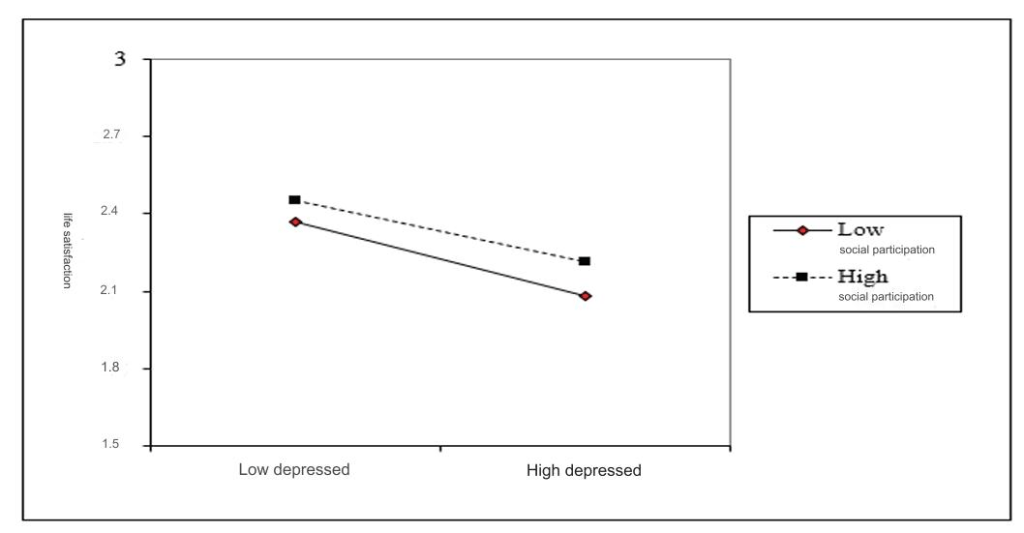
To examine whether social participation moderates the impact of depression on life satisfaction, a moderation regression analysis was conducted, as presented in Table 5. The adjusted R^2 value, with the interaction term included, was found to be 0.001, indicating statistical significance. Thus, it was verified that the influence of depression on life satisfaction in older adults is moderated by social participation. Consequently, as depression increases, life satisfaction tends to be lower in the group with lower social activity compared to the group with higher social activity. The interaction effect is illustrated in Figure 2.
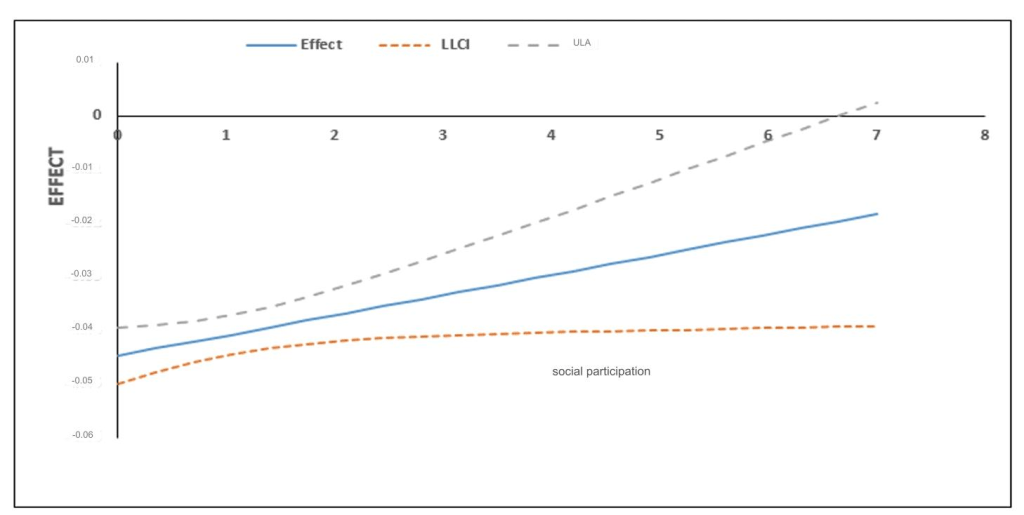
Interaction Effects of Depression and Social Participation on Life SatisfactionMeanwhile, when the moderator variable is a continuous variable rather than a categorical one, explanations about the range where the moderation effect occurs are typically provided by Aiken and West (1991), mentioning mean values and mean ±1 standard deviation values. However, in SPSS PROCESS, Johnson-Neyman technique is employed to present the moderation effect values over the entire range of social participation in the relationship where depression influences life satisfaction. The confidence bands for the moderation effect are shown in Figure 3. The values indicate that the effect of depression on life satisfaction is statistically significant at a 95% confidence level for values below 6.3, as the range from the lower limit to the upper limit does not include 0.
3) Adjusted Mediation Effects
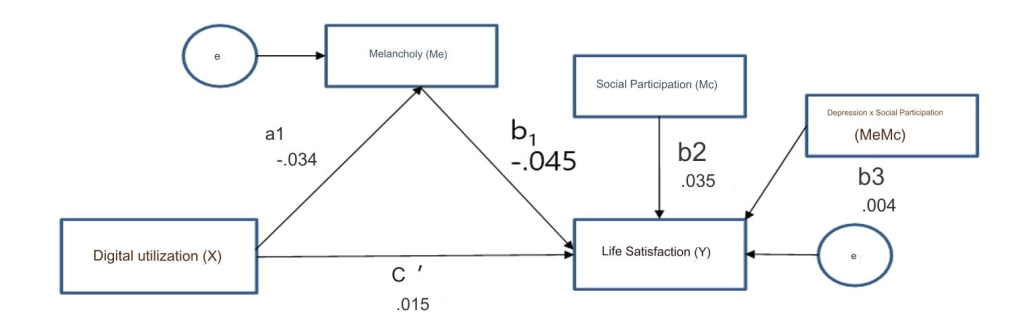
Having verified the mediation and moderation effects presented earlier, we proceeded to examine the combined adjusted mediation effects by including gender, age, marital status, education level, annual income, and health status as control variables. The results are presented in Table 6, focusing on the outcomes related to the main variables. Analyzing the results, we found that digital usage (a1) had a negative impact on depression. Subsequently, depression (b1) was confirmed to have a negative effect on life satisfaction. Lastly, social participation (c1′) and depression × social participation (b3) were verified to have positive effects on life satisfaction.
| (N=8,664) | ||||||
| Dependent Variable | Mediator Variable: Depression | Mediator Variable: Life satisfaction | ||||
| Digital Usage (a1) | -0.034 | 0.014 | -2.481* | 0.015 | 0.002 | 6.490*** |
| Depression (b1) | -0.045 | 0.003 | -16.817*** | |||
| Social Participation (c1′) | 0.035 | 0.008 | 4.277*** | |||
| Depression X Social Participation (b3) | 0.004 | 0.002 | 2.344* | |||
| * p<.05, ** p<.01, *** p<.001 | ||||||
[Table 6] Direct Effects of Adjusted Mediation Analysis
The size of the effect of digital usage on life satisfaction  can be calculated based on the conditional indirect effect, as expressed in the following equation (Hayes, 2018).
w = a1(b1+b3W) (W is mediation factor)
= -0.034(-0.045+0.004 X social participation)
In essence, examining the equation reveals that as the value of social participation increases, the impact of digital usage on life satisfaction through mediating depression also increases. This implies the existence of a moderated mediation effect. To verify this moderated mediation effect, conditional indirect effects were calculated using bootstrapping with the mean (0) and the mean ±1 standard deviation as conditions to assess the coefficients and statistical significance. The results in Table 7 indicate that the confidence intervals do not include zero for both upper and lower bounds, suggesting statistically significant outcomes. In summary, when the digital usage of older adults is low, depression tends to increase, leading to decreased life satisfaction. This mediating effect is moderated by the control variable of social participation, confirming the presence of a moderated mediation effect. The values for all paths are presented in Figure 4.
| (N=8664) | ||||
| Social participation | The conditional indirect effects at specific values of the moderator variable. | |||
| Boot indirect effect | Boot Standard Error | Boot LLCI | Boot ULCI | |
| -1SD(-.987) | 0.0015 | 0.0005 | 0.0004 | 0.0027 |
| Average value(0) | 0.0014 | 0.0005 | 0.0004 | 0.0024 |
| +1SD(.987) | 0.0012 | 0.0005 | 0.0003 | 0.0022 |
Ⅴ. Conclusion
This study utilized the 2020 Elderly Survey to investigate the impact of digital usage on life satisfaction among individuals aged 65 and older, considering depression as a mediating factor. Additionally, the study examined the moderating mediated effect of social participation in this relationship. The significance lies in targeting the most vulnerable elderly population within the information-disadvantaged group and verifying the integrated perspective on whether social participation acts as a protective factor in the relationship between depression and life satisfaction. The key findings and discussions of this study are as follows:
Firstly, it was found that digital usage not only directly influences life satisfaction but also has an indirect effect through depression, supporting a partial mediation model. This aligns with prior research suggesting that improving elderly individuals’ digital information accessibility and skills can alleviate depression and enhance life satisfaction (Oh et al., 2018). Therefore, efforts to enhance the digital competence of the elderly should not only focus on educational programs but also involve a shift from a supplier-centered to a consumer-centered approach in ICT policies (Kim & Sim, 2020). Initiatives such as those in Europe, where large tablets are used to facilitate access to digital services for the elderly, present innovative approaches (Blazic & Blazic, 2020).
Secondly, depression was found to have different effects on life satisfaction depending on the level of social participation, confirming the moderating effect of social participation. This aligns with previous research indicating that social participation alleviates depression and positively influences quality of life (Kim, 2015; Heo, 2017; Kim, 2018). In this study, social participation was examined comprehensively, including leisure activities and economic activities. Therefore, there is a need for diverse programs to encourage elderly individuals’ social participation, as well as measures to develop job opportunities based on regional characteristics to promote economic activity participation.
Thirdly, the mediating effect of depression in the relationship between digital usage and life satisfaction decreased when considering the moderating effect of social participation. This aligns with previous research indicating that social participation acts as a protective factor against depression (Kim et al., 2017; Heo et al., 2017; Lee, 2018). The results suggest that even when digital usage is low and depression is high, the impact on life satisfaction decreases when social participation is high. Therefore, programs that expand both formal and informal social support networks, such as support for self-help groups and educational programs, should be developed and promoted to encourage social activity participation.
In conclusion, this study provides empirical evidence for the effectiveness of improving digital usage and promoting social participation as strategies to enhance life satisfaction among the most vulnerable elderly population. The limitations of the study include the simplicity of measuring digital competence and usage levels based on the Elderly Survey data. Future research should consider latent class analysis to identify subgroups of elderly individuals with different digital competencies and usage patterns. Additionally, the study’s reliance on self-reported social participation metrics and the lack of regional-level analysis suggest avenues for further exploration and the application of multilevel modeling in future research.
 Uthando Nethemba