Evidence-first notes on bioscience and deep tech, at the edge of the lab and the market. Information only — not investment advice, not medical advice.
The 30-second version
- What. The incretin (GLP-1) class is expanding beyond glucose and weight into cardiovascular, kidney and heart-failure indications. In the only two head-to-head trials, the dual agent (tirzepatide) beat the mono agent (semaglutide) on weight and glucose — but both trials were Lilly-sponsored and open-label — while the deeper evidence on hard cardio-kidney-metabolic (CKM) outcomes belongs to semaglutide.
- So what. This is not “one drug wins everything”; the axes split. Weight/glucose favor tirzepatide; hard cardiovascular and kidney outcomes are led by semaglutide. The evidence only holds if you separate surrogate endpoints (percent body weight) from hard outcomes (MACE, composite kidney).
- Now what. The real bottleneck is not headline efficacy but durability, lean-mass loss, safety and access. One year after stopping, much of the lost weight returns (only a partial benefit persists), so these should be treated like chronic-disease therapies requiring continued dosing.
The five-minute read
Incretins have become a metabolic “platform”
The GLP-1 class controls glucose and body weight by stimulating insulin secretion, increasing satiety and delaying gastric emptying. The mechanism has expanded mono (GLP-1) → dual (GIP/GLP-1) → triple (GIP/GLP-1/glucagon), adding targets such as energy expenditure and fatty liver. Indications now reach past the glucose and weight headlines into cardiovascular disease, kidney disease, heart failure, liver disease (MASH) and sleep apnea.
From the Principal’s CKM (cardio-kidney-metabolic) vantage point, the key question is not “how much weight comes off (%)?” but “how does this actually reshape CKM standard-of-care, and where is the real bottleneck?”
Two axes split — weight versus hard outcomes
In the only two head-to-head trials, the dual agent tirzepatide beat the mono agent semaglutide. In the first direct obesity comparison, SURMOUNT-5 (NEJM 2025), tirzepatide reached −20.2% versus semaglutide −13.7% (difference −6.5 percentage points, P<0.001). But both trials carry the same conflict of interest (COI): Lilly-sponsored and open-label.
On cardiovascular and kidney hard outcomes, however, the evidence is deeper for semaglutide. In SELECT, MACE fell about 20% (HR 0.80); in FLOW, a composite of kidney, cardiovascular and death events fell 24% (HR 0.76). Tirzepatide has no completed cardiovascular outcome trial (CVOT). In short, winning on weight is not the same as leading on hard CV outcomes — and there, semaglutide is ahead.
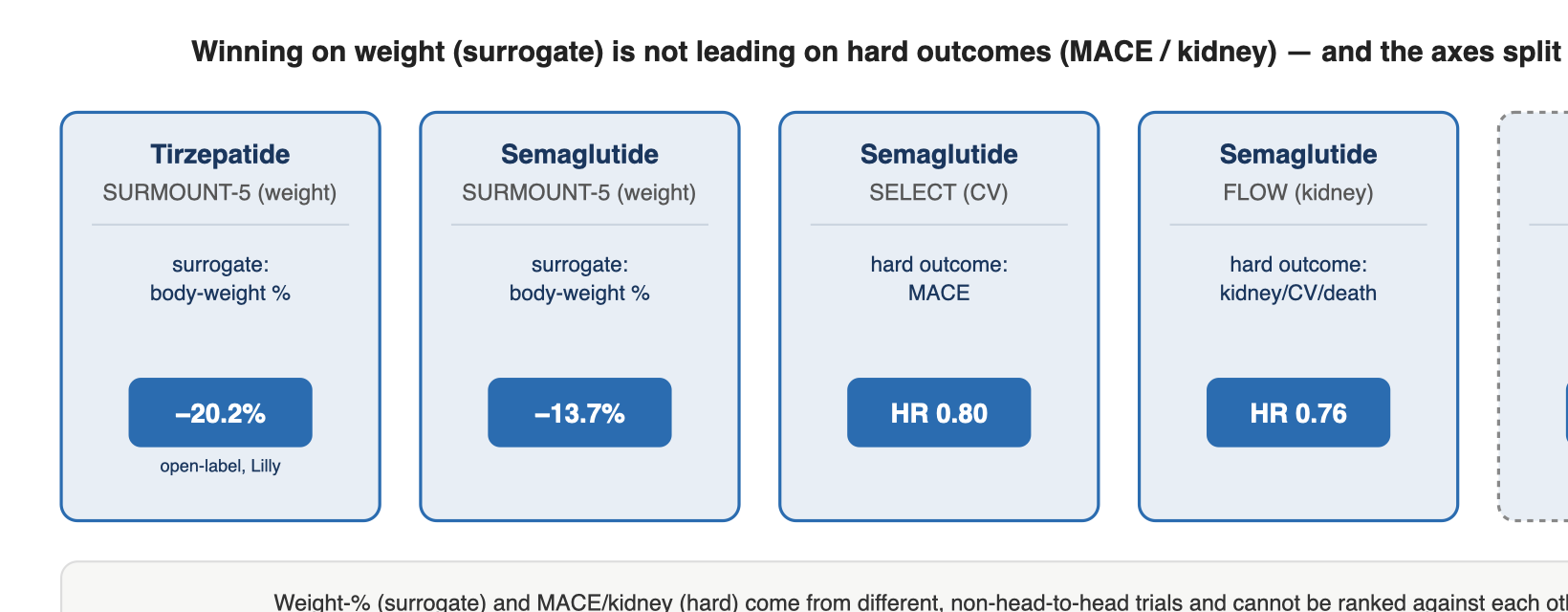
| Weight / glucose axis | Hard-outcome axis (heart, kidney) | |
|---|---|---|
| tirzepatide (dual GIP/GLP-1, Lilly) |
Superior — SURMOUNT-5 −20.2% (obesity) | No completed CVOT |
| semaglutide (mono GLP-1, Novo) |
SURMOUNT-5 −13.7% | Leads — CV −20% (SELECT) · kidney −24% (FLOW) |
The real bottleneck: durability, safety, access
One year after discontinuation, about 60% of on-treatment weight loss is regained; the regain then decelerates and plateaus near 75%, so roughly a 25% partial benefit persists (a modeled estimate). This is neither “it all comes back” nor “it is maintained” but somewhere in between — and it argues for treating these agents like chronic-disease therapies requiring continued dosing. Gastrointestinal (GI) adverse events (nausea, vomiting, diarrhea) dominate the safety profile and are the main driver of real-world discontinuation.
Deep dive
1. Background — incretin biology
GLP-1 controls glucose and weight by stimulating insulin secretion, increasing satiety and delaying gastric emptying. The receptor axis divides into GLP-1, GIP and glucagon, and drug generations have expanded mono (GLP-1) → dual (GIP/GLP-1) → triple (GIP/GLP-1/glucagon), adding energy expenditure and fatty liver as targets. The action is multi-pathway — central satiety, gastrointestinal and pancreatic — and the delayed gastric emptying is the source of the GI adverse events.
2. What this landscape establishes — approved agents and evidence
Core (verified): in the only two head-to-head trials, the dual GIP/GLP-1 agent (tirzepatide) beat the GLP-1 mono agent (semaglutide) on weight and glucose. But both were Lilly-sponsored and open-label (COI).
- Head-to-head, type 2 diabetes — SURPASS-2 (NEJM 2021, n=1,879, 40 weeks): tirzepatide was superior to semaglutide 1 mg — HbA1c −2.09/−2.37/−2.46% (5/10/15 mg) versus −1.86%; weight −8.5/−11.0/−13.1% versus −6.7%. Note the comparator was semaglutide 1 mg (the maximum T2D dose at the time).
- Head-to-head, obesity — SURMOUNT-5 (NEJM 2025-05, Aronne, n=751 without diabetes, 72 weeks, maximum tolerated dose): tirzepatide −20.2% (95% CI −21.4 to −19.1) versus semaglutide −13.7% (−14.9 to −12.6), difference −6.5 percentage points, P<0.001. First direct obesity comparison. Open-label, Lilly-sponsored (COI).
- Indirect comparison (weaker evidence): a Bucher indirect treatment comparison (ITC) reconfirmed the direction (tirzepatide 15 mg +4.79 percentage points versus semaglutide 2.4 mg) — but as an indirect comparison with Lilly-affiliated authors (COI), it is weaker evidence than head-to-head.
- semaglutide (Ozempic/Wegovy/Rybelsus, Novo): trails tirzepatide on weight and glucose but has deeper CKM outcome evidence (see §3).
3. Indication expansion — the CKM core
Core (verified): tirzepatide leads on weight and glucose, but semaglutide has the deeper CKM hard-outcome evidence — the two axes split.
- Cardiovascular — SELECT: semaglutide 2.4 mg reduced MACE by about 20% (HR 0.80) in 17,604 people with overweight/obesity plus cardiovascular disease and without diabetes, complemented by SUSTAIN-6 / PIONEER-6 in T2D. Tirzepatide has no completed head-to-head CVOT (SURPASS-CVOT is NEJM 2025-12).
- Kidney — FLOW (NEJM 2024;391:109, n=3,533 T2D + CKD, on background RAS inhibition): semaglutide 1.0 mg reduced the major kidney, cardiovascular and death composite by 24% (HR 0.76, 95% CI 0.66–0.88). Core evidence for the CKM kidney axis.
- Heart failure (HFpEF) — SUMMIT: tirzepatide’s reduction in the composite of CV death / HF worsening was consistent regardless of CKD status (33% reduction in the CKD group versus 42% in the non-CKD group, P-interaction >0.05). A caveat on the mortality component must accompany this (see §6).
Hard outcomes versus surrogates (essential): percent weight is a surrogate endpoint; MACE, the kidney composite and death are hard outcomes. This is not “one drug wins everything” — the evidence splits by agent (tirzepatide = weight/glucose; semaglutide = CV/kidney outcomes), so separating the strength of evidence per indication is the heart of an evidence-first read. MASH and OSA are developed in later parts.
4. Neighbouring domains — the CKM continuum
That GLP-1 crosses cardio, kidney and metabolic through a single pharmacology is a demonstration of the view of CKM as one disease continuum. But over-reading it as “one drug fixes everything” is a mistake — the strength of evidence per indication (hard outcome versus surrogate) must be separated. This is the bioscience version of the firm’s framing that “the bottleneck lies elsewhere” (headline efficacy versus real-world durability, safety, access).
5. Commercialization and investment context (TRL, companies)
- Maturity: semaglutide and tirzepatide are both approved and in indication expansion (TRL 9). MariTide (Amgen) is Phase 2.
- Market structure: a Novo–Lilly duopoly (market size, growth and supply constraints are quantified in later parts —).
- Pipeline: next-generation triple/oral/amylin agents span research to some late-stage programs; the efficacy–safety frontier is developed in later parts.
- Company implications are limited to neutral description; competitive or efficacy-ranking statements are not buy/sell signals.
6. The skeptic’s bottom line
- Weight regain after stopping (durability) [Lancet eClinicalMedicine 2026]: about 60% of on-treatment weight loss is regained one year after discontinuation. But the regain decelerates and plateaus near 75.3% (95% CI 68.9–81.6) — it does not fully return to baseline, so about a 25% partial benefit persists (a modeled estimate). Neither “it all comes back” nor “it is maintained,” and the key implication is a chronic-disease premise of continued dosing.
- GI adverse events (safety signal) [FAERS 2007–2023, PMC]: the most frequent GI events for semaglutide are nausea 50.3%, vomiting 30.2%, diarrhea 25.7%, abdominal pain 24.4%. Note these are FAERS reporting proportions, not incidence rates. A disproportionality signal for delayed gastric emptying (IC025 0.342) was seen. GI events dominate the safety profile and are the main driver of real-world discontinuation.
- Lean/fat-free mass loss, real-world discontinuation rate, unknown long-term safety, cost/access, compounding: quantified in later parts. A compounded-semaglutide dosing-error signal (5–20× overdose) was extracted but is unverified (FDA alert source) — a target for later verification.
- SUMMIT mortality-component caveat: the HFpEF composite reduction is driven mainly by decongestion / HF-worsening components, and the mortality component may be unfavorable (inherited from source asset §5 caveat).
- Principle: do not over-extend headline efficacy (trial conditions) into real-world durability and safety.
7. What to watch
- The completed tirzepatide CVOT (SURPASS-CVOT, NEJM 2025-12) — whether superiority on weight translates into superiority on hard outcomes.
- Whether the post-discontinuation regain plateau reproduces in the real world.
- Quantitative data on lean-mass loss and real-world discontinuation rates.
- MariTide (GIP antagonist, Amgen) Phase 3 progress and durability.
- Hard-outcome evidence for MASH and OSA indication expansion.
References
- Frías, J. P., et al. 2021. “Tirzepatide versus Semaglutide Once Weekly in Patients with Type 2 Diabetes (SURPASS-2).” New England Journal of Medicine 385: 503. https://doi.org/10.1056/NEJMoa2107519
- Aronne, L. J., et al. 2025. “Tirzepatide versus Semaglutide for Weight Loss (SURMOUNT-5).” New England Journal of Medicine. https://doi.org/10.1056/NEJMoa2416394
- Lincoff, A. M., et al. 2023. “Semaglutide and Cardiovascular Outcomes in Obesity without Diabetes (SELECT).” New England Journal of Medicine. HR 0.80. https://doi.org/10.1056/NEJMoa2307563
- Perkovic, V., et al. 2024. “Effects of Semaglutide on Chronic Kidney Disease in Patients with Type 2 Diabetes (FLOW).” New England Journal of Medicine 391: 109. HR 0.76. https://doi.org/10.1056/NEJMoa2403347
- Packer, M., et al. 2025. “Tirzepatide in Heart Failure with Preserved Ejection Fraction and Obesity (SUMMIT).” New England Journal of Medicine.
- eClinicalMedicine. 2026. “Durability of Weight Loss after GLP-1 Discontinuation.” Lancet eClinicalMedicine.
- FDA Adverse Event Reporting System (FAERS), 2007–2023. Gastrointestinal signal analysis, PMC.
- Amgen. MariTide Phase 2 (NCT05669599). https://clinicaltrials.gov/study/NCT05669599
Disclosure
This post is for information only and is not investment advice, and not medical advice. Treatment decisions should always be made with your own clinician.
COI note: this post describes listed pharmaceutical companies (Novo Nordisk NVO, Eli Lilly LLY, Amgen AMGN) and the clinical trials they sponsored in a descriptive context. The only two head-to-head trials (SURPASS-2, SURMOUNT-5) and the indirect comparison (Bucher ITC) are Lilly-sponsored and open-label, and some include Lilly-affiliated authors. All efficacy figures are attributed with the trial name and journal, and quantitative claims are attributed to the relevant trial or authors. Competitive and efficacy-ranking statements are factual, neutral descriptions and are not buy/sell implications for any security. The author holds no position in, and has no financial interest in, the companies named.


Leave a Reply