Category: Perspectives
-
The memory wall and advanced packaging: the new Moore’s Law is bandwidth, not transistors
Evidence-first notes on bioscience and deep tech, at the edge of the lab and the market. Information only — not investment advice. The 30-second version What. Inside the AI accelerator, the rate-limiting step is no longer logic (FLOPs) but memory bandwidth and the packaging that attaches it. If Moore’s Law was a transistor-density game, the…
-
Computing power, now and next: a landscape map — where is the real bottleneck?
Evidence-first notes on bioscience and deep tech, at the edge of the lab and the market. Information only — not investment advice. The 30-second version What. Computing-power debates compress into headline metrics (node nm, “N-times faster,” qubit counts, TB/s), but the step that actually blocks real use sits systematically next to those numbers. The landscape’s…
-
Computing’s Single Point of Failure: Why the Semiconductor Supply Chain Is Tied to a Few Places on the Map
Evidence-first notes on bioscience and deep tech, at the edge of the lab and the market. Information only — not investment advice. The 30-second version What. The ultimate bottleneck for AI and computing is neither chip performance (physics) nor capital (economics), but a geopolitical structure in which advanced logic, EUV lithography, HBM, and upstream materials…
-
The honest TRL of post-CMOS: the gap between headline qubit counts and the “when is it useful?” question
Evidence-first notes on bioscience and deep tech, at the edge of the lab and the market. Information only — not investment advice. The 30-second version What. For post-CMOS alternatives (quantum, neuromorphic, photonic and others), the real question is not “does it work?” but “when does it become useful?” The estimated resources to break RSA-2048 have…
-
What died is not Moore’s Law but its economics
Evidence-first notes on bioscience and deep tech, at the edge of the lab and the market. Information only — not investment advice. Computing-power series, Part 3. The 30-second version What. The real bottleneck hidden behind the “node in nm” headline is not physics but economics — density keeps rising, but the decline in cost-per-transistor ($/transistor)…
-
Power is the bottleneck — what actually fills AI’s 2028-2030 electricity gap
Evidence-first notes on bioscience and deep tech, at the edge of the lab and the market. Information only — not investment advice. The 30-second version What. AI compute demand doubles roughly every 5-6 months, and the binding constraint on scaling has shifted from silicon efficiency to physical grid capacity. A data center takes 2-3 years…
-
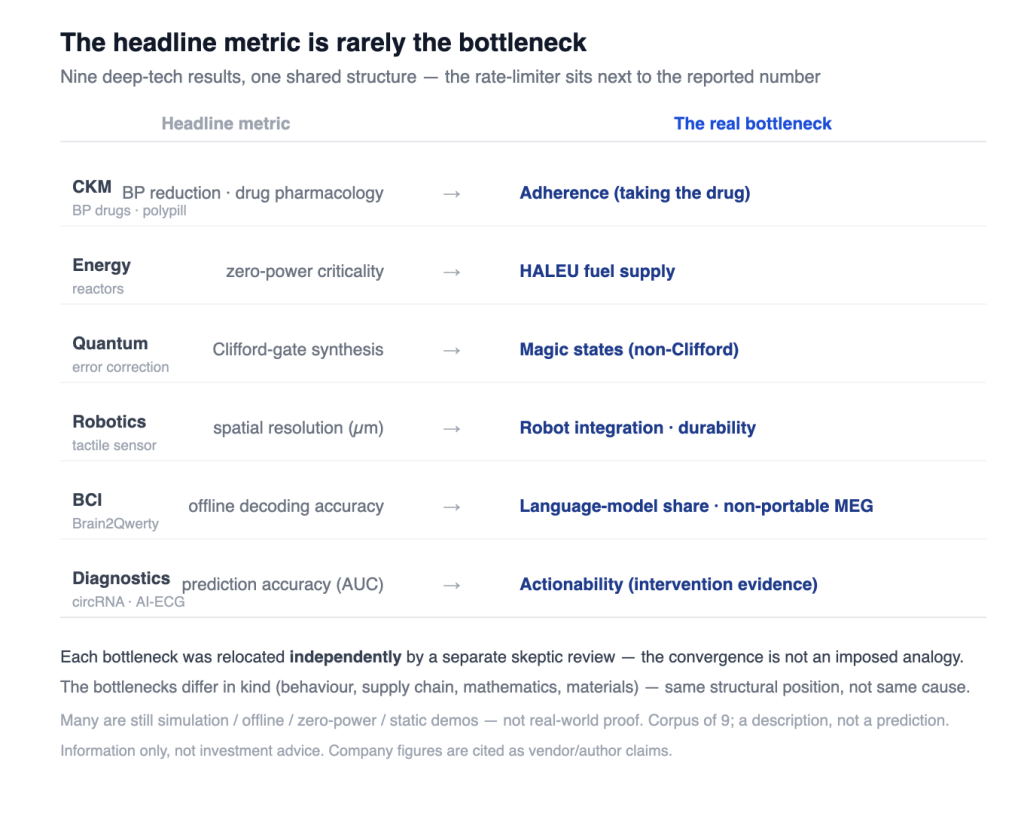
The headline metric is rarely the bottleneck — one structure shared by nine deep-tech results
Evidence-first notes on bioscience and deep tech, at the edge of the lab and the market. A cross-domain synthesis, not a single-paper analysis. Information only — not investment advice. The 30-second version What. Across nine seemingly unrelated deep-tech results we covered over two weeks — blood-pressure drugs and a heart-failure polypill, an ECG-AI biomarker, a…
-
The Demise of the Clinical Research Guru in the AI Era
The rise of AI is fundamentally reshaping the landscape of clinical research, challenging the traditional role of the “guru” or key opinion leader. In an age where vast amounts of public data are accessible to everyone, is the expert opinion still as valuable as it once was? The Democratization of Evidence For decades, the opinions…
-
[Thought] Knowledge Work in the Age of AI
The rise of AI has led to a common prediction: the value of knowledge work is plummeting. With powerful tools that can generate text, summarize information, and write code in seconds, it seems that the days of high-value human expertise are numbered. After all, if an AI can do it, why would anyone pay a…
-
[Thought] The Rising Cost of Original Training Data: Will Humans Become AI’s Data Providers?
As artificial intelligence (AI) systems evolve, they are becoming increasingly reliant on high-quality, original data to sustain their growth. However, the scarcity and rising cost of obtaining such data are posing significant challenges. A provocative concern is emerging in this context: could humans eventually become mere providers of data, akin to “livestock” for AI systems?…

