Evidence-first notes on bioscience and deep tech, at the edge of the lab and the market. A cross-domain synthesis, not a single-paper analysis. Information only — not investment advice.
The 30-second version
- What. Across nine seemingly unrelated deep-tech results we covered over two weeks — blood-pressure drugs and a heart-failure polypill, an ECG-AI biomarker, a circRNA Alzheimer’s test, a noninvasive brain-to-text decoder, an error-correction compiler, unconventional superconductors, a batch of nuclear microreactors, and a tactile sensor — one structure recurs: the metric the headline celebrates is orthogonal to the actual rate-limiting step. And the bottleneck was relocated independently by each result’s own skeptical review.
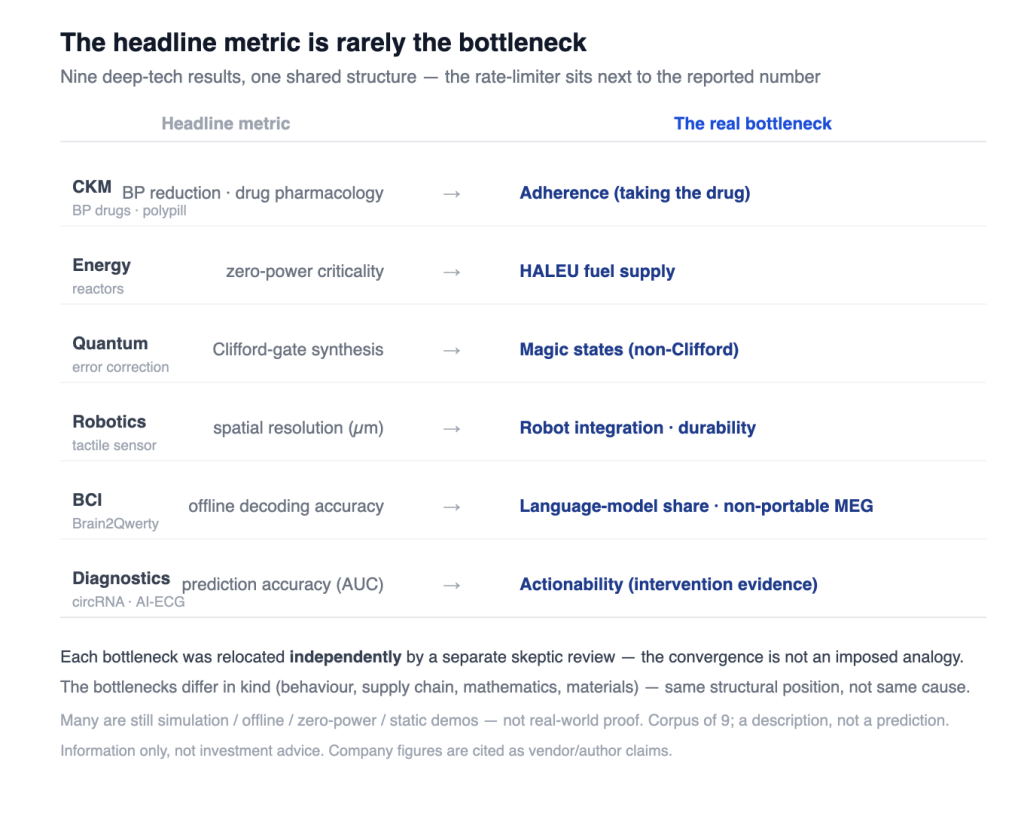
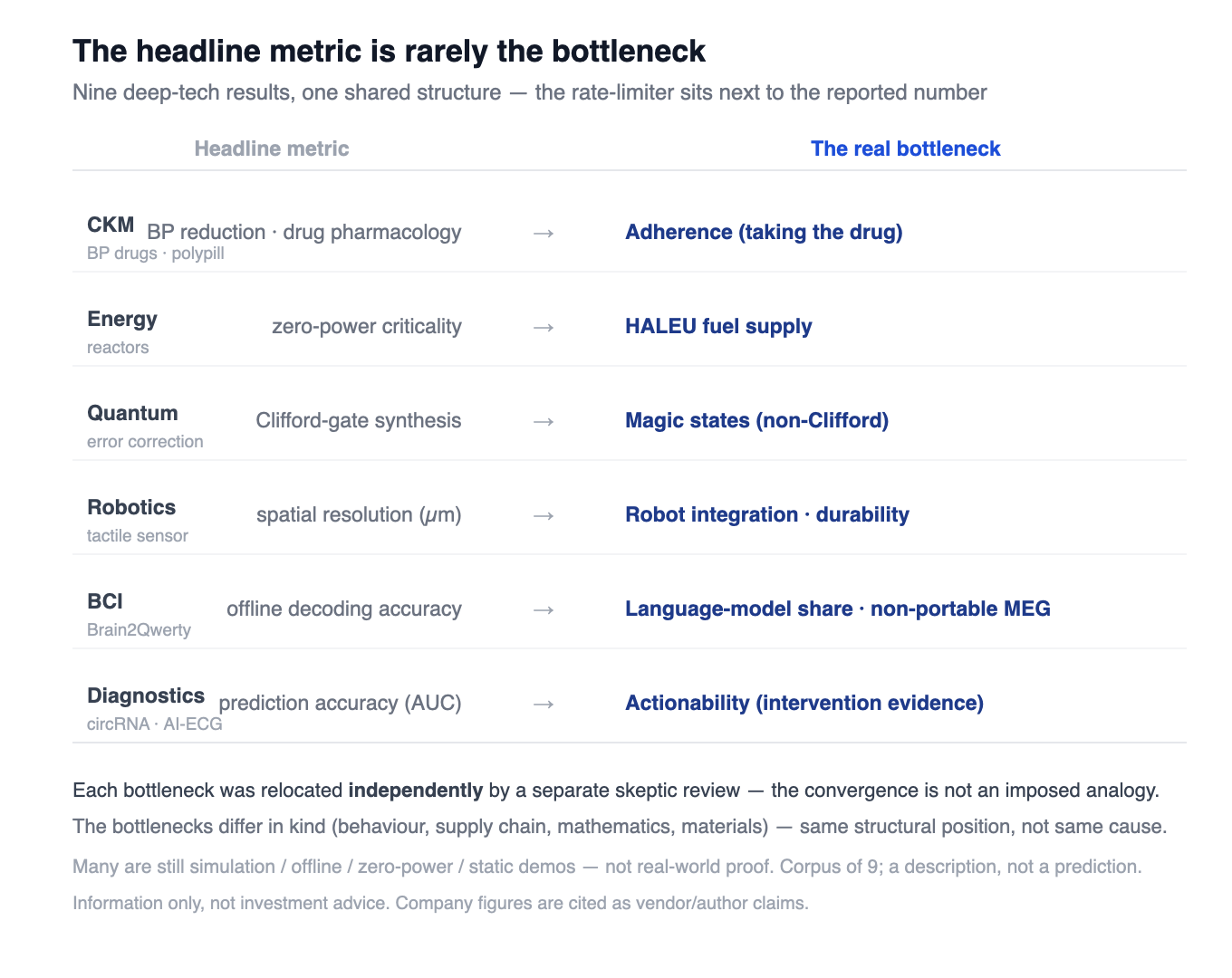
- So what. The real rate-limiter sits next to the reported number: in cardio-kidney-metabolic (CKM) medicine it is not the pharmacology but adherence; for the reactors it is not criticality but fuel supply; for the quantum result it is not Clifford-gate synthesis but magic states; for the robot sensor it is not resolution but integration and durability; for the decoders it is not accuracy but how much a language model filled in, and intervention evidence.
- Now what. It changes the reading order. Before reacting to a headline metric (criticality, “20×”, 0.945, an AUC), ask where the field’s actual bottleneck is — and anchor attention on evidence that the bottleneck is moving (a fuel contract, a magic-state cost, an intervention trial, an adherence decomposition), not on the metric paper.
The five-minute read
What CKM already taught: the bottleneck was adherence, not the molecule
In cardio-kidney-metabolic medicine, a proposition recurs: the rate-limiting step of clinical effect is not pharmacology but adherence — whether patients keep taking the drug. Two results we reviewed point to the same spot by different routes. In an individual-participant-data meta-analysis of 51 antihypertensive trials, the apparent long-term attenuation of benefit largely disappeared once the analysis was restricted to adherent patients (a >5-year hazard ratio of 0.84, per the authors). A heart-failure polypill trial (POLY-HF) secured its effect by lifting adherence — 79% versus 54% — with a fixed-dose combination. The headline (the pressure drop, the component pharmacology) was not what governed real-world value; the implementation axis next to it was. (Both stop short of a causal decomposition of adherence versus drug effect, so “adherence is the causal rate-limiter” remains a claim, not a settled fact.)
The same structure recurs across non-bio domains, in each field’s own language
What is striking is that this is not confined to CKM. The DOE reactor program produced three criticalities on deadline — but all three were zero-power, and the real bottleneck to power is HALEU fuel supply. In quantum error correction, automating logical Clifford gates is progress, but the bottleneck for universal computation is the magic states outside that set (and the result is Stim simulation, no hardware). The tactile sensor improved resolution, but the use bottleneck is robot integration and cyclic-fatigue durability, and the demos were static and manual. The brain-to-text decoder reported offline accuracy, but the bottleneck is separating what a language model filled in and its reliance on a non-portable MEG scanner. The headline metric improved; the rate-limiter sat systematically elsewhere.
The force of this observation is that it is not an analogy we imposed. Each result’s devil’s-advocate review relocated the bottleneck independently — different domains, different reviewers, all pointing at the same structural position (next to the reported metric). That agreement across independent judgments is the primary evidence for the convergence.
So what changes?
It reorders how you read a deep-tech claim: first locate the real bottleneck, then judge whether the headline touches it. It also reframes what is worth tracking — the trigger is not the next metric paper but evidence the bottleneck is moving.
Deep dive
1. Background: why “metric” and “bottleneck” must be separated
Deep-tech coverage usually compresses success into one headline number: criticality for a reactor, “N× improvement” for quantum, an AUC for a diagnostic, micrometres for a sensor, a relative-risk reduction for a drug. These measure real achievements, but there is no guarantee the measured axis is the one blocking real-world use. The observation here is simple: in seven of the nine results, the reported metric measured an axis orthogonal to the bottleneck, and getting a usable outcome depended on something adjacent — a supply, a material, a resource, a behaviour, a piece of mathematics.
The prototype of this lens is CKM itself. From a Medical-Affairs and implementation standpoint, “the bottleneck to clinical effect is implementation (adherence), not the molecule” is familiar. The contribution here is that the proposition is not CKM-specific — it re-appears as a shared structure across several deep-tech domains.
2. The pattern, stated (C1)
Laying out each domain’s real bottleneck (each is evidenced in the underlying analysis, and in each case the headline alone does not deliver the outcome):
- CKM: headline = pressure reduction / component pharmacology → bottleneck = adherence.
- Energy: headline = zero-power criticality → bottleneck = HALEU fuel supply.
- Quantum: headline = logical Clifford (CNOT) synthesis → bottleneck = magic states (non-Clifford T).
- Robotics: headline = tactile resolution → bottleneck = robot-grasping integration, cyclic-fatigue durability, curved/large-area materials.
- BCI: headline = offline decoding accuracy → bottleneck = separating the language-model share, and dependence on non-portable MEG.
- Diagnostics (circRNA, ECG-AI): headline = prediction accuracy → bottleneck = actionability (intervention evidence).
The bottlenecks differ in kind — behaviour, supply chain, mathematics, materials science, statistics. So this is not a convergence of a single cause; it is a convergence of a single structural position (next to the reported metric). Reading it as a common cause would over-interpret it. That distinction is the core constraint of the synthesis.
3. Strengths and limits — the discipline behind the evidence
Strength: independent relocation of the bottleneck. This convergence is not an author’s narrative bias because each analysis’s adversarial gate moved the bottleneck on its own. The energy gate relocated it to “all zero-power, not generation”; the quantum gate to “Clifford-only, magic states”; the robotics gate to “static/manual demo, integration and durability unproven”; the BCI gate to “read from the brain versus filled by the language model”; the two CKM gates to “adherence and pharmacology not decomposed.” The same structure recurred across mutually independent judgments.
Limit: the size and grade of the corpus. This is a sample of nine, and some of the material is low-grade — the energy item is policy/news (not peer-reviewed), the unconventional-superconductivity item is an arXiv preprint from a single group (muSR time-reversal-breaking not yet independently reproduced; Tc ~1.1 K), the ECG-AI item is partially verified, and the circRNA item is published but conditional. So the confidence of the synthesized signal cannot exceed the verification ceiling of its inputs. As a description C1 is well-supported (the structure recurs); it should not be inflated into a predictive claim. When quoting numbers, source caveats travel with them: Quantinuum’s “20× spacetime” is a vendor preprint claim; the circRNA 0.945 is a discovery-cohort apparent value and diagnostic superiority was untested (only progression was incremental); “three criticalities” were zero-power.
The demonstration-vs-reality gap. Many achievements in this corpus are not real-world proof. The three reactors are zero-power criticality, not commercial power; the quantum result is Stim simulation, not hardware (TRL ~3); the sensor is a static, manual demo, not robot integration; the decoder is offline on a non-portable MEG, not a real-time wearable. Not extending the headline past that gap is the practical point of C1.
4. A neighbouring signal: the algorithm’s “read versus filled” problem
As a secondary axis, the three statistical-inference results (circRNA, ECG-AI, Brain2Qwerty) share a verification weakness: it is hard to separate what the model read from the data from what a prior or language model filled in. Information leakage could inflate the circRNA apparent 0.945; ECG-AI carries shortcut-learning risk; and in Brain2Qwerty the language-model prior’s contribution to accuracy was not separated. If any one of them demonstrates, via a formal ablation, that the “filled-in” share is small, that result exits this signal.
An important boundary: the quantum result was explicitly rejected from this signal. The temptation to lump its CP-SAT solver in as an “AI layer” fails, because that solver is a deterministic synthesis/search tool and its results are reproducible in simulation. We do not force a merger on the surface fact that “an algorithm was used.” Likewise the leap from “unconventional superconductor” to “topological qubit” was already fenced off by both analyses and both reviews (temperature, time-horizon, reproduction pending), and this piece inherits that rejection.
5. Commercialization lens: where hype is manufactured (neutral)
Inverting C1 through a commercialization lens reveals a secondary pattern: inflated (“hype”) language is not random but tends to cluster at the commercialization boundary. In five of the nine, the inflation vectors were predictable in form — pre-regulatory direct-to-consumer deployment; superiority adjectives from authors with paid-consulting or commercial partnerships; a vendor preprint’s multiple-claim; strong adjectives from patent-holding inventors; and a government source’s political-success framing. This is a structural observation about where claims get amplified, stated neutrally; it is not a buy/sell view on any company, and the individual, already-neutral framings from each analysis are inherited unchanged.
6. The skeptic’s bottom line
- The convergence is a description of a recurring structure, not a prediction — and its confidence is capped by a nine-item corpus that includes policy/news, preprint and partial-verified inputs.
- It is a convergence of structural position, not of cause: the bottlenecks differ in kind, so do not read a single mechanism into them.
- The quantum item was rejected from the “algorithm” signal, and the “superconductor → topological qubit” leap is not made — the discipline is to exclude forced links.
- Many results are simulation / offline / zero-power / static demos; company figures are the authors’/vendors’ claims, quoted with that attribution.
7. Falsifiable predictions
To keep this honest, three ways it could be wrong:
- If any single result improves only its headline metric and thereby reaches real-world usability, the structure breaks for that case.
- If a formal ablation shows the language-model/prior “filled-in” share is small in one of the inference results, that result leaves the C3 signal.
- If an intervention trial acting on one of these predictors (e.g., an AI-flagged or biomarker-flagged group) reports outcome benefit within 12–24 months, the “prediction is done, intervention is the wall” reading weakens.
References
This is a firm synthesis, not a single-paper analysis. Below are the firm’s own cross-domain writeups and the nine underlying papers (DOIs/arXiv IDs verified in each analysis).
- Blood Pressure Lowering Treatment Trialists’ Collaboration. 2026. Antihypertensive long-term meta-analysis. Nature Medicine. doi:10.1038/s41591-026-04514-3.
- POLY-HF randomized trial (heart-failure polypill). 2026. Nature Medicine. doi:10.1038/s41591-026-04504-5.
- ECG biomarker for sudden cardiac death (deep learning). 2026. Nature. doi:10.1038/s41586-026-10674-6.
- Phillips, B., et al. (C. Cruchaga). 2026. Blood-based circRNAs for Alzheimer’s. Nature Medicine. doi:10.1038/s41591-026-04485-5.
- Benhemou, A., and N. Berthusen. 2026. Automated logical Clifford gadgets via chain maps. arXiv 2607.02482.
- Unconventional superconductivity in Ag2Pd3S (arXiv 2606.29767); disorder-induced superconductivity in graphene (arXiv 2607.02267). 2026.
- Sasso, G., et al. 2026. High-resolution real-time mechanochromic tactile sensors. Science Advances 12: eaee5236.
- Levy, J., et al. (J.-R. King). 2026. Noninvasive decoding of typed sentences. Nature Neuroscience. doi:10.1038/s41593-026-02303-2.
- DOE Reactor Pilot Program coverage: American Nuclear Society; U.S. DOE; World Nuclear News; Utility Dive (2026).
Disclosure
This post is for information only and is not investment advice, and it is not a buy/sell view on any company named (Oklo, NuScale, Nano Nuclear Energy, Nvidia, or the private firms above). Company figures are cited as vendor/author claims; the individual neutral framings from each source analysis are inherited unchanged. The author holds no position in any company mentioned. This is a synthesis over a nine-item corpus whose confidence is bounded by inputs that include preprint and policy sources.


Leave a Reply