Evidence-first notes on bioscience and deep tech, at the edge of the lab and the market. Information only — not investment advice, and not medical advice.
The 30-second version
- What. Two upper-level disease taxonomies are competing over the cardio-renal-metabolic continuum. In the United States, the AHA-led CKM (Cardiovascular-Kidney-Metabolic) Syndrome (2023 advisory → 2026 multisociety guideline). In Europe, the EAS SMD = Systemic Metabolic Disorder (2025 consensus). Note: the launch brief’s placeholder “Severe/Supramolecular Metabolic Disorders” does not exist and has been corrected.
- So what. Definitional power — who gets to name a condition — shapes staging, guidelines, ICD/reimbursement codes and the use-context of regulatory labels from upstream. But the staging definitions themselves sit at expert-consensus / advisory level, while the GLP-1 / SGLT2i drug efficacy inside them sits at hard-outcome RCT level. Conflating these two evidence tiers is a mistake.
- Now what. CKM opens early intervention from obesity (Stage 1) onward in the US; SMD/MASLD folds in the liver; KDIGO holds the kidney — each a market boundary. Which taxonomy prevails shapes each manufacturer’s indication-expansion path. Watch whether SMD is elevated into guidelines, and how far EMA labels reflect it (currently unverified).
The five-minute read
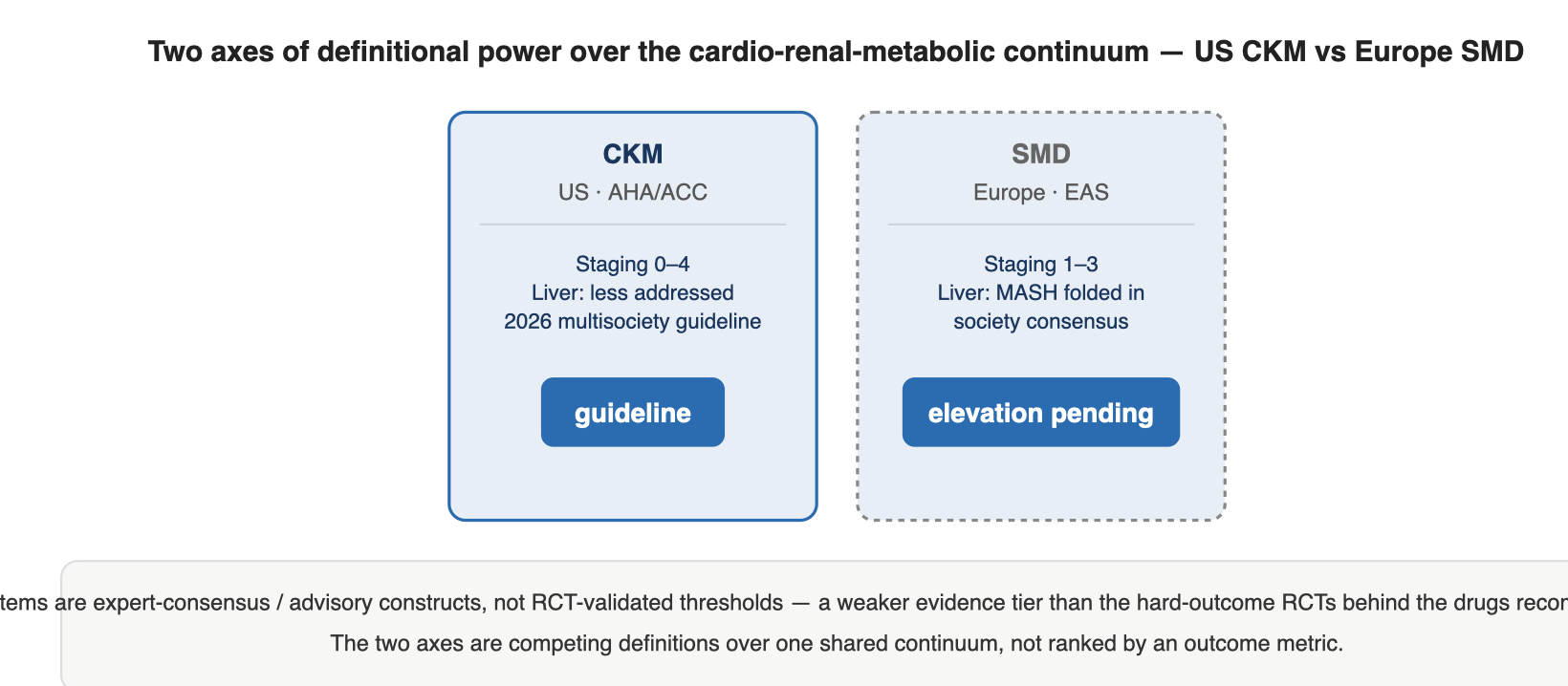
Two maps drawn over one continent
Cardiovascular, kidney and metabolic disease form a single biological continuum, but clinical practice, reimbursement and labels all operate on “named entities.” Which society defines this continuum — with which name, boundaries and stages — determines (1) who is counted as a “patient,” (2) which drug enters first at which stage, and (3) which ICD codes and reimbursement pathways open. A taxonomy is therefore both a scientific description and a rule for allocating markets and standards.
The US axis is the AHA’s CKM Syndrome. It began as a 2023 Circulation Presidential Advisory setting out stages from Stage 0 (no risk factors) to Stage 4 (clinical cardiovascular disease), and was elevated in June 2026 into a joint guideline of four societies (AHA, ACC, ADA, ASN) — a signal that the cardiology, metabolic and nephrology communities have converged on a single CKM frame.
The European axis is the EAS (European Atherosclerosis Society) SMD = Systemic Metabolic Disorder (2025 European Heart Journal consensus). Its key difference from CKM is that SMD explicitly folds the liver (MASH / fatty liver) into its staging. Layered onto this are the AASLD/EASL/ALEH MASLD renaming (2023) and the KDIGO kidney guidelines, so the European/global axis flows as a multi-layer consensus.
The chain: definition → guideline → reimbursement → label
| Society taxonomy (CKM / SMD / MASLD) — evidence tier: expert consensus / advisory ↓ defines stages and diagnostic criteria |
||
| Multisociety guidelines (2026 AHA/ACC/ADA/ASN · ESC · KDIGO · EASL) ↓ first-line treatment algorithms (drug recommendations rest on hard-outcome RCTs) |
||
| ICD coding · quality metrics · reimbursement codes → who is counted as a “patient” | ||
| Use-context of regulatory labels (FDA / EMA indication) → the market boundary of the drug |
| CKM (US · AHA) | SMD (Europe · EAS) | |
|---|---|---|
| Staging | Stage 0–4 | Stage 1–3 |
| Liver axis | Relatively less addressed | Explicitly folded in (MASH / fatty liver) |
| Status | 2026 multisociety guideline | Society consensus (elevation unconfirmed) |
| Open question | Over-diagnosis risk at early stages | Clinical uptake; guideline elevation |
Regulatory labels still operate as “disease units” (indications). On 2024-03-08 the FDA added an MACE-risk-reduction indication to Wegovy on the basis of SELECT (N=17,604) — a way of stacking individual, disease-specific indications. Upper-level taxonomies like CKM/SMD do not write label text directly; instead they expand the “use” of a label through guidelines, reimbursement and clinical pathways.
Deep dive
1. Background: why naming governs standards and markets
From a Medical Affairs standpoint, disease classification is not a neutral description. Where the boundaries of a stage are drawn determines cohort size, the entry point of first-line drugs and the reimbursement trigger. This landscape contrasts the two axes of that definitional power — the AHA’s CKM in the US and the EAS’s SMD in Europe — and maps how the liver (EASL MASLD), kidney (KDIGO) and regulatory (FDA/EMA) layers overlap between them.
2. What this synthesis newly establishes
The single most important correction is the term itself. The launch brief’s hypothesized label “SMD = Severe/Supramolecular Metabolic Disorders” does not exist (refuted). The real, official taxonomy is SMD = Systemic Metabolic Disorder, the EAS 2025 consensus (European Heart Journal 2025;46(38):3685–3713, DOI 10.1093/eurheartj/ehaf314, online 2025-05-07; co-chairs Romeo, Vidal-Puig, Husain). Under the no-fabrication principle, this is a case of confirming an absence and correcting to the real frame.
- CKM staging: Stage 0 (no risk factors) → Stage 1 (excess/dysfunctional adipose tissue: overweight/obesity, abdominal obesity, impaired glucose tolerance) → Stage 2 (metabolic risk factors or CKD) → Stage 3 (subclinical cardiovascular disease) → Stage 4 (clinical cardiovascular disease, sub-classified 4a/4b by presence of kidney failure). Source: Ndumele CE, et al. Circulation 2023;148(20):1606–1635.
- SMD staging: Stage 1 (metabolic abnormality without organ damage) → Stage 2 (early organ damage: T2D, MASH, CKD stage 3, subclinical ASCVD) → Stage 3 (advanced multi-organ damage: heart failure, cirrhosis, CKD stages 3–5, ASCVD). The decisive difference from CKM is that SMD explicitly folds the liver into its staging.
- Liver axis (MASLD nomenclature, 2023 Delphi): led by AASLD/EASL/ALEH, an umbrella term SLD (steatotic liver disease) was created, MASLD replaced NAFLD, MASH replaced NASH, and MetALD was introduced for co-existing alcohol use. The follow-on management guidance is the EASL–EASD–EASO MASLD CPG (J Hepatol 2024).
- Cardiac and kidney axes: ESC 2023 (recommends GLP-1RA/SGLT2i in diabetes + ASCVD for CV risk reduction independent of glucose lowering); KDIGO 2024 CKD guideline + 2025 focused update (broad recommendation of SGLT2i in proteinuric CKD regardless of diabetes status).
3. Strengths and limits of the method
This landscape is a structural taxonomy analysis grounded in primary documents (society advisories, consensus statements, guidelines). Its strengths: each frame’s staging, sponsoring body and publication year is attributed to a primary source, and the reality of the term was verified and corrected. Its limits are clear. The staging systems themselves are not RCT-validated diagnostic thresholds but expert-consensus / advisory-level constructs, and sit at a different evidence tier from the hard-outcome RCT basis of the drug recommendations (GLP-1 / SGLT2i) inside them. “Staging definition” and “drug evidence” must not be read at the same strength. In addition, the degree to which EMA labels reflect the taxonomy is currently unverified and needs checking in Part 3.
4. Neighbouring domains
The taxonomy contest is entangled with a re-partitioning of stakes across hepatology, nephrology and endocrinology. SMD folding in the liver, and the MASLD renaming pulling the liver into a metabolic frame, suggest that the European axis has made a differentiator out of a gap in the historically cardiology-centric CKM axis (which addresses hepatic biomarkers relatively less). KDIGO, as a global kidney standard-setter belonging to neither the US nor Europe, becomes the stage on which the two axes overlap and contend.
5. Commercialization and market context (TRL, companies)
The same drugs (semaglutide, tirzepatide, empagliflozin, dapagliflozin) map to different market boundaries depending on which frame they sit in.
- CKM frame → in the US, justifies early intervention from Stage 1 (obesity) → expands GLP-1 into preventive/early entry (a TAM-expansion vector).
- SMD/MASLD frame → folds in the liver (MASH) → resmetirom (first approved MASH drug, 2024) and the MASH expansion of GLP-1 (semaglutide ESSENCE, and others) become formally staged within the “metabolic disease continuum.”
- KDIGO kidney axis → expansion of SGLT2i/GLP-1 into CKD (regardless of diabetes).
In short, CKM opens the obesity/CV-prevention market for GLP-1, MASLD/SMD opens the liver market, and KDIGO opens the kidney market. Which society taxonomy prevails governs each manufacturer’s indication-expansion path (Novo Nordisk, Eli Lilly, AstraZeneca, Boehringer Ingelheim, and others). The associated regulations and guidelines are already at the commercial stage (TRL 9 for approved drugs); here only facts are stated. Company-level tickers, market caps and investment implications belong to a separate investment layer.
6. The skeptic’s bottom line
This inherits the skeptic gate of the underlying landscape.
- Taxonomy inflation. In three years, CKM (2023), MASLD (2023) and SMD (2025) have been joined by a competing model, “LMV (Liver-Metabolic-Vascular) syndrome” (2025). Naming competition over the same pathophysiology has overheated, and because each name is entangled with society influence, research funding and guideline stakes, it is fair to comment that purely scientific motives cannot fully explain it.
- Disease-mongering concern (framed as commentary). By folding “overweight / abdominal obesity” into CKM Stage 1 as a formal stage of a disease continuum, there is a noted risk of labelling healthy variation as an early drug-intervention target (particularly given alignment with GLP-1 market-expansion incentives). As a counterpoint, however, there is also evidence that early risk stratification is justified in preventive medicine (the PREVENT risk equations). Rather than concluding either way, both sides are presented.
- Asymmetry in evidence strength. Staging systems are consensus; drug efficacy is RCT. Do not conflate the two tiers.
- Verdict (inherited): proceed-with-caveats. The series is clearly worth pursuing, but the tier separation (staging = consensus / efficacy = RCT), the conflicts of interest in the naming competition, and the negative or positive implications for listed pharma remain matters for per-part escalation.
7. What to watch
- Clinical uptake of SMD (EAS) and whether it is elevated into guidelines.
- Whether EMA labels reflect the SMD/MASLD taxonomy in their wording (currently unverified).
- How global standard-setters such as KDIGO reconcile the overlap between the US and European taxonomies.
- The adoption dynamics of CKM vs SMD by Asian societies (e.g. Korean Association of Internal Medicine, KDA, KSoLA) and reimbursement implications (Part 5).
References
- Ndumele, Chiadi E., et al. 2023. “Cardiovascular-Kidney-Metabolic Health: A Presidential Advisory From the American Heart Association.” Circulation 148(20): 1606–1635. DOI 10.1161/CIR.0000000000001184. ahajournals.org (online 2023-10-09).
- American Heart Association/ACC/ADA/ASN. 2026. “2026 Guideline for the Prevention, Detection, Evaluation, and Management of Cardiovascular-Kidney-Metabolic Syndrome.” JACC. DOI 10.1016/j.jacc.2026.03.056. jacc.org (2026-06-09).
- Romeo, Stefano, Antonio Vidal-Puig, and Mansoor Husain, et al. 2025. “Clinical staging to guide management of metabolic disorders and their sequelae: a European Atherosclerosis Society consensus statement.” European Heart Journal 46(38): 3685–3713. DOI 10.1093/eurheartj/ehaf314. academic.oup.com (online 2025-05-07).
- Rinella, Mary E., et al. 2023. “A multisociety Delphi consensus statement on new fatty liver disease nomenclature.” Journal of Hepatology. DOI S0168-8278(23)00418-X. journal-of-hepatology.eu (online 2023-06).
- EASL–EASD–EASO. 2024. “Clinical Practice Guidelines on the management of MASLD.” Journal of Hepatology. DOI 10.1016/j.jhep.2024.04.031. sciencedirect.com.
- European Society of Cardiology. 2023. “2023 ESC Guidelines for the management of cardiovascular disease in patients with diabetes.” escardio.org.
- KDIGO. 2024. “KDIGO 2024 Clinical Practice Guideline for the Evaluation and Management of Chronic Kidney Disease” (+ 2025 focused update). kdigo.org.
- Novo Nordisk / FDA. 2024. “Wegovy receives FDA approval for cardiovascular risk reduction (SELECT, N=17,604).” prnewswire.com (2024-03-08).
Disclosure
This post is for information and knowledge-accumulation purposes only. It is not investment advice, and it is not medical advice — diagnostic and treatment decisions must be discussed with a qualified professional.
The author holds no position in, and has no direct financial interest in, any listed company mentioned. COI note: statements about the societies (AHA, ACC, ADA, ASN, ESC, EASD, EASL, EAS, KDIGO) and regulators (FDA, EMA), and about listed pharmaceutical companies (GLP-1/SGLT2i manufacturers — Novo Nordisk, Eli Lilly, AstraZeneca, Boehringer Ingelheim, and others), are made on a factual, neutral basis. Where a society’s guideline sponsorship or industry relationship exists, that fact is attributed. Quantitative claims are attributed to the original documents, societies or regulators; figures not independently verified by the author are stated with their source.
The taxonomy critique in this post (inflation, disease-mongering concern) is not an attempt to disparage any particular society or company, but a neutral commentary on the structural conflicts of interest in a naming competition. Counterpoints — such as the preventive-medicine justification for early risk stratification — are presented alongside.
Skeptic verdict proceed-with-caveats inherited.


Leave a Reply