Evidence-first notes on bioscience and medical affairs, at the edge of the clinic and the market. Information only — not investment advice, not medical advice.
The 30-second version
- What. The four US “definition-setting” societies (AHA, ACC, ADA, ASN) have converged on a single Cardiovascular-Kidney-Metabolic (CKM) syndrome frame that ties heart, kidney and metabolism together, and the multidisciplinary guideline operationalizing it has now been formally published (2026-06-09, simultaneous release in JACC and Circulation, PubMed PMID 42265997).
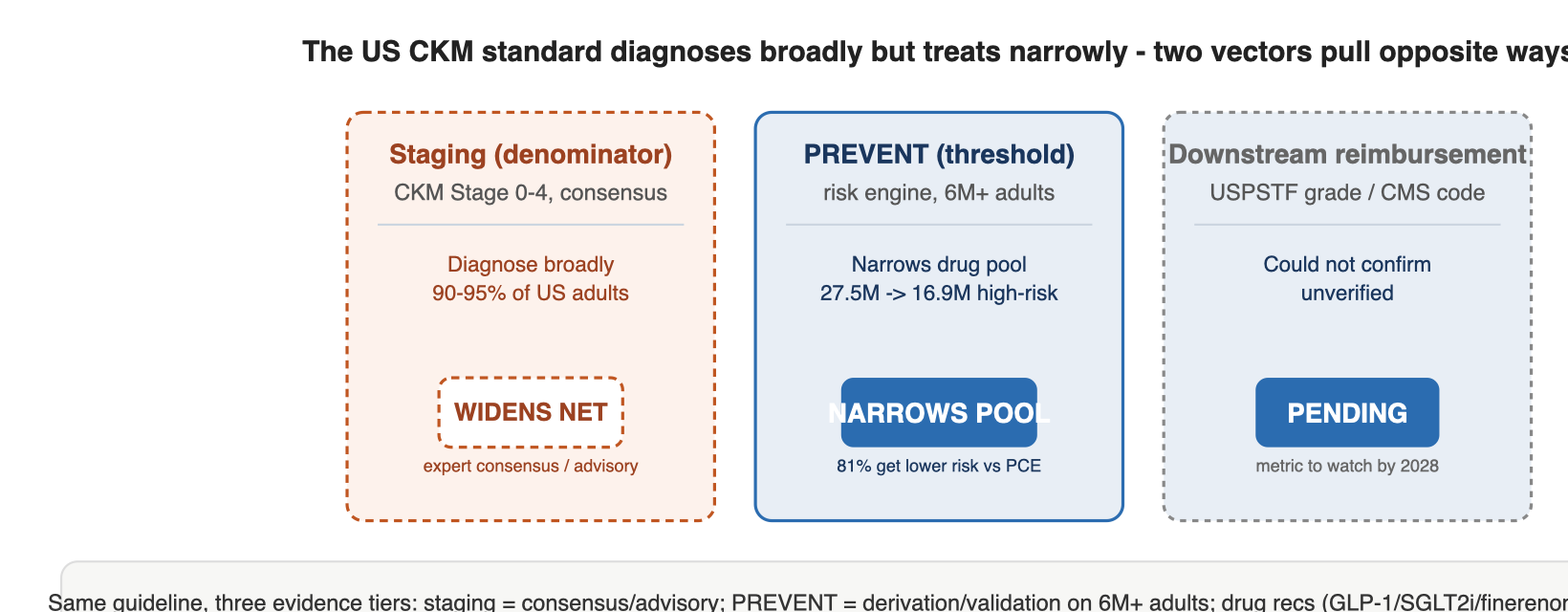
- So what. The core is a directionally divergent asymmetry. CKM staging (Stage 0–4) enrolls roughly 90–95% of US adults into a “disease continuum,” widening the diagnostic net, while the absolute-risk engine PREVENT estimates lower risk than the older Pooled Cohort Equations (PCE) and therefore narrows the pool eligible for statins and antihypertensives. The resultant of these two vectors — “diagnose broadly, treat narrowly” — is the central tension in the US standard.
- Now what. Do not read the evidence tiers as one. Staging definitions = expert consensus/advisory; drug recommendations (GLP-1 / SGLT2i / finerenone) = hard-outcome RCTs; PREVENT-staging coupling = operationalization — three different tiers. Whether downstream reimbursement and quality metrics take hold (USPSTF grade, CMS codes) is still unverified and is a metric to watch.
The five-minute read
Four societies under one roof — dismantling the “disease silos”
Between 2023 and 2026, the US cardiology (AHA, ACC), diabetes (ADA) and nephrology (ASN) societies set aside their separate disease taxonomies and gathered around a single CKM frame. This is not mere renaming but a complete standard architecture: (1) staging the whole population into Stage 0–4, (2) resetting treatment thresholds through a single risk engine, the PREVENT equations, and (3) cascading the result downstream into screening, reimbursement and quality metrics. The multidisciplinary guideline published on 2026-06-09 retires and replaces the 2013 AHA/ACC/TOS obesity management guideline, repositioning obesity from a “weight-management target” to “Stage 1 of the cardiac-kidney-metabolic continuum.”
Staging moves upstream, the risk engine moves down — the directions diverge
The design logic of CKM staging cuts the pathophysiological continuum — “adipose-tissue dysfunction → metabolic risk factors → subclinical organ damage → clinical disease” — into four stages. The decisive move is pulling cardiovascular staging, which traditionally began at hypertension and dyslipidemia, further upstream to overweight/obesity (Stage 1).
Yet the absolute-risk engine inside the same frame, PREVENT, moves the opposite way. PREVENT estimates lower risk in about 81% of individuals than PCE, and at a 5% threshold the high-risk population shrinks from roughly 27.5 million under PCE to about 16.9 million under PREVENT (NHANES analysis). In other words, the diagnosis (staging) expands while the drug threshold (absolute risk) rises. That is why the simplification “CKM = indiscriminate overtreatment” does not hold. That said, the GLP-1 class is a separately expanding vector along the obesity/T2D axis, so its direction differs.
| Stage | Definition |
|---|---|
| Stage 0 | No risk factors (primordial prevention) |
| Stage 1 | Excess / dysfunctional adipose tissue (overweight/obesity, prediabetes), no other factors ← the “upstream expansion” point of staging |
| Stage 2 | Metabolic risk factors (hypertension, dyslipidemia, T2D) and/or moderate-to-high-risk CKD |
| Stage 3 | Subclinical CVD, or PREVENT 10-year total CVD ≥20%, or very-high-risk CKD ← where PREVENT couples to staging |
| Stage 4 | Clinical CVD (4a: without kidney failure / 4b: with kidney failure) |
Acting simultaneously: staging (denominator) expands to 90–95% of adults ↔ PREVENT (drug threshold) contracts the statin-eligible pool.
Do not mix the evidence tiers
Layers of differing evidential strength coexist within one guideline. Staging definitions are expert consensus/advisory (not RCT-validated diagnostic cutoffs); drug recommendations (GLP-1, SGLT2i, finerenone) rest on hard-outcome RCTs; and PREVENT is a large-scale derivation/validation (6 million+ adults), but its coupling to staging is operationalization. Conflating these three layers misreads the actual weight of the standard.
Deep dive
1. Background — a single convergence of US definition-setting power
In the US, the practical power to define, classify and set treatment thresholds for disease sits with the guidelines of the large professional societies. In 2023 the AHA introduced the CKM-syndrome concept — treating heart, kidney and metabolism as one continuum — as a Presidential Advisory (Ndumele et al., Circulation 2023;148:1606–1635), and in 2026 the four societies AHA, ACC, ADA and ASN jointly operationalized it into a formal guideline. In that cardiology (AHA/ACC), diabetes (ADA) and nephrology (ASN) aligned their separate silos under the CKM umbrella, this can be read as a governance realignment of the US cardiometabolic standard. Because the Joint Committee is ACC/AHA, the governance center of gravity sits on the cardiac axis.
2. What this development newly establishes — publication and the replacement relationship of the 2026 guideline
Formal publication confirmed. The “2026 AHA/ACC/ADA/ASN Guideline for the Prevention, Detection, Evaluation, and Management of Cardiovascular-Kidney-Metabolic Syndrome” is not an announcement or a draft but a formal peer-reviewed guideline. Publication date 2026-06-09 online, simultaneously in JACC (DOI 10.1016/j.jacc.2026.03.056) and Circulation, PubMed PMID 42265997. A separate at-a-glance summary is JACC DOI 10.1016/j.jacc.2026.05.008.
Replacement relationship. This guideline retires, replaces and extends the “2013 AHA/ACC/TOS Guideline for the Management of Overweight and Obesity in Adults.” The US obesity-management standard document has, after 13 years, switched to the CKM frame, with obesity repositioned from an independent management target to Stage 1 of the cardiac-kidney-metabolic continuum.
Drug positioning (key recommendations):
- GLP-1-based therapy: quoting the AHA press release (≤150 chars) — “For the first time, GLP-1-based therapies are recommended for select individuals with obesity and/or Type 2 diabetes, and other risk factors…” For the first time, a top US multidisciplinary guideline recommends GLP-1 for a select population with obesity/T2D plus risk factors, for the purpose of reducing CV events.
- SGLT2i, nonsteroidal MRA (finerenone), RAS inhibitors: positioned for cardiac and kidney protection.
- Team-based care: “interdisciplinary, team-based care” and a “CKM coordination point person” are normalized as a Class 1 recommendation for Stage 2–4 patients (per TCTMD).
3. Methodological strengths and limits — the PREVENT risk equations
Primary document: Khan SS, et al. “Development and Validation of the AHA PREVENT Equations.” Circulation 2023;149:430–449. DOI 10.1161/CIRCULATIONAHA.123.067626. Derived and validated on 46 datasets and 6 million+ adults.
Structural differences vs PCE:
| Item | Pooled Cohort Equations (2013) | PREVENT (2023) |
|---|---|---|
| Primary outcome | ASCVD (MI, stroke) | Total CVD = ASCVD + heart failure (HF) |
| Age range | 40/45–79 | 30–79 (10 years younger) |
| Horizon | 10-year | 10-year + 30-year |
| Race | race-based | race-free (race-agnostic) |
| Kidney/metabolic integration | none | eGFR required + optional UACR, HbA1c, SDI (social deprivation index) |
By embedding CKD (eGFR) and metabolic markers (optional HbA1c, UACR) into a cardiovascular risk equation, PREVENT implements “CKM” at the equation level. Because the Stage 3 ≥20% threshold is defined by PREVENT total-CVD risk, staging and equation are a designed pair.
Reclassification effect (a strength that is also a risk): PREVENT estimates lower ASCVD risk than PCE in about 81.0% (79.4–82.6) of individuals, with the downward shift especially large in men (97.7%) and Black adults (89.6%). At a 5.0% threshold, high-risk classification is about 26.7% (roughly 16.9 million) under PREVENT vs about 43.4% (roughly 27.5 million) under PCE — roughly 10 million people move outside “high risk.” TCTMD headlined this as “PREVENT Risk Calculator Means Fewer Patients on Statins, Antihypertensives.”
Limits: that the risk-lowering reclassification is especially large in men and Black adults leaves, behind the statistical refinement, a concern about undertreatment. The clinical safety of shrinking the statin-eligible pool is an open question.
4. Neighbouring domains — from definition to reimbursement, quality metrics and AI
The substance of definition-setting power shows up in the downstream cascade.
- Quality metrics (HEDIS/NCQA): NCQA published a CKM-specific white paper proposing to track BP, HbA1c and uACR as intermediate outcomes aligned to CKM risk stages (ncqa.org). If folded into HEDIS, these tie directly to health-plan performance and reimbursement.
- Primary-care workflow + clinical decision support (CDSS): uACR screening is under-performed in primary care, and many pilots aim to lift it via clinical decision support (auto-suggested orders, prefilled lab interfaces) (AJKD 2024). Given the 90–95% target population and the reality of under-performance, CKM staging physically cannot function as screening without EHR-based risk-prediction models and algorithm deployment. That is, the taxonomy drives demand for clinical AI/software infrastructure, and it can extend to devices such as point-of-care uACR and wearables.
5. Commercialization and market context (TRL, companies)
The CKM frame can function as normative infrastructure in which specific drug classes are assigned a “place to be sold” (a Stage). Related listed pharma (facts, neutral): GLP-1 class — Novo Nordisk, Eli Lilly; SGLT2i — AstraZeneca, Boehringer Ingelheim; nonsteroidal MRA finerenone — Bayer are the principal makers. But two things must be separated.
- The drug evidence itself (mature on TRL): GLP-1, SGLT2i and finerenone are approved medicines validated by hard-outcome RCTs (SELECT, FLOW, FIDELIO and others); their evidence tier is high.
- Reimbursement/entrenchment of the CKM frame (immature): a formal USPSTF grade for CKM-integrated screening, or a separate CMS reimbursement code, could not be independently confirmed in this analysis pass (unverified). The current state operates through a combination of existing individual recommendations (obesity, prediabetes, CKD, lipid screening); we do not assert the existence of a CKM-specific code. Whether reimbursement takes hold is a target for future quantitative tracking (Part 4).
Attribution of quantitative claims: the reclassification figures and prevalence (90–95%) above are attributed to society documents, secondary reporting (TCTMD) and NHANES analysis — not manufacturer marketing figures.
6. The skeptic’s bottom line
This section inherits the skeptic gate of the source deep-dive.
- Disease-mongering (staging inflation) concern: by enrolling “overweight/prediabetes, no other factors” as a formal Stage 1 of the disease continuum, the structure counts roughly 90–95% of US adults as “CKM patients.” A critique is possible that this labels healthy variation and can justify medicalization and early pharmacological intervention. For balance, however: in this pass, no peer-reviewed critique explicitly framing CKM as disease-mongering was identified. The above critique is this analysis’s editorial framing; what is confirmed is the “90–95%” prevalence figure and the accompanying editorial’s concerns about scope and reimbursement barriers. The counter-argument — that early risk stratification is justified as preventive medicine — is stated alongside.
- The two-sidedness of reclassification (the key counterpoint): as noted, PREVENT actually estimates lower risk, reducing the statin- and antihypertensive-eligible pool. So “CKM = indiscriminate overtreatment” is a simplification; in reality the obesity/GLP-1 axis (expansion) and the statin/PCE axis (contraction) point in opposite directions. Concerns about undertreatment (risk lowered in men and Black adults) and about overdiagnosis coexist within one frame.
- Evidence-tier separation: do not conflate staging definitions (consensus/advisory) vs drug recommendations (hard-outcome RCTs) vs PREVENT (large-scale derivation/validation, but staging coupling is operationalization).
- Verdict: this inherits the source part’s skeptic verdict of proceed-with-caveats (conditional). The basis: (1) with 12 core documents/figures confirmed, the factual skeleton is solid, but (2) the tier separation among staging, drug efficacy and PREVENT — and the editorial status of the disease-mongering critique — must be stated explicitly, and (3) three items (individual-recommendation COR/LOE, USPSTF, CMS) remain unverified, leaving a standing reason to hold publication pending a deep-read of the primary text. It is neither a hold (factual error/fabrication) nor verified-clean (residual unverified items remain).
7. What to watch (falsifiable predictions)
- Formal USPSTF/CMS incorporation: if within 24 months (≤2028) CKM-integrated screening (including uACR) is codified as a formal USPSTF grade recommendation or a separate CMS reimbursement code, the “definition → reimbursement” chain completes. If not (remaining a combination of individual recommendations), CKM stalls at the “guideline layer.” (Currently unverified.)
- PREVENT’s statin contraction flows back into guidelines: if the statin-eligible pool is measurably reduced, subsequent lipid guidelines are predicted to lower the risk threshold (e.g., 7.5% → 5%) to recalibrate.
- The absence of the liver as a revision pressure: whether the gap of CKM not explicitly enrolling the liver (MASLD/MASH) into staging will be filled at the next revision (≤2029) with liver biomarkers / FIB-4. If not, the US axis stays fixed on heart-kidney-metabolism, and the liver remains held by the European SMD/EASL axis.
References
- Ndumele, Chiadi E., et al. 2023. “Cardiovascular-Kidney-Metabolic Health: A Presidential Advisory From the American Heart Association.” Circulation 148 (20): 1606–1635. https://www.ahajournals.org/doi/10.1161/CIR.0000000000001184
- American Heart Association / American College of Cardiology / American Diabetes Association / American Society of Nephrology. 2026. “2026 Guideline for the Prevention, Detection, Evaluation, and Management of Cardiovascular-Kidney-Metabolic Syndrome.” Journal of the American College of Cardiology (published online 2026-06-09). https://www.jacc.org/doi/10.1016/j.jacc.2026.03.056 · PubMed PMID 42265997 https://pubmed.ncbi.nlm.nih.gov/42265997/ · simultaneously in Circulation.
- Khan, Sadiya S., et al. 2023. “Development and Validation of the American Heart Association’s PREVENT Equations.” Circulation 149: 430–449. https://www.ahajournals.org/doi/10.1161/CIRCULATIONAHA.123.067626
- Professional Heart Daily (AHA). 2026. “2026 Guideline for the Prevention, Detection, Evaluation, and Management of CKM Syndrome.” https://professional.heart.org/en/science-news/2026-guideline-for-the-prevention-detection-evaluation-and-management-of-ckm-syndrome
- TCTMD. 2026. “AHA/ACC Release First Comprehensive Guideline for CKM Syndrome.” https://www.tctmd.com/news/ahaacc-release-first-comprehensive-guideline-ckm-syndrome
- TCTMD. “PREVENT Risk Calculator Means Fewer Patients on Statins, Antihypertensives.” https://www.tctmd.com/news/prevent-risk-calculator-means-fewer-patients-statins-antihypertensives
- Journal of General Internal Medicine. 2025. (PREVENT vs PCE reclassification analysis.) https://link.springer.com/article/10.1007/s11606-025-09858-z
- NCQA. “NCQA Releases New White Paper on CKM Syndrome.” https://www.ncqa.org/blog/ncqa-releases-new-white-paper-on-ckm-syndrome/
- AHA Newsroom. “First-Ever Guideline on Cardiovascular-Kidney-Metabolic Syndrome Issued.” https://newsroom.heart.org/news/first-ever-guideline-on-cardiovascular-kidney-metabolic-syndrome-issued
Unverified items (paywalled primary text / independent confirmation failed): (A) individual drug-recommendation COR/LOE detail; (B) CKM-specific USPSTF grade recommendation; (C) CKM-specific CMS reimbursement code.
Disclosure
This post is for information and knowledge-asset purposes only. It is not investment advice and not medical advice. The author holds no position in the named securities. COI note (inherited from the source analysis frontmatter coi): descriptions of the societies named (AHA, ACC, ADA, ASN, NKF), the regulators (FDA, CMS, USPSTF), and the listed pharma (GLP-1 class Novo Nordisk, Eli Lilly; SGLT2i class AstraZeneca, Boehringer Ingelheim; finerenone Bayer) are stated as facts and neutrally. Industry sponsorship of the CKM guideline writing committee and individual-author conflicts must be checked separately against the primary disclosure; this draft offers no mitigating or advocacy language. Quantitative claims such as reclassification and prevalence are attributed to society documents, secondary reporting and NHANES analysis — not manufacturer marketing figures.
 Uthando Nethemba
Leave a comment