Evidence-first notes on bioscience and deep tech, at the edge of the lab and the market. Information only — not investment advice.
The 30-second version
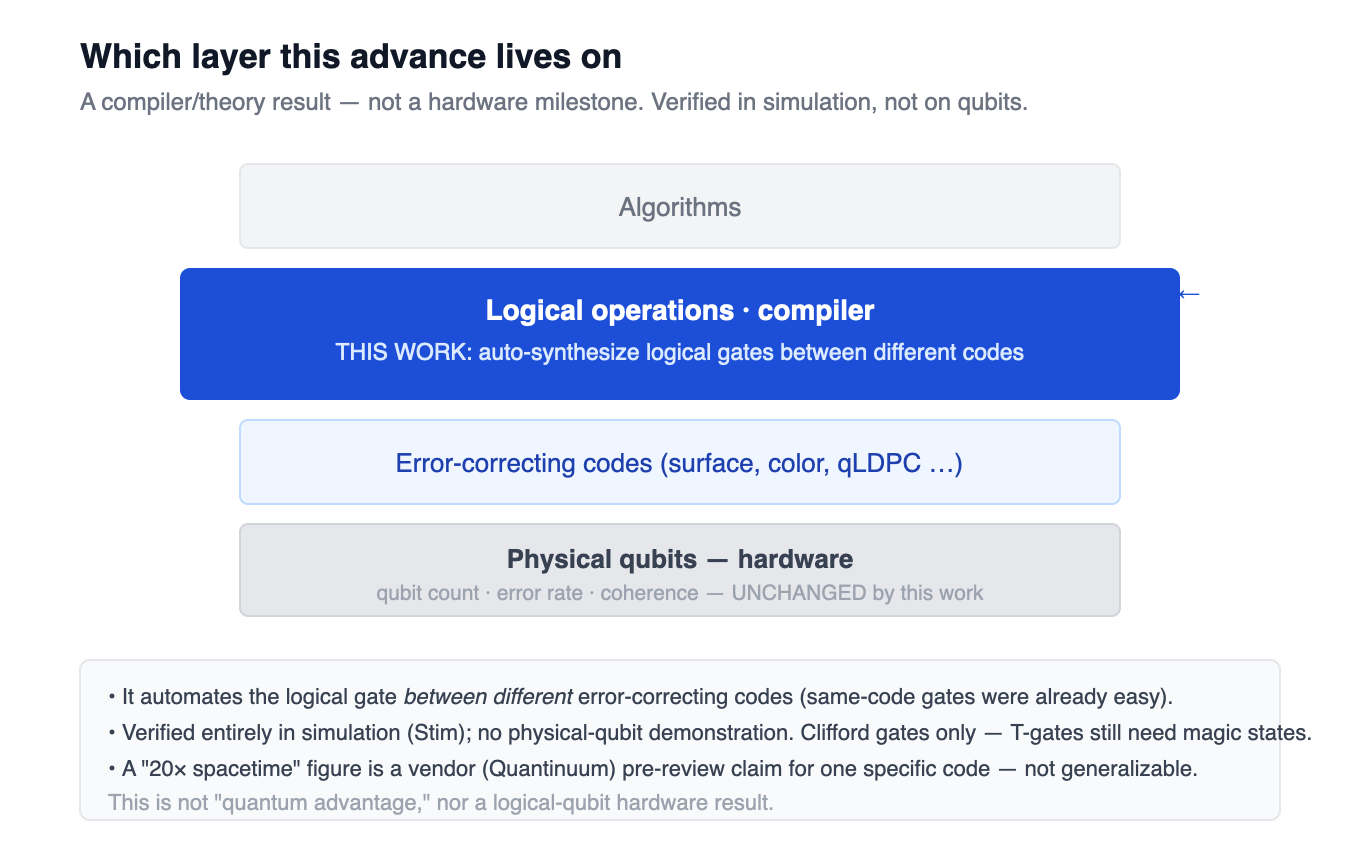
- What. A new preprint (Benhemou & Berthusen, arXiv, 2 July 2026) gives an automated way to design the logical gate — a logical CNOT or CZ — that connects two different quantum error-correcting codes. It treats each code as a chain complex and searches, with a constraint solver, for a shallow physical-gate pattern that realizes the desired logical operation. This is a compiler / theory result, verified entirely in simulation.
- So what. Wiring logical qubits together within one code is a solved problem (transversal gates); doing it between different codes has been hand-crafted case by case. Automating that interface for arbitrary CSS codes is the contribution. But it changes nothing about the hardware — qubit counts, error rates and coherence are untouched — and it handles Clifford gates only.
- Now what. TRL 3, and simulation-only. Its value is as a piece of the error-correction compiler stack, not a product, and its payoff arrives only once fault-tolerant machines are built from heterogeneous codes. Useful, but a layer above the hardware — not “quantum advantage.”
The five-minute read
What is new: automating the wiring between unlike codes
To run a real quantum algorithm you first have to protect qubits with an error-correcting code, and then perform logical operations on the encoded (logical) qubits. Entangling two logical qubits held in the same code is comparatively easy — a “transversal” gate pairs up the physical qubits and applies the gate qubit-by-qubit. The hard case is joining logical qubits held in different codes, which until now has largely meant bespoke, hand-designed constructions limited to closely related codes.
This work automates that. Each CSS code is written as a chain complex; a degree-1 map between the two complexes turns each of its components into a single physical CNOT, and the map’s structure automatically guarantees that the code space is preserved and the logical action is well-defined. The method builds the space of valid maps and uses a constraint solver (CP-SAT) to find shallow, sparse circuits. It reproduces known transversal constructions and finds many new low-depth ones, across surface codes, color codes, bivariate-bicycle qLDPC codes and more.
What changes, and what does not
What changes: designing the logical interface between two arbitrary CSS codes goes from hand-crafted to automatic, which could lower the spacetime cost of code switching and magic-state injection in a future machine that mixes codes (say, low-overhead qLDPC for memory and surface codes for logic). What does not change: this is a software / theory layer. Qubit counts, physical error rates and coherence times are exactly as before, and only Clifford gates are synthesized — the non-Clifford T-gates that universal computation needs still rely on magic states. It is a better way to compile within a fixed hardware budget, not a hardware milestone.
Deep dive
1. Background: logical-qubit scaling and heterogeneous architectures
Fault-tolerant quantum computing needs many physical qubits per logical qubit, and one of the bottlenecks in scaling logical qubits is the interface for performing logical operations across different code blocks or modules. Real architectures are likely to be heterogeneous: bivariate-bicycle and other qLDPC codes are attractive for low-overhead storage, while surface and color codes are convenient for logic and magic-state processing. Joining those with a cheap logical CNOT is exactly the kind of glue a practical stack will need — and, until now, exactly the kind of thing built by hand.
2. What the paper does
Each CSS code is represented as a chain complex. A degree-1 chain map between two such complexes assigns each 1-component to a physical CNOT from one code’s qubits to the other’s; the chain-map conditions enforce stabilizer (code-space) preservation and a well-defined linear action on logical operators. The authors construct the affine space of chain maps that realize a target logical action and search it with a CP-SAT constraint solver for low-depth, low-CNOT-count circuits. Circuits are classified as distance-preserving or partially distance-preserving; the latter can be restored to full code distance by adding flag measurements (for example, an unflagged case with distances (4, 6) is restored to distance 6 with five flags). Representative overheads are shallow — depth of order 2–4, with CNOT counts up to roughly 130 in the larger examples. Everything is verified with the Stim stabilizer simulator under a circuit-level depolarizing noise model; there is no physical-qubit demonstration.
3. Strengths and limits
- Strength: it automates, for arbitrary CSS code pairs, an interface that was previously bespoke, and it recovers known constructions while finding new shallow ones — a genuinely useful compiler primitive.
- Simulation only. All results come from Stim simulation; none run on physical hardware.
- Clifford only. It synthesizes CNOT/CZ. Universal computation still needs T-gates via magic states; this work does not make T-gates cheaper, so it does not by itself solve fault-tolerant computation.
- Solver scalability. Searching the chain-map space with a classical constraint solver can become expensive as codes grow; behaviour well beyond the benchmarked sizes is not established.
- The “20×” figure. A claimed ~20× spacetime-volume saving is for one specific code ([[16,4,4]]) against one specific alternative (an automorphism-assisted construction), from simulation, in a not-yet-peer-reviewed preprint by authors at a hardware vendor — it should not be generalized.
- Reproducibility and review status. The construction is described as reproducible with Stim, but a public code/data release has not been confirmed. The work is an arXiv preprint accepted to the QEC 2026 conference — conference acceptance is not journal peer review.
- Competing interest. Both authors are at Quantinuum, a trapped-ion hardware vendor. The paper reads as a sober theory paper, but the quantitative advantage claims are a vendor’s pre-review numbers, stated here without softening.
4. Neighbouring domains
Quantum × classical EDA. Framing logical-gate design as a constraint-solving search over chain maps is structurally close to classical logic synthesis and electronic-design-automation compilers. As fault-tolerant stacks mature, a distinct “QEC compiler” software layer is plausible — though putting a market size or timeline on that would be speculation, and this post does not.
Quantum × materials. The premise that different physical platforms (trapped-ion, superconducting, neutral-atom) favour different codes is what makes cross-code interfaces valuable. That loosely connects to this week’s unconventional-superconductivity results (new candidate platforms), but only as a long-horizon possibility — it does not imply, and this work does not require, topological qubits or their realization.
5. Commercialization and market context (TRL, companies)
TRL 3 — an analytical/simulation proof of concept. The algorithm is formalized and checked in simulation, but there is no hardware integration or demonstration; this is a compiler/theory contribution and should not be read against a hardware TRL.
Companies (facts only; public vs private separated). The authors are at Quantinuum (private; trapped-ion; majority-owned by Honeywell, merged with Cambridge Quantum). Other error-correction-focused players include QuEra and Atom Computing (private; neutral-atom) and PsiQuantum (private; photonic). On the public side, quantum-hardware names include IBM, IonQ (NYSE: IONQ), Rigetti (NASDAQ: RGTI), and Alphabet/Google and Honeywell (Quantinuum’s majority owner). Investment read (neutral): a compiler-layer preprint has no direct read-through to any of these; the value is a research/compilation asset, and any market effect is indirect and years out.
6. The skeptic’s bottom line
A final skeptical read rates this a conditional proceed. Four points must survive into any summary.
- This is not a hardware result but a contribution at the compiler / theory layer that automatically designs logical gates between error-correcting codes, and it is verified entirely in simulation (Stim) — with no physical-qubit demonstration.
- It synthesizes Clifford gates only (CNOT/CZ); the T-gates that universal computation needs still depend on magic states, so this does not by itself solve fault-tolerant quantum computation.
- The “spacetime 20Ð saving” is a vendor (Quantinuum) pre-review preprint figure for one specific code against one specific alternative, and cannot be generalized.
- The link to this week’s superconductivity result is a long-horizon possibility (“more platforms → more demand for cross-code interfaces”), not a leap to topological-qubit realization.
7. What to watch
- Journal peer review: the work is an arXiv preprint accepted to QEC 2026 (conference acceptance is not journal review); whether the quantitative claims and distance-preservation proofs hold up.
- A public code/data release, so the constructions can be independently reproduced.
- Solver scalability well beyond the benchmarked code sizes.
- Any physical-hardware demonstration of a cross-code logical CNOT (by Quantinuum or others).
- Whether a genuine “QEC compiler” layer consolidates as heterogeneous fault-tolerant architectures take shape.
References
- Benhemou, Asmae, and Noah Berthusen. 2026. “Automated Logical Clifford Gadgets for Heterogeneous Architectures via Chain Maps.” arXiv preprint arXiv:2607.02482 (open-access, not peer-reviewed; accepted to the QEC 2026 conference — conference acceptance is not journal peer review; both authors at Quantinuum; verified in Stim simulation, no physical-qubit demonstration; the “20×” figure is a vendor pre-review claim for one code and is not generalizable).
Disclosure
This post is for information only and is not investment advice. The author holds no position in, and has no direct financial interest in, any of the public quantum names mentioned (IBM, IonQ, Rigetti, Alphabet/Google, Honeywell); Quantinuum is private. The work discussed is a pre-peer-review preprint verified only in simulation; the “20×” figure is the authors’ (Quantinuum) preprint claim, and a public reproduction package has not been confirmed.


Leave a Reply