Evidence-first notes on bioscience and deep tech, at the edge of the lab and the market. Information only — not investment advice.
The 30-second version
- What. A new Science Advances paper (Sasso et al., 3 July 2026) builds a tactile sensor from a stretchable “mechanochromic” film — a soft Bragg reflector that changes structural colour as it deforms — sandwiched in silicone. A plain camera reads the colour per pixel, so contact shape and pressure come straight out of the image, with no deep learning and no 3D-reconstruction step. It maps fine features (a fingerprint, a coin, a leaf) at roughly 100-micrometre resolution.
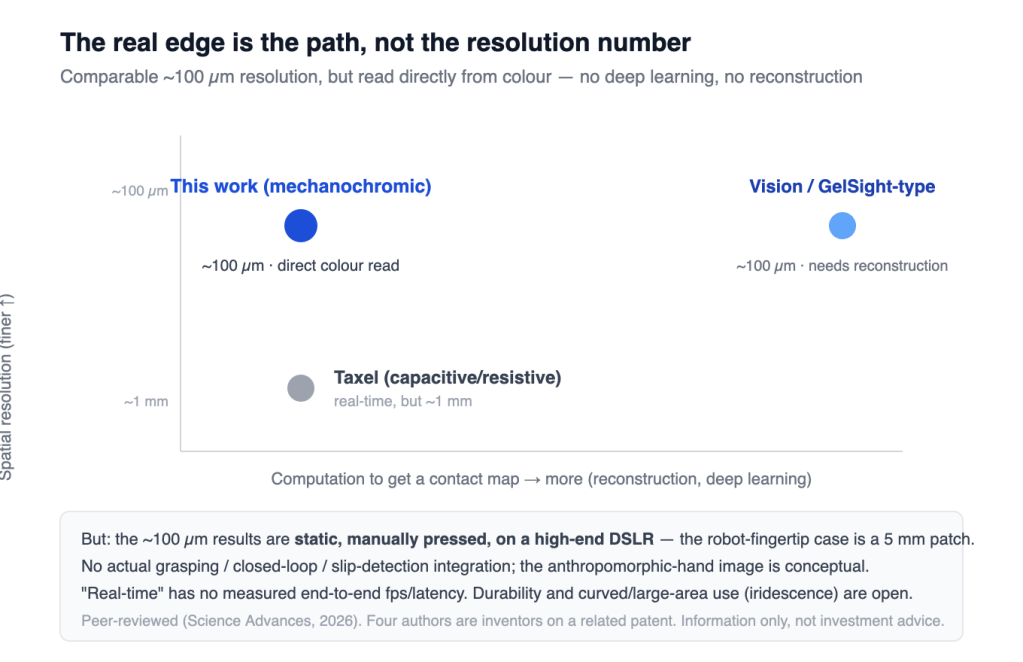
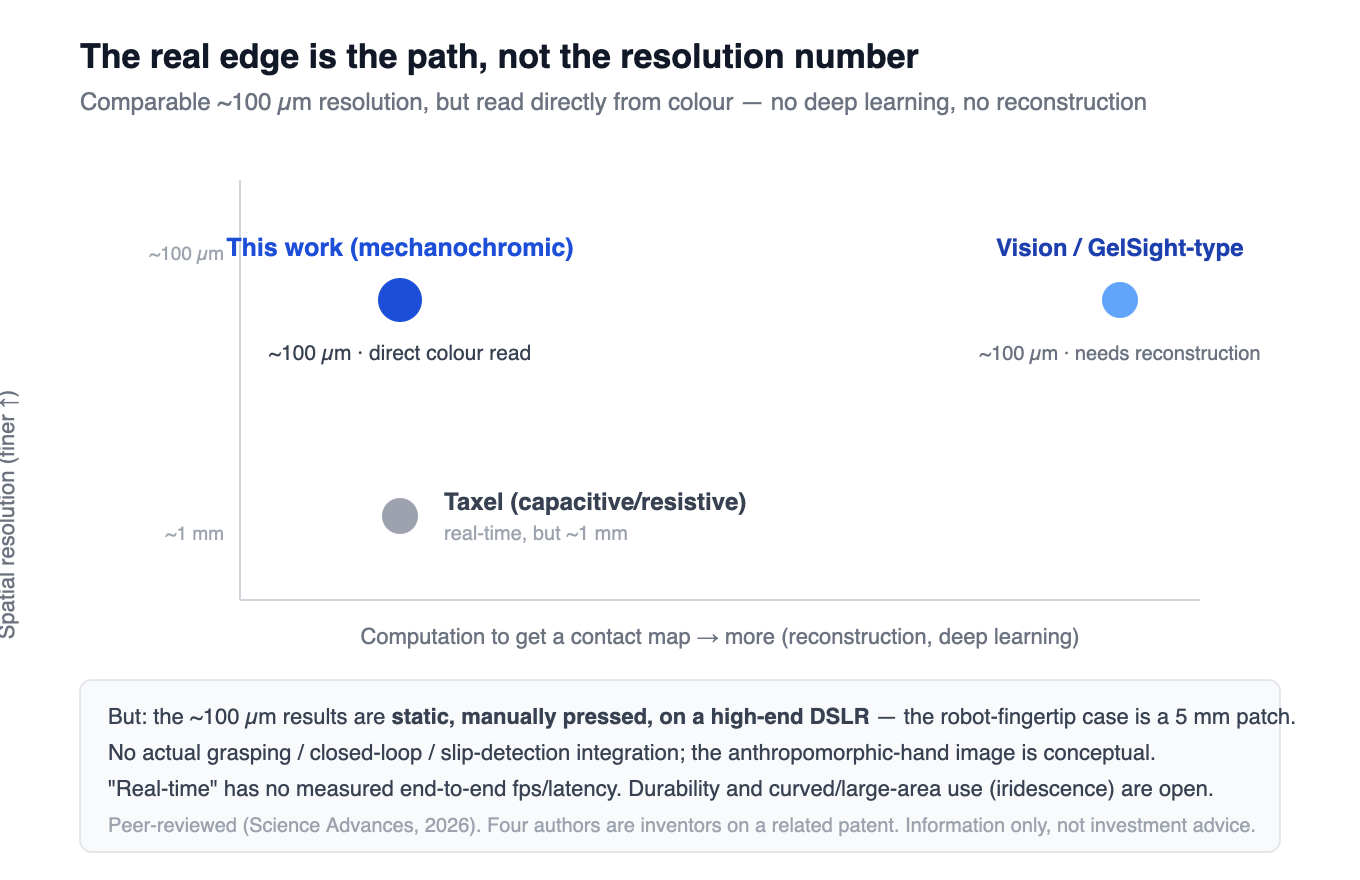
- So what. The honest headline is not “higher resolution” — it is comparable ~100 µm resolution reached by a simpler, lower-latency path. But those maps are static, manually pressed, and captured on a high-end DSLR; the robot-fingertip case is a 5 mm patch, with no actual grasping, closed-loop control or slip detection, and the anthropomorphic-hand picture is conceptual.
- Now what. TRL 3 — a device-level proof of concept. “Real-time” is argued from the physics and the lack of a processing pipeline, but no end-to-end fps or latency is measured; durability and curved/large-area use (structural colour is angle-dependent) are open. Four of the authors are inventors on a related patent.
The five-minute read
The resolution-versus-speed trade-off it targets
Robotic touch has long faced a trade-off. Taxel-based sensors (capacitive, resistive, piezoelectric) run in real time but are limited to about a millimetre by the size and spacing of their sensing pixels. Camera-based “vision tactile” sensors (the GelSight family) get much finer — around 100 µm — but only after turning raw images into 3D contact maps, which adds computation and latency. This work goes after both at once.
The trick is to encode strain directly as colour. A thin stretchable film acts as a Bragg reflector whose reflected wavelength shifts as it stretches, so mechanical deformation becomes a spatially resolved colour change (red → green → blue) that a camera reads pixel by pixel. There is no reconstruction network in between. The device is that mechanochromic film (about 16 µm, made by a Lippmann-type optical process) between a black and a transparent silicone layer, tuned to map either contact shape or pressure.
What it showed — and what it did not
The fine-resolution demonstrations — topographic maps of a fingerprint, a one-penny coin and a leaf at roughly 100 µm — were done by pressing objects statically, by hand (no force control), imaged on a high-end DSLR. The correlation against finite-element models is good (Pearson ~0.93–0.97; RMSE ~8–11%), and pressure mapping holds to about 1 MPa. What is not shown is integration into a working robot: the robot-fingertip case is a 5 mm patch pressed on a coin, with no grasping, manipulation, closed-loop control or slip detection, and the anthropomorphic hand in the figures is a concept image. And note the resolution claim itself is not a rigorous line-pair/MTF measurement — it is the ability to resolve topographic features under those static, DSLR conditions.
Deep dive
1. Background: why fine and fast have been hard together
Fine spatial detail and low latency have pulled in opposite directions for tactile sensors. Taxel arrays are inherently real-time but resolution-limited by pixel geometry, wiring and cross-talk; even learned super-resolution rarely gets below about a millimetre. Vision-based sensors get to ~100 µm with a camera, but the step of turning images into 3D contact maps — often with deep learning — costs computation and time. A sensor that reads a physically meaningful quantity directly from the image would sidestep that step.
2. What the paper does
Each point of the surface reports its local strain as a structural colour: the stretchable Bragg reflector shifts its reflected wavelength as it deforms, so the camera image is, in effect, a strain map already. Thickness of the silicone layers is tuned to map either contact shape or pressure. The authors validate the colour-to-strain and colour-to-pressure relationships against finite-element models (Pearson ~0.93–0.97, RMSE ~8–11%), report strain sensitivities across a wide range and pressure response up to about 1 MPa, and present ~100 µm topographic maps of a fingerprint, a coin and a leaf. The paper is peer-reviewed (Science Advances).
3. Strengths and limits
- Strength: comparable ~100 µm resolution with no deep learning and no reconstruction latency — a genuinely simpler, more direct read than camera-plus-network approaches.
- Static, device-level demos. The ~100 µm results are static, manually pressed, on a high-end DSLR; the robot-fingertip case is a 5 mm patch. There is no grasping, closed-loop control or slip-detection integration, and the anthropomorphic-hand image is conceptual.
- “Real-time” not measured. The real-time claim rests on a structural argument (no processing pipeline) and the material’s physical response limit (on the order of a millisecond), plus demonstration video — but no end-to-end fps or latency figure is reported.
- Reframe the headline. The contribution is not higher resolution but comparable resolution reached more simply and with lower latency.
- Durability and geometry. Cyclic fatigue and colour–strain hysteresis are left as future work (no repeated-cycle data), and on curved or large areas the accuracy degrades because structural colour is angle-dependent (iridescence) — which the authors acknowledge.
- Competing interest. Four of the authors are inventors on a related patent (application 102026000018424, filed 24 June 2026), so promotional language (“transformative,” “unprecedented”) should be read as the authors’ framing.
4. Neighbouring domains
Robotics × materials (the main axis). This sensor is, fundamentally, a soft photonic material — a stretchable mechanochromic Bragg reflector — repurposed for touch. It descends from work on scalable structural-colour manufacturing in stretchable materials (Miller, Liu & Kolle, Nature Materials 21:1014, 2022), and its limits are materials limits: the curved/large-area iridescence problem eases only as non-iridescent (angle-independent) mechanochromic elastomers improve. In other words, the robotics performance is physically tied to a materials-science variable — that dependency is the critical path for this line of work.
Robotics × AI (weaker). “No deep learning needed for the sensing transform” is a real point, but it says nothing about the policy-learning compute used to act on touch — extending it there would be out of scope for this paper.
5. Commercialization and market context (TRL, companies)
TRL 3 — a device-level proof of concept. Robot integration, durability, fps/latency and large-area/curved use are largely not yet done, so near-term productization is not indicated. The vision-tactile ecosystem is anchored by GelSight (the incumbent camera-based tactile approach), with soft-material and optical suppliers around it; several robotics labs (including Meta FAIR on the research-hardware side) work on tactile sensing. Investment read (neutral): a single device-level result has weak direct read-through; the value here is a method and a materials dependency to track, and any commercial effect depends on unproven integration and durability.
6. The skeptic’s bottom line
A final skeptical read rates this a conditional proceed. Five points must survive into any summary.
- This is a device-level proof of concept: the ~100 µm results are all static, manually pressed, on a high-end DSLR, and the robot fingertip is a 5 mm patch — with no grasping, closed-loop control or slip-detection integration, and the anthropomorphic-hand image is conceptual.
- “Real-time” rests on the no-pipeline argument and the material’s ~1 ms physical limit; no end-to-end fps or latency is reported.
- The point is not higher resolution but comparable ~100 µm reached without deep learning or reconstruction — more simply and with lower latency.
- Durability (cycling, hysteresis) is left as future work, and curved/large-area accuracy degrades because structural colour is angle-dependent (iridescence).
- Four authors are inventors on a related patent (102026000018424, 24 June 2026); “transformative/unprecedented” language is the authors’ framing.
7. What to watch
- A measured end-to-end pipeline: actual fps and latency under camera read-out, not just the material’s response limit.
- Integration into a working gripper — grasping, closed-loop control, slip detection — beyond the 5 mm patch.
- Durability data: repeated-cycle fatigue and colour–strain hysteresis.
- Angle-independent (non-iridescent) mechanochromic elastomers, the materials step that gates curved-surface use.
- Whether the patent turns into a product or licensing, and how it compares with incumbent vision-tactile sensors.
References
- Sasso, Giacomo, Alessandro Pagani, Aaron M. Duncan, Gianni Pedrizzetti, Nicola Pugno, James J. C. Busfield, and Federico Carpi. 2026. “High-resolution real-time mechanochromic tactile sensors.” Science Advances 12 (27): eaee5236. doi:10.1126/sciadv.aee5236 (peer-reviewed; Queen Mary University of London and Italian university collaborators).
- Miller, B. H., H. Liu, and M. Kolle. 2022. “Scalable optical manufacture of dynamic structural colour in stretchable materials.” Nature Materials 21: 1014–1018. (The stretchable-structural-colour lineage this sensor builds on.)
Disclosure
This post is for information only and is not investment advice. The author holds no position in, and has no direct financial interest in, any company mentioned. Note a competing interest in the source paper: four of its authors are inventors on a related patent (application 102026000018424, “Multimodal tactile device…,” filed 24 June 2026), so the paper’s promotional language (“transformative,” “unprecedented”) is read here as the authors’ own framing. All figures cited are cross-checked against the paper; no copyrighted figures are reproduced.


Leave a Reply