Tag: Robotics
-
A $16K Humanoid Completed a Gallbladder Removal in a Pig — But a Human Drove Every Move
Evidence-first notes on bioscience and deep tech, at the edge of the lab and the market. Information only — not investment advice. The 30-second version What. A UC San Diego team (Yip lab) mounted wristed laparoscopic instruments on a low-cost commercial humanoid (Unitree G1) and ran a three-stage study — benchtop characterization, dry-lab user study,…
-
The embodied-AI commercial landscape — a record funding boom coexists with almost no deployed autonomous worker; the bottleneck is the outcome layer (autonomy, robot data, reliability), not the chassis
Evidence-first notes on bioscience and deep tech, at the edge of the lab and the market. Information only — not investment advice. All valuation, funding and market-size figures are attributed to the company announcement, trade press or bank projection as noted inline; private post-money rounds are not audited or market-clearing values, “in-talks” rounds are not…
-
Embodied AI, Part 4 — the hardware is maturing and the demos and pilots are real, but the true ceiling is the deployment layer: lights-out autonomous reliability and labor-replacement unit economics
Evidence-first notes on bioscience and deep tech, at the edge of the lab and the market. Information only — not investment advice. All deployment, pilot, uptime and cost figures are attributed to their source, and separated into three tiers: peer-reviewed / primary reporting (IEEE Spectrum), company press release or company page (company claim), and secondary…
-
Embodied AI Part 3 — the data bottleneck: robot foundation models have no internet-scale corpus, and teleop, sim and human video have not closed Goldberg’s 100,000-year gap
Evidence-first notes on bioscience and deep tech, at the edge of the lab and the market. Information only — not investment advice. All dataset sizes, teleoperation costs, simulation-fidelity claims and synthetic-data figures are attributed to the relevant arXiv paper, journal, NVIDIA blog or company announcement. Peer-reviewed sources (Science Robotics, arXiv academic work), company/vendor claims (NVIDIA,…
-
Robot foundation models / VLA — the “ChatGPT moment for robotics” claim versus what the benchmarks actually measure
Evidence-first notes on bioscience and deep tech, at the edge of the lab and the market. Information only — not investment advice. Every generalization figure below is attributed to the model’s arXiv paper or to a DeepMind / Nvidia / Physical Intelligence / Figure announcement; peer-reviewed and arXiv results are separated from company demos and…
-
Humanoid hardware platforms — the chassis, actuators and hands are maturing fast and are no longer the binding constraint, but a good spec sheet is not autonomous capability, and most deployment demos are teleoperated, pre-trained or cherry-picked
Evidence-first notes on bioscience and deep tech, at the edge of the lab and the market. Information only — not investment advice. Every degree-of-freedom (DoF), cost, unit-count, runtime and payload figure is attributed to the manufacturer spec, company statement, teleoperated demo or trade-press aggregator that reported it, and first-party specs are separated from company claims.…
-
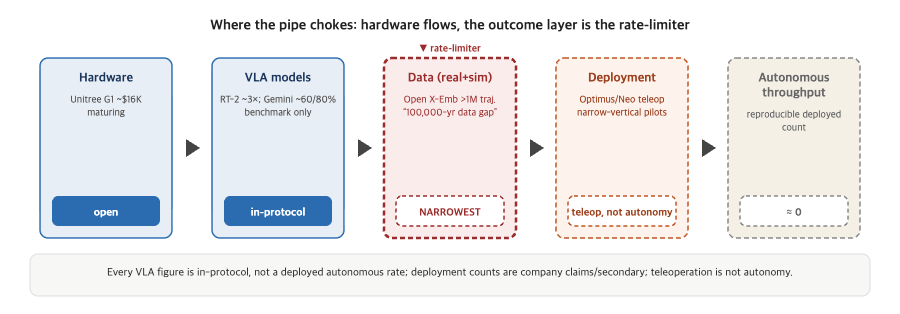
The embodied-AI landscape — humanoid hardware is maturing and is no longer the bottleneck; the binding constraint is autonomous cross-task generalization, real-robot data scarcity, sim-to-real and reliability (impressive demo ≠ deployable autonomous worker)
Evidence-first notes on bioscience and deep tech, at the edge of the lab and the market. Information only — not investment advice. All generalization figures, deployment counts and valuations are attributed to the source. VLA generalization numbers (RT-2 ~3x, Gemini Robotics ~60/80%, RT-2-X ~3x) are all within-benchmark / in-protocol success rates, not real-world autonomous task…
-
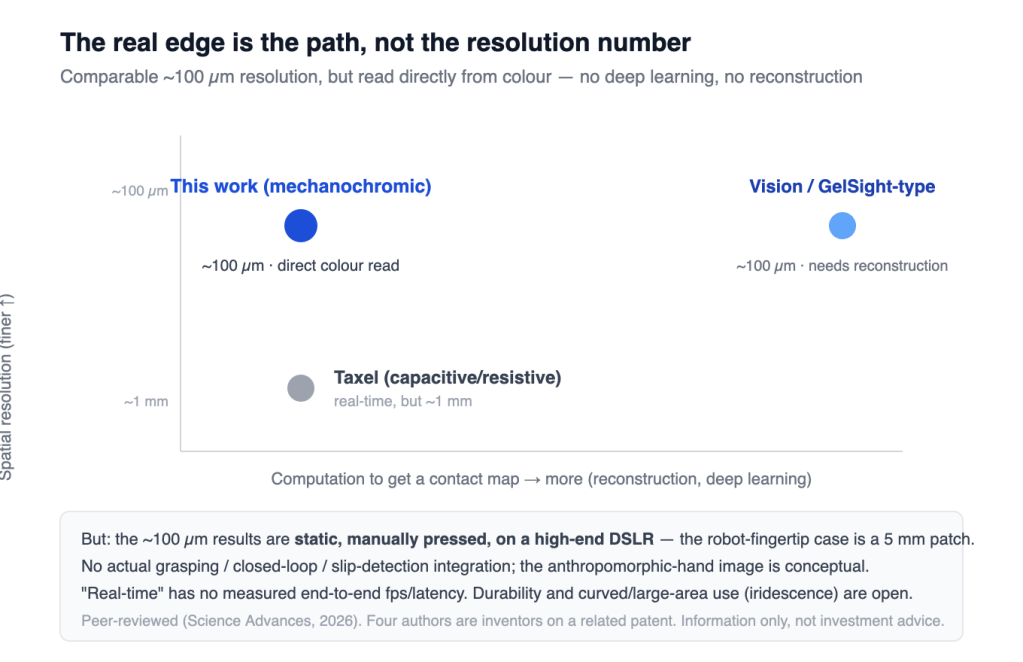
A tactile sensor that reads touch straight from colour — no deep learning, but a static, device-level demo
Evidence-first notes on bioscience and deep tech, at the edge of the lab and the market. Information only — not investment advice. The 30-second version What. A new Science Advances paper (Sasso et al., 3 July 2026) builds a tactile sensor from a stretchable “mechanochromic” film — a soft Bragg reflector that changes structural colour…

