Evidence-first notes on bioscience and deep tech, at the edge of the lab and the market. Information only — not investment advice. All valuation, funding and market-size figures are attributed to the company announcement, trade press or bank projection as noted inline; private post-money rounds are not audited or market-clearing values, “in-talks” rounds are not closed, and announced units are not deployed, autonomous or profitable. This is the closing part of the embodied-AI series.
The 30-second version
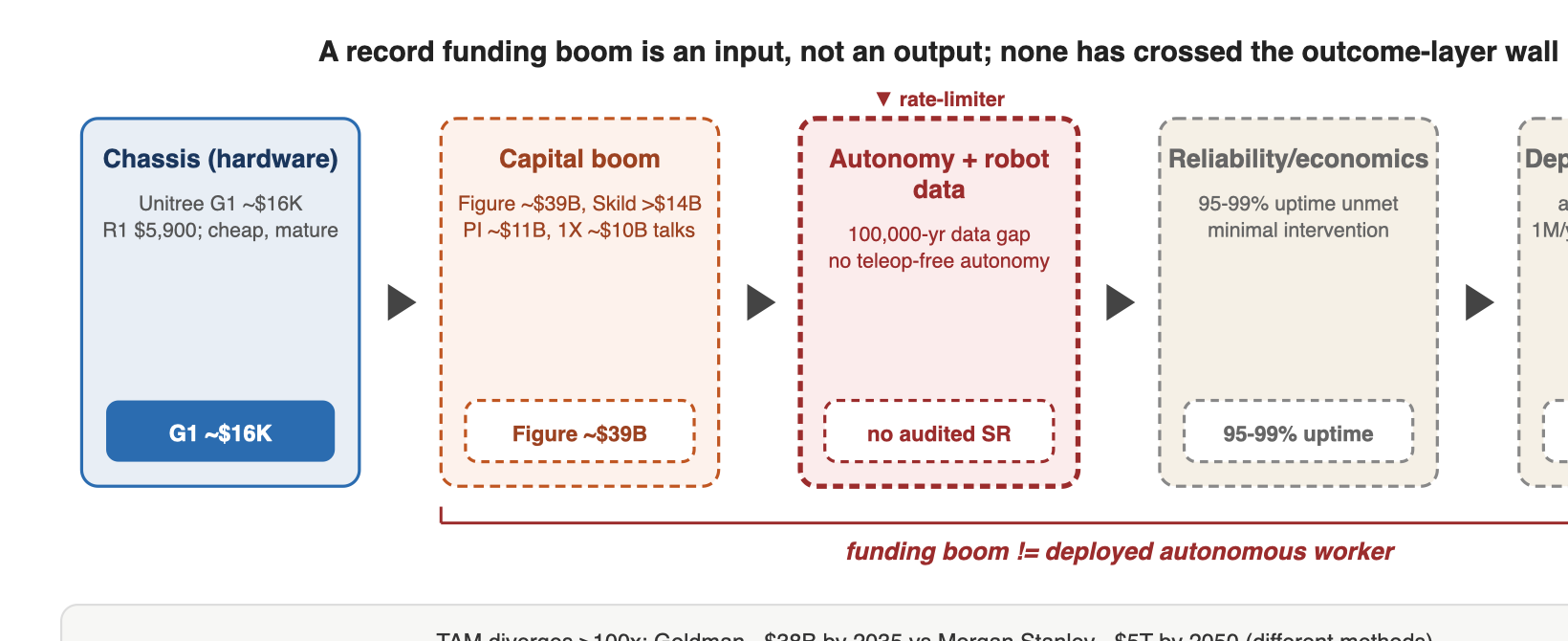
- What. Embodied AI is living through a paradox. The headline is a record robotics funding boom — Figure ~$39B post-money (company-announced Series C), Skild AI >$14B, Physical Intelligence ~$11B (reportedly in talks, unclosed), Apptronik ~$5B, Agility Robotics ~$2.5B SPAC (announced, closing signaled; Nasdaq AGLT), 1X ~$10B (in talks, unclosed), plus Tesla’s 1M/yr Optimus plan and Nvidia’s “multitrillion-dollar” marketing. Yet at the outcome layer there is almost no deployed autonomous worker to match it.
- So what. The bottleneck is not the chassis — hardware is maturing and getting cheap (Unitree G1 ~$16K, R1 $5,900; Nvidia+Unitree GR00T reference). The binding constraint sits at the outcome layer: autonomous cross-task generalization, real-robot data, and reliability/economics. As of mid-2026 Tesla Optimus is still un-produced (Musk, Q1’26 call: production start slated late July/August, “quite slow”), 1X Neo is largely teleoperated (CEO-confirmed “Expert Mode”), and Figure/Agility/Boston Dynamics deployments are narrow, supervised pilots. No vendor discloses a teleop-free autonomous success rate, intervention frequency or uptime under an independent protocol.
- Now what. The firm’s read: the weight of current evidence sits at (b) demo/teleop-bound stall plus (c) narrow-vertical pilots (overlapping), while (a) a genuine robotics “ChatGPT moment” is unproven — but not refuted. It becomes provable only when one platform is observed, simultaneously, to be (i) teleop-free, (ii) generalizing to novel out-of-training tasks, (iii) reproducible and independently audited, (iv) improving with data/compute scale, and (v) industrially reliable (95–99% uptime, minimal intervention). Verdict: proceed-with-caveats. Funding boom ≠ deployed autonomous worker.
The five-minute read
A headline of capital, an outcome layer of almost nothing
The paradox rhymes with the space-economy series — “launch costs collapsed, but only one player won” — except robotics is a step earlier: in space there was at least one clear winner (SpaceX); in embodied AI there is, at the outcome layer, not yet a single winning player. The headline is the largest robotics funding wave on record: Figure ~$39B post-money (company-announced Series C, Sept 2025), Skild AI >$14B (Jan 2026, reportedly the largest robotics-AI round), Physical Intelligence ~$11B (reportedly in talks, March 2026, unclosed), Apptronik ~$5B (Feb 2026), Agility ~$2.5B SPAC (announced June 2026), 1X ~$10B (in talks, Sept 2025, unclosed), Tesla’s 1M/yr Optimus plan, and Nvidia’s “multitrillion-dollar” framing. None of this is matched at the outcome layer by a demonstrated, large-scale, autonomous deployment.
Translated into a single lens, the through-line of the whole series holds: the headline is “humanoid capital boom and hardware demos,” but the bottleneck is one thing — autonomous cross-task generalization, real-robot data, and reliability/economics. Hardware (the chassis) is maturing and capital has exploded, but there is no evidence the boom has translated into a deployed autonomous worker. Every valuation below is flagged as private/in-talks and not audited; every quantitative deployment claim is attributed to the vendor.
| Layer | Company (ticker / status) | Commercial position, H1 2026 (attributed) | Status |
|---|---|---|---|
| HW incumbent (auto-integrated) | Optimus (Tesla, TSLA) | Still un-produced mid-2026; Musk Q1’26 call: start late July/Aug, “quite slow”; plan year-end mass, 1M/yr, Texas up to 10M/yr | Un-produced (planned) |
| HW+FM (manufacturing, own VLA) | Figure AI (private) | Series C >$1B @ ~$39B post-money (company-announced, Sept 2025); BMW 1,250+ hrs (company claim); 100,000 units over 4 yrs (plan) | Pilot / early deploy (autonomy scope undisclosed) |
| FM generalist (private) | Physical Intelligence (private) | π0/π0.5 VLA; ~$11B reportedly in talks (March 2026, unclosed), up from ~$5.6B Series B | Research / early commercial (valuation unclosed) |
| FM “omni-bodied” (private) | Skild AI (private) | Series C ~$1.4B @ >$14B (Jan 2026, reportedly largest robotics-AI round); ~$30M 2025 revenue (company claim) | Research / early commercial (valuation announced) |
| HW+FM (manufacturing, Apollo) | Apptronik (private) | Series A-X $520M @ ~$5–5.5B (Feb 2026, CNBC); Google DeepMind Gemini Robotics partnership | Pilot / early deploy |
| HW logistics/warehouse (SPAC) | Agility Robotics (→ AGLT) | Churchill Capital Corp XI SPAC ~$2.5B, gross >$620M, Nasdaq AGLT (announced 2026-06-24, closing signaled); Digit v4, up to 20h runtime (company claim); Amazon/GXO | Narrow warehouse deploy, early scale |
| HW home (teleop path) | 1X Technologies (private) | Neo $20K / $499·mo; many tasks VR-teleoperated (“Expert Mode,” CEO-confirmed to WSJ); ~$10B in talks (Sept 2025, unclosed) | Teleop-led (not autonomous, self-stated) |
| HW electric Atlas | Atlas (Boston Dynamics / Hyundai) | Electric Atlas; DeepMind foundation-model partnership; Hyundai 2028 deployment, ~30,000/yr target | Not deployed (target) |
| “Picks-and-shovels” (full stack) | Nvidia (NVDA) | Isaac GR00T open reference humanoid; Jetson AGX Thor T5000 (2,070 FP4 TFLOPS, 128GB, 40–130W); invested in Figure/Skild; Jensen “multitrillion-dollar opportunity” (marketing) | Upstream infra (HW+model+sim) |
| HW low-cost volume (China) | Unitree (private) | G1 base ~$16K, R1 $5,900; supplies H2 Plus body to Nvidia GR00T reference | Low-cost R&D platform volume |
Deep dive
1. Background — how the series set up the question
Parts 0–4 built a falsifiable frame around three hypotheses: (a) a genuine robotics “ChatGPT moment” (reproducible, independently verified, teleop-free autonomous cross-task generalization, with a data-scale response and industrial reliability); (b) a demo/teleop-bound stall (impressive demos and capital, but deployment stuck on remote operation and narrow pre-trained tasks); and (c) narrow-vertical commercialization (real but confined ROI in one repetitive setting). The chassis was already shown not to be the binding constraint — low-cost volume (Unitree ~$16K, R1 $5,900), in-house manufacturing (Figure BotQ) and the Nvidia+Unitree reference design have moved hardware toward maturity. This closing part translates the whole arc into the commercial landscape and adjudicates where the evidence actually sits.
2. What this landscape establishes — company positions (all attributed)
- Tesla Optimus (un-produced incumbent): the largest announced scale (year-end mass, 1M/yr, Texas up to 10M/yr) but still un-produced mid-2026, with Musk himself calling early production “quite slow.” Consistent with the Part 0 framing of Optimus units as “for learning/data collection, not production work.” The extreme of announced-scale ≠ deployed-and-working. Especially sensitive because the Optimus narrative is entangled with how the market perceives TSLA.
- Figure AI (largest private valuation, manufacturing focus): ~$39B is a company-announced private post-money (Sept 2025), roughly 15× the Feb 2024 round — the rise itself a symbol of the hype cycle. It is a round issue price, not an audited or market-clearing value, and the BMW deployment (1,250+ hrs) is a company claim whose autonomy scope and intervention frequency are undisclosed.
- Physical Intelligence and Skild (FM generalists, private): π0 (arXiv, primary) and Skild’s “omni-bodied” model are real research, but the valuations are in-talks (~$11B, unclosed) and announced (>$14B); Skild’s ~$30M revenue and “control any robot” claim are company claims without independent real-deployment verification.
- Apptronik (Google belt): Google-led funding and the DeepMind Gemini Robotics partnership position it to bolt hardware onto a DeepMind VLA. The $520M @ ~$5B round is CNBC-confirmed, but deployment is at pilot stage.
- Agility Robotics (narrow warehouse, SPAC): Digit’s Amazon/GXO warehouse work is the most concrete narrow-vertical real deployment (the core evidence for hypothesis c), but the ~$2.5B SPAC is announced with closing signaled, and scale is early (Part 0: RoboFab ~8 units/shift). A SPAC listing echoes the cautionary SPAC-era space names — a skeptic touchpoint.
- 1X Technologies (home, teleop-led): Neo is the textbook case of teleop ≠ autonomous — the CEO himself confirmed to the WSJ that “Expert Mode” is remote human operation. The ~$10B valuation is in talks (unclosed).
- Nvidia (picks-and-shovels): the one position that captures compute upstream whether or not the boom translates into deployment. It sells hardware (Jetson Thor), models (GR00T) and simulation (Isaac/Cosmos/Omniverse) as a vertical stack and has invested in Figure/Skild — symmetric to the space-series pattern of vertical integration capturing the surplus of collapsing launch costs. Jensen’s “multitrillion-dollar” line is a marketing projection, not realized revenue.
- Unitree (low-cost volume): the clearest demonstration that the chassis is not the bottleneck (G1 ~$16K, R1 $5,900), and now a Nvidia reference-body supplier — hardware upstream is already maturing via low-cost volume.
3. Adjudicating the Part 0 question — where the evidence sits
(a) A genuine robotics “ChatGPT moment” — unproven on current data, but not refuted. VLA foundation models do generalize on benchmarks and demos (RT-2 ~3×, Open X-Embodiment RT-2-X ~3×, Gemini on-device ~60% / off-device ~80%, π0 open-world claims — arXiv, primary). But there is no reproducible, independently audited case of teleop-free autonomous cross-task generalization in real deployment. Capital has bet heavily on this hypothesis (Figure, Skild, PI), yet deployment evidence stops at narrow supervised pilots plus teleop. So (a) is unproven — but not refuted, since the benchmark generalization is real and the data-scale response is still open. The falsifiable definition: (a) is confirmed only when a platform is observed to be, simultaneously, (i) teleop-free, (ii) generalizing to novel out-of-training tasks, (iii) reproducible/independently audited, (iv) improving with real-robot data and compute scale, and (v) industrially reliable (95–99% uptime, minimal intervention). Until those five are seen together, “the robotics ChatGPT moment has arrived” is overstatement.
(b) Demo/teleop-bound stall — strongly supported by current data. Teleop is pervasive (1X Neo “Expert Mode,” Optimus “for learning/data collection”); no vendor discloses teleop-free autonomous success rate or intervention frequency under an independent protocol; the data bottleneck is openly acknowledged (Goldberg’s “100,000-year data gap” — there is no internet-scale real-robot dataset); and every VLA generalization number is within a benchmark/demo protocol. The observed pattern is impressive demos and rising capital, but deployment tied to remote operation and narrow pre-trained tasks, with the data wall unresolved.
(c) Narrow-vertical commercialization — early-to-middling evidence, and overlapping with (b). Agility Digit in Amazon/GXO warehouses and Figure’s single-station BMW role are factual anchors of narrow-vertical deployment, and trade press likewise summarizes pilots as “narrow, supervised, not broadly orderable.” But even these have not independently demonstrated 95–99% uptime with minimal intervention, so (c) is “pilots in progress,” not “ROI reached.” It is not exclusive of (b) — the two overlap (narrow pilots that still mix teleop and supervision inside them).
Adjudication: the weight of current evidence sits at (b) demo/teleop-bound stall plus (c) narrow-vertical pilots (overlapping), while (a) is unproven but not refuted. Hardware maturity, VLA benchmark generalization and a record funding boom are all real — but there is no evidence they have translated into a deployed autonomous worker. Impressive demo · huge round ≠ deployable autonomous worker, exactly the Part 0 premise, now observed in the commercial landscape.
4. The skeptic’s catch — “humanoid TAM $X trillion” and the valuation flags
The domain’s signature hype anchor is the investment-bank claim that “humanoids become a multitrillion-dollar market.” It is isomorphic to the space series’ “$1 trillion space economy” catch — the number diverges enormously across banks in both timing and magnitude, so it cannot be cited as a single fact.
- Morgan Stanley: humanoid TAM ~$5 trillion by 2050 (with ~$1.6T/yr revenue by 2040, ~$3T US-only).
- Goldman Sachs: ~$38 billion TAM by 2035, ~502,000 global units shipped by 2032.
- BofA / Citi / Morgan Stanley / UBS average: ~$4.5 trillion by 2050.
Goldman’s near-term figure ($38B by 2035, shipment-based) and Morgan Stanley’s far-term figure ($5T by 2050, labor-replacement-based) differ by more than 100× in magnitude and ~15 years in timing — a wider spread than the space “$1T vs $3T” catch — and they measure different things (near-term units × price vs far-term labor displacement × wages), so they are not head-to-head comparable. A projection is a forecast, not an achievement; the measurable anchor is §2’s deployment reality — effectively no deployed autonomous humanoid worker yet. Separately, the valuations are flagged: Figure ~$39B, Skild >$14B and Apptronik ~$5B are private self-declared post-money, while Physical Intelligence ~$11B and 1X ~$10B are reportedly in-talks (unclosed) — none is audited or market-clearing, and Nvidia is a picks-and-shovels position whose “multitrillion” line is marketing, not realized revenue.
5. Commercialization and investment context
- Value flows upstream, for now. The point where cash is provably flowing today is not deployed autonomous labor but the compute and simulation infrastructure that trains and runs it — Nvidia’s vertical stack (Jetson Thor / GR00T / Isaac-Cosmos-Omniverse) captures compute demand upstream regardless of whether deployment materializes.
- Announced ≠ deployed. Tesla 1M/yr, Figure 100,000 over 4 yrs, Hyundai 30,000/yr and Agility RoboFab are announced targets, not deployment or uptime.
- Valuations flagged. Private post-money and in-talks rounds are not audited or market-clearing values; a round price is the price of future-growth expectation, not a multiple of current profit.
- Company statements here are neutral, source-attributed descriptions, not competitive or outcome rankings and not buy/sell implications for any security. Deal terms and exact valuations are attributed to the company announcement or trade press and are, in detail, unclosed/unaudited.
6. The skeptic’s bottom line
- Funding boom ≠ deployed autonomous worker: capital is at a record high while deployment stays at narrow supervised pilots plus teleop crutches; no vendor publishes a teleop-free autonomous success rate, intervention frequency or uptime under an independent protocol.
- TAM projections diverge ~100×: Goldman $38B by 2035 vs Morgan Stanley $5T by 2050, on different methodologies — isomorphic to the space “$1T” catch. Not a settled fact; flag it.
- Valuations are not audited: Figure/Skild/Apptronik are private self-declared post-money; Physical Intelligence and 1X are reportedly in-talks (unclosed).
- Teleop ≠ autonomous, benchmark ≠ real world: 1X Neo “Expert Mode” is remote operation (CEO-confirmed), and every VLA generalization number is within a benchmark/demo protocol.
- Nvidia = picks-and-shovels: it captures compute upstream whether or not the boom translates to deployment, and the “multitrillion” line is marketing.
- Neutral-framing note: to prevent misreading listed (TSLA, NVDA, Hyundai) and private (Figure, Physical Intelligence, 1X, Apptronik, Skild, Agility) implications as security signals. Verdict: proceed-with-caveats.
7. What to watch (falsifiable) and the series retrospective
- P1 — teleop-free autonomy vs data scale ((a)↔(b) decider): if a platform demonstrates teleop-free novel-task autonomous generalization under a reproducible, independently audited protocol, and real-robot-data/compute scale translates into rising success rate, the evidence moves toward (a); if deployment success keeps falling short of benchmarks and the teleop/data bottleneck persists, (b) is reinforced.
- P2 — narrow-vertical uptime vs boom persistence ((c) decider): if narrow industrial deployments (Agility Digit, Figure) scale to 95–99% uptime with minimal intervention and announced units translate to real deployment, (c)’s ROI holds; if the funding boom persists without deployment, uptime or revenue following — or if the Agility SPAC and private rounds correct — that is a bubble-correction signal isomorphic to the space-series SPAC shakeout.
- P3 — data bottleneck vs compute substitution × cross-domain: if simulation/synthetic data (Nvidia Isaac/Cosmos) and human-video pre-training substantively replace real-robot teleop, the data wall eases and (a) strengthens — simultaneously pushing the computing-power axis (on-robot inference, GPU simulation) and confirming the “foundation model + benchmark vs real world” lens shared with the firm’s bio-foundation-models / ai-protein-design / ai-drug threads; if the sim-to-real gap persists, (b) strengthens.
- Retrospective: the embodied-AI series is the robotics instance of the firm’s through-line — the real bottleneck is at the outcome layer, not the chassis. As in GLP-1 (mechanism headline vs hard outcome), energy-storage (lab Wh/L vs GWh $/kWh), computing-power (chip performance vs power/data-center) and space-economy (launch $/kg vs sustained unit economics), embodied AI’s bottleneck is autonomous cross-task generalization, real-robot data, and reliability/economics. Cross-domain, the decisive asymmetry is the data bottleneck: language and protein foundation models train on internet-scale data, but robots have no internet-scale real-robot data (Goldberg’s 100,000-year gap) — isomorphic to the bio-FM data bottleneck and the space effective-demand bottleneck. The value that provably flows is upstream compute (Nvidia’s picks-and-shovels), and battery runtime/thermal management remains the one candidate exception to “hardware is not the bottleneck.”
References
- Figure AI. 2025. “Figure Series C.” Company announcement (Series C, ~$39B post-money). https://www.figure.ai/news/series-c
- The Robot Report. 2025. “Figure AI raises $1B in Series C funding toward humanoid robot development.” https://www.therobotreport.com/figure-ai-raises-1b-in-series-c-funding-toward-humanoid-robot-development/
- TechCrunch. 2026. “Physical Intelligence is reportedly in talks to raise $1 billion again” (~$11B, in talks, unclosed). https://techcrunch.com/2026/03/27/physical-intelligence-is-reportedly-in-talks-to-raise-1-billion-again/
- CNBC. 2026. “Apptronik raises $520 million at $5 billion valuation for Apollo robot.” https://www.cnbc.com/2026/02/11/apptronik-raises-520-million-at-5-billion-valuation-for-apollo-robot.html
- BusinessWire. 2026. “Skild AI Raises $1.4B, Now Valued Over $14B.” https://www.businesswire.com/news/home/20260114335623/en/Skild-AI-Raises-1.4B-Now-Valued-Over-14B
- GeekWire. 2026. “Digit maker Agility Robotics to go public in $2.5B deal — here’s what the filings say about its finances” (SPAC, Nasdaq AGLT). https://www.geekwire.com/2026/digit-maker-agility-robotics-to-go-public-in-2-5b-deal-heres-what-the-filings-say-about-its-finances/
- Morgan Stanley. “The Humanoid Robot Market Could Reach $5 Trillion by 2050” (bank projection). https://www.morganstanley.com/insights/articles/humanoid-robot-market-5-trillion-by-2050
- NVIDIA Newsroom. “NVIDIA Open Humanoid Robot Reference Design” (Isaac GR00T, Jetson Thor). https://nvidianews.nvidia.com/news/nvidia-open-humanoid-robot-reference-design
- Electrek. 2026. “Tesla Optimus production — Fremont Model S/X line” (still un-produced mid-2026; Musk “quite slow”). https://electrek.co/2026/04/22/tesla-optimus-production-fremont-model-sx-line/
Disclosure
This post is for information only and is not investment advice.
COI note: this post describes listed companies (Tesla TSLA, Nvidia NVDA, Hyundai [Boston Dynamics parent]) and private companies (Figure AI, Physical Intelligence, 1X Technologies, Apptronik, Skild AI, Agility Robotics [SPAC → Nasdaq AGLT], Unitree) in a descriptive, neutral context. Every valuation, funding and market-size figure is attributed to the company announcement, trade press or bank projection. Private post-money valuations (Figure ~$39B, Skild >$14B, Apptronik ~$5B) are self-declared round prices, not audited or market-clearing values; “reportedly in-talks” rounds (Physical Intelligence ~$11B, 1X ~$10B) are not closed; the Agility SPAC (~$2.5B) is announced with closing signaled but unaudited. Announced unit targets are not deployed, autonomous or profitable; teleop is not autonomous; benchmark success is not real-world reliability. Nvidia’s “multitrillion-dollar” framing is company marketing, not realized revenue. TAM projections diverge more than 100× across banks (Goldman ~$38B by 2035 vs Morgan Stanley ~$5T by 2050) on different methodologies and are flagged, not cited as fact. Quantitative claims are attributed to the vendor, author or preprint/press release. All company statements are factual, neutral descriptions and are not buy/sell implications for any security. The author holds no position in, and has no financial interest in, the companies named.


Leave a Reply