Evidence-first notes on bioscience and deep tech, at the edge of the lab and the market. Information only — not investment advice. There is no pure-play listed fusion stock today (Commonwealth Fusion Systems is private). Every figure for energy (MJ), temperature, magnetic field (T), triple product, duration, power (MW) and timeline is attributed to the announcing agency, paper or company roadmap, with agency/peer-reviewed data separated from company target and trade-press. Throughout, keep four distinctions: total energy (MJ) is not net gain (Q); triple product and duration are not Q; scientific Q (Q_plasma) is not engineering Q (Q_engineering) is not wall-plug; and target/roadmap is not an operating plant.
The 30-second version
- What. Magnetic confinement is the fusion family that leads on triple product and steady-state operation. Between 2021 and 2025 it produced three kinds of real, agency-confirmed milestone: JET reached a DT total fusion energy of 69.26 MJ (2023, up from 59 MJ in 2021); W7-X set a long-pulse triple-product record (43 s, 2025-05); and China’s EAST held a >100-million-degree plasma for 1066 s (2025), with WEST at 1337 s and KSTAR holding 100 million degrees for 48 s. Commonwealth Fusion Systems (CFS) also demonstrated a 20 T REBCO high-temperature-superconductor (HTS) magnet (2021).
- So what. Read through the firm’s lens, every one of these milestones is non-Q. JET’s 69 MJ is a total-energy record, not net gain — JET never showed Q_plasma>1 in fifty years (fusion output stayed below heating input). The W7-X, EAST, WEST and KSTAR records are confinement/steady-state/temperature physics in non-DT (hydrogen/deuterium) plasmas, where Q does not even apply. No magnetic-confinement device has demonstrated Q_plasma>1 (that belongs to inertial confinement, NIF, covered in Part 2), and no device of any family has demonstrated Q_engineering>1.
- Now what. The 20 T HTS magnet is genuine, demonstrated hardware progress, and because fusion power density scales as the fourth power of the field (∝ B⁴) it could shrink machines substantially. But CFS’s SPARC Q>1 (~2027) and ARC 400 MWe (2030s) are targets/roadmap, not operating plants, and HTS only raises the field — it does not touch tritium breeding, 14 MeV neutron materials or duty cycle. Meanwhile ITER’s DT operation has slipped to 2039 (+EUR 5bn). The data best fit Part 0 hypothesis (a): the milestones are real, but the outcome layer stays decades out.
The five-minute read
Three milestones, one missing metric — none of them is Q
Magnetic confinement measures itself by the triple product — density n times temperature T times energy-confinement time tau. For DT fusion to self-sustain or produce large gain, this product must clear a threshold (the Lawson criterion, roughly nT-tau of order 10^21 keV-s-m^-3 for DT). The headline records each pushed a different axis of that product, not the bottom line. JET pushed high fusion output and total energy in a real DT plasma; W7-X held a high triple product for a long pulse; EAST, WEST and KSTAR held high temperature for a long duration. All three are real. None of them is net energy gain, because the triple product and the duration are inputs to gain, not gain itself, and — crucially — the long-duration machines run hydrogen or deuterium, so they burn essentially no fusion fuel and Q is undefined for them.
The single hardware advance that could change the geometry of the problem is the 20 T REBCO HTS magnet. Because fusion power density scales as B⁴, doubling the field can, in principle, deliver the same performance in a machine roughly sixteen times smaller. That is the wager separating the giant, lower-field public path (ITER) from the compact, high-field private path (CFS SPARC). The B⁴ scaling is sound, peer-reviewed design physics; whether it actually shortens the path to grid electricity is an unproven proposition that only SPARC’s Q>1 (2027 target) can adjudicate, and even that would be plasma break-even, not plant electricity.
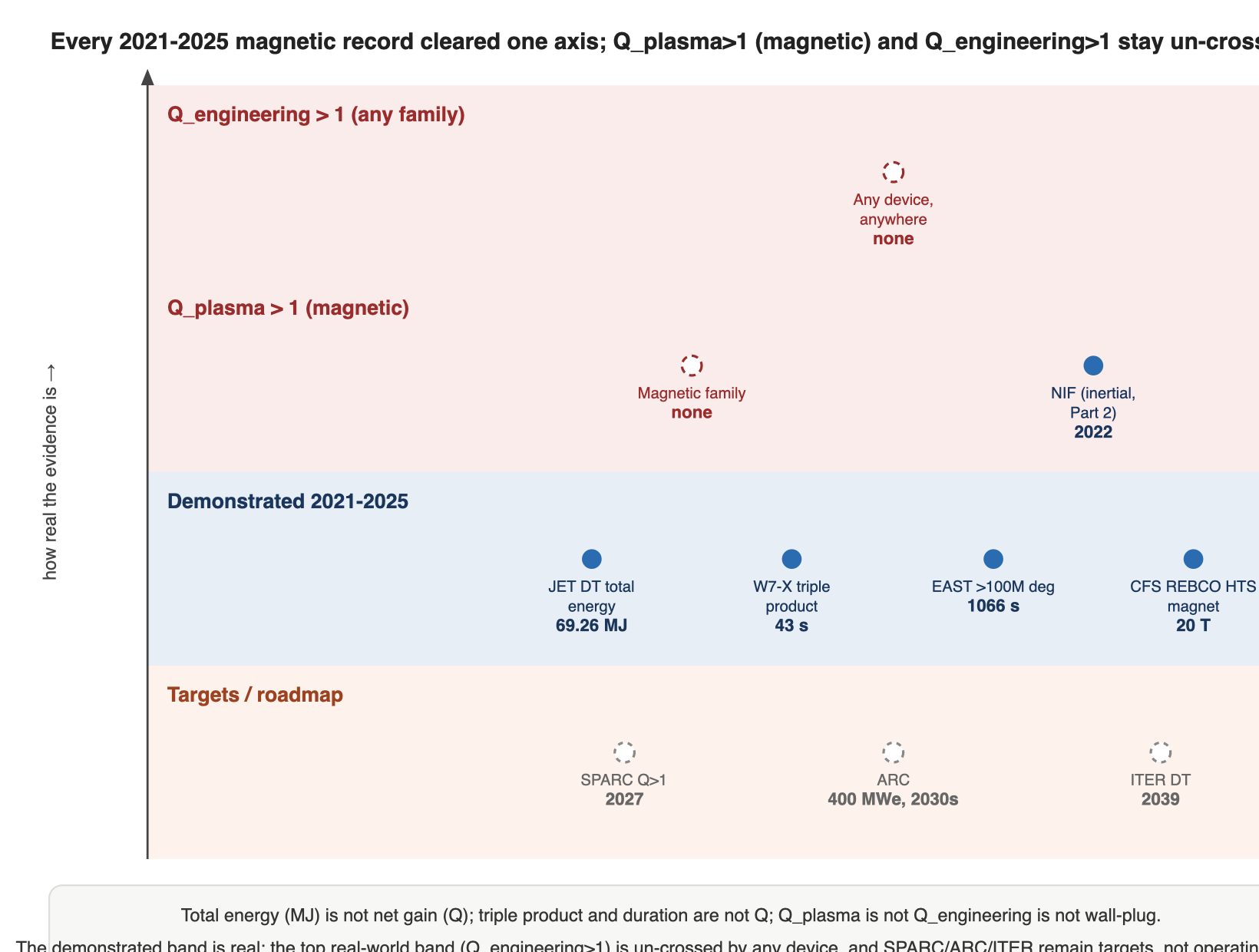 1 (magnetic) and Q_engineering>1 stay un-crossed” width=”1640″ height=”1240″ style=”width:100%;height:auto;max-width:820px;” />
| Milestone (2021-2025) | What it is (attributed) | What it is NOT |
|---|---|---|
| JET 59 MJ (2021) then 69.26 MJ (2023) | DT total fusion energy world record, one pulse (~10 MW / 5-5.2 s, DTE2/DTE3) — demonstrated, agency (EUROfusion/ITER Org) | NOT net gain. JET stayed Q_plasma<1 for fifty years (output < heating input) |
| W7-X triple product, 43 s (2025-05) | Long-pulse triple-product world record, ~90 pellets, 1.8 GJ turnover / 360 s, beta 3%, ~30M deg peak — demonstrated, agency (IPP) | NOT fusion energy or Q — hydrogen plasma, no DT burn; Q undefined |
| EAST 1066 s / WEST 1337 s / KSTAR 100M deg 48 s | Steady-state duration / high-temperature physics records — demonstrated, agency (CAS ASIPP, CEA, KFE) | NOT fusion energy or Q — non-DT plasmas; duration is one axis of the problem, not gain |
| CFS 20 T REBCO HTS magnet (2021) | World-record field for its magnet class, ~165 miles of HTS tape — demonstrated hardware (CFS/MIT) | NOT a plant. Raises field only; SPARC Q>1 (~2027) and ARC 400 MWe (2030s) are targets/roadmap |
| Q_plasma>1 (magnetic family) | Not shown by any magnetic device as of 2026-07 | Shown only by inertial confinement (NIF, 2022 — Part 2) |
| Q_engineering>1 (any family) | Not shown by any device, anywhere | The gap between plasma break-even and net plant electricity |
Deep dive
1. Background — the triple product, and why the magnetic field is leverage
Magnetic confinement holds a hot plasma with magnetic fields so that density, temperature and confinement time can be raised together. Performance is the triple product nT-tau, and DT ignition or large gain requires clearing the Lawson threshold (roughly of order 10^21 keV-s-m^-3 for DT; standard plasma physics). The 2021-2025 headline records each advanced a single axis — JET the fusion output and energy, W7-X the triple product held over time, EAST/KSTAR the temperature held over long duration.
The decisive scaling is that, at fixed normalized pressure (beta), fusion power density in a tokamak scales as the fourth power of the on-axis field, ∝ B⁴ (the high-field pathway; MIT/CFS SPARC-ARC design literature, peer-reviewed). Doubling the field can therefore, in principle, deliver the same performance in a machine roughly sixteen times smaller. This is exactly the fork between the two paths. ITER takes the lower-field, giant route — an on-axis toroidal field around 5.3 T (design value) produced by low-temperature Nb3Sn superconductors, with the missing field compensated by sheer size (plasma major radius ~6 m), yielding the world’s largest machine across 35 nations over decades. CFS SPARC takes the high-field, compact route — REBCO HTS magnets for an on-axis field around 12 T (design value), aiming for the same Q in a much smaller machine. The B⁴ scaling and the shrink potential are physically sound; whether SPARC turns them into an actual Q>1 is a target, not a demonstration, and raising the field does not by itself solve tritium fuel cycle, neutron materials or duty cycle. HTS pushes one axis of the triple product; it does not touch the outcome layer.
2. What these milestones establish — tokamak energy and duration records (fact, attributed)
On the public/energy side, JET (EUROfusion, UK) set the DT total-energy record. In its DTE2 campaign on 2021-12-21 it produced 59 MJ over a 5 s pulse (~10 MW average), more than 2.5 times the 22 MJ of 1997 (DTE1). In its final DTE3 campaign on 2023-10-03 it produced 69.26 MJ over 5.2 s from just 0.2 mg of fuel (announced 2024-02-08); JET was then retired after its last pulse in December 2023. The firm caveat is essential: 69 MJ is the total fusion energy released in one pulse, not net gain. Producing that ~10 MW-class output required tens of MW of external heating, so fusion output was below heating input and Q_plasma<1. JET never achieved Q_plasma>1 in half a century. Reading “69 MJ” as break-even or near-commercial conflates energy with Q.
On the steady-state side, EAST (CAS ASIPP, China) held a >100-million-degree plasma for 1066 s on 2025-01-20, more than doubling its own 403 s record of 2023. WEST (CEA, France) held a steady-state H-mode for 1337 s in 2025-02, briefly above EAST. KSTAR (KFE, Korea) held an ion temperature of 100 million degrees for 48 s with H-mode past 100 s in its 2023-12 to 2024-02 campaign, its first with a tungsten divertor, later extended to 102 s. Again, the caveat: EAST, WEST and KSTAR run hydrogen or deuterium, do essentially no DT burning, and so produce negligible fusion energy — Q does not apply. These are steady-state and high-temperature physics records, proving the plant can hold hot, long, stable plasmas, not that it produces net energy. The move to a tungsten divertor (KSTAR) is outcome-layer progress on heat flux and materials, but it is not power generation.
ITER (35-nation public program) is the giant, lower-field route and remains under construction. Its 2024 revised baseline pushes research operation to 2034 and DT operation from 2035 to 2039 (about a decade of delay, +EUR 5bn), changes the first wall from beryllium to tungsten, and targets Q around 10. ITER has not yet produced plasma, let alone Q. As of 2026-07, no magnetic-confinement tokamak has demonstrated Q_plasma>1.
3. Method — strengths and limits: the stellarator, and the discipline of the Q layers
W7-X (Max-Planck IPP, Germany) is the stellarator counterpoint. On 2025-05-22 it held the triple product at a new high for 43 s, surpassing the long-pulse triple-product marks of tokamaks (JT60U, JET), by injecting about 90 cooled hydrogen pellets over the pulse (a high-performance injector developed at DOE ORNL) under microwave heating. Companion OP 2.3 records include an energy turnover of 1.8 GJ over 360 s, a plasma pressure of beta 3% (a first for the full volume) and a peak temperature near 30 million degrees. An IPP addendum of 2025-06-30 revised JET to a comparable ~60 s, making the two joint leaders.
The stellarator’s strength is steady-state potential: a tokamak drives a plasma current to make its field and is therefore intrinsically pulsed and current-driven-instability-prone, whereas a stellarator makes a 3D field with external coils alone, which is inherently better suited to continuous operation. The 43 s triple product and 360 s energy turnover demonstrate that steady-state axis. The limit is the same as everywhere in this Part: W7-X runs hydrogen, is not designed to burn DT or generate fusion energy, so its record is confinement quality, not net gain. Its historical bottleneck was the extreme precision required to build 3D coils, and HTS high-field stellarators (e.g. private Type One Energy, outside this Part’s scope) are early stage.
The discipline that holds this Part together is layering the meanings of Q. Total energy (MJ) is not net gain (Q>1): JET’s 69 MJ is energy, not break-even. Triple product and duration are not Q: the non-DT records prove inputs to gain, not gain. Q_plasma is not Q_engineering: even if a magnetic device later reaches plasma break-even (SPARC 2027 target), that is not the whole-plant electrical balance including magnet, cryogenic, heating and conversion losses. No device of any family has demonstrated Q_engineering>1.
4. Neighbouring domains — materials, computing-power baseload, and fission SMRs
- Materials (HTS/REBCO and neutron materials). The decisive hardware of this Part is a materials-and-superconductor supply-chain problem: mass, low-cost, uniform production of the ~165 miles of REBCO HTS tape is the upstream bottleneck for scaling SPARC/ARC, while first-wall and structural materials that survive 14 MeV neutrons (tungsten, reduced-activation steel) are the core of the outcome layer (Part 3). The magnet is a case of “when the material works, the physics opens”; neutron materials are the symmetric case of “if the material fails, commercialization is blocked.”
- Computing-power (data-center baseload demand-pull). The largest demand narrative for private tokamaks is AI data centers’ appetite for 24/7 carbon-free baseload. HTS compaction promises faster, more modular plants (ARC 400 MWe) that ride this pull — but if Q_engineering, tritium and materials stay unsolved, roadmap is not operating plant.
- Energy-reactor (fission SMRs). Against the magnetic timeline (ITER DT 2039, SPARC Q>1 2027, ARC 2030s), fission SMRs chase the same firm baseload demand but sit far higher on TRL and regulatory maturity (the reactor is demonstrated technology), making them an earlier competitor. The “HTS shortens the path” narrative should be set beside the reality that SMRs already work.
5. Commercialization and competitive context (TRL, companies)
- Maturity (TRL frame): confinement physics milestones are demonstrated (energy, triple product, duration, the 20 T magnet), but the outcome-layer maturity is early because no magnetic device has shown Q_plasma>1 and none of any family has shown Q_engineering>1. The gating layers are net gain, tritium breeding, neutron materials and duty cycle — not headline plasma performance.
- CFS (private) — demonstrated vs targeted, kept separate. Demonstrated: the 20 T REBCO HTS magnet (2021-09, world record for its class, ~165 miles of tape); SPARC ~75% built with the first of 18 magnets being installed; design parameters up to 140 MW fusion power for 10 s (pulsed) at an on-axis field around 12 T. Target/roadmap: SPARC first plasma 2026 and Q>1 (net energy gain, plasma break-even) in 2027 — which, if achieved, would be the first Q_plasma>1 in the magnetic family, but is currently unproven; and ARC 400 MWe in Virginia in the early 2030s, a follow-on demonstrator that is roadmap, not an operating plant. SPARC is a Q_plasma demonstrator, not a power station — it is not designed to generate electricity, so even Q>1 there is not Q_engineering>1.
- ITER (public) — the giant, lower-field route, now re-deferred to DT 2039 (+EUR 5bn), tungsten first wall, target Q around 10; still under construction.
- No pure-play listed fusion stock exists. CFS is private (VC-backed). Listed exposure is indirect only — investors, off-takers (big tech), fission SMR names and the HTS magnet/materials supply chain.
- Company statements are limited to neutral, source-attributed description; timeline and target figures are not buy/sell signals. SPARC Q>1 and ARC 400 MWe are company roadmap/target, not demonstrated. ITER’s delay and cost increase are stated as public-program facts, neutrally.
6. The skeptic’s bottom line
- Energy is not gain: JET’s 59/69 MJ is total pulse energy, not net gain — JET stayed Q_plasma<1 for fifty years. Reading it as break-even conflates energy with Q.
- Triple product and duration are not Q: W7-X, EAST, WEST and KSTAR run non-DT plasmas that burn essentially no fuel; these are confinement/steady-state/temperature records where Q does not apply. Duration is one axis of the problem, not the answer.
- No magnetic device has shown Q_plasma>1: that belongs to inertial confinement (NIF, 2022 — Part 2), and even there wall-plug is negative with no repetition rate.
- No device of any family has shown Q_engineering>1: the whole-plant electrical balance has never been positive anywhere.
- HTS raises field only: the 20 T magnet is real, demonstrated hardware and the B⁴ leverage is sound, but SPARC Q>1 and ARC 400 MWe are targets/roadmap, and raising the field does not solve tritium (TBR>1), 14 MeV neutron materials or duty cycle. This fits Part 0 hypothesis (a) — the milestones are real, but the outcome layer stays decades out; hypothesis (b), “this time is different,” is decided only by an actual SPARC Q>1.
- Neutral-framing note: to prevent misreading company (CFS private) or adjacent-security (SMR, HTS materials, big-tech off-taker) implications as buy/sell signals, and to keep ITER’s delay/cost as neutral public-program fact.
7. What to watch (falsifiable)
- P1: if SPARC demonstrates first plasma (2026) and Q_plasma>1 (net energy gain, 2027), that would be the first Q_plasma>1 in the magnetic family and would strengthen the high-field “this time is different” path. Repeated deferral without demonstration shifts weight to “decades out” or “shakeout.” (Verify: 2026-2027 SPARC results.)
- P2: the decisive commercialization signal is not Q_plasma>1 but Q_engineering>1 — a positive whole-plant electrical balance including magnet, cryogenic, heating and conversion losses. Until then, “Q>1 equals power generation” is overstated, and SPARC must be kept as a Q_plasma demonstrator, not a plant. (Verify: Part 3.)
- P3: if a compact 20 T HTS tokamak actually co-demonstrates tritium breeding (TBR>1), 14 MeV neutron-durable materials and repeated operation together, the high-field path strengthens; if raising the field leaves any one of these as a fundamental barrier, “raise the field and the rest follows” is falsified. (Verify: Parts 3-4.)
References
- ITER Organization. “JET makes history again” (JET DT total-energy record; 59 MJ). https://www.iter.org/node/20687/jet-makes-history-again
- EUROfusion. “DTE3 record” (JET 69.26 MJ, DTE3 final campaign; announced 2024-02-08). https://euro-fusion.org/eurofusion-news/dte3record/
- EUROfusion. “Wendelstein 7-X sets world record for long plasma triple product” (W7-X, 43 s, 2025-05). https://euro-fusion.org/eurofusion-news/wendelstein-7-x-sets-world-record-for-long-plasma-triple-product/
- Max-Planck IPP. “Wendelstein 7-X” (device and OP 2.3 records; 1.8 GJ / 360 s, beta 3%; joint-leader addendum). https://www.ipp.mpg.de/5532945/w7x
- Physics World. “China’s Experimental Advanced Superconducting Tokamak smashes fusion confinement record” (EAST 1066 s, 2025-01-20). https://physicsworld.com/a/chinas-experimental-advanced-superconducting-tokamak-smashes-fusion-confinement-record/
- Fusion Energy Insights. “KSTAR tokamak achieves 100-million-degree plasma for record 48 s” (KSTAR, 2023-12 to 2024-02 campaign). https://fusionenergyinsights.com/blog/post/kstar-tokamak-achieves-100-million-degree-plasma-for-record-48s
- Hackaday. “Commonwealth Fusion’s 20-tesla magnet: a bright SPARC toward fusion’s future” (20 T REBCO HTS magnet, 2021-09; ~165 miles of tape). https://hackaday.com/2021/09/27/commonwealth-fusions-20-tesla-magnet-a-bright-sparc-towards-fusions-future/
- OODA Loop. “Commonwealth Fusion installs first of 18 magnets in SPARC reactor; first plasma / energy targeted for 2027” (SPARC build status, targets). https://oodaloop.com/briefs/technology/commonwealth-fusion-installs-first-of-18-magnets-in-sparc-reactor-first-plasma-energy-targeted-for-2027/
- ITER Organization. “Updated baseline presented” (2024 revised baseline; DT 2039, tungsten first wall, target Q~10). https://www.iter.org/node/20687/updated-baseline-presented
- Physics World. “ITER fusion reactor hit by massive decade-long delay and EUR 5bn price hike” (ITER delay/cost). https://physicsworld.com/a/iter-fusion-reactor-hit-by-massive-decade-long-delay-and-e5bn-price-hike/
Disclosure
This post is for information only and is not investment advice.
COI note: the named organizations are described in a neutral, source-attributed context. ITER is a public 35-nation consortium; JET/EUROfusion, Max-Planck IPP (W7-X), CAS ASIPP (EAST), CEA (WEST) and KFE (KSTAR) are public programs; Commonwealth Fusion Systems (SPARC/ARC) is a private, VC-backed company. There is no pure-play listed fusion stock — listed exposure is indirect only, via investors, off-takers, fission SMR names and the HTS magnet/materials supply chain. Every figure for Q, triple product, energy (MJ), temperature, magnetic field (T), duration, power (MW) and timeline is attributed to the announcing agency, peer-reviewed paper, company roadmap/target or trade press, with those tiers kept separate. Total energy (MJ) is not net gain (Q); triple product and duration are not Q; scientific Q (Q_plasma) is not engineering Q (Q_engineering) is not wall-plug; announced/target is not demonstrated; roadmap is not an operating plant. SPARC Q>1 and ARC 400 MWe are company targets/roadmap, not demonstrated. ITER’s delay and cost increase are stated as neutral public-program facts. Company and competitive statements are factual, neutral descriptions and are not buy/sell implications for any security. The author holds no position in, and has no financial interest in, the entities named — not investment advice.


Leave a Reply