Evidence-first notes on bioscience and deep tech, at the edge of the lab and the market. Information only — not investment advice. Q values are always attributed to a device, series and denominator (scientific Q_plasma, engineering Q, or wall-plug Q are not the same number); tritium, materials and duty-cycle figures are attributed to the peer-reviewed paper, agency, company roadmap or trade source, and modeled numbers are marked as modeled rather than measured. No pure-play listed fusion company exists; all program statements are neutral and factual.
The 30-second version
- What. Ignition is real: on 2022-12-05 NIF produced 3.15 MJ of fusion energy against the 2.05 MJ laser delivered to the target (target gain 1.5, later ~2.3 in 2024), the first controlled ignition. But that headline is a plasma-heat balance (Q_plasma), and it does not touch the four outcome-layer constraints that decide whether a plant ever sends electricity to the grid: (1) engineering / wall-plug power balance, (2) the tritium fuel cycle, (3) first-wall / blanket materials under 14.1 MeV neutrons, and (4) duty cycle.
- So what. The firm’s recurring lens — “the headline is the starting point; the real bottleneck is elsewhere” — is at its most extreme in fusion. No device has demonstrated Q_engineering>1 (grid electricity out > recirculating electricity in) — this is an absence of evidence, confirmed. ITER’s target of Q≥10 is itself Q_plasma (50 MW of injected heating → 500 MW of fusion thermal power, not electrical). Tritium is a kilogram-scale resource: the world civilian inventory is roughly 25 kg, ITER alone consumes about 12 kg over its life, and a 1 GWe plant would burn about 400 g per day — self-sufficiency requires a breeding ratio TBR>1 (effective minimum ~1.04), but the breeding blanket is at TRL 1–2 and closed-loop plant-scale TBR>1 is unproven.
- Now what. The materials-test infrastructure is not yet running: 14.1 MeV D-T neutrons drive an estimated ~20–50 dpa on the DEMO first wall with a helium-to-dpa ratio roughly ten times that of fission, so fission irradiation data cannot qualify fusion first-wall materials. The dedicated fusion-spectrum neutron source, IFMIF-DONES, only broke ground on 2025-05-19 with an operational target around 2034. Duty cycle (pulsed / rep-rate operation and 80–85% availability) is a set of model assumptions, not measured. And because no fusion plant operates, all LCOE is modeled (floor ~$25–29/MWh vs first-of-a-kind ~$150–200/MWh). Two claims are refuted: “ignition = net energy = power imminent,” and “fission irradiation data can qualify fusion first-wall materials.”
The five-minute read
Three different Q’s — and why “Q>1” almost never means what the headline suggests
The most common confusion in this domain, and the entry point to its outcome layer, is that the three Q’s use different denominators. Q_plasma (scientific) is fusion thermal power divided by heating power injected into the plasma — it excludes the wall-plug electricity that runs magnets, cooling and lasers. Q_engineering is electricity sent to the grid divided by the electricity the plant recirculates. Q_wall-plug is total fusion output over all grid power drawn. ITER’s own “Tao of Q” defines Q≥10 as 50 MW of injected heating producing 500 MW of fusion power, and states that the electricity these systems consume is unrelated to the plasma’s own heat balance — so even ITER’s Q≥10 is Q_plasma, not Q_engineering. NIF’s 3.15 MJ was against the 2.05 MJ laser at the target, but the facility drew roughly 300+ MJ from the wall to fire that laser, so the facility-level energy balance is strongly negative. Q_plasma>1 and Q_wall-plug<1 can be true at the same time.
Four constraints ignition does not touch
Beyond the power balance sit three more outcome-layer constraints. Tritium: D-T fusion burns tritium (half-life 12.3 years), which barely exists in nature; a plant must breed its own via 6Li + n → T + 4He (and 7Li + n → T + 4He + n’) in a lithium blanket, needing TBR>1 — but no plant-scale closed-loop TBR>1 has been shown, and small component experiments such as BABY measure a TBR, they do not demonstrate an integrated power-plant subsystem. Materials: 14.1 MeV neutrons displace atoms (dpa) and transmute the structure into helium and hydrogen gas, embrittling and swelling it; no operating fusion-spectrum materials-test neutron source exists. Duty cycle: commercial power needs continuous or high-repetition operation at high availability, whereas today’s milestones are short pulses (W7-X’s 43 s record) or roughly one shot per day (NIF).
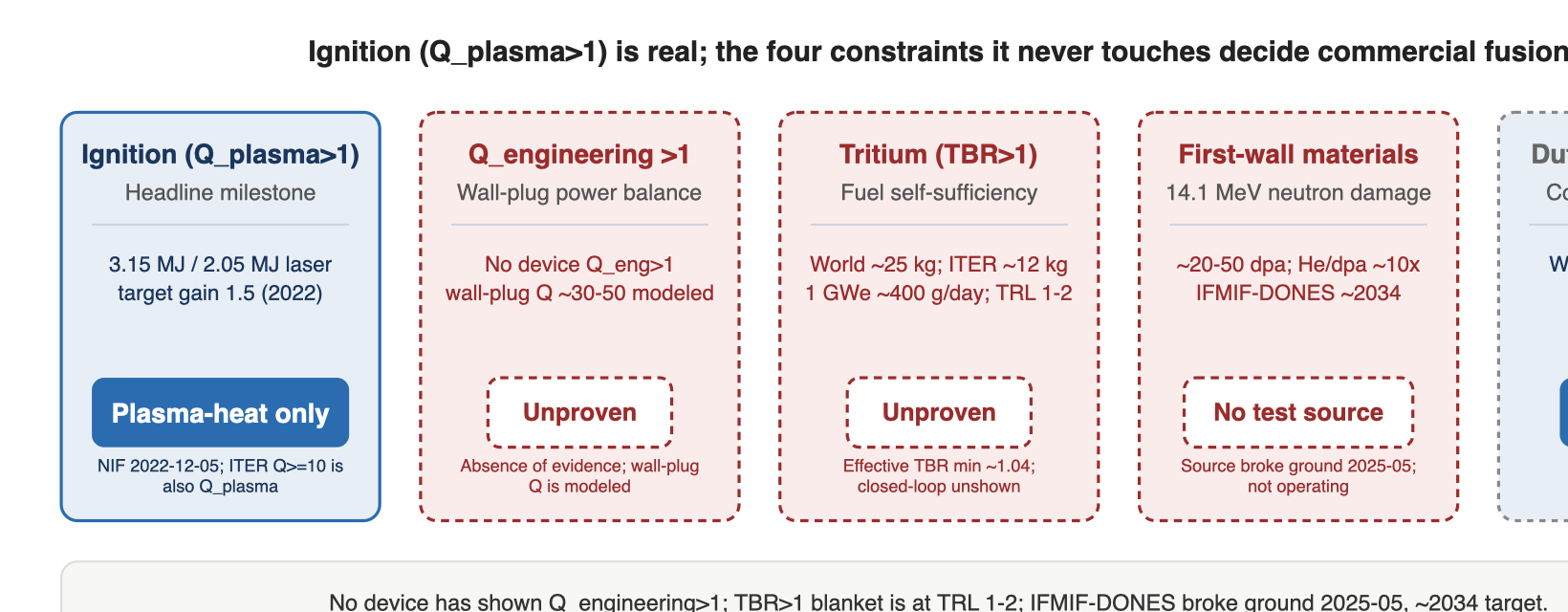 1) is real; the four constraints it never touches decide commercial fusion” width=”1640″ height=”640″ style=”width:100%;height:auto;max-width:820px;” />
| Outcome-layer constraint | Status (2026-07, attributed) | Verdict |
|---|---|---|
| Ignition / Q_plasma>1 (headline) | NIF target gain 1.5 (2022), ~2.3 (2024); ITER goal Q≥10 = 50 MW → 500 MW thermal (ITER Tao of Q) | Real, but plasma-heat only |
| 1. Q_engineering / wall-plug | No device has shown Q_engineering>1 (absence of evidence); wall-plug economic Q ~30–50 is a modeled consensus, not first-source confirmed | Bottleneck (unproven) |
| 2. Tritium fuel cycle (TBR>1) | World inventory ~25 kg; ITER consumes ~12 kg over life; 1 GWe burns ~400 g/day; TBR min ~1.04 required; blanket TRL 1–2; closed-loop plant-scale TBR>1 unproven | Fundamental bottleneck |
| 3. First-wall / blanket materials | 14.1 MeV neutrons → ~20–50 dpa on DEMO first wall; He/dpa ~10× fission; no operating fusion-spectrum test source (IFMIF-DONES broke ground 2025-05, ~2034 target) | Bottleneck (infra not running) |
| 4. Duty cycle / rep-rate | Milestones are short pulses (W7-X 43 s) or ~1 shot/day (NIF); 80–85% availability is a model assumption, not measured | Bottleneck (assumed, not measured) |
| LCOE (preview, Part 4) | No operating plant → no measured LCOE; all modeled (floor ~$25–29 vs FOAK ~$150–200/MWh) | Entirely modeled |
Deep dive
1. Q_plasma ≠ Q_engineering ≠ wall-plug — why no device shows Q_engineering>1
The three Q’s differ only in their denominator, and that is exactly where headlines go wrong. Q_plasma (scientific) = fusion thermal output / heating power injected into the plasma; it excludes magnet, cooling and laser wall-plug power. Q_engineering = electricity to the grid / recirculating electricity, and it includes internal plant consumption. Q_wall-plug = total fusion output / all grid power drawn, including magnets, heating, control and assembly.
- ITER “The Tao of Q” (primary): defines Q as the out-versus-in ratio of fusion thermal output to injected heating, and states Q≥10 = 50 MW injected → 500 MW fusion thermal output. ITER itself notes that the electricity these systems consume is unrelated to the plasma’s own heat balance — so even ITER’s Q≥10 is Q_plasma, not Q_engineering. ITER is an experimental device and is not designed to produce electricity.
- NIF (inherited from Part 0): the 3.15 MJ is against the 2.05 MJ laser delivered to the target (target gain, a Q_plasma-family figure). But firing that laser drew roughly 300+ MJ of facility wall-plug power (laser wall-plug efficiency on the order of ~1%), so the facility-level energy balance is strongly negative. Q_plasma>1 and Q_wall-plug<1 hold simultaneously.
- Key observation: no device has demonstrated Q_engineering>1 (an absence of evidence, confirmed). Even NIF, which demonstrated ignition and Q_plasma>1, is wall-plug-negative; ITER and JET do not produce electricity at all. Ignition is not electricity. Multiple explainers (EUROfusion glossary, Proxima) suggest a commercial plant needs a wall-plug Q on the order of ~30–50 because recirculating power (magnets, cooling, heating, tritium processing, pumps) is large — but that specific ~30–50 value is a modeled consensus, not first-source confirmed here; only the direction (the engineering threshold is far above Q_plasma=1) is consistent across sources.
2. The tritium fuel cycle (TBR>1) — self-sufficiency is unproven
The second constraint is the fuel itself. D-T fusion burns tritium (3H), which has a 12.3-year half-life and is effectively absent from nature, so a plant must breed its own tritium in its blanket to run continuously.
- A kilogram-scale resource (attributed): the world civilian tritium inventory is roughly 25 kg (2024, mostly a Canadian CANDU by-product; some sources cite ~50 kg). CANDU reactors produce about 2 kg/year in total (~130 g per reactor per year), and about half of the fleet is scheduled to retire within this decade. ITER alone will consume about 12 kg over its operating life, and one projection has the world inventory falling to about 14 kg by 2055 (Science/AAAS, UPenn Kleinman, Pearson 2018). For scale, Proxima (company/near-primary) describes a 100 MW plant consuming ~17 kg/year and a 1 GWe plant ~400 g/day — a single commercial plant would burn the world inventory within about a year, so external procurement cannot fuel a fleet.
- TBR and its unproven status: the tritium breeding ratio (TBR) is tritium bred in the blanket divided by tritium burned; self-sufficiency requires TBR>1, and accounting for neutron leakage, structural absorption, nuclear-data uncertainty and decay losses pushes the effective minimum to ~1.04–1.05 (OSTI/FESS-FNSF). Breeding uses 6Li + n → T + 4He (exothermic) and 7Li + n → T + 4He + n’ (endothermic, regenerating a neutron), with neutron multipliers (Be, Pb) added to reach TBR>1. But no plant-scale closed-loop TBR>1 has been demonstrated; breeding-blanket technology sits at TRL ~1–2. The recent BABY experiment (arXiv 2412.02721) directly measured a TBR in a small molten-salt setup under high-energy neutron irradiation — a pioneering component-level measurement, not an integrated power-plant subsystem demonstrating closed-loop self-sufficiency.
- Why it is hard: heating systems, diagnostics, ports and the divertor pierce the wall and consume solid angle, so blanket coverage is never 100%; reaching TBR>1 under that constraint leaves very little design margin, and the same blanket must simultaneously survive the neutron damage of Section 3.
3. First-wall / blanket materials and 14 MeV neutron damage — the test infrastructure is not even running
The third constraint is materials. D-T fusion’s 14.1 MeV neutrons damage structures far more aggressively than fission’s roughly 2 MeV spectrum, and there is no operating fusion-spectrum neutron source to reproduce and qualify that damage.
- Damage mechanisms: fast neutrons knock atoms out of the lattice (dpa), with the DEMO first wall expected to reach up to ~20 dpa in an early phase and ~50 dpa later (IFMIF-DONES requirement, IOP). Via (n,α) and (n,p) transmutation, 14 MeV neutrons generate helium and hydrogen gas inside the structure; helium collects at grain boundaries as bubbles, causing embrittlement and swelling. The fusion first wall’s He/dpa ratio (on the order of ~10 appm/dpa) is roughly ten times that of fission (~0.1–0.5) — the physical reason fission irradiation data cannot substitute for fusion qualification (literature consensus; the specific appm/dpa value is not first-source confirmed here). DEMO’s candidate structural material is EUROFER, a reduced-activation ferritic-martensitic steel.
- IFMIF-DONES — broke ground 2025, not yet operating: DEMO and commercial first walls must survive 14 MeV irradiation for 10+ years, but no operating facility reproduces that environment on the ground; existing fission reactors and ion beams differ in spectrum and He/dpa. IFMIF-DONES (International Fusion Materials Irradiation Facility – DEMO Oriented Neutron Source) collides an accelerated D+ beam (125 mA, 40 MeV) with a 25 mm-thick, 15 m/s liquid-lithium curtain to generate 14 MeV-centered neutrons, targeting 20 NRT dpa within 2.5 years (0.3 L) and 50 NRT dpa within 3 years (0.1 L). Status: first stone laid at Escuzar, Granada on 2025-05-19, with the EU approving 202M EUR (25% of the total); major system installation starts in 2026 and the operational target is around 2034. Until then, 10+ year first-wall materials remain unqualified.
- Inertial confinement adds load (Part 2): laser-driven inertial confinement adds target mass-production, chamber recovery (debris, splash) and final-optics damage; at several shots per second the chamber wall must recover from each shot’s shock, neutrons and debris — a repetition-rate problem layered on top of the first-wall problem (see Section 4).
4. Duty cycle / repetition rate — a gross milestone is not continuous power
The fourth constraint is sustained operation. A power plant needs continuous (stellarator), long-pulse (tokamak) or high-repetition (inertial) operation at high availability, whereas current milestones are mostly short, low-repetition events.
- Magnetic confinement (pulsed vs steady-state): W7-X (stellarator) set a 43-second long-pulse triple-product record in 2025 (Part 0), and tokamaks aim for tens-to-hundreds-of-seconds pulses. But commercial power needs months-to-years of continuous (or high-frequency repeated) operation at high availability; tokamak pulsed current drive, divertor heat load and steady-state non-inductive current drive remain unresolved.
- Inertial confinement (rep-rate): NIF fires roughly once per day (a research facility), far from the several-shots-per-second repetition rate a power plant needs. Inertial economic models typically assume ~0.2 Hz to a few Hz and driver lifetimes of tens of millions of shots (e.g. Royal Society models) — assumptions, not demonstrated.
- Availability = capacity factor: economic models usually assume 80–85% availability (e.g. the arXiv costing framework), but accounting for tritium processing, blanket replacement, materials degradation and remote maintenance, the realistic capacity factor of early plants is unknown. A gross ignition or gross Q_plasma milestone tells you nothing about continuous-power availability — modeled is not measured.
5. LCOE preview — no operating plant, so no measured cost
Only after the four constraints above are resolved does the economics question become meaningful, and the honest starting point is that no operating fusion plant exists, so there is no measured LCOE — every figure is modeled.
- A wide modeled spread: even assuming the fusion core were free, a 1 GWe magnetic-confinement tokamak has a modeled LCOE floor of about $29/MWh (7% WACC, 85% availability; 1cfe/arXiv model), and inertial models compute down to about $25/MWh under favorable conditions. Yet the same class of industry analysis puts 2030s first-of-a-kind (FOAK) LCOE at about $150–200/MWh, with nth-of-a-kind (NOAK) only reaching ~$60–100/MWh (trade/model). The spread between optimistic and realistic runs from single digits to several-fold, and all of it is assumption-dependent.
- Why it is estimated: capex (HTS magnets, vacuum, tritium plant), availability, blanket replacement interval, tritium processing cost and remote-maintenance cost are all unmeasured. This is the economic axis of the “always 30 years away” question.
- Competition: near-term firm/baseload carbon-free power will first be carried by fission SMRs (a demonstrated technology) and renewables-plus-storage (LDES); when fusion opens an economic window is the subject of Part 4.
6. Synthesis — the binding constraint is not ignition
Overlaying the four outcome layers fixes the firm thesis: ignition (Q_plasma>1) is a real scientific milestone, but the binding constraint is not ignition — it is (1) Q_engineering, (2) tritium, (3) materials and (4) duty cycle, and the genuinely hard part begins after Q_plasma>1.
- (1)+(4), power balance: even with Q_plasma>1, recirculating power (magnets, cooling, heating, tritium processing) is large and availability is unknown, so Q_engineering>1 does not follow automatically — which is why no device has shown it.
- (2)+(3), fuel × materials: the blanket that provides tritium self-sufficiency (TBR>1) must simultaneously survive 14 MeV neutron damage — two unresolved outcome layers stacked on the same component (blanket/first wall) — and the neutron source to qualify it (IFMIF-DONES) broke ground in 2025 and is not operating.
- Firm cross-thesis: this mirrors space-economy (falling launch cost is not profitability), energy-storage (lab Wh/L is not grid $/kWh) and GLP-1 (mechanism is not a hard outcome) — the headline metric is the entry point, and the contest is decided by a different ceiling in the outcome layer. In fusion that ceiling is not ignition but Q_engineering, tritium, materials and duty cycle, and then LCOE (Part 4). Ignition demo is not grid electricity.
7. What to watch (falsifiable)
- P1 — reaching Q_engineering (settles 1 and 4): if any device (SPARC a leading candidate) demonstrates not just Q_plasma>1 but an actual Q_engineering>1 (positive plant-wide power balance) together with recirculating power and availability between 2026 and 2035, the “this time is different” hypothesis strengthens; if leading devices clear Q_plasma but stall at the recirculation / duty-cycle wall, the “decades away” hypothesis strengthens.
- P2 — tritium and materials together (settles 2 and 3): if a D-T plant demonstrates closed-loop TBR>1 as an integrated subsystem and IFMIF-DONES (operational target ~2034) qualifies EUROFER-class steel to 20/50 dpa, that is a commercial-path signal; if either proves a fundamental barrier (tritium inventory exhaustion or materials failure), the “decades away” case strengthens, and whether D-3He / p-11B alternative fuel cycles become a bypass is also adjudicated here.
- P3 — economics × cross-domain (settles 5): if FOAK LCOE enters the competitive range against fission SMR and renewables-plus-storage (LDES) and data-center baseload demand-pull turns into real PPAs and real power, the economic window opens; if LCOE stays near $150–200/MWh and SMR/LDES pre-empt near-term firm power, the fusion economic window slips toward 2040–2050+.
References
- ITER Organization. “The Tao of Q” (Q_plasma definition; Q≥10 = 50 MW → 500 MW). https://www.iter.org/node/20687/tao-q
- EUROfusion. Glossary — “Breakeven” (scientific vs engineering breakeven). https://euro-fusion.org/glossary/breakeven/
- Proxima Fusion. “Talking About Q>1: Why Clarity Matters.” https://www.proximafusion.com/press-news/talking-about-q-greater-than-1-clarity-matters-in-fusion
- Science (AAAS). “Fusion power may run out of fuel before it even gets started” (tritium scarcity). https://www.science.org/content/article/fusion-power-may-run-fuel-even-gets-started
- Kleinman Center (UPenn). “Tritium: A Few Kilograms Can Make or Break Nuclear Fusion.” https://kleinmanenergy.upenn.edu/commentary/blog/tritium-a-few-kilograms-can-make-or-break-nuclear-fusion/
- Pearson, Antoniazzi & Nuttall. 2018. “Tritium supply and use.” Fusion Engineering and Design. https://www.sciencedirect.com/science/article/pii/S092037961830379X
- Proxima Fusion. “Fueling Our Star on Earth: The Tritium Challenge Explained.” https://www.proximafusion.com/press-news/fueling-our-star-on-earth-the-tritium-challenge-explained
- OSTI (DOE). “Tritium Breeding Ratio Evaluation… FESS-FNSF” (TBR min ~1.04; blanket TRL 1–2). https://www.osti.gov/servlets/purl/2448047
- BABY experiment (small-scale molten-salt TBR measurement). arXiv 2412.02721. https://arxiv.org/html/2412.02721v1
- IFMIF-DONES design (14 MeV; 20/50 dpa). Nuclear Fusion (IOP). https://iopscience.iop.org/article/10.1088/1741-4326/ac318f
- EUROfusion. “IFMIF-DONES starts construction phase” (2025 groundbreaking). https://euro-fusion.org/related/ifmif-dones/international-materials-facility-ifmif-dones-starts-construction-phase/
- IFMIF-DONES (official) — construction start; D+ 125 mA / 40 MeV; Li curtain; EUROFER. https://ifmif-dones.es/
- “A costing framework for fusion power plants” (LCOE model). arXiv 2601.21724. https://arxiv.org/pdf/2601.21724
- “Can fusion energy be cost-competitive…” Energy Policy (ScienceDirect). https://www.sciencedirect.com/science/article/abs/pii/S0301421523000964
Disclosure
This post is for information only and is not investment advice.
COI note: the companies named (all private — Commonwealth Fusion Systems, Helion, TAE, Zap, General Fusion, First Light, Proxima Fusion) and the public programs and facilities (ITER, NIF/LLNL, JET, EUROfusion, IFMIF-DONES, DEMO) are described in a factual, neutral context; ITER, IAEA and DOE/OSTI materials cited here are public. There is currently no listed pure-play fusion company — listed exposure is indirect, via large corporate investors, offtakers or adjacent fission-SMR names. Every quantitative claim is attributed to the relevant paper, agency, company roadmap or trade source, with peer-reviewed, agency, company-roadmap and secondary sources kept separate; consumption rates, the ~30–50 wall-plug Q, the He/dpa ratio and all LCOE figures are company-roadmap or modeled/consensus rather than first-source measured, and are labeled as such. Scientific Q is not engineering Q is not wall-plug Q; a demonstrated component test is not an integrated power-plant subsystem; modeled LCOE is not measured LCOE. This is not a recommendation to buy or sell, and not investment advice.


Leave a Reply