Evidence-first notes on bioscience and deep tech, at the edge of the lab and the market. Information only — not investment advice. All generalization figures, deployment counts and valuations are attributed to the source. VLA generalization numbers (RT-2 ~3x, Gemini Robotics ~60/80%, RT-2-X ~3x) are all within-benchmark / in-protocol success rates, not real-world autonomous task success. Hardware deployment figures (Figure at BMW, Optimus unit counts) are company claims or secondary reporting, not independently verified against primary filings (noted inline). Teleoperation is not autonomy; a demo is not a deployment.
The 30-second version
- What. Embodied AI stacks three layers — humanoid hardware (Tesla Optimus, Figure, Unitree, electric Atlas, Agility Digit, 1X Neo), robot foundation models (VLA: vision-language-action — RT-2, Open X-Embodiment, π0, Nvidia GR00T, Google DeepMind Gemini Robotics), and data (real-robot interaction data plus sim-to-real). The headlines are almost always hardware demos, and that hardware progress is real: Unitree G1 at roughly $16K (R1 at $5,900), Figure’s in-house BotQ manufacturing, an electric Atlas designed to automotive supply-chain parts.
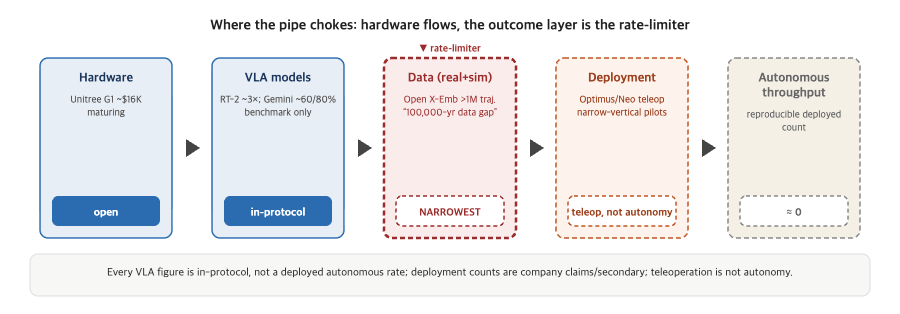
- So what. The recurring lens — “the headline is the starting point; the real bottleneck is elsewhere” — applies cleanly. Hardware (chassis, actuators) is maturing and is no longer the binding constraint. The real bottleneck sits in the outcome layer: (1) autonomous cross-task generalization (a task done by demo or teleoperation is not a task done by itself), (2) real-robot data scarcity (there is no internet-scale corpus of robot interaction data — Berkeley’s Ken Goldberg calls it a “100,000-year data gap”), and (3) sim-to-real transfer and fingertip-level reliability (industrial arms run 95–99% uptime; humanoids are far below). Every disclosed VLA generalization number is a benchmark/in-protocol success rate, not a deployed autonomous success rate. Impressive demo ≠ deployable autonomous worker.
- Now what. Teleoperation is pervasive, not incidental. 1X’s Neo runs many household tasks under VR-headset remote operation (“Expert Mode”), and Tesla’s Elon Musk stated on the Q4 2025 call that Optimus is “primarily for learning and data collection rather than performing productive tasks.” The central question — has robotics reached a genuine “ChatGPT moment” (autonomous cross-task generalization), or is the field still demo/teleop-bound with the data bottleneck unsolved? — currently resolves to (b) demo/teleop-bound plus (c) a narrow-vertical commercialization pattern. Option (a), a genuine ChatGPT moment, is unproven but not refuted.
The five-minute read
Three layers — and which one is rate-limiting
Embodied AI is a three-layer stack, and the layers do not fail in the same place. Hardware (upstream) is maturing fast: Unitree ships a research-grade humanoid near $16K, Figure builds its own bodies at BotQ, and Boston Dynamics designed the electric Atlas around automotive-grade components. The remaining hardware limits — fingertip dexterity, battery runtime, thermal management — are real but no longer the central unknown. Foundation models (midstream) are the one layer that has demonstrably improved generalization, but only on benchmarks and staged demos. Data (downstream) is the deepest and least-solved constraint: language and protein foundation models train on internet-scale corpora, but no comparable corpus of real robot interaction exists. Today’s data comes from expensive, slow teleoperation, from simulation with a residual sim-to-real gap, and from egocentric human video with an embodiment mismatch.
The headline is hardware; the bottleneck is generalization, data and reliability
The disclosed foundation-model numbers are genuine — and genuinely narrow. RT-2 showed web-knowledge transfer and roughly 3x better generalization with emergent reasoning; Open X-Embodiment pooled >1M real-robot trajectories across 22 embodiments and reported RT-2-X at ~3x; Gemini Robotics On-Device reported ~60% on seven tasks (~80% off-device) from ≤100 demos. But every one of these is a within-protocol success rate, not an autonomous real-world task rate — benchmark success ≠ real-world task success. Two claims are actively refuted by the evidence: that humanoids are already deployed autonomous workers / robotics’ “ChatGPT moment” has arrived (contradicted by pervasive teleoperation and by Musk’s own framing of Optimus as a data-collection platform), and that the bottleneck is hardware (the binding constraint has moved to the outcome layer). What remains unproven, in either direction, is whether robot foundation models scale like language models once the data engine turns.
| Layer | Representative players & headline metric (source-attributed) | Verdict |
|---|---|---|
| Hardware (humanoid platforms) | Optimus (Tesla), Figure 03, Unitree G1 ~$16K / R1 $5,900, electric Atlas (Boston Dynamics / Hyundai), Digit (Agility), Neo (1X) — low-cost volume & in-house manufacturing demonstrated (company / official) | Maturing — no longer the bottleneck |
| Foundation models (VLA) | RT-2 ~3x generalization; Open X-Embodiment >1M trajectories / RT-2-X ~3x; π0 flow VLA; GR00T N1 open humanoid FM; Gemini Robotics On-Device ~60% (off-device ~80%), ≤100 demos (arXiv / DeepMind / Nvidia) | Benchmark generalization only — in-protocol, not deployed autonomy |
| Data (real-robot & sim-to-real) | No internet-scale robot data; teleoperation is expensive/slow; sim-to-real gap; Goldberg’s “100,000-year data gap” | Deepest, unsolved — the series’ final rate limiter |
| Deployment reality | Optimus “for learning and data collection” (Musk, Q4’25); 1X Neo many tasks via VR teleop (“Expert Mode”); Agility Digit in narrow warehouse tasks; Atlas/Hyundai targeting 2028 | Teleop-pervasive; narrow-vertical pilots |
| Autonomous cross-task generalization | No reproducible-protocol demonstration of deployed teleop-free novel-task autonomy; all figures are benchmark / demo / company claim | Top bottleneck — unproven, not refuted |
Deep dive
1. Background — the three-layer stack and where “demo” stops meaning “deployed”
Embodied AI runs a chain of distinctions that headlines routinely collapse: demo ≠ teleop ≠ autonomous ≠ deployed ≠ reliable. A martial-arts demo, a factory-floor video and an announced unit count each say something narrower than “unstructured real-world autonomy.” The hardware layer — chassis, actuators, hands, battery, bill of materials — is maturing through low-cost volume (Unitree), in-house manufacturing (Figure BotQ) and mass-production design (electric Atlas built to automotive supply chains). “Can we build a robot body?” is no longer the central unknown; the open questions have moved to the foundation-model and data layers below it. This axis is the physical-world extension of the firm’s foundation-model thread (bio-foundation-models, ai-protein-design): just as in protein design “in-silico design ≠ wet-lab expression/function,” in robotics “VLA benchmark success ≠ real-world autonomous reliability.”
2. What this landscape establishes — disclosed results, attributed to arXiv / announcement / demo
Principle: generalization figures, deployment counts and valuations are reported as in the source; benchmark/demo results are separated from any deployed autonomous result (there are none on a reproducible protocol); and cross-program numbers are not head-to-head.
- RT-2 (Google DeepMind) — web-knowledge transfer, ~3x generalization improvement, emergent reasoning (arXiv 2307.15818). Research — benchmark success, not deployment.
- Open X-Embodiment (160+ researchers / 21 institutions) — >1M real-robot trajectories, 22 embodiments, 60 datasets; RT-1-X wins 4 of 5, RT-2-X ~3x (arXiv 2310.08864). Cross-embodiment transfer demonstrated on benchmarks.
- π0 / π0.5 (Physical Intelligence, private) — a VLA flow model (arXiv 2410.24164, 2024-10); π0.5 (2025-04) claims open-world generalization; $400M Series A (2024-11). Deployed autonomous success rate not independently confirmed.
- Isaac GR00T N1 (Nvidia) — an open humanoid foundation model trained on egocentric human video plus real and simulated data; reported to exceed SOTA imitation baselines on simulation benchmarks (Nvidia / arXiv 2503.14734, 2025-03). Simulation-benchmark-centric.
- Gemini Robotics (Google DeepMind) — launched 2025-03; On-Device (2025-07) ~60% on seven tasks, off-device ~80%, from ≤100 demos; Gemini Robotics 1.5 (arXiv 2510.03342). Benchmark / demo success rates.
- Optimus (Tesla) — Musk, Q4 2025 call: currently “primarily for learning and data collection rather than performing productive tasks” (his own statement; secondary reporting). Data-collection stage, not productive work.
- Figure 03 (Figure AI, private) — BMW Spartanburg pilot cited by the company (a Figure 02 ten-hour shift, 11 months, 90,000+ parts, 1,250+ runtime hours), plus in-house BotQ manufacturing. These are company claims; the scope of autonomy and the human-intervention frequency are not disclosed, and I could not independently verify the numbers against a primary document.
- Unitree G1 / R1 (private) — G1 base ~$16K, R1 $5,900 (2025-07) — the lowest-cost volume humanoids to date, sold as research/development platforms (Unitree official).
- Digit (Agility Robotics, SPAC AGLT) — deployments cited at Amazon, Schaeffler, GXO, Toyota; RoboFab nominal 10,000/yr but roughly ~8 units per shift in practice; $2.5B SPAC (GeekWire / filings). Narrow warehouse tasks, early scale.
- Neo (1X Technologies, private) — 2025-10-28 reservations at $20K / $499 per month; many tasks run under VR remote operation (“Expert Mode”) (The Robot Report / Engadget). Teleop-led — the company itself states this is not autonomy.
- Electric Atlas (Boston Dynamics / Hyundai) — shown at CES 2026; 2026 units reportedly pre-committed (RMAC, DeepMind), with a Hyundai target of ~30,000/yr and 2028 deployment (Boston Dynamics / Hyundai official). Early commercial — targets, not deployments.
3. The central commercial question — is this robotics’ genuine “ChatGPT moment”? (falsifiable)
With hardware maturing, the VLA progress resolves into one of three hypotheses, each stated so that specific observations would falsify it.
- (a) A genuine ChatGPT moment — VLA foundation models have opened autonomous cross-task generalization, and scaling data will expand capability the way it did for language models. Falsified if deployed autonomous success stays far below benchmark numbers (persistent sim-to-real gap), novel-task generalization fails without teleop, and data scale does not translate into success. Currently unproven but not refuted.
- (b) Demo/teleop-bound plateau — demos keep improving, but the field stays bound to remote operation plus narrow pre-trained tasks, and the data bottleneck remains the decisive wall. Evidence: 1X Neo “Expert Mode,” Optimus “for learning and data collection,” the 2024 We Robot teleoperation controversy, Goldberg’s “100,000-year data gap.” Weakened if teleop-free autonomous novel-task generalization is demonstrated on a reproducible protocol across platforms.
- (c) Narrow-vertical commercialization — no general ChatGPT moment yet, but structured industrial verticals (warehouse tote-loading, single-station manufacturing) reach reliable ROI while general-purpose home humanoids stay teleop-assisted. Evidence: Agility Digit in warehouses, Figure at a single BMW station, 1X Neo at home still teleop-led. Weakened if narrow deployments scale to 95–99% uptime with minimal intervention, or if general-purpose home autonomy arrives quickly.
Current provisional position: the evidence converges on (b) plus (c) — no reproducible-protocol demonstration of deployed autonomous cross-task generalization exists (all figures are benchmark, demo or company claim), teleoperation is pervasive, and the data bottleneck is openly acknowledged. The decider for (a) is whether deployed autonomous success responds to data scale; the decider for (c) is the uptime and intervention frequency of narrow industrial deployments. Reading a VLA benchmark number as “proof of autonomous capability” is the specific error this series guards against.
4. The outcome-layer bottleneck — where the firm’s lens bites
- demo ≠ teleop ≠ autonomous. Public demos mix remote operation, single pre-trained tasks and genuine autonomy, and vendors usually blur the distinction. Intervention frequency (interventions/hour) is the key undisclosed outcome-layer metric.
- benchmark ≠ real-world. VLA generalization figures (RT-2 3x, Gemini ~60/80%, RT-2-X ~3x) are controlled-protocol rates; the sim-to-real gap (contact dynamics, sensor noise, visual fidelity) systematically lowers real success, especially in contact-rich manipulation (wet soap, foam packaging, specular metal).
- Real-robot data scarcity is the deepest bottleneck. No internet-scale robot corpus exists. Teleop is costly and slow, simulation carries a gap, and human video carries an embodiment mismatch. Even Open X-Embodiment (>1M trajectories) is tiny against language-model token scale — Goldberg’s “100,000-year data gap” is the symbol of this layer.
- Reliability / uptime is the gate to labor-substitution economics. Industrial arms (FANUC, ABB, KUKA) run 95–99% uptime (secondary); humanoids are far below (secondary). Without disclosed intervention frequency, MTBF and safety validation, a labor-substitution ROI does not close.
- Cross-domain link. Filling the data gap with compute (simulation / synthetic scale-up) ties directly to the computing-power axis (on-robot inference, GPU simulation) — the reason Nvidia sells hardware, model (GR00T) and simulator (Isaac) vertically. The “foundation model + benchmark vs real-world” lens is the physical extension of the bio-foundation-models and ai-protein-design threads.
5. Commercialization and competitive context
- Maturity (TRL frame): humanoid hardware is maturing (roughly TRL 6–7 on chassis/actuators via low-cost volume and in-house manufacturing), while deployed autonomous generalization is early (TRL 4–5 equivalent) because no reproducible-protocol autonomous deployment exists. The gating layers are generalization, data and reliability — not the body.
- Tesla (TSLA): Optimus is framed by Musk as a learning / data-collection platform; announced unit counts are not the same as deployed, working units. Post-series note: announced ≠ shipped (Optimus ~300 vs 1,000+ figures conflict across sources) (unit count unverified — no Tesla primary disclosure).
- Nvidia (NVDA): markets “physical AI” — GR00T (model) and Isaac (simulator) — as a growth axis, selling hardware, model and simulation vertically.
- Alphabet / Google DeepMind (GOOGL): RT-2, Open X-Embodiment and Gemini Robotics are the research frontier of VLA generalization; also the foundation-model partner for the electric Atlas.
- Boston Dynamics / Hyundai: electric Atlas targeting 2028 deployment (~30,000/yr goal); 2026 units reportedly pre-committed. Targets, not deployments.
- Private players: Figure AI (in-house BotQ, BMW pilot as company claim), Physical Intelligence (π0/π0.5, $400M Series A), 1X Technologies (Neo, teleop-led), Agility Robotics (Digit, narrow warehouse deployments, $2.5B SPAC / AGLT), Apptronik, Unitree (low-cost volume), Skild AI (VLA). Reported valuations (Physical Intelligence ~$11B, Figure ~$39B) are secondary reporting and unverified against primary sources.
- Company implications are limited to neutral, source-attributed description; competitive, product-ranking or “hype cycle” statements are not buy/sell signals. Valuations and deal terms are [unverified] in detail.
6. The skeptic’s bottom line
- Benchmark ≠ deployment: every generalization figure is an in-protocol number; the count of reproducible-protocol deployed autonomous cross-task generalizations is zero.
- Teleop ≠ autonomous: 1X Neo runs many tasks under “Expert Mode” remote operation, and Optimus is a data-collection platform by Musk’s own framing. Do not read either as autonomous labor.
- Company-claim skew: deployment counts (Figure BMW 90,000+ parts / 1,250+ runtime hours; Optimus unit numbers) are company claims or secondary reporting, with autonomy scope and intervention frequency undisclosed; I could not independently verify them.
- Data scarcity is unsolved: there is no internet-scale robot corpus; the “100,000-year data gap” (Goldberg) is openly acknowledged, and teleop / sim / human-video substitutes fall short.
- Reliability shortfall: humanoids sit far below the 95–99% uptime of industrial arms; labor-substitution ROI is unproven.
- Neutral-framing note: to prevent misreading listed-company (TSLA, NVDA, GOOGL, Hyundai) and private-company implications as security signals. “ChatGPT moment for robotics” / “humanoids replace labor” narratives are hype-contested — do not read demo/teleop/benchmark numbers as deployed autonomous capability.
7. What to watch (falsifiable)
- P1 — data-scale response of deployed autonomy: if any platform demonstrates teleop-free novel-task autonomous generalization on a reproducible protocol and shows real-robot data scale translating into higher success, hypothesis (a) strengthens; if deployed success keeps trailing benchmarks and teleop dependence persists, the field shifts toward (b). (Watch: robot foundation-model releases and any independent audit.)
- P2 — narrow industrial vs general-purpose home: if Agility Digit / Figure-type narrow deployments scale to 95–99% uptime with minimal intervention, hypothesis (c) holds; if 1X-Neo-type general-purpose home autonomy arrives teleop-free and fast, the “narrow-vertical only” framing weakens. Whether announced units (Hyundai 30,000/yr, Figure 100,000/yr plans) translate into deployed, working units is the test (announced ≠ deployed).
- P3 — data bottleneck vs compute substitution: if simulation / synthetic data (Nvidia Isaac) and human-video pretraining substantively replace real-robot teleop, the data wall eases and (a) strengthens — while pushing simulation / inference demand onto the computing-power axis and confirming the cross-domain tie to the bio-foundation-models thread; if the sim-to-real gap persists, (b) strengthens.
- Also watch: whether any humanoid vendor ever discloses deployed autonomous success rate, intervention frequency, MTBF and uptime on an independent protocol — none does today.
References
- Brohan, Anthony, et al. 2023. “RT-2: Vision-Language-Action Models Transfer Web Knowledge to Robotic Control.” arXiv 2307.15818 (Google DeepMind). https://arxiv.org/abs/2307.15818
- Open X-Embodiment Collaboration. 2023. “Open X-Embodiment: Robotic Learning Datasets and RT-X Models” (>1M trajectories, 22 embodiments; RT-2-X ~3x). arXiv 2310.08864. https://arxiv.org/abs/2310.08864
- Physical Intelligence. 2024. “π0: A Vision-Language-Action Flow Model for General Robot Control.” arXiv 2410.24164. https://arxiv.org/html/2410.24164v1
- Nvidia. 2025. “Isaac GR00T N1: An Open Foundation Model for Humanoid Robots.” Nvidia Research. research.nvidia.com/…/isaac-gr00t-n1-open-foundation-model-humanoid-robots
- Google DeepMind. 2025. “Gemini Robotics On-Device brings AI to local robotic devices” (~60% on-device / ~80% off-device, ≤100 demos). deepmind.google/blog/gemini-robotics-on-device-brings-ai-to-local-robotic-devices
- The Robot Report. 2024. “Physical Intelligence raises $400M for foundation models for robotics.” therobotreport.com/…/physical-intelligence-raises-400m-for-foundation-models-for-robotics
- The Robot Report. “Teleop, not autonomy: the path for the 1X Neo humanoid” (VR “Expert Mode” teleoperation). therobotreport.com/…/teleop-not-autonomy-the-path-for-1x-neo-humanoid
- Boston Dynamics. “Electric — a New Era for Atlas.” bostondynamics.com/blog/electric-new-era-for-atlas
- GeekWire. 2026. “Digit maker Agility Robotics to go public in $2.5B deal — what the filings say about its finances” (RoboFab, deployments, SPAC). geekwire.com/2026/digit-maker-agility-robotics-to-go-public-in-2-5b-deal
Disclosure
This post is for information only and is not investment advice.
COI note: this post describes listed companies (Tesla TSLA, Nvidia NVDA, Alphabet/Google DeepMind GOOGL, Hyundai [parent of Boston Dynamics]) and private companies (Figure AI, Physical Intelligence, 1X Technologies, Agility Robotics [SPAC AGLT], Apptronik, Unitree, Skild AI) in a descriptive, neutral context. Every generalization figure, deployment count and valuation is attributed to the source: peer-reviewed / arXiv work, company demos and blogs, and teleoperated demos are labeled separately. VLA generalization numbers (RT-2 ~3x, Gemini ~60/80%, RT-2-X ~3x) are within-benchmark / in-protocol success rates, not deployed autonomous success rates. Hardware deployment figures (Figure at BMW, Optimus unit counts) are company claims or secondary reporting, not independently verified against primary filings. Reported valuations (Physical Intelligence ~$11B, Figure ~$39B) are secondary reporting and unverified. Quantitative claims are attributed to the vendor, author or preprint / press release. Benchmark success ≠ real-world task success; teleop ≠ autonomous; demo ≠ deployed; announced units ≠ deployed-and-working. Competitive, product-ranking and “hype cycle” statements are factual, neutral descriptions and are not buy/sell implications for any security. The author holds no position in, and has no financial interest in, the companies named.


Leave a Reply