Evidence-first notes on bioscience and deep tech, at the edge of the lab and the market. Information only — not investment advice. Every degree-of-freedom (DoF), cost, unit-count, runtime and payload figure is attributed to the manufacturer spec, company statement, teleoperated demo or trade-press aggregator that reported it, and first-party specs are separated from company claims. A good spec sheet is not autonomous capability; a teleoperated demo is not autonomy; announced production capacity is not units shipped and working.
The 30-second version
- What. Humanoid robot hardware — the chassis, actuators and hands — is maturing quickly along three paths at once: low-cost mass production (Unitree R1 at $5,900), in-house manufacturing (Figure’s BotQ line), and automotive-supply-chain design (the all-electric Atlas at a stated 56 DoF, reach 2.3 m, lift 50 kg, with actuators supplied by Hyundai Mobis; first-party, bostondynamics.com). The specs are real: Figure 03 reports a first-generation tactile skin sensing down to 3 g of pressure at each fingertip (figure.ai); the Tesla Optimus Gen 3 hand is stated at 22 DoF with roughly 50 actuators (Musk remarks / Feb-2026 video — a company statement, not independently verified).
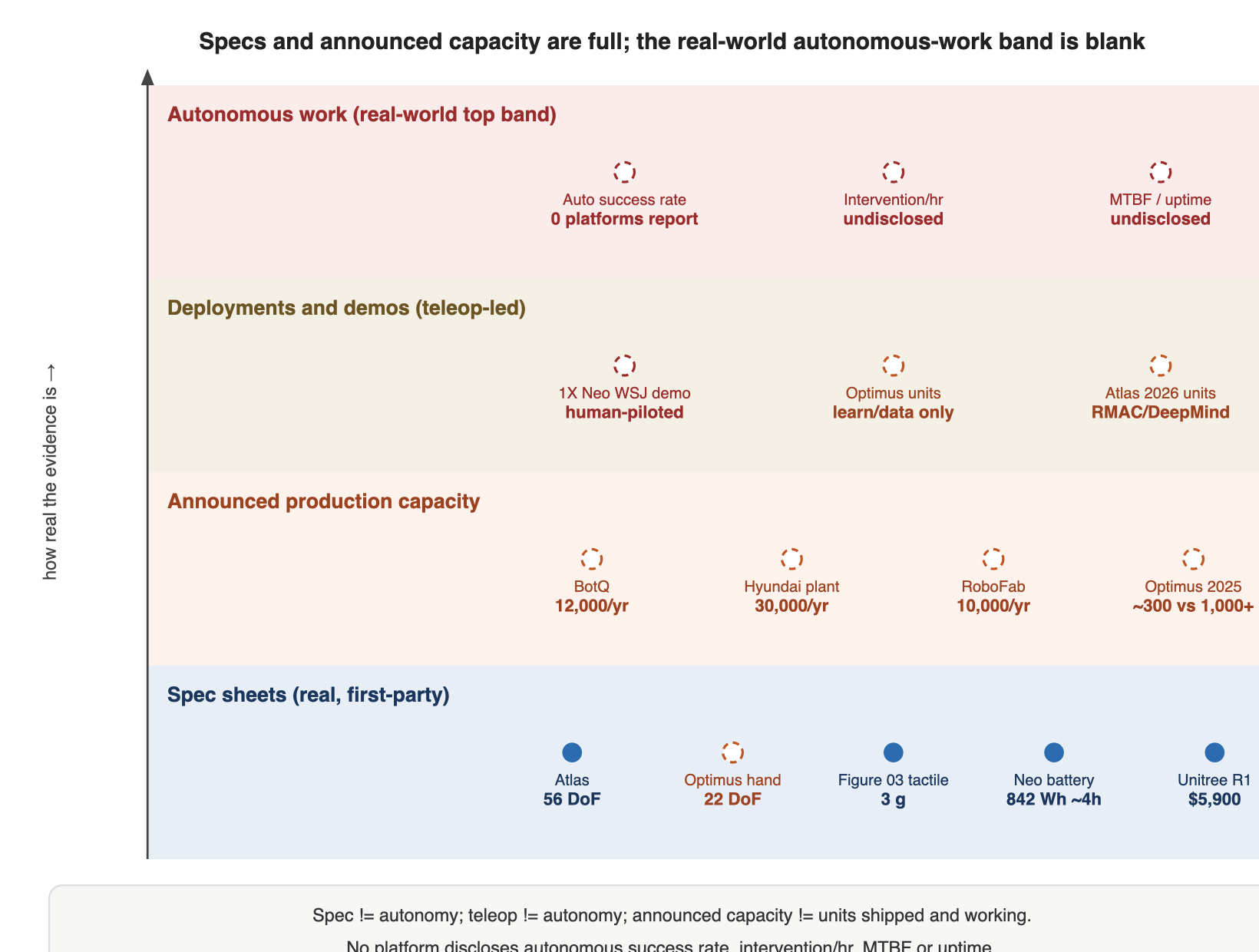
- So what. On the “can we build the body?” question, the answer is increasingly yes — so the chassis is no longer the binding constraint. The residual hardware limits are narrow: fingertip dexterity, battery runtime (mostly around a single-charge ~4 hours), and thermal management. But the decisive skeptic point is that a good spec sheet is not autonomous work capability. ★ 1X has stated its WSJ Neo demo did nothing autonomously — every motion was human-piloted (“Expert Mode”); and Musk framed Optimus deployment as “primarily for learning and data collection rather than performing productive tasks.” Teleop is not autonomy; a demo is not a deployment.
- Now what. Announced production capacity is not units shipped: BotQ (12,000/yr), Hyundai (30,000/yr) and Agility RoboFab (10,000/yr) are capacity targets, not deployed fleets. Optimus 2025 deployment counts are conflicting in secondary reporting (~300 vs 1,000+) with no Tesla primary disclosure. Battery runtime is roughly ~4 hours and MTBF is undisclosed. No platform discloses a real autonomous success rate, intervention rate (interventions/hr) or uptime — the metric that would separate “good spec” from “autonomous worker” is simply absent.
The five-minute read
The chassis is maturing along three paths — and it is real
This is Part 1 of the embodied-AI series, and it examines the upstream layer (HARDWARE) of the three-layer stack (HARDWARE × FOUNDATION MODEL × DATA) laid out in Part 0. The headlines are loud — a 22-DoF Optimus Gen 3 hand, Figure’s in-house BotQ manufacturing, Boston Dynamics’ all-electric Atlas at a stated 56 DoF, Unitree’s R1 at $5,900 — and the hardware progress behind them is genuine. The all-electric Atlas replaces hydraulics with electric actuation (a watershed for manufacturability and serviceability) and its actuators are supplied by an automotive tier-one, Hyundai Mobis (first-party, bostondynamics.com). Figure states its actuators run at “2x faster speeds” with improved torque density (figure.ai, company). When a car-parts supplier enters the actuator supply chain, “can we build the body?” has moved from a core unknown to a supply-chain question.
Low-cost mass production is equally real. The Unitree R1 is priced at $5,900 (AIR at $4,900) and the G1 base at roughly $13,500–16,000 (Unitree / trade press), while industrial-service platforms remain far more expensive — Apollo is described with a “$50K target” (secondary). Credible teardowns of the bill of materials (BOM) do not exist, so cost figures are mostly undisclosed and the gap between the $5,900 tier and the industrial tier is wide.
A good spec sheet is not autonomous capability
The firm’s recurring lens applies cleanly: the headline (mechanical potential) is the starting point; the real bottleneck is elsewhere. A stated 56 DoF, a 22-DoF hand or a 25 kg payload is mechanical potential — not the ability to use those degrees of freedom autonomously and reliably in an unstructured environment. The gap between the disclosed specs and the undisclosed metrics (autonomous success rate, intervention frequency, uptime) is the subject of this piece. ★ The most decisive single data point is 1X’s own admission: at the WSJ demonstration, Neo did nothing autonomously and every motion was performed by a skilled human pilot (“Expert Mode”), with the pilot session video serving as the neural-network training data (humanoidsdaily). Musk, separately, characterized deployed Optimus units as “primarily for learning and data collection rather than performing productive tasks” (Q4 2025 call). A martial-arts clip or a hand close-up is not autonomous productive labor. And announced production capacity (BotQ 12,000/yr, Hyundai 30,000/yr, RoboFab 10,000/yr) is a capacity target, not a shipped-and-working fleet.
| Platform (company) | Actuators / DoF | Hand / dexterity | Battery / runtime | Cost / units (attributed) | Source type |
|---|---|---|---|---|---|
| Optimus Gen 3 (Tesla TSLA) | Electric; hand 22 DoF, ~50 actuators, forearm tendon drive | 22-DoF tendon hand | Undisclosed | Unit count undetermined (§5); cost undisclosed | Musk remarks / Feb-2026 video (company statement) |
| Figure 03 (Figure AI, private) | Actuators “2x” speed, higher torque density | Fingertip 3 g tactile, palm camera, compliant fingertip | Foot-coil 2 kW wireless charging (hours undisclosed) | BotQ line 12,000/yr; 100,000 over 4 yrs (announced) | figure.ai (first-party / company) |
| 1X Neo (1X, private) | Tendon drive (avoids heavy harmonic drives) | 22-DoF hand | 842 Wh, ~4 h; 6-min / 1-h quick charge | $20,000 / $499·mo; 10,000+ pre-orders | 1x / humanoidsdaily (quasi-first-party) |
| Electric Atlas (Boston Dynamics / Hyundai) | All-electric 56 DoF, reach 2.3 m, lift 50 kg, autonomous battery swap | (hand spec not detailed) | Autonomous swap; -20 to 40 °C | 2026 units reserved (RMAC / Google DeepMind); Hyundai 30,000/yr plant, $26B US investment (announced) | bostondynamics.com (first-party) |
| Apollo (Apptronik, private) | 28 DoF (some secondary reports claim 71 — conflicting) | (5-finger hand) | Hot-swap 4 h, <5-min swap | “$50K target” (secondary) | apptronik / secondary |
| Digit (Agility, SPAC AGLT) | 28 DoF, 175 cm, 65 kg | 3 DoF per arm (manipulation + balance) | ~4 h (2:1 shift ratio); OSHA-certified | ~100 sold (secondary); RoboFab 10,000/yr (nominal) | Agility / trade (quasi-first-party) |
| G1 / R1 (Unitree, private) | G1 23 DoF (EDU 43); R1 low-DoF | (base model limited) | G1 ~2 h / R1 ~1 h | R1 $5,900 / G1 ~$13.5–16K | Unitree / trade |
Deep dive
1. Background — the thesis: the body is not the bottleneck, using it autonomously is
In Part 0’s three-layer stack (HARDWARE × FOUNDATION MODEL × DATA), this piece is the settled account of the upstream layer. The recurring proposition is that low-cost mass production (Unitree), in-house manufacturing (Figure BotQ) and automotive-supply-chain design (electric Atlas, Hyundai Mobis) have moved “can we build the body?” down from a core unknown — re-confirming Part 0’s Refuted #2 (“the binding constraint is hardware”). Three things must be kept strictly separate. First, spec sheet ≠ autonomous work capability: 56 DoF, a 22-DoF hand or a 25 kg payload is mechanical potential, not reliable autonomous use in an unstructured environment. Second, demo ≠ teleop ≠ deployed: factory-floor clips and hand close-ups mix remote operation, single-task pre-training and cherry-picked footage. Third, announced units ≠ shipped and working: capacity targets are not deployed fleets. The central question is how large the gap is between the disclosed specs and the undisclosed autonomous capability.
2. What this landscape establishes — four axes of hardware maturity (attributed)
Question: which first-party specs support the claim that the chassis is not the bottleneck? The evidence spans four axes.
- Actuators. The electric Atlas replaces hydraulics with an all-electric drive and states 56 DoF, reach 2.3 m and lift 50 kg, with actuators supplied by Hyundai Mobis (first-party, bostondynamics.com). Figure 03 states “2x faster” actuators with improved torque density (figure.ai, company). The hydraulic-to-electric transition is the watershed for manufacturability and serviceability, and an automotive tier-one entering the actuator supply chain is the emblem of “the chassis is now a supply-chain problem.”
- Hand / dexterity. The Optimus Gen 3 hand is stated at 22 DoF with ~50 actuators and forearm tendon drive (Musk remarks / Feb-2026 video, company statement). 1X Neo states a 22-DoF hand (“human-level dexterity” claim; 1x / humanoidsdaily). Figure 03 adds a first-generation tactile skin sensing down to 3 g at each fingertip, a palm camera and a “softer, more compliant fingertip” that increases contact area (figure.ai, first-party). Tendon drive plus tactile sensing is the current dexterity frontier, but the real-world manipulation reliability of that tactile sensing is undisclosed.
- Cost / BOM. The Unitree R1 at $5,900 (AIR $4,900) and the G1 base at ~$13,500–16,000 (Unitree / trade) show that low-cost mass-produced humanoids are real. Conversely, Apollo carries a “$50K target” and Digit is a higher-cost service platform (secondary), and BOM/cost is mostly undisclosed for lack of credible teardowns. The gap between the $5,900 tier and the six-figure industrial tier is wide.
- Battery / runtime. Most platforms sit at roughly a single-charge ~4 hours: 1X Neo at 842 Wh / ~4 h (6-min / 1-h quick charge), Apollo at hot-swap 4 h (<5-min swap), Digit at ~4 h (claiming near-continuous operation via a 2:1 shift ratio), Figure 03 with a 2 kW foot-coil wireless charge (runtime hours undisclosed), and Unitree G1 ~2 h / R1 ~1 h. “24/7 shifts” are not achieved by energy density but worked around with swap-and-dock infrastructure (an energy-domain hook).
Attribution: the above establishes mechanical specs and manufacturing capacity — that a body can be built and stamped out cheaply. It does not establish what that body does autonomously and reliably (§3). Spec ≠ autonomy.
3. ★ Demo ≠ teleop ≠ autonomous — the 1X Neo admission is decisive
The point where hardware maturity is misread as autonomous capability separates into three layers.
- 1X Neo — the teleop admission (most decisive). 1X stated at the WSJ demonstration that it “did not see Neo do anything autonomously” and that every motion was performed by a skilled human pilot (humanoidsdaily; quote kept short). The structure is a data flywheel in which a human operator remotely performs unfamiliar tasks (“Expert Mode”) and those session videos become neural-network training data. 1X targets “most” tasks being autonomous in 2026 but acknowledges quality variance (“robotic slop”). Teleop is not autonomy — and this is the first-party-grade evidence behind this piece’s Refuted #2.
- Optimus — “for learning and data collection, not productive tasks.” On the Q4 2025 call Musk characterized deployed units as “primarily for learning and data collection rather than performing productive tasks” (remarks, kept short). A martial-arts or hand-close-up demo is not autonomous productive labor.
- Figure / Atlas / Digit — narrow deployments, autonomy scope undisclosed. Figure at BMW and Digit at Amazon/GXO warehouses are real deployments, but they do not disclose autonomous success rate or intervention frequency (interventions/hr) under an independent protocol. The 2026 electric-Atlas units are reserved for RMAC and Google DeepMind (research and trials), not unstructured commercial autonomy.
No platform discloses a real-deployment autonomous success rate, intervention frequency, MTBF or uptime. What is disclosed is specs (DoF, payload, battery) and demos (teleop, pre-trained, cherry-picked). The “key undisclosed result-layer metric” Part 0 named is blank at the hardware layer too. A good spec does not demonstrate autonomous capability.
4. Residual hardware limits — the exception candidates (fingertips, battery, thermal)
Part 0 named fingertip dexterity, battery and thermal management as the exception candidates to “hardware is not the bottleneck.” This section quantifies them.
- Battery runtime (the clearest residual limit). Disclosed runtimes are mostly ~4 hours (Neo 842 Wh, Apollo, Digit) to ~1–2 hours (Unitree). “10-hour shifts” and “24/7 operation” are achieved not by higher energy density but worked around with battery hot-swap (Apollo <5 min), autonomous swap (Atlas), a 2:1 shift ratio (Digit) and wireless docking (Figure 03 2 kW). Energy remains a result-layer constraint, and the workaround infrastructure raises deployment complexity and cost. On-robot inference (Jetson-Thor-class) adds power and heat that overlap with the battery burden (a computing-power hook).
- Fingertip dexterity / tactile reliability. A 22-DoF tendon hand and 3 g tactile sensing are a mechanical frontier, but the real-deployment success rate and closed-loop tactile reliability of contact-rich manipulation (wet, specular or deformable objects) are undisclosed. Rising dexterity specs ≠ demonstrated manipulation reliability.
- Thermal management / serviceability. Hydraulic-to-electric transition (Atlas) and in-house manufacturing (BotQ injection molding, die casting) point serviceability in the right direction, but there is no public data on continuous-operation heat or MTBF for high-DoF, high-torque actuators. The gap versus 95–99% uptime for industrial robot arms is deferred to Part 4.
5. Commercialization overlay — announced ≠ shipped (TRL, related companies)
Maturity (TRL frame): the mechanical chassis is roughly TRL 7–8 (mass production and in-house manufacturing demonstrated), while autonomous work capability is early (TRL 4–5 equivalent) because no platform discloses an autonomous success rate. The gating layers are autonomy, data and reliability — not the body.
- Optimus 2025 deployment count — undetermined. Secondary reporting conflicts between ~300 (self-plant units at the Q4 2025 call) and 1,000+, with no Tesla primary disclosure. Giga Texas 10M/yr and Fremont 1M/yr are long-range target remarks. Unit count is unverified; targets are announced.
- Production-capacity targets (all announced). BotQ 12,000/yr initial line and 100,000 over 4 years (figure.ai), Hyundai 30,000 robots/yr plant and $26B US investment (bostondynamics.com), Agility RoboFab 10,000/yr nominal — with only Unitree demonstrating actual low-cost shipment. Capacity ≠ shipped and working.
- Nature of the deployment destinations. The 2026 electric-Atlas units are fully reserved but to RMAC / Google DeepMind (research and trials); Digit is ~100 units (warehouse pilots); 1X Neo is consumer-facing but teleop-led. “Fully reserved” is not “deployed as autonomous labor.”
- Related companies (neutral, attributed): listed — Tesla (TSLA), Hyundai (parent of Boston Dynamics), Nvidia (NVDA, Jetson Thor on-robot compute); private — Figure AI, 1X Technologies, Apptronik, Unitree; Agility Robotics is pursuing a SPAC listing (AGLT). All statements are factual and neutral.
6. The skeptic’s bottom line
- Spec ≠ autonomy: 56 DoF and a 22-DoF hand are mechanical potential; the autonomous success rate is undisclosed and, for the hardware examined, zero platforms report one.
- Teleop ≠ autonomous, demo ≠ deployed: 1X admitted its WSJ Neo demo was fully human-piloted (“Expert Mode”), and Musk framed Optimus deployment as for learning and data, not production.
- Announced ≠ shipped: BotQ 12,000/yr, Hyundai 30,000/yr and RoboFab 10,000/yr are capacity targets; Optimus 2025 counts conflict (~300 vs 1,000+) with no Tesla primary disclosure.
- Company statements are not independent verification: the Optimus Gen 3 hand spec (22 DoF, ~50 actuators) is a Musk remark / video, and Apollo’s DoF (28 vs 71) conflicts across sources — both unverified.
- The result-layer metrics are simply absent: autonomous success rate, intervention rate, MTBF, uptime and a credible BOM are undisclosed. “Hardware maturity = autonomous labor imminent” is a misread. Residual hardware limits (battery ~4 h, fingertip reliability, thermal) exist, but the chassis is not the bottleneck.
- Neutral-framing note: to prevent misreading listed-company (TSLA, Hyundai, NVDA) and private-company (Figure, 1X, Apptronik, Unitree, Agility/AGLT) hardware statements as security signals.
7. What to watch (falsifiable)
- P1 — autonomy scope disclosed: if any platform discloses a teleop-free autonomous success rate and intervention frequency (interventions/hr) under a reproducible protocol, it signals Part 0’s “genuine ChatGPT moment”; if platforms keep releasing only specs and demos and rely on teleop (1X Expert Mode), the demo/teleop-bound stall is reinforced. (Verified in Part 2 / Part 4.)
- P2 — announced → shipped translation: if BotQ 12,000/yr, Hyundai 30,000/yr and RoboFab 10,000/yr translate into actual shipped-and-operating counts, and Optimus deployment counts are confirmed by a Tesla primary disclosure, mass production is demonstrated; if only targets repeat and counts stay undetermined, announced ≠ shipped is confirmed. (Verified in Part 5.)
- P3 — battery / thermal exception resolved: if fingertip manipulation reliability, continuous operation (without battery swap) and MTBF converge toward the 95–99% uptime of industrial robots, the “hardware is not the bottleneck” thesis is completed; if ~4 h runtime, swap workarounds and undisclosed tactile reliability persist, the residual hardware limits remain result-layer constraints (energy / computing-power hooks). (Verified in Part 4.)
References
- Figure AI. “Introducing Figure 03” (fingertip 3 g tactile, 2x actuators, 2 kW foot-coil wireless charging). Company release. https://www.figure.ai/news/introducing-figure-03
- Figure AI. “BotQ” (in-house manufacturing line, 12,000/yr initial, 100,000 over 4 years). Company release. https://www.figure.ai/news/botq
- Humanoids Daily. “1X details Neo human-in-the-loop strategy and hardware as pre-orders go live” (WSJ demo human-piloted / Expert Mode; 22-DoF hand; 842 Wh, ~4 h). https://www.humanoidsdaily.com/news/1x-details-neo-human-in-the-loop-strategy-and-hardware-as-pre-orders-go-live
- Boston Dynamics. “Boston Dynamics unveils new Atlas robot to revolutionize industry.” Company blog. https://bostondynamics.com/blog/boston-dynamics-unveils-new-atlas-robot-to-revolutionize-industry/
- Boston Dynamics. “Electric — a new era for Atlas” (all-electric, 56 DoF, reach 2.3 m, lift 50 kg, Hyundai Mobis actuators, autonomous battery swap). Company blog. https://bostondynamics.com/blog/electric-new-era-for-atlas/
- Unitree. “G1” product page (G1 ~23 DoF, EDU 43; runtime; pricing). https://www.unitree.com/g1/
- Apptronik. “Apollo” product page (28 DoF; hot-swap 4 h battery, <5-min swap; payload 25 kg). https://apptronik.com/apollo
- Agility Robotics. “Agility Robotics announces new innovations for market-leading humanoid robot Digit” (28 DoF, 175 cm, 65 kg; ~4 h; RoboFab 10,000/yr nominal). https://www.agilityrobotics.com/content/agility-robotics-announces-new-innovations-for-market-leading-humanoid-robot-digit
Disclosure
This post is for information only and is not investment advice.
COI note: this post describes listed companies (Tesla TSLA; Hyundai, parent of Boston Dynamics; Nvidia NVDA, supplier of the Jetson Thor on-robot compute) and private companies (Figure AI, 1X Technologies, Unitree, Apptronik; Agility Robotics is pursuing a SPAC listing, AGLT) in a descriptive, neutral context. Every DoF, cost, unit-count, runtime and payload figure is attributed to the manufacturer spec, company statement, teleoperated demo or trade-press aggregator that reported it. Unit counts and costs are as reported and, where the primary source is missing or sources conflict, are labeled unverified (e.g., Optimus Gen 3 hand 22-DoF/~50-actuator is a Musk remark / Feb-2026 video; Optimus 2025 deployment ~300 vs 1,000+ has no Tesla primary disclosure; BotQ 12,000, Hyundai 30,000 and RoboFab 10,000/yr are announced capacity, not shipped units; battery MTBF and autonomous success/intervention/uptime metrics are undisclosed across all platforms). A good spec sheet is not autonomous capability; a teleoperated demo is not autonomy; announced capacity is not units shipped and working. Competitive and capability statements are factual, neutral descriptions and are not buy/sell implications for any security. The author holds no position in, and has no financial interest in, the companies named.


Leave a Reply