Evidence-first notes on bioscience and deep tech, at the edge of the lab and the market. Information only — not investment advice, not medical advice. All reduction and knockdown figures are attributed to the sponsoring trial or company; nex-z Phase 1 numbers are Intellia investor/conference data (AHA 2025-11), company presentations rather than peer-reviewed data. Safety events, holds and hold-lifts are attributed to the regulator (FDA), the company (Intellia IR) or trade press, with the tier noted inline.
The 30-second version
- What. Parts 1 and 2 of this ATTR-CM series covered chronic-dosing modalities — stabilizers (tafamidis, acoramidis, daily oral) and silencers (siRNA vutrisiran SC q12w; ASO eplontersen SC q4w) — all of which maintain their effect by repeat dosing. Part 3’s nex-z (nexiguran ziclumeran, NTLA-2001) inverts that axis: it is an in-vivo CRISPR/Cas9 nuclease that permanently knocks out the liver TTR gene in a single intravenous dose. The knockdown is demonstrated — serum TTR fell ~87% at 36 months (n=9) after one dose (company/press release) — but it buys durability through genome permanence, not repeat dosing.
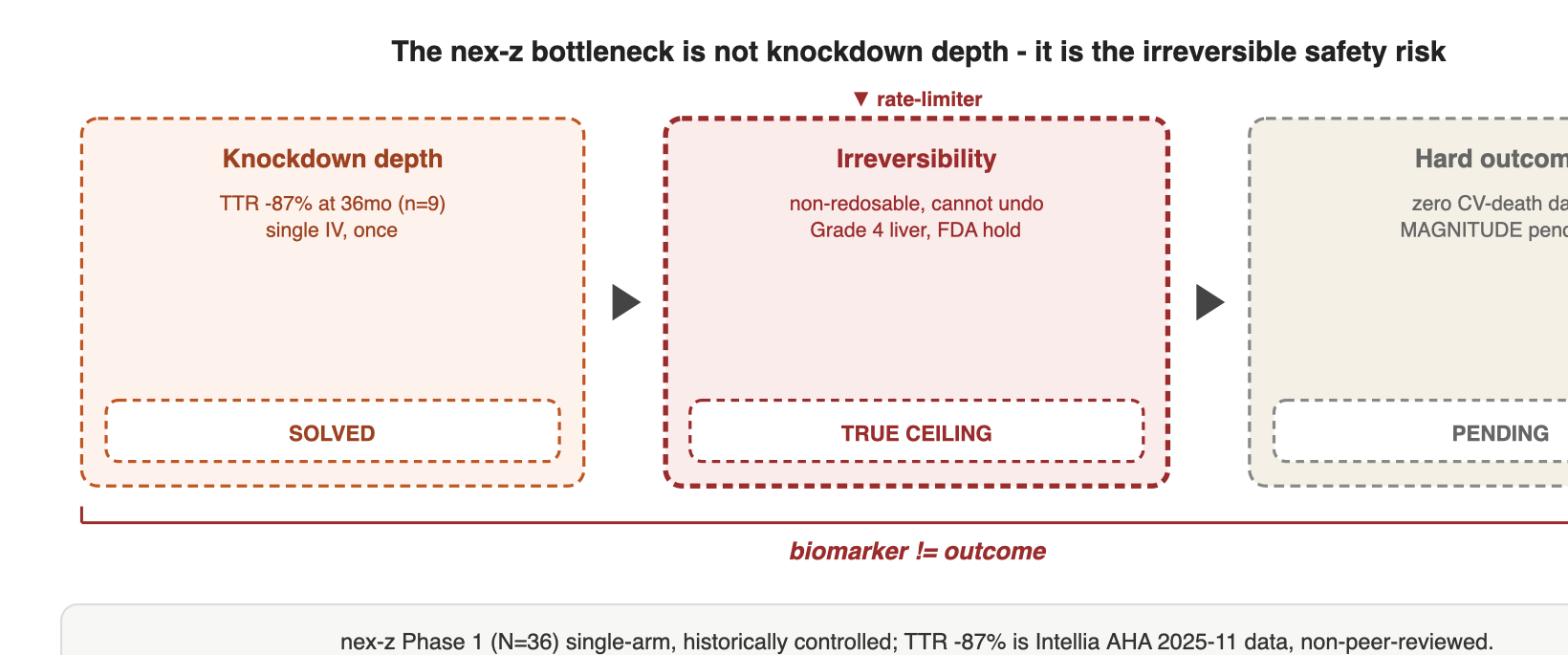
- So what. Permanence eliminates adherence and dosing burden at the root, but at a symmetric cost: the edit is non-redosable and irreversible. The real bottleneck is not the depth of knockdown (that is largely solved) but the asymmetric safety risk that irreversibility creates — an off-target, immune or genomic event cannot be undone, and a shortfall cannot be topped up. And the benefit is not yet outcome-proven: nex-z has zero hard outcomes (CV death, mortality). Every figure above is a biomarker/surrogate; the pivotal MAGNITUDE trial is pending.
- Now what. In late 2025 that bottleneck surfaced in the clinic. In the Phase 3 MAGNITUDE program a participant developed a Grade 4 liver-enzyme/bilirubin rise and later died, and the FDA placed the trials on hold. The company attributes the direct cause of death to septic shock (infection), stated as not related to the liver event; edit-versus-death causality is not established and must not be read as “editing killed the patient.” The FDA holds have since been lifted (MAGNITUDE-2 January 2026, MAGNITUDE 2 March 2026) with liver mitigations — enhanced monitoring, short-course steroids, and exclusion of pre-existing liver abnormality / EF <25%.
The five-minute read
What nex-z changes — durability by genome permanence, not repeat dosing
Stabilizers and silencers both buy durability the same way: by dosing again. Tafamidis and acoramidis are taken daily; vutrisiran is dosed every 12 weeks, eplontersen every 4 weeks. nex-z overturns that axis at the root. It uses a lipid nanoparticle (LNP) to deliver Cas9 mRNA plus a guide RNA to hepatocytes, cuts the TTR gene with a double-strand break, and the indels from repair permanently switch off TTR production. The target is the same hepatic TTR that silencers address, but instead of periodically degrading the mRNA, nex-z cuts the DNA once. The reduction does not need to be “re-dosed to persist” — the reduction itself is fixed at the genome level. On the headline metric this works: a single dose lowered serum TTR a mean 87% at 36 months (n=9, mean absolute 22.9 µg/mL), with follow-up to 44 months (company data, AHA 2025-11).
The bottleneck is not knockdown depth — it is the asymmetric risk of irreversibility
The firm’s recurring lens — “the headline is the starting point; the real bottleneck is elsewhere” — applies cleanly. The headline is “one dose, TTR down 87%,” but the real bottleneck is liver toxicity, irreversibility and the absence of any hard outcome. A chronic drug can be stopped, reduced or switched; an edit cannot be undone, and it cannot be re-dosed. That makes the safety bar structurally higher than for any chronic medicine — an asymmetric risk. In October–November 2025 this turned fatal in the clinic for the first time: in the Phase 3 MAGNITUDE / MAGNITUDE-2 program a participant met a predefined safety threshold with a Grade 4 liver-enzyme and total-bilirubin rise; the FDA placed the trials on hold on 29 October 2025, and the participant (early 80s, high BMI, comorbidities; dosed 30 September, Grade 4 on 27 October) died on 5 November 2025. The company’s position is that the direct cause of death was septic shock (infection), with the CEO stating it was “not related to the liver event,” while acknowledging the liver toxicity itself was likely treatment (nex-z) related. An independent regulatory or autopsy adjudication of edit-versus-death causality has not been published — the causality remains unverified, and the honest position is neither “editing killed the patient” nor “unrelated.”
| Axis | Stabilizer (tafamidis, acoramidis) | Silencer siRNA (vutrisiran) | Silencer ASO (eplontersen) | Editing nex-z |
|---|---|---|---|---|
| Mechanism | Tetramer stabilization | Hepatic TTR mRNA degradation | Hepatic TTR mRNA degradation (ASO) | Permanent knockout of hepatic TTR DNA |
| Dosing | Daily oral | SC q12w | SC q4w | Single IV (once in a lifetime) |
| How durability is secured | Repeat dosing | Repeat dosing | Repeat dosing | Genome permanence (no re-dosing needed) |
| Adherence dependence | High | Moderate | Moderate | None (eliminated at the root) |
| Re-dose / reversibility | Free, reversible | Free, reversible | Free, reversible | Not possible, irreversible |
| Hard-outcome evidence | Demonstrated (ATTR-ACT, ATTRibute-CM) | Demonstrated (HELIOS-B HR 0.72) | Primary not met (press release) | Not established (MAGNITUDE ongoing) |
Deep dive
1. Background — the fourth modality on the same TTR axis
Parts 1 and 2 established that stabilizers and silencers are all chronic-dosing modalities acting on the same target: hepatic TTR. Stabilizers hold the tetramer together; silencers (siRNA/ASO) periodically degrade the TTR mRNA. nex-z is the fourth modality on that same axis, but it intervenes at the most upstream (genomic) and most permanent point. It is an in-vivo CRISPR/Cas9 nuclease: LNP delivers Cas9 mRNA plus a guide RNA to hepatocytes, a double-strand break (DSB) is made in TTR, and the indels from non-homologous end-joining repair permanently knock out expression. Where a silencer degrades mRNA on a schedule, nex-z cuts the DNA once. It is neither a stabilizer (which grips the tetramer) nor a silencer (which degrades mRNA) — it is the most upstream and most durable intervention of the four.
2. What this study newly establishes — nex-z Phase 1 (company/conference tier, non-peer-reviewed)
Principle: knockdown figures and clinical markers are reported as in the source; biomarker/surrogate results are separated from any hard endpoint (there are none yet); the tier (company/conference, not peer-reviewed) is stated.
- Phase 1 ATTR-CM cohort, N=36 (50% NYHA III, 31% variant form), cut-off 2025-08-23, presented at AHA 2025-11 (GlobeNewswire 2025-11-10).
- Serum TTR: mean −87% at 36 months (n=9) (mean absolute 22.9 µg/mL), longest follow-up 44 months, achieved with a single dose.
- 24-month clinical markers: NT-proBNP, hs-TnT, 6-minute walk (6MWT) and NYHA reported “stable or improved” in most patients (NT-proBNP 70%, hs-TnT 85%, 6MWT 69%, NYHA 81% stable/improved).
- Post-hoc mortality: 3.9 vs 12.7 per 100 person-years against a matched historical control.
★ Evidence hierarchy (demo-gap): the above is single-arm, non-randomized, historically controlled. It is not a hard-endpoint RCT; TTR −87% is a biomarker (surrogate); the “stable/improved” myocardial markers suggest improvement versus natural history but have no placebo control. The mortality comparison is a post-hoc historical-control analysis and is therefore hypothesis-generating. This is company/conference data, not peer-reviewed.
3. Methodological strengths and limits — the irreversibility bottleneck
The structural safety asymmetry between chronic drugs and editing, applied to ATTR-CM, is where the modality’s real limit sits.
- Response to an adverse event: a chronic drug can be stopped, dose-reduced or switched. An edit cannot be reversed — the edited genome is fixed.
- Off-target / genomic abnormality: a nuclease DSB carries intrinsic risk. The Jasin group (Molecular Cell 2025-11, peer-reviewed) detected megabase-scale loss-of-heterozygosity (LOH) in ~5% of mouse embryos and human epithelial cells after a Cas9 DSB, with LOH cells able to survive and expand; base/prime editors (which avoid DSBs) showed no detectable LOH under the same conditions — mechanistic grounds that a nuclease (nex-z) carries qualitatively higher genomic risk than base/prime editing. ★ But this is a cell/mouse experiment, not MAGNITUDE patient genome data (demo-gap — it must not be translated directly into patient causality).
- Immunity / non-redosable: pre-existing anti-Cas9 antibodies exist in the population (SpCas9 ≈2.5%, SaCas9 ≈10%). This creates a double risk — immune attack on edited cells (one candidate mechanism for the liver toxicity) and neutralization/boosting on re-dosing; anti-PEG/LNP antibodies also constrain re-dosing. So if the effect is insufficient, a top-up is difficult — the strength of durability inverts into an absence of rescue when the effect falls short.
- Implication: editing pays a symmetric cost — “the effect is permanent” carries “the risk is permanent” on its other face. This naturally narrows indications to serious, high-risk disease where irreversibility is justified (progressive, lethal heart failure such as ATTR-CM). ATTR-CM is a favorable indication for clearing that bar (serious, disease-modification needed, unmet need on top of existing therapy), yet its safety bar is still structurally higher than for chronic silencers or stabilizers.
4. Neighbouring domains — LNP chemistry and AI editor design
- Materials / nanotech: a substantial part of the MAGNITUDE liver toxicity is presumed to arise from the LNP ionizable lipid (the VERVE-101→102 reformulation demonstrated the point). LNP chemistry optimization is the rate-limiting step for lowering the editing safety threshold — a contact point with the firm’s in-vivo editing series Parts 2 and 4.
- AI/ML: predicting nuclease-DSB off-target and megabase LOH, and designing non-DSB editors (base/prime), increasingly couples protein language models and structure prediction — a contact point with the firm’s bio-foundation-models and in-vivo editing Part 1.
5. Commercialization and competitive context
- Maturity (TRL frame): the single, permanent knockout (knockdown depth) is demonstrated on the biomarker (roughly TRL 6–7 on the surrogate), but hard-outcome maturity is early (TRL 4–5 equivalent) because MAGNITUDE has zero readout. The gating layer is safety/irreversibility, not knockdown efficacy.
- MAGNITUDE Phase 3 (ATTR-CM, hard-outcome pivotal): randomized, double-blind, placebo-controlled; N ≈1,200 (initial guidance ~765) ATTR-CM patients, 2:1 allocation to a single 55 mg nex-z or placebo (Intellia IR). Primary endpoint: composite of CV-related mortality and recurrent CV events — a hard outcome, in the same family as HELIOS-B and CARDIO-TTRansform composites. Sister trial MAGNITUDE-2 is the ATTRv-PN (polyneuropathy) indication, a neuropathic rather than cardiomyopathic population.
- Holds and lifts (regulatory/company tier): the FDA placed both Phase 3 trials on hold on 2025-10-29 after the Grade 4 liver event; it lifted the MAGNITUDE-2 hold in January 2026 and the MAGNITUDE hold on 2 March 2026. Mitigations: enhanced liver monitoring; short-course steroid guidance for early enzyme rises; exclusion of patients with certain liver abnormality; (per Part 4) exclusion of EF <25% / cardiovascular instability. Frequency: Grade 4 transaminase rise in <1% of MAGNITUDE’s ~650 enrolled and 0 of 47 in MAGNITUDE-2 (company-attributed).
- Commercial footnote: a one-shot edit (Intellia NTLA) offers elimination of dosing burden and adherence as its value proposition, but up-front lump-sum pricing, reimbursement and irreversible risk are the bottlenecks. A chronic silencer (Alnylam vutrisiran) offers recurring revenue (annuity), reversibility and already-secured hard outcomes, but lifelong adherence and cumulative cost are its weaknesses. The two economic models cannot be ranked until hard-outcome symmetry is confirmed — ticker, market-cap and valuation implications are isolated to the investment layer (Part 5).
- Company implications are limited to neutral, trial-attributed description; competitive or efficacy-ranking statements are not buy/sell signals. Deal and pricing/reimbursement details are not independently verified here.
6. The skeptic’s bottom line (proceed-with-caveats)
- Biomarker ≠ outcome: TTR −87% is a surrogate. nex-z’s hard-outcome count is zero (MAGNITUDE pending).
- Death causality is two-layered (do not blur it): liver toxicity = treatment-related (confirmed); direct cause of death = septic shock, attributed by the company/PI; independent edit-versus-death causality = unverified. These three statements must be kept separate to stay honest. Do not assert “editing killed the patient.”
- Hold lifted ≠ safety confirmed: the fact that the FDA conditioned the lift on liver mitigations (monitoring, steroids, exclusion criteria, EF <25%) is itself evidence the regulator judged the signal real but manageable.
- Irreversibility = asymmetric risk: off-target, LOH or immune events surfacing late cannot be undone, and cannot be re-dosed. The nuclease-DSB LOH finding is peer-reviewed but cell/mouse (demo-gap — no direct translation to patient causality).
- No cross-trial ranking: nex-z (biomarker) versus vutrisiran (HR 0.72 hard outcome) cannot be directly compared — different development stage and different endpoints.
- Neutral-framing note: to prevent misreading listed-company (NTLA, ALNY, AZN, IONS, PFE, BBIO) implications as security signals.
7. What to watch (falsifiable)
- P1: the final independent adjudication of the MAGNITUDE death (when published) will not confirm editing off-target / genomic abnormality as the primary cause, and will attribute it to septic shock / comorbidity, with liver toxicity as a contributory factor. (Falsified if editing genomic damage is confirmed as the primary cause by regulator or autopsy.)
- P2: when MAGNITUDE reads its hard outcome (years out), nex-z’s CV-death-plus-recurrent-CV HR will fall within the ±range of siRNA (HELIOS-B 0.72) — i.e. the permanence modality will not give a step-change advantage over silencers; if knockdown depth is similar, outcomes will be similar (shared TTR axis). (Falsified if nex-z shows a qualitative outcome advantage or disadvantage versus silencers.)
- P3: through 2028, no program will successfully read a re-dosing (top-up) protocol for nex-z (or the nuclease-knockout class) — immune and delivery constraints are rate-limiting (consistent with the firm’s in-vivo Part 4 P3). (Falsified if re-dosing demonstrates additional effect.)
References
- Intellia Therapeutics. 2025. “Positive Longer-Term Phase 1 Data of Nexiguran Ziclumeran (nex-z) in ATTR Amyloidosis with Cardiomyopathy.” GlobeNewswire, 10 November 2025 (TTR −87%; 36-month data). globenewswire.com/…/nex-z-longer-term-phase-1-data
- Intellia Therapeutics. “Intellia Announces First Patient Dosed in Phase 3 MAGNITUDE” (MAGNITUDE Phase 3 design: N≈1,200, 2:1, single 55 mg, CV-death + recurrent-CV composite). Investor release. ir.intelliatx.com/…/first-patient-dosed-phase-3
- Intellia Therapeutics. 2026. “Intellia Announces FDA Lift of Clinical Hold on MAGNITUDE Phase 3 Clinical Trial in ATTR-CM.” GlobeNewswire, 2 March 2026. globenewswire.com/…/fda-lift-of-clinical-hold-on-magnitude
- Intellia Therapeutics. 2026. “Intellia Announces FDA Lift of Clinical Hold on MAGNITUDE.” Investor release. ir.intelliatx.com/…/fda-lift-clinical-hold-magnitude
- Clinical Trials Arena. “FDA Releases Hold on Second of Intellia’s ATTR-CM Gene-Therapy Trials” (MAGNITUDE-2 hold lift; ATTRv-PN indication; Leonard attribution). clinicaltrialsarena.com/…/fda-releases-hold-second-intellia
- CGTLive. 2025. “Patient Treated in Intellia TTR Amyloidosis Gene-Editing Trial Dies” (death 2025-11-05; patient details; septic-shock attribution). cgtlive.com/view/patient-treated-trial-intellia-…-nex-z-dies
- BioPharma Dive. “Intellia: FDA Lifts Hold on nex-z CRISPR TTR Amyloidosis Trial” (liver toxicity treatment-related; death not related to the liver event). biopharmadive.com/news/intellia-fda-lifts-hold-nex-z-…/810584/
- Jasin et al. 2025. Cas9 double-strand break → megabase loss-of-heterozygosity (~5%); base/prime editors show no detectable LOH. Molecular Cell (peer-reviewed; cell/mouse). cell.com/molecular-cell/…/S1097-2765(25)00856-1
Disclosure
This post is for information only and is not investment advice, and not medical advice. Treatment decisions should always be made with your own clinician.
COI note: this post describes listed and private companies (Intellia NTLA, Alnylam ALNY, AstraZeneca AZN, Ionis IONS, Pfizer PFE, BridgeBio BBIO, and their sponsored trials) in a descriptive, neutral context. Every knockdown and clinical-marker figure for nex-z is attributed to Intellia investor/conference data (AHA 2025-11) — company presentations rather than peer-reviewed data, and labeled as such. Safety events, holds and hold-lifts are attributed to the regulator (FDA), the company (Intellia IR) or trade press, with the tier noted. The MAGNITUDE death’s direct cause is attributed by the company/PI to septic shock (infection), stated as not related to the liver event; the edit-versus-death causality is not independently adjudicated and is stated as unverified — it must not be framed as “editing killed the patient.” Quantitative claims are attributed to the vendor, author or preprint/press release. Competitive and efficacy-ranking statements are factual, neutral descriptions and are not buy/sell implications for any security. The author holds no position in, and has no financial interest in, the companies named.
 Uthando Nethemba
Leave a comment