Evidence-first notes on bioscience and deep tech, at the edge of the lab and the market. Information only — not investment advice, not medical advice. All funding, valuation and milestone totals are attributed to each company’s press releases or media reports; many details cannot be independently verified and are marked as such. Vendor blog/preprint performance claims (for example a “~20% hit rate”) are attributed to the company or preprint and carry no confirmed peer-review status.
The 30-second version
- What. This is the closing part of the firm’s ai-protein-design series (commercial + skeptic + retrospective). The commercial landscape of AI protein design has an arresting split: funding exploded to the $10^9 scale — Xaira launched with >$1B (2024-04), Isomorphic Labs raised $600M (2025-03) on top of collaboration totals up to ~$3B, Generate:Biomedicines took a $273M Series C + $400M IPO, Chai Discovery ran $70M → $130M → $400M (A/B/C), EvolutionaryScale a $142M seed, and Cradle a $73M Series B — yet the number of approved de novo AI-designed protein drugs at the end of 2025 is zero (all figures attributed to company/media).
- So what. Capital and validation are decoupled. Three bottlenecks sit under the headline: (1) a definition bottleneck — the clinical frontier is not fully de novo backbone proteins but AI-generated / AI-optimized antibodies (Generate GB-0895 Phase 3; Absci ABS-101 Phase 1), while the pure RFdiffusion-style de novo case is still preclinical; (2) a translation bottleneck — the low wet-lab hit rate from Part 4 has yet to cross into a clinical efficacy read-out (zero approvals); (3) a claim bottleneck — improvement narratives (Chai-2’s “~20% hit rate”) arrive largely through company blogs and preprints, without confirmed peer review or independent replication. Funding scale is the size of the bet, not the removal of the bottleneck.
- Now what. The series verdict is proceed-with-caveats. The decisive signals remain unrealized: the first efficacy hard read-out / approval of a fully de novo AI-designed protein, and independent, peer-reviewed replication of the vendor hit-rate claims. Until then, “AI has solved protein design” is an overstatement — and “it failed” is an equally wrong dismissal. The honest state carries the demonstrated wet-lab function and the unresolved translation bottleneck at the same time.
The five-minute read
Capital exploded; approvals are zero
The paradox of the AI-protein-design commercial landscape is that capital and validation have come apart. In 2024–2026 the field absorbed some of the largest early-stage funding in biotech history — Xaira >$1B (2024-04, co-led by ARCH and Foresite), Isomorphic Labs $600M (2025-03, Thrive-led) plus collaboration totals up to ~$3B (including Lilly and Novartis milestones), Generate Series C $273M plus a $400M IPO, Chai Discovery $70M → $130M → $400M across A/B/C (2025–2026), EvolutionaryScale a $142M seed (Amazon and Nvidia participating), and Cradle a $73M Series B. And yet, as of the end of 2025, the number of approved de novo AI-designed protein drugs is zero. Every figure here is attributed to company press releases or media reports; many valuation and milestone details cannot be independently verified.
The headline is the starting point; the real bottleneck is the outcome layer
The firm’s recurring lens — “the headline is the starting point; the real bottleneck is elsewhere” — applies cleanly. The headline reads “AI drug rush,” but the bottleneck is threefold. (1) Definition: the clinical frontier is not fully de novo backbone proteins but AI-generated / optimized antibodies (Generate GB-0895 Phase 3; Absci ABS-101 Phase 1); the pure de novo case is still preclinical. (2) Translation: Part 4’s low wet-lab hit rate has yet to cross into a clinical efficacy read-out (zero approvals). (3) Claim: improvement narratives such as Chai-2’s “near-20% hit rate” arrive through company blogs and preprints, with peer-review and independent-replication status unconfirmed. This is the same skeptic posture the firm inherited from its GLP-1, computing and attribution-of-mechanism work: funding scale is the size of the bet, not the removal of the bottleneck. [diagram placeholder]
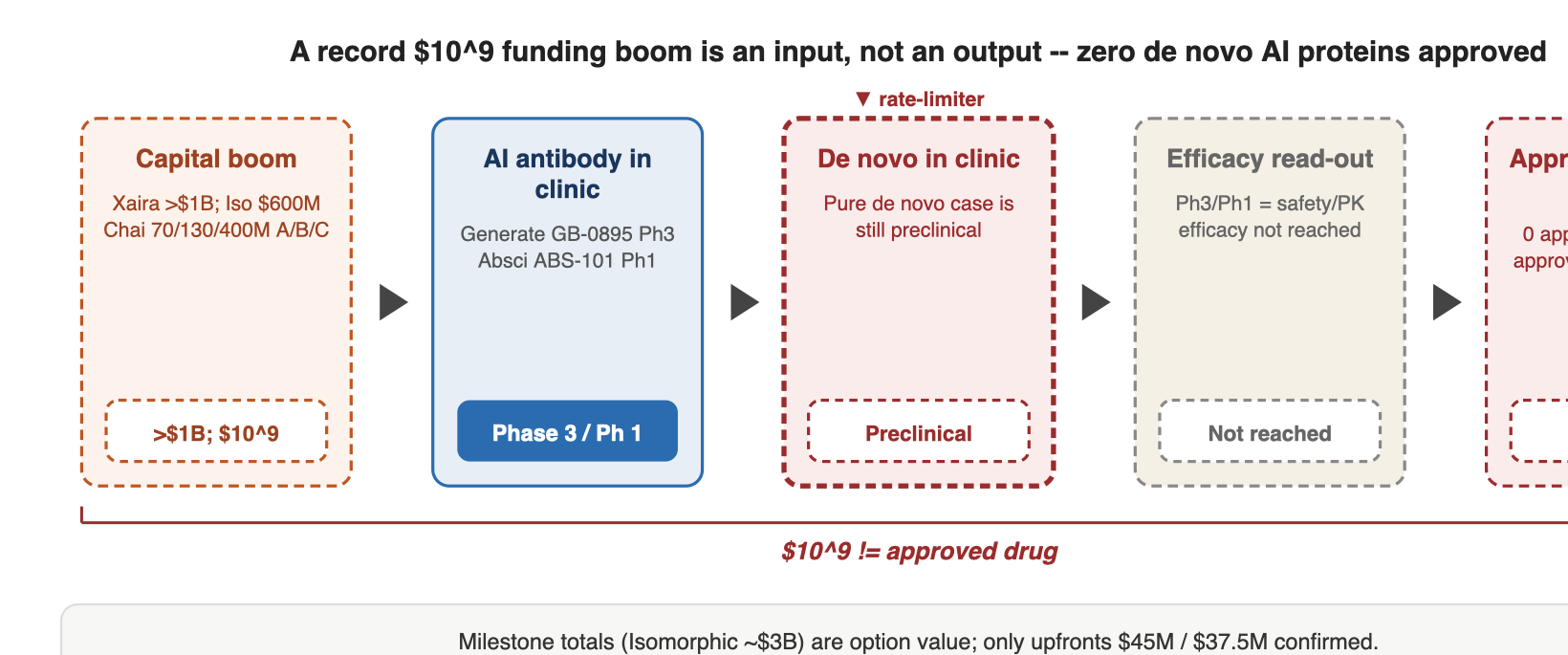
| Layer | Status (2025 year-end) | Verdict |
|---|---|---|
| Early funding (the headline) | Xaira >$1B; Isomorphic $600M + collaborations ~$3B; Generate Series C $273M + IPO $400M; Chai $70/130/400M; ESM3/EvolutionaryScale $142M; Cradle $73M (company/media-attributed) | Demonstrated ($10^9 scale) |
| Large-pharma paid collaborations | Isomorphic–Lilly $45M upfront / up to $1.7B; –Novartis $37.5M / up to $1.2B (milestone totals, not realized amounts) | Demonstrated (upfront); rest optional |
| Clinical entry (antibody optimization) | Generate GB-0895 (anti-TSLP) Phase 3 (SOLAIRIA); Absci ABS-101 (anti-TL1A) Phase 1 (favorable interim safety/PK) | Reached — but not fully de novo |
| Fully de novo backbone protein in the clinic | Preclinical (Chai-2 and others); no disclosed RFdiffusion-style de novo drug candidate in trials | Not yet arrived |
| Clinical efficacy hard read-out | Phase 3 / Phase 1 are safety/progression stages; efficacy read-out not yet reached | Unresolved |
| Approved de novo AI-designed protein drug | Zero (end of 2025) — the approval pipeline is empty | Outcome-layer final signal: 0 |
| Vendor hit-rate claim (Chai-2 ~20%) | Company blog / preprint; no peer review or independent replication | Unconfirmed — escalate |
Deep dive
1. Background — the commercial landscape (all funding/pipeline attributed)
The map below marks listed vs private status. Funding, valuations and milestone totals are attributed to each company’s press releases or media reports, and many details are unverified.
- Xaira Therapeutics (private) — >$1B launch (2024-04, co-led by ARCH and Foresite, with Sequoia, Lux, NEA and others). Recruited members of the RFdiffusion / RFantibody team out of the Baker Lab; end-to-end drug discovery. Clinical candidates undisclosed (early formation) — the widest capital-to-pipeline gap in the field.
- Isomorphic Labs (Alphabet subsidiary) — $600M (2025-03, Thrive-led, with GV and Alphabet). AlphaFold3-based drug-design engine. Lilly ($45M upfront / up to $1.7B) and Novartis ($37.5M upfront / up to $1.2B, three targets plus three more); its own candidates are described as clinical-preparation stage.
- Generate:Biomedicines (private) — Series C $273M plus a $400M IPO. Generative platforms including Chroma (programmable generation). GB-0895 (anti-TSLP, severe asthma) in Phase 3 (SOLAIRIA-1/-2, ~1,600 participants) — the company describes it as the “first AI-derived antibody in Phase 3”; GB-7624 (anti-IL-13) Phase 1; GB-0669 (anti-SARS-CoV-2) Phase 1 positive.
- Absci (ABSI, listed) — generative-AI antibody design. ABS-101 (anti-TL1A, IBD) reached Phase 1 first-dose in 2025-05 (~40 healthy volunteers); 2025-11 interim data showed extended half-life and no SAEs; the company paused internal advancement into later-stage trials and reallocated capital to ABS-201.
- Chai Discovery (private) — $70M Series A (2025-08, Menlo/Anthology, OpenAI investors) → $130M Series B ($1.3B valuation, 2025-12) → $400M Series C (2026-07). Chai-1 (structure prediction) and Chai-2 (de novo antibody design). Preclinical — Chai-2’s “near-20% hit rate / 86% developability” is a company claim with peer-review status unconfirmed.
- EvolutionaryScale (private, spun out of the Meta ESM team) — $142M seed (2024-06; Nat Friedman, Daniel Gross, Lux; Amazon and Nvidia). ESM3 (trained on 2.78B proteins; unified sequence/structure/function generation). Research platform / API; demonstrated generation of esmGFP (the wet-lab gap is treated in the bio-foundation-models series).
- Profluent (private) — Series B $106M (cumulative $150M+). Protein language models; OpenCRISPR (designed genome editor) — a generalization into editing-tool proteins that connects to the in-vivo editing axis.
- Cradle (private) — $73M Series B (IVP-led; cumulative >$100M). Enzyme / protein-engineering SaaS. Not its own drug — a tool-selling model (the company states adoption by 6 of the top 25 pharma and 50+ R&D programs).
- Schrödinger (SDGR, listed) — physics-based + ML platform (incumbent). Platform licensing plus its own pipeline (comparison incumbent).
- Recursion (RXRX, listed) — phenomics + ML (incumbent). Large-scale experimental automation — a contrast to the pure design ventures.
Position notes (neutral, attributed). The capital-to-validation gap runs a spectrum: at one extreme Xaira (>$1B, no disclosed clinical candidate) and Cradle / EvolutionaryScale (tools/platforms, not their own drugs); in the middle Isomorphic (~$3B in collaboration milestones, own candidates clinical-preparation). The parties actually in the clinic are the antibody-optimization programs (Generate, Absci), not fully de novo backbone design. A definitional caution follows: Generate GB-0895 and Absci ABS-101 are described by their companies as “AI-generated / AI-designed antibodies,” but this is AI generation/optimization of antibody candidates — not the same category as Parts 2–3’s RFdiffusion-style fully de novo backbone design. “Zero approved de novo AI-designed protein drugs” is the pure-case count; “AI-involved antibodies” already number several in the clinic — a two-tier structure the firm keeps separate. The lineage of people and technology reinforces the point: David Baker (IPD) → Xaira (RFdiffusion/RFantibody team), the Meta ESM team → EvolutionaryScale, Joshua Meier (ex-Absci) → Chai. The prediction-FM author cohort has moved directly into design and commercial ventures.
Vendor-number caution. The attribution-of-mechanism work refuted and excluded a vendor figure showing a 100x contradiction (“$65.4M market vs $6.38B revenue”). This field is treated the same way: no single market-size vendor figure is adopted as a trust anchor — “AI drug discovery market $X bn by 20XX” estimates vary several- to tens-fold across research vendors, with inconsistent definitions (platform SaaS / service / pipeline value), so they are not used as load-bearing evidence. The only verifiable anchors are individual funding press releases plus clinical-stage facts — and what they say is clear: $10^9 of capital vs zero approved de novo protein drugs.
2. What this landscape newly establishes — discovery engine, or hypothesis generator?
Part 0’s central falsifiable question is re-posed with commercial evidence. Three hypotheses — (a) discovery engine, (b) low-hit-rate hypothesis generator, (c) metric–reality gap — sit as follows once the commercial data is added.
- Signals supporting (a): (i) clinical entry itself — Generate GB-0895 in Phase 3 (company’s “first AI-derived antibody in Phase 3”), Absci ABS-101 with favorable Phase 1 interim safety (extended half-life, no SAEs); (ii) actual upfront cash from large pharma (Isomorphic–Lilly $45M, –Novartis $37.5M) is a paid bet on “more than a hypothesis generator.” But these are mostly antibody optimization, not fully de novo design, and Phase 3 / Phase 1 are safety/PK stages, not efficacy hard read-outs.
- Signals supporting (b): (i) zero approvals — the frontier is a single Phase 3 and a handful of Phase 1s, with an empty approval pipeline; (ii) Absci pausing ABS-101’s internal advancement and reallocating to ABS-201 suggests that clinical progress of a first candidate does not translate directly into commercial conviction (attributed as a strategic/financial decision, not read as an efficacy failure); (iii) Xaira at >$1B with no disclosed clinical candidate — evidence capital has not yet crossed the bottleneck.
- Signals supporting (c): (i) the very structure by which “~20% hit rate”-type improvement claims are announced via company blog / preprint is a metric–reality-gap risk — in-silico / small wet-lab metrics translate into valuation ($1.3B) without peer review or independent replication; (ii) the gap between Part 4’s independent six-target low hit rate (bioRxiv 2025) and the vendor claim remains unresolved.
Current provisional position (commercial update): Part 0’s read is maintained and reinforced — the prediction axis is near settled, while the design axis cannot yet rule out (b)/(c). The decisive fact the commercial layer adds is that capital bet on (a) while clinical validation still sits at (b) — the gap between funding scale and zero approvals is itself “commercial-scale evidence of a hypothesis generator.” The verdict still hangs on the first efficacy hard read-out / approval of a fully de novo AI-designed protein and on independent peer-reviewed replication of the hit-rate claims.
3. Strengths and limits of the methodology — headline vs bottleneck
The through-line lens, in commercial form, contrasts each headline against the bottleneck beneath it.
| Headline (the starting point) | Actual bottleneck (beneath it) |
|---|---|
| “Biggest biotech funding rush → AI designs drugs” | Capital ≠ validation — Xaira >$1B with zero disclosed clinical candidates; capital is the size of the bet, not the removal of the bottleneck |
| “AI-designed antibody reaches Phase 3” | Definition bottleneck — AI generation/optimization of antibodies, not fully de novo backbone; Phase 3 is a safety/progression, not efficacy, stage |
| “Chai-2 near-20% hit rate” | Claim bottleneck — company blog/preprint, peer-review and independent replication unconfirmed; benchmark-hacking / leakage suspected |
| “$3B collaboration total (Isomorphic)” | Milestone total ≠ realized cash — upfronts are $45M / $37.5M; the rest is success-contingent option value |
| “Platform adopted by 6 of top 25 pharma (Cradle)” | Tool adoption ≠ drug output — SaaS uptake carries no guarantee of translation to clinical success or approval |
| “De novo design = discovery engine” | Zero approvals (end of 2025) — the outcome-layer final signal; Part 4’s low wet-lab hit rate has not crossed into the clinic |
This is not a declaration of failure. The wet-lab demonstrations confirmed in Parts 3–4 (cryo-EM-verified binders; a serine hydrolase with a fold unlike nature’s) went beyond demo, and the commercial layer’s Phase 3 reach (Generate), favorable Phase 1 safety (Absci) and paid large-pharma collaboration (Isomorphic) can be read as early signals of a “hypothesis generator → discovery engine” move. The decisive test is the first efficacy read-out and first approval; until then the verdict stays proceed-with-caveats.
4. Connections to neighbouring domains
- Bio-foundation-models (completed): this part closes the design-frontier extension of the prediction FMs (AlphaFold3, ESM3). The prediction FMs’ “generalization vs memorization / esmGFP wet-lab gap” translates isomorphically into the design ventures’ “clinical-validation gap” — and the author cohort moved physically too (Baker → Xaira, Meta ESM → EvolutionaryScale, ex-Absci → Chai).
- ai-drug-clinical-readout axis: the present-day answer to “does an AI-designed molecule translate into an approved drug?” is zero. The frontier is antibodies (Generate Phase 3, Absci Phase 1); the first efficacy read-out for a fully de novo protein has not arrived. This axis becomes a distinct future tracking target (the first read-out is the touchstone).
- Convergence L-S01 (AI = not oracle but hypothesis generator): the proposition established in bio-FM is re-confirmed and reinforced on the design/commercial axis. $10^9 of funding vs zero approvals fixes “a commercial-scale case of a hypothesis generator,” pairing with the attribution-of-mechanism work’s “mechanism headline vs trial-design bottleneck” to feed the knowledge-index and convergence-ledger.
- In-vivo editing / de-novo-design crossover: Profluent’s OpenCRISPR (a designed genome editor) connects the design engine to the in-vivo editing modality — a path by which design engines generalize beyond “protein therapeutics” to “editing-tool proteins.”
5. Commercialization and investment view (TRL, related companies)
- Maturity (TRL frame): funding and platform capability are demonstrated at scale, but therapeutic maturity is early — the frontier is a single Phase 3 antibody and a handful of Phase 1s, with zero approvals. The gating layers are translation (in-silico → wet-lab → therapeutic) and claim verification, not capital.
- Xaira Therapeutics (private): the widest capital-to-pipeline gap (>$1B, no disclosed clinical candidate); RFdiffusion/RFantibody lineage from the Baker Lab.
- Isomorphic Labs (Alphabet): AlphaFold3-based engine; Lilly and Novartis collaborations (upfronts confirmed; ~$3B total is milestone option value); own candidates clinical-preparation.
- Generate:Biomedicines (private): the most clinically advanced pure design-lineage venture — GB-0895 in Phase 3 (company’s “first AI-derived antibody in Phase 3”), on the antibody-optimization side rather than fully de novo.
- Absci (ABSI, listed): ABS-101 Phase 1 with favorable interim safety/PK; internal later-stage advancement paused with reallocation to ABS-201 (attributed strategic/financial decision).
- Chai Discovery (private): $70/130/400M A/B/C, $1.3B valuation at Series B; preclinical, with the Chai-2 “~20% hit rate” claim unconfirmed by peer review.
- EvolutionaryScale / Cradle / Profluent (private): platform/tool models (ESM3, enzyme-engineering SaaS, OpenCRISPR) rather than their own drugs.
- Schrödinger (SDGR) / Recursion (RXRX) (listed): incumbents referenced only for contrast; their current financials/pipelines are not verified in depth here.
- Company statements are limited to neutral, source-attributed description; competitive or ranking statements are not buy/sell signals. Funding totals, valuations and milestone/deal terms are largely unverified in detail (attributed to company/press-release/analyst sources, not independently audited here).
6. The skeptic’s bottom line
- verified-clean: the funding facts (Xaira >$1B; Isomorphic $600M; Chai A/B/C; ESM3 $142M; Cradle $73M; Generate Series C $273M) and clinical-stage facts (GB-0895 Phase 3; ABS-101 Phase 1) are confirmed via primary press releases and major media — that portion alone is clean.
- proceed-with-caveats (the verdict): (1) Chai-2’s “near-20% hit rate / 86% developability” is a company / preprint statement with peer-review and independent-replication status unconfirmed → as flagged in Part 0 §9, this is a large vendor improvement claim on a non-peer-reviewed channel, suspected of benchmark-hacking / data leakage / evaluation-set selection bias, and is escalated to the skeptic agent. Do not adopt it as fact. (2) “AI-designed antibody Phase 3” is not a fully de novo backbone — do not conflate the definitions. (3) Isomorphic’s “$3B” is a milestone total (option value), not realized cash; only upfronts are confirmed. (4) Absci’s ABS-101 pause is attributed as a strategic/financial decision, not an efficacy failure. (5) Single-vendor market-size figures are not adopted (avoiding the attribution-of-mechanism $65.4M trap). (6) Valuations (Chai $1.3B and others) are private-round prices, unrelated to public-market fundamentals.
- Neutral-framing note: the success or failure of listed (SDGR, RXRX, ABSI, Alphabet) and private platforms carries no security or funding implications; superiority/outcome/price-target framing is blocked.
7. What to watch (falsifiable)
- P1: if a fully de novo AI-designed protein (binder / enzyme / de novo antibody) enters the clinic and reads an efficacy hard outcome, it becomes the decisive case for a “hypothesis generator → discovery engine” move. Conversely, if the frontier stays at antibody optimization for years and the pure de novo case remains preclinical, the “design = engine” narrative shrinks to definitional inflation. (Track: pipeline progress at Generate / Absci / Xaira / Isomorphic.)
- P2: if Chai-2’s “~20% hit rate” is replicated by independent groups and peer review across many novel targets, the metric–reality gap (c) weakens and (a) strengthens. If replication fails or the evaluation set proves narrow, the vendor hit-rate claim shrinks to benchmark-hacking (consistent with Part 4’s independent six-target low hit rate). (Track: subsequent peer review.)
- P3: if the correlation between capital scale and clinical success stays weak — that is, if the largest-funded venture (Xaira) is not the fastest to approval — the “capital = validation” misreading is falsified and the bottleneck is re-confirmed to sit at translation. Conversely, if large capital systematically shortens approval lead time, capital’s causal contribution strengthens. (Track: distribution of approval-arrival timing.)
8. Series retrospective — ai-protein-design (Part 0–5)
The series traced sequence → structure prediction through generative de novo design, function, validation and commercialization: the landscape (Part 0) → prediction foundations (Part 1: AF2/AF3 co-folding, ESMFold; disorder / ensemble / PPI unsolved) → generative engines (Part 2: RFdiffusion, ProteinMPNN, Chroma; open-weight, self-consistency filters) → function (Part 3: de novo binders / enzymes / antibodies; success-rate and activity-magnitude bottlenecks) → validation reality (Part 4: high in-silico scores vs low wet-lab hit rate, data leakage, metric–reality gap, independent replication) → commercial synthesis (Part 5). Three through-line conclusions:
- Prediction is settled; design is the bottleneck. AF2/AF3/ESMFold solved single-structure prediction at practical levels (2024 Nobel); generative design reached wet-lab validation (beyond demo), but experimental success rate, activity magnitude and clinical translation remain bottlenecks.
- The real bottleneck is outcome-layer translation — from in-silico metrics (pLDDT, AF2 self-consistency) to wet-lab function (expression, binding, catalysis), then to clinical efficacy / approval. The commercial layer confirmed it: $10^9 of funding vs zero approvals. The headline (funding, “first,” “hit rate”) is only the entry point.
- Capital is not validation. Even the largest-funded venture (Xaira >$1B) has zero disclosed clinical candidates; the frontier is antibody optimization rather than fully de novo; improvement claims are non-peer-reviewed. A “commercial-scale case of a hypothesis generator” holds.
Position in the firm’s through-line — “the real bottleneck is at the outcome layer.” This series reproduced that lens most sharply at the AI×Bio interface. Where the attribution-of-mechanism work saw the “surrogate → hard outcome” translation bottleneck in the heart, and the neuro work saw “amyloid removal → cognition” in the brain, ai-protein-design saw “in-silico score → wet-lab function → clinical approval.” All three are isomorphic — the gap between a surrogate headline and a hard outcome. Series verdict: proceed-with-caveats (conditional). Structure prediction is demonstrated and settled (2024 Nobel); generative de novo design reached wet-lab validation (beyond demo) but experimental success, activity and clinical translation are bottlenecks; the commercial layer confirms this via $10^9 of funding vs zero approvals. The center of gravity currently leans toward “a low-hit-rate hypothesis generator” on the design axis, while the prediction axis leans toward “engine” — an asymmetric state. The decisive test remains the first efficacy hard read-out / approval of a fully de novo AI-designed protein and independent peer-reviewed replication of the hit-rate claims. Until then: no overstatement to “AI has solved protein design,” and no dismissal to “it failed.”
References
- FierceBiotech. 2024. “New AI drug discovery powerhouse Xaira rises with $1B in funding.” https://www.fiercebiotech.com/biotech/new-ai-drug-discovery-powerhouse-xaira-rises-1b-funding
- TechCrunch. 2024. “Xaira, an AI drug discovery startup, launches with a massive $1B.” techcrunch.com/2024/04/24/xaira-launches-with-1b
- TechCrunch. 2024. “EvolutionaryScale, backed by Amazon and Nvidia, raises $142M for protein-generating AI.” techcrunch.com/2024/06/25/evolutionaryscale-142m
- PRNewswire / Isomorphic Labs. 2025. “Isomorphic Labs Announces $600 Million Funding.” prnewswire.com/…/isomorphic-labs-600-million-funding
- Isomorphic Labs. 2024. “Isomorphic Labs kicks off 2024 with two pharmaceutical collaborations” (Lilly, Novartis milestone terms). isomorphiclabs.com/articles/two-pharmaceutical-collaborations
- Absci. 2025. “Absci Announces First Participants Dosed in Phase 1 Clinical Trial” (ABS-101). investors.absci.com/…/first-participants-dosed-phase-1
- Absci. 2025. “Absci Reports Business Updates and Third Quarter 2025 Financial and Operating Results” (ABS-101 interim; ABS-201 reallocation). globenewswire.com/…/absci-q3-2025-results
- BusinessWire / Chai Discovery. 2025. “Chai Discovery Announces $70 million Series A To Transform Molecular Design.” businesswire.com/…/Chai-Discovery-70-million-Series-A
- TechCrunch. 2025. “OpenAI-backed biotech firm Chai Discovery raises $130M Series B at $1.3B valuation.” techcrunch.com/2025/12/15/chai-discovery-130m-series-b
- Generate:Biomedicines. “Series C Financing Announcement” ($273M). generatebiomedicines.com/media-center/series-c-financing-announcement
- Generate:Biomedicines. “Pipeline” (GB-0895 Phase 3 SOLAIRIA; GB-7624; GB-0669). generatebiomedicines.com/pipeline
- Cradle. “Series B” ($73M, IVP-led). https://www.cradle.bio/blog/series-b
Disclosure
This post is for information only and is not investment advice, and not medical advice.
COI note: this post describes listed and private AI protein-design companies in a descriptive, neutral context — listed: Schrödinger (SDGR), Recursion (RXRX), Absci (ABSI), and Alphabet (parent of Isomorphic Labs); private: Xaira Therapeutics, Generate:Biomedicines, EvolutionaryScale, Isomorphic Labs, Chai Discovery, Cradle, and Profluent. Every funding amount, valuation and milestone total is attributed to the company’s press release or media reporting, and many details cannot be independently verified — they are marked as unverified. Vendor blog/preprint performance claims (for example Chai-2’s “~20% hit rate / 86% developability”) are attributed to the company or preprint and carry no confirmed peer-review status; they are not adopted as fact. No single-vendor market-size figure is adopted as load-bearing evidence. Company statements are factual, neutral descriptions and are not buy/sell implications for any security. The author holds no position in, and has no financial interest in, the companies named (default: no financial interest).


Leave a comment