Evidence-first notes on bioscience and deep tech, at the edge of the lab and the market. Information only — not investment advice.
The 30-second version
- What. A UC San Diego team (Yip lab) mounted wristed laparoscopic instruments on a low-cost commercial humanoid (Unitree G1) and ran a three-stage study — benchtop characterization, dry-lab user study, then a live pig (in-vivo, N=2) — completing a laparoscopic cholecystectomy (gallbladder removal) in both animals with no conversion to open surgery. It is published in Nature (2026-07-08, s41586-026-10796-x); the same study is openly posted as arXiv 2607.07972. The “world-first” label is attributed to the institution and press, not independently adjudicated by us.
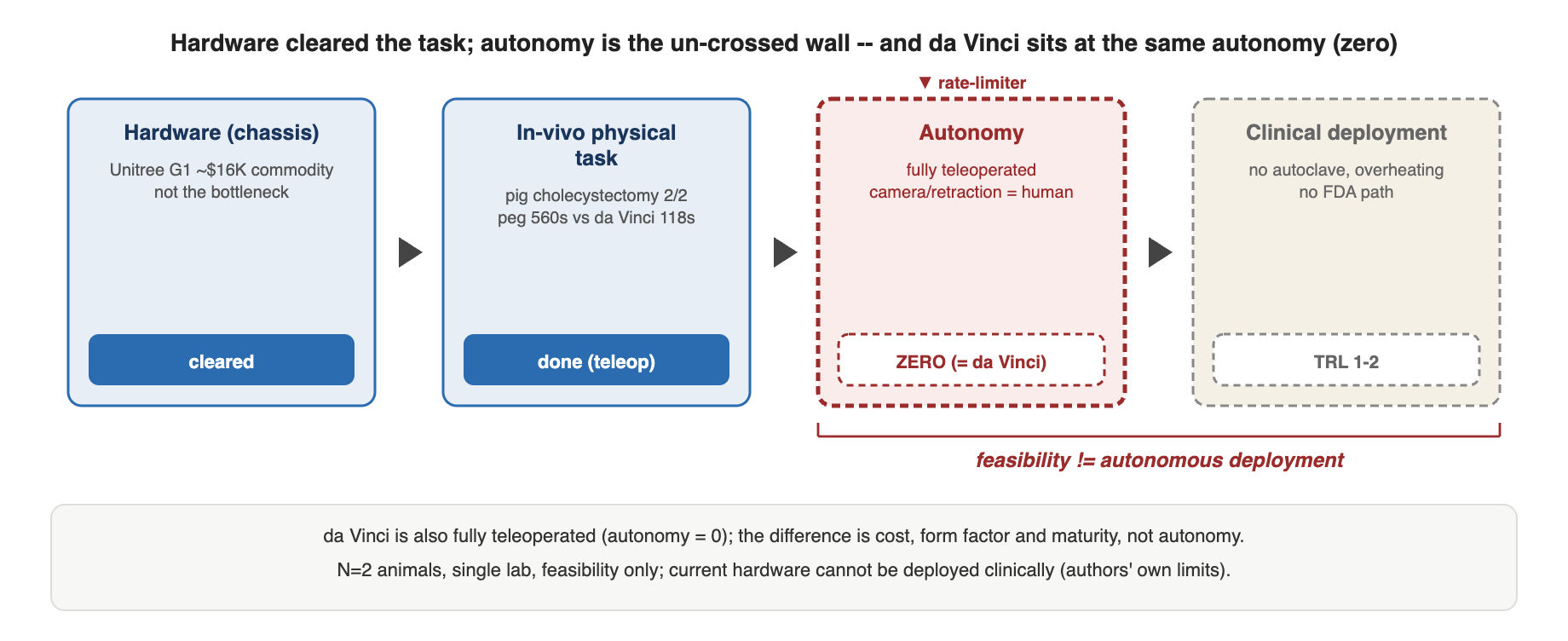
- So what. Read the fine print before the headline: the system was fully teleoperated, and the camera and tissue retraction were handled by a bedside human. This is not autonomous surgery — its autonomy level is the same as da Vinci’s, which is to say zero. The result demonstrates humanoid surgical feasibility, not autonomous surgical capability. Feasibility ≠ autonomy. It confirms our recurring embodied-AI thesis: the hardware chassis is no longer the bottleneck — autonomy, data and reliability are.
- Now what. This is a single-lab, N=2 feasibility study, and the authors themselves admit the current hardware cannot be deployed clinically — no autoclavable (sterilizable) parts, intermittent overheating, frequent repositioning. TRL is 3–4 for the humanoid system; da Vinci teleoperation is TRL 9; an autonomous surgical humanoid is TRL 1–2 and this work contributes nothing to that axis. Because of listed-equity adjacency (Intuitive Surgical / ISRG) and the geopolitics around Unitree, framing is kept strictly neutral and factual.
The five-minute read
The headline says “surgery,” the method says “teleoperation”
The claim that captured attention is easy to state: a general-purpose, roughly $16K commercial humanoid — the Unitree G1, the kind of robot you can buy off the shelf — completed a gallbladder removal in a live pig, twice, with no conversion to open surgery. That is a genuine first-of-kind in-vivo data point, and the paper is peer-reviewed in Nature. But the substance underneath the headline is different from what the word “surgery” implies. The robot made no decisions. A surgeon drove it through a Master Tool Manipulator (MTM) teleoperation framework, hand motions scaled and mapped to the wristed laparoscopic instruments. There was no autonomous tissue manipulation, no autonomous safety judgment, no autonomy of any kind. And two core subtasks — running the camera and retracting tissue — were performed by a human standing at the bedside, not by the robot.
So the accurate description is not “a humanoid performed surgery.” It is “a surgeon performed surgery through a humanoid.” That distinction is the whole story. On the axis that matters for the future of surgical robotics — autonomy — this system sits exactly where the established da Vinci platform sits: at zero. Both are fully teleoperated. The novelty here is not autonomy; it is form factor (a general-purpose humanoid instead of a dedicated $1–2M surgical robot), cost, and the demonstration that off-the-shelf hardware can, however awkwardly, attempt a dedicated robot’s physical task.
Feasibility is not autonomy, and this study proves only the first
Our embodied-AI series keeps returning to one proposition: an impressive demo is not a deployable autonomous worker, and the hardware chassis is no longer the rate-limiter — the rate-limiter is generalizable autonomy, data, and reliability. This paper tests that proposition in a high-stakes physical domain, on living tissue rather than a benchmark, and it splits exactly along the predicted seam. Hardware: not the bottleneck. A commodity humanoid finished the procedure, so the physical chassis is maturing. Autonomy: zero. Reliability: still well short. A dry-lab FLS peg-transfer task took the humanoid 560.1 seconds on average versus 118.2 seconds for a da Vinci Xi — roughly 4.7 times slower — and the in-vivo runs were punctuated by frequent robot repositioning, recalibration, intermittent overheating, and multi-minute pauses. The physical task can be done; doing it reliably and autonomously is a separate, unsolved problem.
The comparison with da Vinci is where framing matters most. The two systems have the same autonomy level (zero), so this study is not “less autonomous” than da Vinci — it is just far less mature. da Vinci is FDA-cleared, used in millions of cases, with dedicated sterilizable instruments and a proven remote-center-of-motion (RCM) mechanism: TRL 9. The humanoid, by the authors’ own account, cannot be sterilized, overheats, has kinematic error, and has an arm span of about 450 mm against an adult’s 1.6–1.8 m. That places the integrated humanoid system at TRL 3–4 — in-vivo feasibility in a relevant environment — and an autonomous surgical humanoid at TRL 1–2, to which this work adds nothing.
What the numbers actually show
The quantitative results (all attributed to the open arXiv version; the paywalled Nature final was not collated against it) are worth stating plainly because they cut against, not toward, hype. Benchtop follower-leader latency was about 156 ms; straight-line tracking orthogonal RMS was 1.30 ± 0.03 mm; circular-motion radial RMS was 10.40 ± 1.32 mm. In-vivo active console time improved from 56:15 in the first case to 31:59 in the second — a learning-curve hint, but with N=2 it cannot be generalized. Case 2 had minor bile leakage and liver-bed bleeding, managed with suction and cautery. None of this supports a safety conclusion; it is feasibility data, and the authors present it as such. The most striking thing about the paper is how candidly the authors expose their own limits — overheating, no autoclavable components, sensitivity of RCM control to trocar placement. The hype, where it exists, lives in the press headlines, not in the paper.
Deep dive
1. Background
Dedicated surgical robots — da Vinci being the archetype — are purpose-built, expensive teleoperation platforms. The research question here inverts that premise: can a general-purpose, economical commercial humanoid, designed for human environments and usable in a standard operating room, meet the physical demands that dedicated platforms have owned? The study evaluates that across three stages: (1) benchtop characterization of latency, precision, and workspace; (2) a dry-lab user study using Fundamentals of Laparoscopic Surgery (FLS) tasks across experience levels; and (3) an in-vivo pig study of an actual cholecystectomy. This is a continuation of the same lab’s earlier teleoperated-handheld-laparoscopy work (LapSurgie, arXiv 2510.03529).
2. What this study newly established
On the feasibility axis, the contribution is a step-change: to our knowledge (per the institution and press, not our independent adjudication) this is the first completed laparoscopic procedure in a live animal using a general-purpose humanoid. Both cases used a standard four-trocar layout (three 5 mm, one 12 mm) and finished without conversion. On the autonomy and algorithmic axis, the contribution is essentially none — teleoperated laparoscopy, wristed instruments, FLS scoring, and dVRK comparison are all established methods, and there is no autonomy algorithm here. Reporting both axes separately is the honest way to grade it.
3. Methods — strengths and limits
Strength: peer-reviewed in Nature plus an openly posted arXiv version allowed direct cross-checking of the quantitative claims (the source analysis logged 18 of 21 claims confirmed against the arXiv full text). Limits, in order of severity: N=2, single lab — no statistics, no generalization, complication and success frequencies are not estimable, and even the 56→32 minute improvement is N=2. Feasibility was the stated primary aim, not autonomous or unsupervised performance; human involvement (full teleoperation plus bedside assistance) was constant. The unresolved engineering limits — no autoclavable parts, overheating, RCM sensitivity to trocar placement, insufficient arm span — mean, in the authors’ own words, that the current hardware cannot be clinically deployed. And there is the ordinary animal-to-human gap: a completed pig cholecystectomy does not transfer to human safety across varied scenarios. Three items remain unverified in the source analysis: the precise roles of collaborating surgeons cited only in secondary coverage, whether the paywalled Nature final differs numerically from the arXiv version, and IACUC/animal-ethics approval details.
4. Connection to neighbouring domains
This slots directly into a recurring thread in this outlet’s embodied-AI coverage: benchmark or demo performance is not the same as deployment. The series has repeatedly found an “autonomy gap” in benchmarks, demos, and teleoperation; this is the rare case where that gap is re-confirmed on real living tissue. The autonomy path forward would require a surgical vision-language-action (VLA) model capable of autonomous tissue manipulation and safety judgment — and its bottleneck is surgical-gesture data scarcity, the surgical analogue of the “100k-year robot-data gap” discussed in the series, made worse by regulatory and patient-safety constraints on generating such data. Separately, the authors’ cited limit of intermittent overheating maps onto the series’ note that battery and thermal management can become real-use constraints under sustained high-load precision work — a candidate exception to the “hardware is not the bottleneck” thesis, surfaced here in vivo.
5. Commercialization and investment lens (TRL, related companies)
TRLs, kept separate: the general-purpose humanoid surgical system (this study) is TRL 3–4; dedicated teleoperated surgical robots (da Vinci) are TRL 9; an autonomous surgical humanoid is TRL 1–2. On companies, stated as neutral facts: the hardware maker Unitree is private (China); the research entity, the UCSD Yip lab, is non-commercial. As factual context reported by multiple outlets in July 2026, the U.S. Department of Defense has been described as classifying Unitree hardware as Chinese military technology — a geopolitical and procurement consideration noted here without evaluation. The listed-equity adjacency is Intuitive Surgical (NASDAQ: ISRG), which holds the da Vinci standard; if humanoid surgery were ever to mature into a low-cost alternative there could be long-run adjacency or competitive implications, but at an N=2 animal-feasibility stage any product-competition read is premature and is deferred to the investment layer. There is no near-term commercial product signal; absent a sterilization and safety architecture and a regulatory (IDE/FDA) path, clinical commercialization is years out and uncertain.
6. The counter-view (skeptic block)
The source analysis passed its adversarial gate as proceed-with-caveats (conditional), not verified-clean, and required these caveats to travel with any published version:
- This work is fully teleoperated, with the camera and tissue retraction performed by a bedside human — it is not autonomous surgery (same autonomy level as da Vinci = zero). Do not frame it as “autonomous humanoid surgery.”
- N=2 animals, single lab, feasibility as the primary aim — safety, success rate, and learning effects cannot be generalized. The current hardware cannot be clinically deployed: no sterilization, overheating (the authors’ own admission).
- “World-first” is attributed to the institution and press; the quantitative figures are attributed to the open arXiv version (the Nature final was not collated).
The gate also noted that the falsification bar for autonomy is explicit: a surgical VLA would have to reproduce autonomous tissue manipulation and safety judgment at a credible success rate on real tissue, and if a vendor ever claims “autonomy” while concealing teleoperation or bedside assistance, that claim should be downgraded to hype.
7. What to watch next
- Whether any group publishes autonomous surgical subtask success rates (suturing, dissection) via a surgical VLA — the real autonomy signal.
- Entry into a human IDE / regulatory pathway.
- Resolution of the sterilization and thermal-management hardware limits.
- How Unitree-related geopolitics affects clinical procurement and supply.
References
- Liang, Z., N. Thareja, P. Zhang, C. Joyce, S. Atar, F. Richter, G. Jacobsen, S. Liu, R. Broderick, and M. Yip. 2026. “In vivo feasibility study of humanoid robots in surgery.” Nature, July 8. doi:10.1038/s41586-026-10796-x. https://www.nature.com/articles/s41586-026-10796-x (paywalled).
- Same study, open version: arXiv 2607.07972 v1 (2026-07-08). https://arxiv.org/abs/2607.07972 · full text https://arxiv.org/html/2607.07972v1 (source for the quantitative figures).
- Project page: https://humanoid-surgeon.github.io/
- Prior work, same lab: “LapSurgie: Humanoid Robots Performing Surgery via Teleoperated Handheld Laparoscopy.” arXiv 2510.03529. https://arxiv.org/pdf/2510.03529
- UC San Diego (official): “Surgeons Use Teleoperated Humanoid Robots to Perform Live Surgery — a World First.” https://today.ucsd.edu/story/surgeons-use-teleoperated-humanoid-robots-to-perform-live-surgery-a-world-first
- Geopolitical (secondary): “Humanoid Robots Perform First Live Surgery; Pentagon Flags Hardware as Chinese Military Tech.” Tech Times, July 11, 2026. https://www.techtimes.com/articles/320157/20260711/humanoid-robots-perform-first-live-surgery-pentagon-flags-hardware-chinese-military-tech.htm
- This outlet’s embodied-AI deep-dive series (hardware ≠ bottleneck; teleop ≠ autonomous; demo ≠ deployed; the “100k-year robot-data gap”)
Disclosure
This post is for information only and is not investment advice, and it is not a buy/sell view on any company named. Neutral factual context: the hardware used (Unitree G1) is made by a private Chinese company that multiple July 2026 outlets reported the U.S. Department of Defense has described as Chinese military technology — stated as fact, without evaluation. The comparison platform (da Vinci) is a product of Intuitive Surgical (NASDAQ: ISRG), a listed company; because humanoid surgery is at an N=2 animal-feasibility stage, any adjacency or competition implication is premature and is deferred to the investment layer. Quantitative figures are attributed to the open arXiv version of the study and to UCSD official/secondary coverage; the paywalled Nature final was not collated. The underlying study is academic (UCSD, non-commercial), with no identified financial relationship to the firm or author. The author holds no position in any company mentioned (default: no interest).


Leave a Reply