Evidence-first notes on bioscience and deep tech, at the edge of the lab and the market. Information only — not investment advice.
The 30-second version
- What. Two arXiv preprints within days of each other approach superconductivity from opposite ends. One is experimental — a new material (the chiral topological semimetal Ag2Pd3S) reported to be an unconventional, time-reversal-symmetry-breaking superconductor. The other is pure theory — a prediction that adding disorder to graphene, long thought to suppress superconductivity, can instead switch it on.
- So what. Neither is hype. Ag2Pd3S is a cryogenic bulk result (Tc ≈ 1.1 K), and the graphene work is a mean-field calculation with no measured transition temperature. This is not room-temperature superconductivity. The novelty is not a high Tc — it is a new material platform (intrinsic symmetry-breaking in a topological semimetal) and a conceptual counterexample (disorder as a switch, not a killer).
- Now what. TRL 1 — basic physics, far from any product; the investment case is weak. Both are pre-review, single-group preprints, so the decisive next step is independent replication — for Ag2Pd3S, of the symmetry-breaking signal in particular.
The five-minute read
Two opposite approaches — but evidence comes before mechanism
Superconductivity is a field with a long memory of retractions and re-evaluations (the LK-99 room-temperature saga is only the latest). So the first question about any claim is not “what is the mechanism?” but “how good is the evidence?” The two preprints this week sit at opposite ends of that question.
Ag2Pd3S is a material discovery: bulk superconductivity is measured in a specific chiral topological semimetal, and the authors argue it is unconventional. The graphene result is a mechanism proposal: a calculation showing that vacancy or hydrogenation disorder can induce a finite superconducting order parameter even from arbitrarily weak attraction. One is an experiment; the other is theory. Both are basic physics, not applications.
The evidence ladder
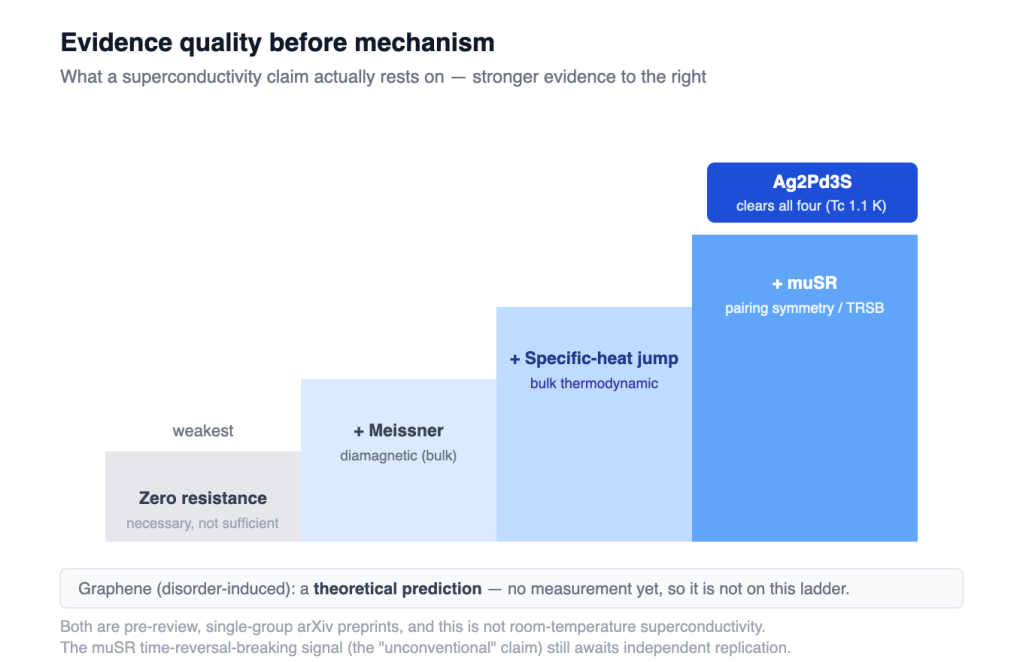
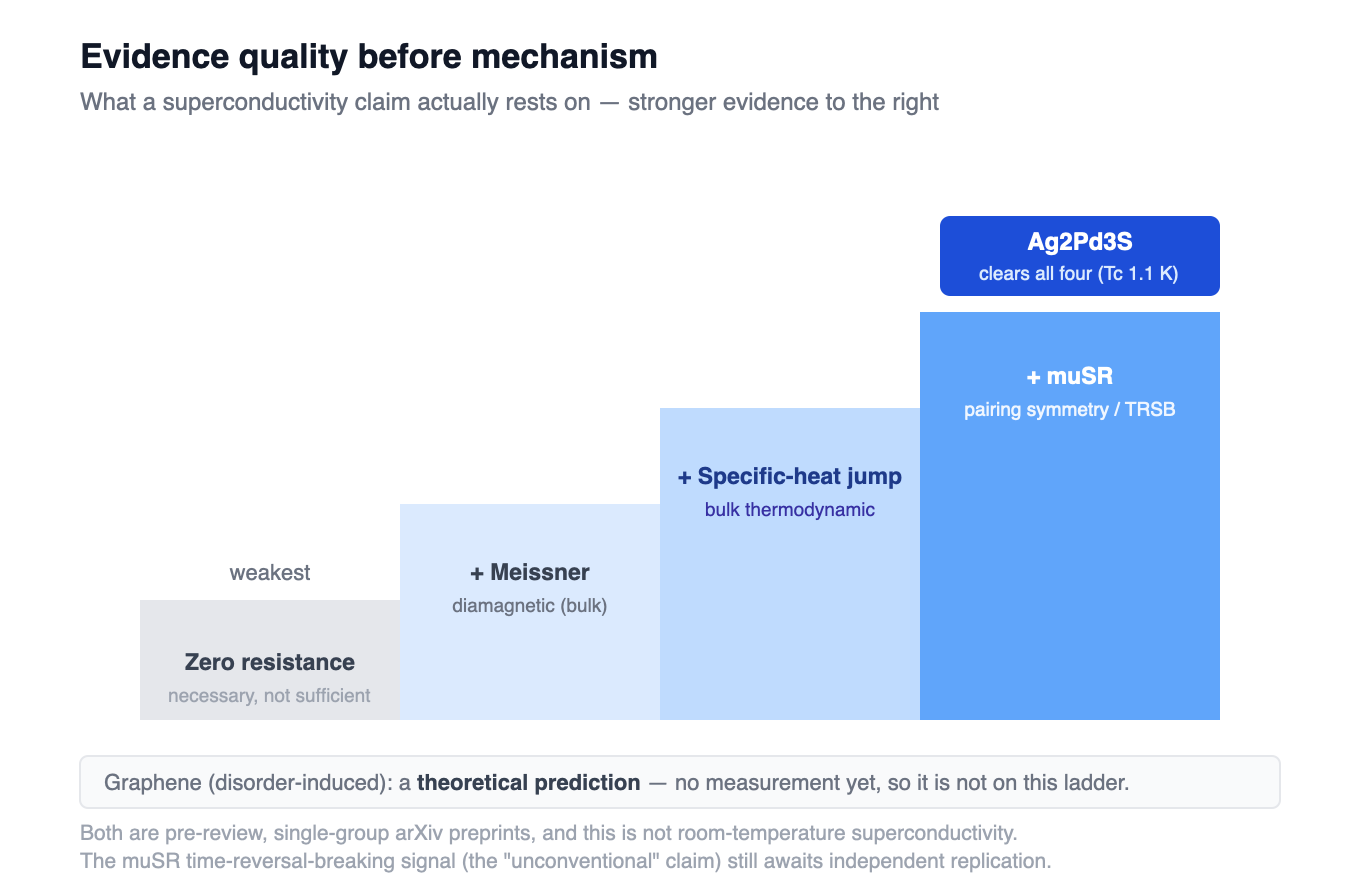
Not all “superconductivity” claims rest on the same footing. Zero resistance alone is necessary but not sufficient — it has produced false positives before. Stronger claims add the Meissner effect (diamagnetic shielding, a bulk signature), then a specific-heat jump (bulk thermodynamics), then probes like muon spin spectroscopy (muSR) that speak to pairing symmetry.
Ag2Pd3S clears the full stack: the authors report zero resistance, magnetization, a specific-heat signature and muSR — bulk thermodynamic evidence, not resistance alone. The graphene result, being a prediction, is not on the ladder at all: there is no measurement yet.
So what changes?
What moves is the map of where unconventional superconductivity can appear — a new host material on one side, a new switch (disorder) on the other. What does not move is any near-term application: one result is cryogenic, the other is a calculation. And the “unconventional” label on Ag2Pd3S rests on a symmetry-breaking signal that this exact field has had to re-interpret before — so it is a claim awaiting replication, not a settled fact.
Deep dive
1. Background: unconventional superconductivity and its replication history
In a conventional superconductor, electrons pair via lattice vibrations into a simple, isotropic (s-wave) state. “Unconventional” means the pairing is something else — anisotropic, sign-changing, or symmetry-breaking — which usually points to richer physics. But the signatures are subtle, and the field has a cautionary record: the time-reversal-symmetry-breaking (TRSB) claim in Sr2RuO4 was debated and re-evaluated for two decades, and the LK-99 episode showed how fast a resistance-only “room-temperature” claim can collapse. That history is why the evidence ladder above matters more than the mechanism story.
2. Ag2Pd3S — a new material (experiment)
The claim is bulk superconductivity in Ag2Pd3S, a chiral topological semimetal that hosts multifold fermions (Kramers–Weyl and higher-spin quasiparticles). The authors report it as the first chiral topological semimetal superconductor showing intrinsic TRSB.
- Evidence quality: not resistance alone — zero resistance plus magnetization (diamagnetic shielding), specific heat, and muSR. This is bulk thermodynamic evidence, the normal standard for a condensed-matter superconductivity paper.
- Tc: ≈ 1.1 K, at ambient pressure in a bulk crystal (no pressure or gating). Cryogenic.
- The “unconventional” basis: the muSR data indicate a spontaneous internal magnetic field below Tc (TRSB), while the abstract also describes a fully gapped state and, theoretically, a loop-supercurrent-ordered (non-s-wave) state.
- Not cited here: the specific-heat jump ratio, upper critical field, type-I/II classification, Ginzburg–Landau parameter and superconducting volume fraction are details we deliberately do not quote — they need checking against the definitive PDF and are left unverified.
3. Disorder-induced superconductivity in graphene — a new mechanism (theory)
The second preprint is a self-consistent Bogoliubov–de Gennes mean-field calculation on a tight-binding model. There is no experiment, no resistance, no Meissner measurement — it is a prediction. The claim: introducing low concentrations of vacancy or hydrogenation disorder creates low-energy states that induce a finite superconducting order parameter even from arbitrarily weak attraction, with a geometric (quantum-geometry) contribution to the superfluid weight driving macroscopic phase coherence. The transition temperature is reported in dimensionless units (relative to bandwidth), not in kelvin.
This is interesting precisely because it runs against Anderson’s theorem intuition, in which nonmagnetic disorder is expected to leave or suppress conventional superconductivity rather than create it. But mean-field theory ignores fluctuations and does not fully capture competing effects such as Anderson localization, so until there is an experiment this is a hypothesis, not an observation.
4. Neighbouring domains
Quantum × Materials. A fully gapped, chiral, TRSB superconductor built on multifold fermions is exactly the kind of system that condensed-matter physics connects to topological superconductivity and, through it, to Majorana-mode and topological-qubit material searches. That is a genuine research direction — but it is a search for candidate materials, not a qubit. With Tc ≈ 1.1 K and a claim still awaiting replication, any leap to “topological qubit realized” would be wrong.
Materials × 2D electronics. “Turn superconductivity on with defects” is a device-design idea — engineering disorder rather than avoiding it — that sits in the same 2D-materials lineage as magic-angle graphene. Whether the quantum-geometry picture converts into a measurable prediction is the open question.
Distance to applications. Neither result competes with today’s commercial superconductors (NbTi/Nb3Sn in MRI, Al/Nb in quantum hardware, REBCO tapes in power). They are knowledge assets — platform and mechanism understanding — not commercial triggers.
5. Commercialization and market context (TRL, companies)
TRL 1 — basic principle/phenomenon. Ag2Pd3S is a bulk discovery, but 1.1 K is liquid-helium / dilution-fridge territory, unrelated to device or power applications; the graphene work is a hypothesis, before any TRL definition applies. There is no commercial vendor claim here — both are academic preprints, so there is no vendor hype to separate.
Companies and infrastructure (facts only). muSR measurements are possible only at a handful of large facilities — TRIUMF (Canada), PSI (Switzerland), ISIS (UK), J-PARC (Japan). There is no public company whose results are tied to these findings; any link to a listed cryogenics or instrumentation vendor would be too weak to state. Investment read (neutral): the case for a commercial trigger is weak; the value here is in accumulated understanding of platforms and mechanisms, to be re-evaluated only if and when a higher-Tc or device-compatible version appears.
6. The skeptic’s bottom line
A final skeptical read rates this a conditional proceed. Three caveats must survive into any summary.
- Not room-temperature superconductivity. Ag2Pd3S is an ambient-pressure, ~1.1 K cryogenic bulk result; the graphene case is a pure theoretical (mean-field) prediction with no measured transition temperature.
- Pre-review, single-group. Both are pre-peer-review arXiv preprints from single groups. In particular, the time-reversal-symmetry-breaking (muSR) signal in Ag2Pd3S is the kind of claim this field has re-evaluated before — it should be read as a claim, not a confirmed result, until independently replicated.
- Topological, not a qubit. The topological-superconductor angle for Ag2Pd3S is a direction in materials search for Majorana and topological qubits, not qubit realization. Secondary parameters (specific-heat jump, upper critical field, and so on) remain unverified pending the definitive PDF.
7. What to watch
- Independent replication of the Ag2Pd3S muSR TRSB signal — the crux of the “unconventional” claim.
- The definitive Ag2Pd3S paper: gap structure, specific-heat jump, upper critical field and superconducting volume fraction (all left unverified here).
- Whether the graphene prediction survives beyond mean field (fluctuations, localization) and yields a kelvin-scale, testable transition.
- Any experimental attempt at defect-engineered superconductivity in real graphene.
- Whether the topological-superconductor lead attracts follow-up material searches — the honest measure of significance, well short of any device.
References
- Kushwaha, R. K., et al. (R. P. Singh, corresponding). 2026. “Unconventional Superconductivity in the Chiral Topological Semimetal Ag2Pd3S.” arXiv preprint arXiv:2606.29767 (pre-peer-review; open access).
- van Poppelen, J., T. Löthman, and A. M. Black-Schaffer. 2026. “Disorder-induced superconductivity in graphene.” arXiv preprint arXiv:2607.02267 (pre-peer-review, theory; open access).
Disclosure
This post is for information only and is not investment advice. The author holds no position in, and has no direct financial interest in, any listed company related to these materials or mechanisms (superconductor, cryogenics-instrumentation or quantum-hardware vendors). Both papers are pre-peer-review arXiv preprints; figures distinguish what the abstracts confirm from details that need checking against the definitive versions, and secondary parameters are deliberately not quoted.


Leave a Reply