Evidence-first notes on bioscience and deep tech, at the edge of the lab and the market. Information only — not investment advice.
The 30-second version
- What. The US Department of Energy’s Reactor Pilot Program (created by Executive Order 14301) set a target of three advanced reactors reaching criticality by 4 July 2026, using a DOE authorization path instead of the usual NRC licensing. Three private microreactors met it: Antares (Mark-0), Valar Atomics (Ward 250) and Deployable Energy (Unity). The regulatory shortcut genuinely compressed the timeline.
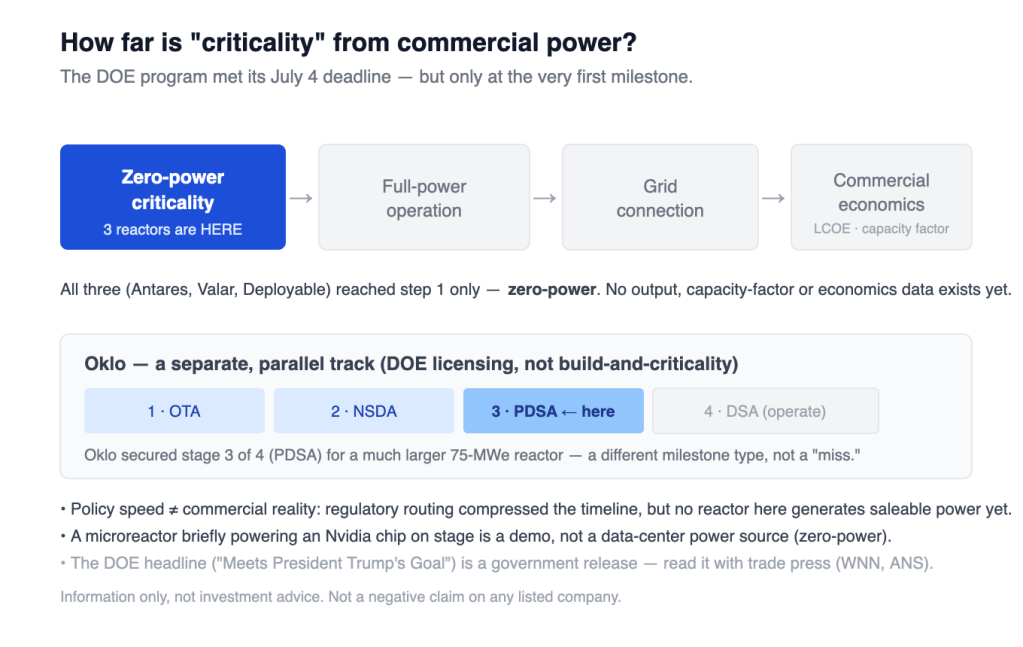
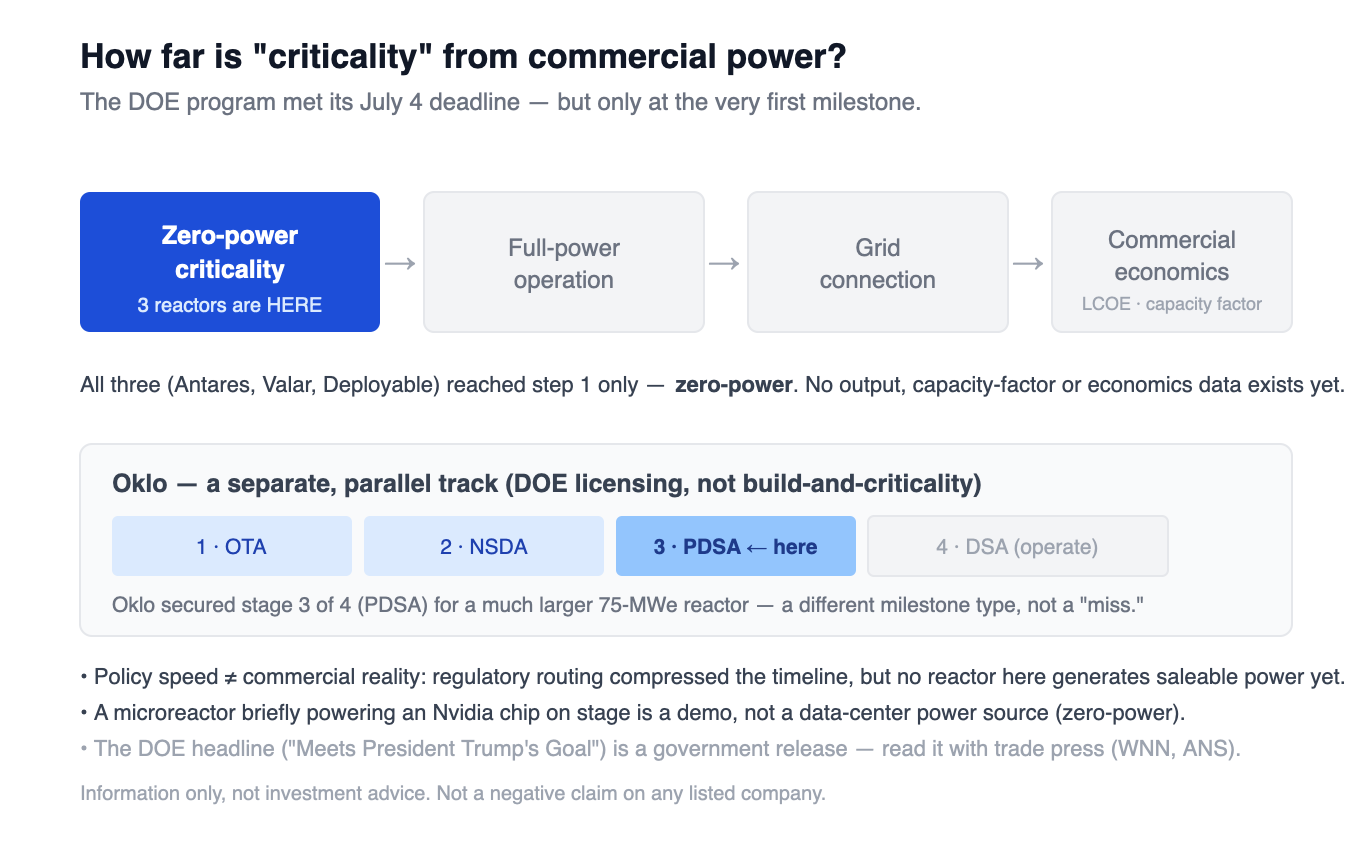
- So what. But every one of the three was a zero-power criticality — a self-sustaining chain reaction at essentially no output. None reported generation, capacity factor or economics. Policy speed and commercial viability are different things. And Oklo (NYSE: OKLO), often grouped in, was on a different, parallel track: it secured a DOE licensing approval (PDSA, stage 3 of 4) for a much larger 75-MWe reactor — a different milestone type, not a “miss.”
- Now what. This is early-stage: no LCOE or capacity-factor data exists, and 2028-style commercial dates are company claims in a field with a long record of slippage. The demand story underneath it — AI data-center power — is real, but a microreactor briefly lighting an Nvidia chip on stage is a demonstration, not a data center’s power source.
The five-minute read
A deadline met by routing around the regulator
Commercial reactors in the US are licensed by the Nuclear Regulatory Commission. The Reactor Pilot Program instead used a DOE authorization path — a four-stage sequence (OTA → NSDA → PDSA → DSA) — to let private companies build and test first-of-a-kind reactors on a compressed schedule. The target was three reactors critical by 4 July 2026, and three made it: Antares’ Mark-0 (4 June, at Idaho National Laboratory), Valar Atomics’ Ward 250 (18 June) and Deployable Energy’s Unity (1 July, at INL). Federal officials called it the first time three distinct advanced-microreactor designs went critical inside a month.
The one word that resizes the story: zero-power
Reaching “criticality” means a reactor sustains a fission chain reaction. It does not mean it generates usable power — and all three of these were zero-power criticality demonstrations, at essentially no measurable output. No generation figures, capacity factors or net-energy data were released by any of them. So this is an early physics milestone, not a demonstration of commercial power. Valar’s much-publicized moment of using its reactor’s electricity to run an Nvidia chip on stage is best read as demonstration theater: a zero-power reactor cannot power a data center.
Oklo: a different track, read neutrally
Oklo did not reach criticality by the deadline. Instead, on 11 June it secured a Preliminary Documented Safety Analysis (PDSA) approval — stage 3 of the four-stage DOE authorization — for its Aurora-INL project, a 75-MWe liquid-metal-cooled fast reactor. That is an order of magnitude larger than the 100-kWt–1-MWe microreactors that went critical, and a licensing milestone rather than a build-and-criticality one. The two are not directly comparable, and “didn’t hit the deadline” is not the same as falling behind.
Deep dive
1. Background: routing around the NRC
The Reactor Pilot Program stems from Executive Order 14301 (23 May 2025), directing DOE to let private firms build and test first-of-a-kind reactors via DOE authorization rather than NRC licensing. The four stages are: an Other Transaction Agreement (OTA), a Nuclear Safety Design Agreement (NSDA), a Preliminary Documented Safety Analysis (PDSA), and finally a Documented Safety Analysis (DSA) — the last being approval to operate. Criticality happens after authorization. The stated goal was three reactors critical by 4 July 2026.
2. What actually happened
Three companies reached criticality, all zero-power:
- Antares Nuclear — Mark-0, a sodium heat-pipe-cooled, TRISO-fueled microreactor; zero-power fueled criticality on 4 June at INL (confirmed by DOE, World Nuclear News and the US Army). The company says a full-power Mark-1 will operate in 2027 — a company claim, unverified.
- Valar Atomics — Ward 250, a 100-kWt helium-cooled TRISO HTGR; zero-power criticality on 18 June (DOE-confirmed).
- Deployable Energy — Unity, a 1-MWe high-temperature gas-cooled microreactor; zero-power criticality on 1 July at INL (ANS- and DOE-confirmed).
Oklo did not reach criticality; it secured PDSA approval (stage 3 of 4) on 11 June for the 75-MWe Aurora-INL fast reactor (OTA and NSDA earlier in 2026; DSA, the operate approval, not yet). ANS noted that the 4 July deadline was “notably absent” from Oklo’s recent messaging.
3. How much do these milestones weigh?
The regulatory routing did compress the timeline — that much is real. But zero-power criticality is far from commercial power: no company released output, capacity factor, LCOE, fuel-cycle or endurance-operation data. On a TRL scale these prototype criticality demonstrations sit around 5, with full-power, grid-connected, durable operation still unproven; claims beyond that are not yet supported. And note the framing of the sources: DOE’s own announcement was titled around meeting a presidential goal — a government release with an incentive to declare success, which is worth reading against independent trade press (World Nuclear News, ANS) rather than taking at face value.
4. Neighbouring domains
Energy × AI. The commercial logic under the nuclear revival is AI data-center electricity demand (projections on the order of ~1,300 TWh by 2035 circulate in industry analyses; attribute the figure rather than treating it as fact). That demand — visible in reported deals such as Meta–Oklo and Google–Kairos on the demand side — is the real driver, and it is distinct from the technical criticality results here.
Energy × Materials. The single largest bottleneck for advanced-reactor rollout is HALEU (high-assay low-enriched uranium) fuel supply; many TRISO-fueled microreactors depend on it. The 2024 NDAA directed DOE to allocate at least 21 tons, with conditional supply commitments to several firms — a reminder that the fuel/materials supply chain is a rate-limiting step separate from regulatory speed.
5. Commercialization and market context (TRL, companies)
TRL ~5 for the criticality demonstrations (prototype in a relevant setting), with commercial deployment (2028-style dates) being company claims in a sector known for schedule slippage. Companies, facts only, public vs private separated:
- Public: Oklo (NYSE: OKLO), NuScale Power (NYSE: SMR), Nano Nuclear Energy (NASDAQ: NNE); demand-side, Nvidia (NASDAQ: NVDA). (X-energy and Holtec have reportedly filed for 2026 IPOs; completion is unconfirmed, so they are treated as private here.)
- Private: Antares Nuclear, Valar Atomics, Deployable Energy, X-energy, TerraPower, Kairos Power, Radiant Nuclear.
Investment read (neutral): a policy/criticality checkpoint has weak direct read-through to any listed name; the value here is a program-status and supply-chain picture, and any market effect is indirect and dependent on unproven commercial milestones.
6. The skeptic’s bottom line
A final skeptical read rates this a conditional proceed. Four points must survive into any summary.
- The three reactors that reached criticality (Antares, Valar, Deployable) were all zero-power demonstrations, with no output, capacity-factor or net-energy data — an early physics milestone, not commercial power.
- Oklo’s “missing the deadline” is not a failure but a different kind of milestone: against a much larger 75-MWe reactor it secured licensing stage 3 of 4 (PDSA), and the two tracks are not directly comparable.
- DOE’s official announcement is a government release framed around a presidential goal, which may be a stronger claim than the technical reality (zero-power) — read it against independent trade press.
- This is information only, not investment advice, and should not be read as a negative claim on any listed company.
7. What to watch
- The first full-power, grid-connected operation (Antares’ claimed 2027 Mark-1 is the near-term test) — and any actual output/capacity-factor data.
- Whether DOE authorization connects cleanly onward to NRC commercial licensing and grid interconnection.
- HALEU supply against the NDAA allocation — the fuel/materials rate-limiter.
- Oklo’s progression from PDSA to DSA (operate approval) on the larger reactor.
- Whether 2028-style commercial timelines hold, given the sector’s slippage record.
References
- American Nuclear Society / Nuclear Newswire. 2026. “The deadline arrives: Checking in on the Reactor Pilot Program.” ans.org.
- US Department of Energy. 2026. Advanced-reactor criticality announcements (first, second, third). energy.gov. (Government release; read against independent coverage.)
- World Nuclear News. 2026. “First criticality for US microreactor under DOE programme”; “Valar Atomics achieves criticality in DOE Reactor Pilot Program”; “Criticality for third US reactor ahead of 4 July deadline.” world-nuclear-news.org.
- American Nuclear Society / Nuclear Newswire. 2026. “Oklo secures DOE PDSA approval.” ans.org.
- Utility Dive. 2026. “DOE agrees to give HALEU to 5 advanced nuclear companies.” utilitydive.com.
Disclosure
This post is for information only and is not investment advice. It is not a buy/sell recommendation and should not be read as a negative claim on Oklo (NYSE: OKLO) or any company named — Oklo’s not reaching the deadline is a different milestone type (a larger 75-MWe reactor at licensing stage 3 of 4), stated alongside the scale and stage. The author holds no position in, and has no direct financial interest in, any company mentioned (Oklo, NuScale, Nano Nuclear Energy, Nvidia, and the private firms above).


Leave a Reply