Evidence-first notes on bioscience and deep tech, at the edge of the lab and the market. Information only — not medical or investment advice.
The 30-second version
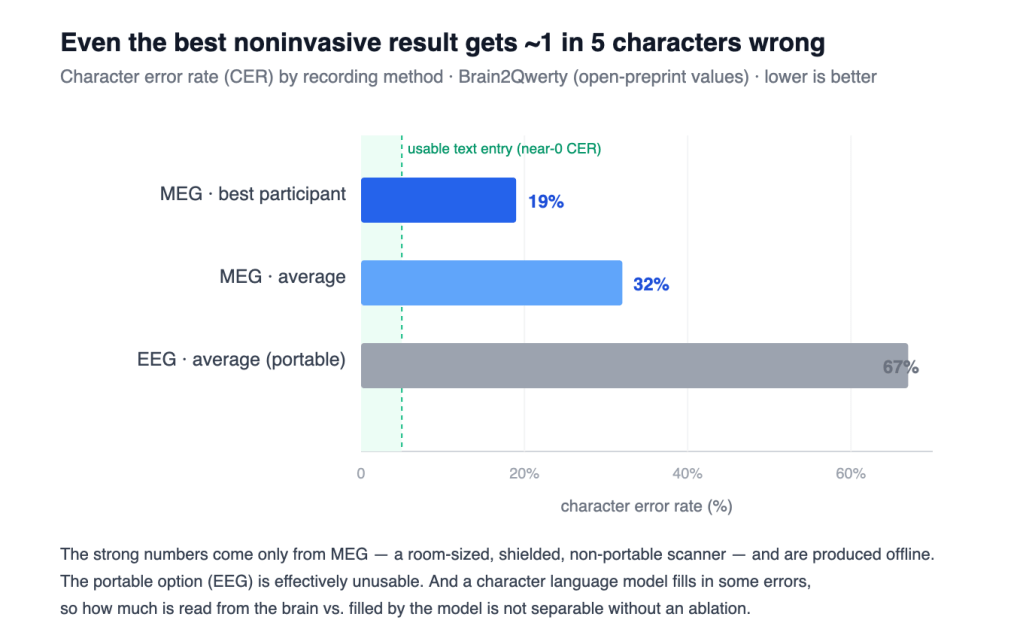
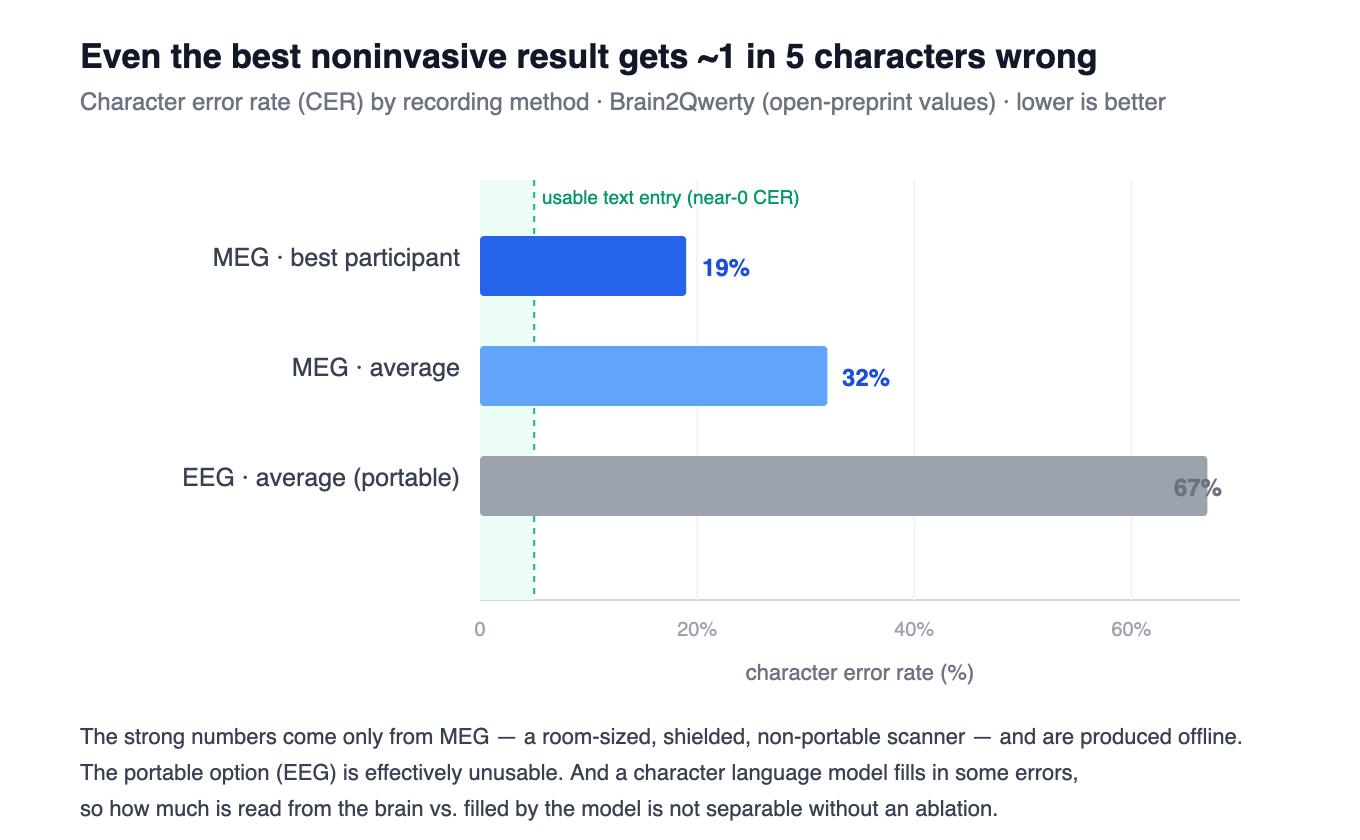
- What. A study from Meta AI, ENS and the Basque Center on Cognition (Levy et al., Nature Neuroscience, 30 June 2026; “Brain2Qwerty”) reconstructs typed sentences from noninvasive brain activity — no surgery, no implant. It pushes the character error rate (CER) down to about one-third on average (32%) and about one-fifth for the best participant (19%). That is a rigorous new state of the art for noninvasive brain-to-text.
- So what. But those numbers hold only on a non-portable MEG scanner the size of a room, and only offline (output after the sentence ends). Participants actually typed on a keyboard; the vocabulary was constrained to ~372 words; and a character language model corrects errors from prior probability. The gap between the “wireless mind-reading” headline and the actual task is large.
- Now what. This is TRL 3 — a lab proof of concept. Meta has no related product, and with non-portable MEG the case for a consumer or clinical device is weak today. What to watch: (1) CER when the language model is removed (ablation), (2) zero-shot performance on new participants, (3) whether it transfers to portable sensors (OPM-MEG / next-gen EEG).
The five-minute read
What is new: the noninvasive ceiling moved up
Brain-computer interfaces (BCIs) that restore communication for people who have lost speech or typing have so far been led by the invasive camp: electrodes placed on or in the cortex deliver real-time, large-vocabulary, high-accuracy decoding — at the cost of neurosurgery. On the other side, scalp EEG is safe and portable but has such a low signal-to-noise ratio that sentence-level text reconstruction has stayed far above any usable error rate.
Brain2Qwerty moves that noninvasive ceiling. On CER, it reaches 32% on average and 19% for the best participant using MEG (magnetoencephalography); the best participant even reconstructed some out-of-training sentences perfectly. The model is a convolutional encoder feeding a transformer, capped with a character-level 9-gram language model pretrained on Spanish Wikipedia.
What the headline erases
Read the number alone and you miss the point. Four conditions are attached.
1. Modality. The strong result comes only from MEG — a device built on superconducting sensors inside a room-sized magnetically shielded chamber. It is non-portable. The portable option measured alongside it, 64-channel EEG, has a CER of 65–66% — two of every three characters wrong, effectively unusable. “Noninvasive” does not mean “wearable.”
2. Offline. The decoder emits the sentence only after typing ends. This is not a real-time communication tool.
3. Real typing. The 35 participants (all native Spanish speakers and skilled typists) physically typed on a non-magnetic QWERTY keyboard. This is not pure “inner-speech reading” — motor and sensory signals are part of it, and the authors note it cannot be applied to fully locked-in patients, who cannot type.
4. Constrained vocabulary and the language model. The vocabulary is narrow — 128 sentences per session, ~372 unique words. Under those conditions a character language model corrects errors from prior probability, so how much of the accuracy is read from the brain versus filled in by the model cannot be settled without an ablation. This is the study’s real weak link.
So what changes?
What changed is the scientific ceiling on how far noninvasive decoding can go. What did not change is the distance to real use: an average CER near one-third is still high, the hardware is not portable, the output is offline, and the subjects are healthy adults who can type. And note: the flashy “61% word accuracy, real-time” figures circulating in the press are not from this Nature Neuroscience paper — they belong to a separate, non-peer-reviewed preprint (v2), and the two should not be conflated (see deep dive).
Deep dive
1. Background: the old ceiling on noninvasive BCI
BCI performance and safety trade off. Invasive approaches (ECoG surface grids, penetrating microelectrode arrays) have high signal-to-noise ratios and have shown real-time, large-vocabulary speech and handwriting decoding — at the cost of craniotomy and long-term implant stability. Scalp EEG is the opposite: safe, cheap, portable, but the skull blurs the signal, and sentence-level text reconstruction has stayed well above any usable error rate.
MEG sits between them. It measures the tiny magnetic fields from neural currents at better spatial and temporal resolution than EEG — but only inside a room-sized magnetically shielded room, with superconducting (SQUID) sensors held near absolute zero. Noninvasive, yet non-portable. Brain2Qwerty asked how far noninvasive language decoding can go on that MEG signal.
2. What the study found
Levy et al. (2026) had 35 healthy adults (native Spanish speakers, skilled typists, mean age 31.6) type sentences on a non-magnetic keyboard while their brain activity was recorded. Words were shown by rapid serial visual presentation, then typed from memory with the typed characters hidden on screen. Recording was ~0.9 hours per participant. A convolutional encoder and transformer convert the neural signal into character probabilities, and a character-level 9-gram language model corrects errors. Training is cross-subject (all participants pooled); output is offline.
Performance (open-preprint values): MEG mean CER 32 ± 0.6%, best participant 19 ± 1.1%; EEG mean CER 67 ± 1.5%. The contribution is a rigorous new noninvasive state of the art, but it is the product of MEG’s signal quality + real typing signals + a constrained vocabulary + the language-model prior, and those pieces have to be read apart.
Note on the figures. The CER values above are from the study’s open preprint (arXiv:2502.17480). The Nature Neuroscience version is cited in secondary press at MEG 29% / best 18% / EEG 65%, but the published PDF has not been checked directly. The conclusion (“about one in three characters wrong”) is unaffected; the exact figures will be reconciled when the PDF is available.
3. Methodological strengths and limits
Strengths. MEG and EEG were recorded under the same protocol, so the modality gap is shown directly; cross-subject training targets generalization across participants; and the code and project page are public, which is how these facts were cross-verified against the preprint.
Limits.
- Modality practicality. The best performance is MEG, which is non-portable; portable EEG is at CER 65–66%, unusable. Reading “noninvasive” as “wearable” is a mistake.
- Language-model contribution (the key one). With a near-closed ~372-word vocabulary and a character 9-gram LM on top, much of the accuracy could come from language priors rather than the brain signal. The preprint abstract does not surface an LM ablation, so the accuracy cannot be decomposed into brain-versus-model. This is the weakest link.
- Generalization. 35 subjects, one language, skilled typists, cross-subject pooling — zero-shot performance on new participants, transfer across languages, and non-expert performance are unknown.
- Task nature. Real typing means motor and sensory signals are included; as the authors state, it does not apply to locked-in patients, so it does not directly serve the core clinical target (severe paralysis).
- Version. This paper is the v1 study (offline, character-level, CER ~29–32%); a separate v2 preprint (section below) reports word-level, real-time numbers on a different footing and is not directly comparable.
4. Neighbouring domains
The BCI landscape (invasive vs noninvasive). Clinical communication restoration is currently led by invasive work; the commercial invasive camp — Neuralink, Precision Neuroscience, Synchron (all private) — targets real-time, large-vocabulary, high-accuracy decoding while accepting surgical risk. Brain2Qwerty moves the noninvasive ceiling on the other side: clearly ahead on safety (no surgery, no implant), still well behind on performance, real-time operation and portability. The accurate framing is that the noninvasive frontier moved up — not right, toward wearability.
Neuro × AI (the decoder is part of the performance). A large share of the accuracy comes from the AI stack (transformer + language-model prior). This is the same pattern seen in tumor liquid biopsy and protein-structure prediction — a domain signal with a foundation-model overlay — and it inherits the same verification problem: separating what the decoder read from what the model filled in.
The neuromorphic boundary. This is neural-signal decoding, unrelated to neuromorphic chips or on-chip learning (measurement plus offline GPU decoding). Even within neuro, “signal decoding” and “brain-inspired computing” are separate axes.
5. Commercialization and market context (TRL, companies)
TRL 3 — a lab proof of concept in a controlled cohort: healthy volunteers, offline, non-portable MEG, constrained vocabulary, not applied to the clinical target group. MEG hardware itself is a mature clinical instrument, but the brain-to-text application is early.
Timeline (estimate). A consumer or everyday-communication product on non-portable MEG is unrealistic on size and cost. It is immediately usable as a research tool, but the clinical communication-restoration path is unclear in its current form (locked-in patients excluded). Signals of a product within five years are weak.
Companies (facts only; public vs private separated).
- Public: Meta Platforms (NASDAQ: META) — the study’s originator, but with no related commercial product (pure research); no near-term consumer-device roadmap has been disclosed.
- Private (invasive BCI): Neuralink, Precision Neuroscience, Synchron.
- Noninvasive-adjacent hardware: optically pumped magnetometer (OPM-MEG) work toward portable MEG is progressing separately, but this paper used conventional SQUID MEG; portable MEG is a different technology axis, and specific vendor performance claims are unverified.
Investment read (neutral). The study advances the scientific ceiling of what noninvasive decoding can do, but the case for a commercial device is weak today (non-portable MEG). The AI decoder IP and method would need to be re-evaluated if and when they combine with portable sensors (OPM-MEG / next-gen EEG). On regulation, there is no surgical risk, so implant-stability issues are absent; neural-data privacy is a separate matter beyond this paper.
6. The skeptic’s bottom line
A final skeptical read rates this a conditional proceed, not a hold. Three caveats must survive into any summary.
- Modality and performance together. The result holds only on non-portable MEG (portable EEG is at 65–66% CER, unusable) and is produced offline — not a consumer wearable or a real-time tool.
- Language model vs brain. Participants actually typed, the vocabulary is ~372 words, and a character LM corrects errors from prior probability — so how much is read from the brain versus filled by the model cannot be settled without an ablation.
- v1 vs v2. This Nature Neuroscience paper is the offline, character-level, ~29–32% CER v1. The “61% word accuracy, real-time” figures in the press belong to a separate non-peer-reviewed preprint (v2, 9 participants, ~10× data) and must not be conflated with it.
7. What to watch
- A language-model ablation — how far CER rises without the LM, i.e., the floor on information actually carried by the brain signal.
- Open-vocabulary and zero-shot: performance on out-of-training words and new (held-out) participants, and the calibration required.
- Transfer to portable sensors (OPM-MEG / next-gen EEG) — the gate to real usability.
- The published figures: the PDF’s CER (29/18/65 vs preprint 32/19/67), 95% CIs, per-participant variance, and MEG-vs-EEG tests.
- Peer review of v2: whether the word-accuracy and real-time claims pass review and replicate.
References
- Levy, Jarod, Mingfang (Lucy) Zhang, Svetlana Pinet, Jérémy Rapin, Hubert Jacob Banville, Stéphane d’Ascoli, and Jean-Rémi King. 2026. “Noninvasive decoding of typed sentences from human brain activity.” Nature Neuroscience, June 30. doi:10.1038/s41593-026-02303-2. (Meta AI + ENS/PSL/CNRS + BCBL; published full text behind a paywall — PDF not directly checked.)
- Levy, Jarod, et al. 2025. “Brain-to-Text Decoding: A Non-invasive Approach via Typing.” arXiv preprint arXiv:2502.17480 (same study; source for cross-verified participant, device, CER and design figures).
- Meta AI Research. 2025. “Brain-to-Text Decoding: A Non-invasive Approach via Typing.” Publication page. Project/code: facebookresearch.github.io/brain2qwerty.
Disclosure
This post is for information only and is not medical or investment advice. The author holds no position in, and has no direct financial interest in, any company named here (Meta Platforms; or the private companies Neuralink, Precision Neuroscience, Synchron). The “61% word accuracy / real-time” figures cited in the press are from a separate, non-peer-reviewed preprint (v2), not this published paper; the peer-reviewed version’s exact CER (reported as 29/18/65 in secondary coverage) has not been checked against the PDF and is distinguished as such above.


Leave a Reply