Evidence-first notes on bioscience, at the edge of the clinic and the market. Information only — not medical or investment advice.
The 30-second version
- What. A new Nature Medicine study (1 July 2026; Phillips et al., corresponding author C. Cruchaga) reports a 34-marker panel of brain-enriched circular RNAs (circRNAs) measured in blood. Its defensible contribution is not a more accurate diagnosis — it is that the panel adds information on top of plasma pTau217 when predicting who will progress to symptomatic Alzheimer’s disease (AD) (nested likelihood-ratio P = 0.002, replicated across three cohorts).
- So what. The much-quoted “AUC 0.945” is an in-sample, best-case number on a task where the labels were already defined by spinal-fluid biomarkers (A+T+ vs A−T−). On the same task in a truly independent cohort it is 0.863; on the harder amyloid-PET task it is roughly 0.72–0.77. The abstract itself calls circRNA “comparable” to pTau217 for diagnosis. The novelty is in the trajectory, not the accuracy.
- Now what. This is TRL 4 — validated in research cohorts, not yet in a real-world clinical population. The signal that circRNA scores start rising 2–4 years before symptoms is intriguing but rests on small subgroups. Watch for replication of the incremental progression signal in large, diverse, prospective cohorts.
The five-minute read
What is actually new: not accuracy, but “who converts, and when”
Blood-based AD diagnosis is largely a solved problem: plasma pTau217 already matches amyloid-PET and spinal fluid for identifying AD pathology (ALZpath pTau217, Ashton 2024). So reading this study as “early AD diagnosis, AUC 0.945” misses the point. The paper’s own abstract describes circRNA as “comparable” to pTau217 for classifying AD, and the diagnostic edge (0.945 vs 0.877) is not backed by any formal statistical test.
The defensible contribution sits on a different axis: predicting progression to symptomatic AD. Here the circRNA panel adds information on top of pTau217 — it moves the question from “does this person have amyloid pathology?” to “who will actually convert to symptoms, and roughly when?” That is the question that matters for selecting candidates for anti-amyloid therapy and timing intervention.
Separating the numbers honestly
Two things have to be kept apart.
Diagnostic accuracy. The headline AUC 0.945 is an in-sample (apparent) value from the discovery cohort, on the cleanest possible contrast — spinal-fluid-defined A+T+ AD versus A−T− controls. Applied to a genuinely independent cohort on the same task, it falls to 0.863 (a −0.082 drop, consistent with in-sample optimism). The A4 cohort’s 0.723 is a different task (amyloid-PET-defined, no spinal fluid), and should be read against the same model’s amyloid-PET performance (0.757 in discovery, 0.771 in replication). In short: about 0.86 on the like-for-like task, about 0.72–0.77 on the amyloid-PET task.
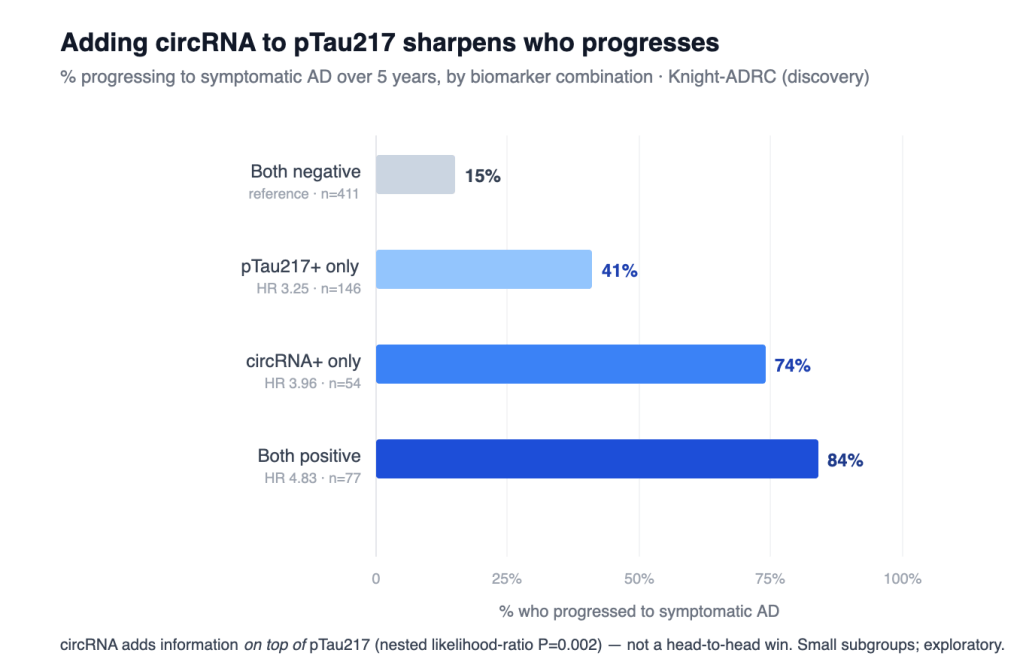
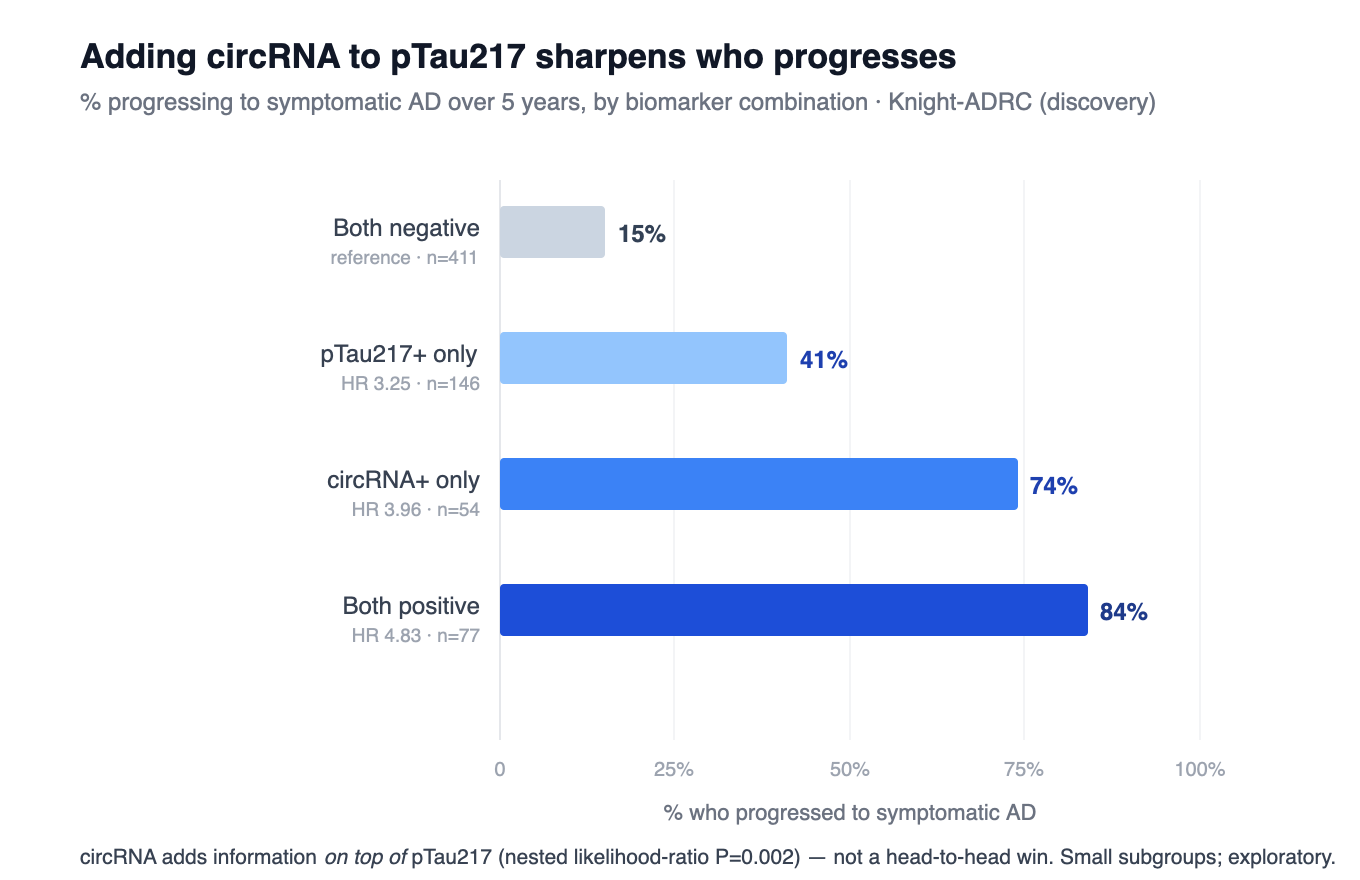
Progression prediction. Here the formal test is significant. The progression hazard ratio is 2.92 (95% CI 1.63–5.23) for circRNA versus 1.81 (1.11–2.94) for pTau217 — confidence intervals that overlap broadly, so this is not a head-to-head win. What is supported is the increment: adding circRNA on top of pTau217 in a nested model improves it (likelihood-ratio P = 0.002), the combined model reaches HR 4.58, and the signal reproduces across three cohorts (HR 2.92 / 3.83 / 2.93).
So what changes?
The clinical foundation — pTau217 as a blood marker of AD pathology — does not move. What this study opens is a shift from “status classification” toward “conversion-trajectory prediction,” and even that is incremental and preliminary. The question for the field is whether the incremental progression signal holds up in the populations where a test would actually be used.
Deep dive
1. Background: the bar a new blood marker has to clear
Blood-based AD biomarkers have matured quickly. Plasma pTau217 identifies AD pathology at accuracy approaching amyloid-PET and spinal fluid (ALZpath pTau217 AUC ≈ 0.92–0.96; Ashton et al. 2024) and is already the de-facto reference analyte for research and some commercial services. A new blood marker therefore has to show not “as accurate as pTau217” but “adds something pTau217 does not.”
circRNAs are a biologically plausible candidate: their covalently closed loop resists exonucleases, giving greater blood stability than linear mRNA or miRNA, and a brain-tissue atlas exists as prior work (Dube et al. 2019). This study tries to carry that into a blood-detectable, multi-pathway signature.
2. What the study found
Phillips et al. selected a 34-circRNA panel in a discovery cohort (Knight-ADRC, n = 1,221; 405 AD / 816 cognitively unimpaired) by association with clinical AD status, then applied the same weights and cutoff to independent cohorts (Knight-ADRC replication, n = 551; the A4 prevention trial, n = 1,767). Using genuinely independent cohorts rather than a single-set cross-validation is a point in the study’s favour.
(a) Diagnosis — context, not the story. For biomarker-confirmed status (A+T+ vs A−T−), circRNA AUC was 0.945 in discovery and 0.863 in the Knight replication; integrated with pTau217, 0.967 / 0.955. On the amyloid-PET task the same model gave 0.757 (discovery), 0.771 (replication) and 0.723 (A4). The 0.945 is thus a best-case in-sample value on a spinal-fluid-defined contrast; honest out-of-sample performance is roughly 0.72–0.86 depending on the task.
(b) Progression — the actual contribution. For progression to symptomatic AD, circRNA HR reproduced across three cohorts (2.92 / 3.83 / 2.93), and adding it on top of pTau217 was significant (nested likelihood-ratio P = 0.002); the combined model reached HR 4.58. Stratifying by both markers (see figure), 15% of double-negatives progressed versus 84% of double-positives. circRNA scores began separating from normal roughly 2–4 years before symptom onset. The panel also performed poorly in non-AD dementias (AUC 0.41–0.55 for Parkinson’s, Lewy-body and frontotemporal dementia), which supports AD specificity.
3. Methodological strengths and limits
Strengths. External validation across three cohorts (≈2,400 people) is ahead of the typical discovery-only study. Porting frozen weights to independent cohorts and seeing diagnosis fall only modestly (0.945 → 0.863) and the amyloid-PET task barely move (0.757 → 0.726 on held-back samples) suggests the optimism is not catastrophic. The progression signal reproduced three times, and the low performance in non-AD dementias argues for specificity.
Limits.
- In-sample optimism. The 0.945 model was fitted in the discovery cohort, and the paper reports no cross-validation, held-out split, permutation or bootstrap. Read 0.945 as an apparent value; the defensible out-of-sample range is ~0.72–0.86.
- Label mismatch (a whiff of circularity). The 34 features were selected on clinical AD status, but the headline diagnostic AUC is reported against biomarker-defined (PET/CSF) labels. Selecting on one label and reporting on another leaves room for optimism.
- Diagnostic superiority is untested. There is no formal test for 0.945 vs 0.877 (the abstract says “comparable”), and the replication cohorts carry no direct circRNA-vs-pTau217 diagnostic comparison — so even the descriptive edge rests on discovery alone.
- Progression is incremental, not superior. The circRNA and pTau217 hazard ratios have widely overlapping confidence intervals (2.92 [1.63–5.23] vs 1.81 [1.11–2.94]). The strongest honest claim is the nested likelihood-ratio increment (P = 0.002), not superiority. Unless progression was a pre-specified primary endpoint (not evident in the text), it should not be described as one.
- One progression number to quote carefully. A five-year progression AUC comparison (0.870 vs 0.676) carries P = 1.86 × 10⁻⁵, but the paper does not state how that AUC comparison was tested (no DeLong or bootstrap named), so it should not be cited on its own; the likelihood-ratio P = 0.002 is the cleaner basis.
- Small events, small subgroups. Progressors number 78 / 61 / 97; the pre-symptomatic-divergence bins hold n = 18–33; and in the ancestry check the African-ancestry sample is n = 38 with just 4 AD cases. The 2–4-year lead time and the cross-ancestry robustness are preliminary.
- Pre-analytical sensitivity. circRNA measurement is sensitive to blood collection and processing, so standardization is a gate before any clinical use.
4. Neighbouring domains
Oncology’s liquid-biopsy ML architecture. A 34-marker, multi-pathway signature feeding an ML classifier is the same design pattern already validated in cancer liquid biopsy (multi-signature panels plus a classifier), now spreading into neurodegeneration — and it inherits the same risks: overfitting, batch effects, and label-definition circularity.
CKM × neuro. circRNAs are also being studied as blood markers in heart failure, chronic kidney disease and metabolic disease, so the same assay infrastructure (RT-qPCR / sequencing) could be reused along the brain–vascular–metabolic axis. The authors flag the effect of AD-related comorbidity on circRNA levels as unresolved — and confounding in diabetic, renal or cardiovascular populations is exactly the sort of question a cardio-kidney-metabolic reader should keep in view.
5. Commercialization and market context (TRL, companies)
This is a TRL 4 result — validated in research cohorts, not in an intended-use clinical population; the authors themselves call for “larger, diverse prospective clinical cohorts.” A CLIA/laboratory-developed-test route could reach research or early-commercial use in perhaps 12–24 months, though the 2024 tightening of US LDT oversight narrows that path; a formal IVD clearance (FDA de novo / 510(k)) would be a multi-year effort. The company has not publicly specified its regulatory route.
Companies in the frame (facts only; public vs private separated):
- Private: Circular Genomics (commercializing this panel as its CircPATH platform); C2N Diagnostics (PrecivityAD2, a pTau217-class test).
- Public: Quanterix (NASDAQ: QTRX, Simoa); Fujirebio / H.U. Group (Tokyo: 4544, Lumipulse pTau217); Roche (SIX: ROG, Elecsys blood AD).
- Therapeutic demand side (public): Eisai (4523) / Biogen (BIIB) and Eli Lilly (LLY), for selecting anti-amyloid-therapy candidates.
Company claims vs peer-reviewed values. Circular Genomics’ press materials use language such as “breakthrough performance,” an asymptomatic-progression “AUC 0.870,” and “61% stronger prediction than pTau217.” These are company (vendor) framings and should be read separately from the peer-reviewed text, which supports an incremental progression contribution (likelihood-ratio P = 0.002), not diagnostic superiority.
6. The skeptic’s bottom line
A final skeptical read rates this a conditional proceed, not a clean pass.
- Reading AUC 0.945 as early-diagnosis performance overstates it — it is an in-sample, spinal-fluid-defined best case; the like-for-like external value is 0.863, and A4’s 0.723 is a different task.
- Diagnostic superiority over pTau217 is untested (the abstract says “comparable”), with no direct comparison in the replication cohorts, and a label mismatch between feature selection and reporting.
- Progression is an increment, not a win: overlapping hazard-ratio intervals; the defensible claim is the nested likelihood-ratio (P = 0.002) plus three-cohort reproduction and the combined HR 4.58.
- The five-year AUC-comparison P value has no stated method and should not be quoted alone.
- Small events and subgroups (progressors 78 / 61 / 97; divergence bins n = 18–33; African-ancestry n = 38 with 4 AD) make the lead-time and cross-ancestry claims preliminary.
All figures here were checked line-by-line against the primary paper; what remains open is clinical generalization, since the validation cohorts skew toward US, highly educated volunteers.
7. What to watch
- Whether the incremental progression signal (circRNA on top of pTau217) reproduces in large, diverse, prospective clinical cohorts.
- Whether the 2–4-year pre-symptomatic divergence survives beyond the small bins (n = 18–33) as a pre-specified endpoint.
- Pre-analytical standardization (collection/processing protocols) and a specified regulatory path (CLIA/LDT vs IVD).
- Whether specificity holds in cardio-kidney-metabolic comorbidity (confounding).
- Whether the company’s headline numbers (e.g. AUC 0.870, “61% stronger”) are reproduced and formally tested in later peer review.
References
- Phillips, Bridget, Jessie Sanford, Vaibhav A. Janve, Menghan Liu, Matt Johnson, Katherine Gong, et al. (Carlos Cruchaga, corresponding; Washington University / Knight-ADRC). 2026. “Blood-based circular RNAs for early diagnosis of Alzheimer’s disease.” Nature Medicine, July 1. doi:10.1038/s41591-026-04485-5. (PMID 42387213)
- Ashton, Nicholas J., et al. 2024. “Diagnostic Accuracy of a Plasma Phosphorylated Tau 217 Immunoassay for Alzheimer Disease Pathology.” JAMA Neurology 81 (3): 255–263.
- Dube, Umber, et al. 2019. “An atlas of cortical circular RNA expression in Alzheimer disease brains demonstrates clinical and pathological associations.” Nature Neuroscience 22 (11): 1903–1912.
Disclosure
This post is for information only and is not medical or investment advice; clinical decisions should be based on individual patients and current guidelines. The author holds no position in, and has no direct financial interest in, any company named here (Quanterix, Fujirebio / H.U. Group, Roche, Eisai, Biogen, Eli Lilly; or the private companies Circular Genomics and C2N Diagnostics).
Note on a competing interest in the source paper. The corresponding author, Carlos Cruchaga, is a paid consultant to and has a 2023 research partnership with Circular Genomics, the company commercializing this panel as CircPATH. This is stated as a fact, not an allegation of misconduct; it is why the company’s own figures (“breakthrough,” “61% stronger than pTau217,” “AUC 0.870”) are labelled as company claims and kept separate from the peer-reviewed values above. Readers should weigh company claims and paper values accordingly.


Leave a Reply