Evidence-first notes on bioscience, at the edge of the clinic and the market. Information only — not medical or investment advice.
The 30-second version
- What. A new individual-participant-data meta-analysis in Nature Medicine (1 July 2026) pooled 51 randomized trials and 357,314 people to ask a deceptively simple question: does the relative cardiovascular benefit of blood-pressure lowering get bigger the longer you stay on treatment? The answer: no. The benefit is established within months and then stays flat — if anything it attenuates slightly (P for trend = 0.006).
- So what. This is not evidence that the drugs stop working. In the authors’ own subgroup of adherent patients (≥80% of doses), the attenuation disappears (>5-year HR 0.84, essentially the same as year one). And the absolute benefit keeps compounding: the number-needed-to-treat falls from 337 at one year to 80 at five. “No compounding of the relative effect” is a world away from “no point taking it long term.”
- Now what. The defensible clinical message is: don’t justify lifelong adherence with a promise that the proportional benefit keeps growing — justify it with baseline risk and accumulating absolute benefit. The interesting scientific frontier is re-analyzing this same dataset with causal-inference machinery to separate genuine biological attenuation from selection and non-adherence dilution.
The five-minute read
Taking a piece of clinical folklore apart along the time axis
“The longer you keep your blood pressure down, the more cardiovascular benefit you accrue — proportionally.” It is a natural story, and clinicians lean on it to argue for long-term adherence. This study tested it head-on. Using the Blood Pressure Lowering Treatment Trialists’ Collaboration (BPLTTC) resource, the authors took 51 trials (one of the original 52 was dropped for missing time-to-event data), split follow-up into discrete one-year windows (0–1 … >5 years), and fitted trial-stratified Cox models. Every effect estimate is standardized to a 5-mmHg reduction in systolic blood pressure.
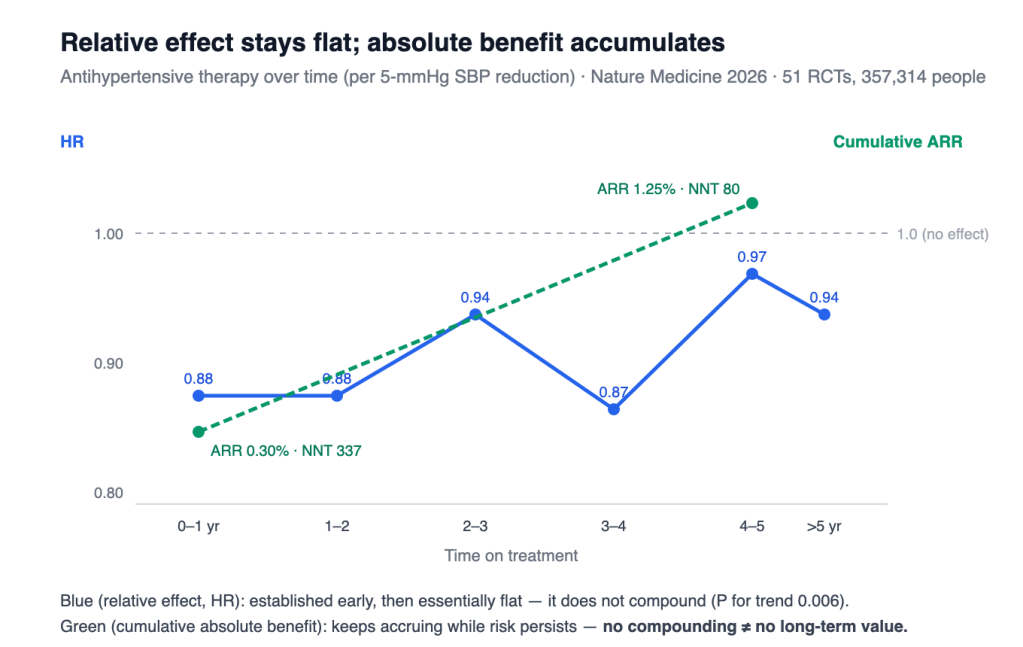
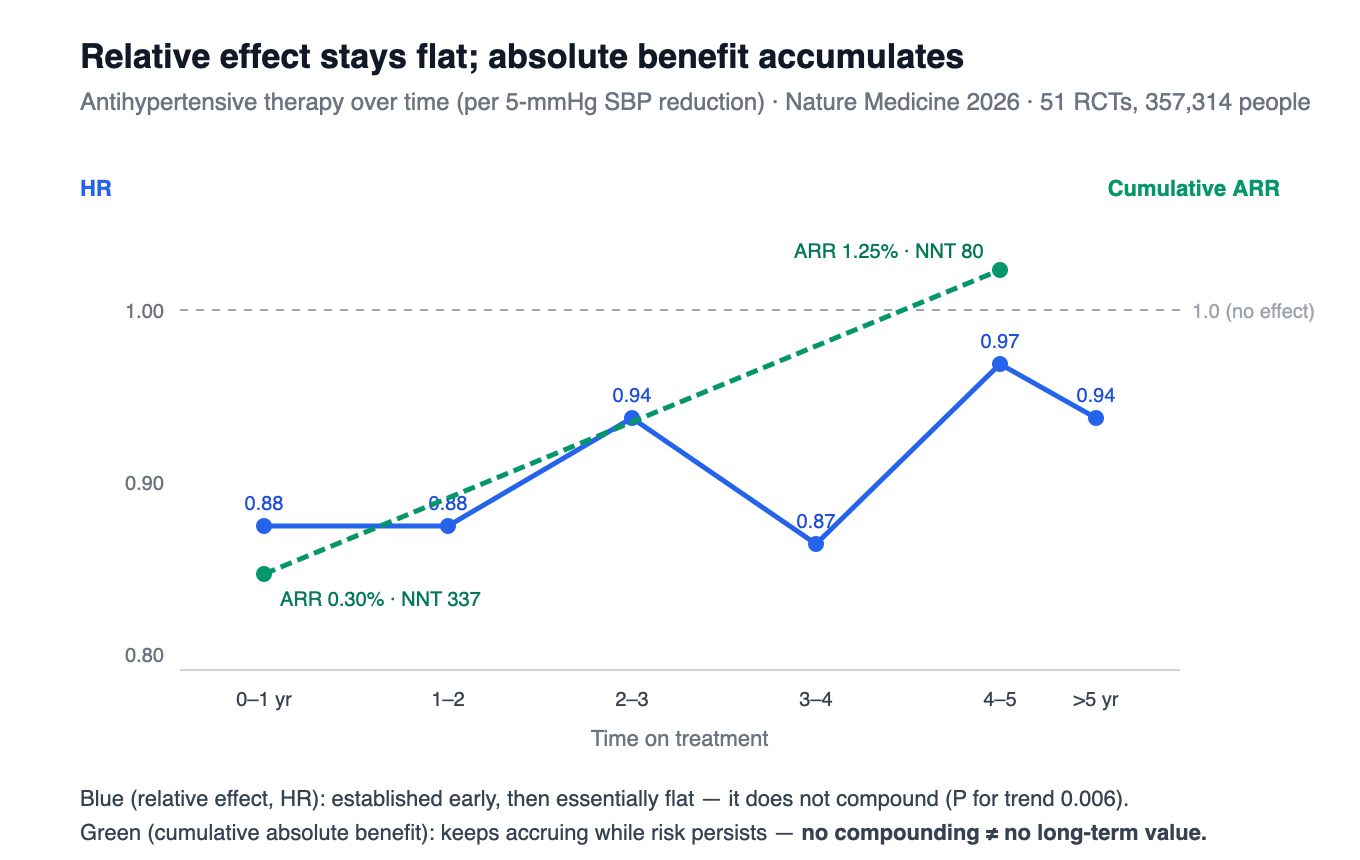
The result is undramatic in the best way. The hazard ratio for major adverse cardiovascular events (MACE) starts at 0.88 in year one and moves 0.88 → 0.94 → 0.87 → 0.97 → 0.94 across the windows — no growth over time. The formal test points, if anywhere, toward mild attenuation (P for trend = 0.006). Heart failure attenuates the most (year-one HR 0.73 → >5 years 1.02).
But the whole story turns on what “attenuation” actually is
Stop there and you invite a dangerous misreading. Two things have to be held apart.
First, the absolute benefit accumulates. Cumulative absolute risk reduction for MACE grew from 0.30% at one year to 1.25% at five, so the number-needed-to-treat dropped from 337 to 80. The proportional effect need not grow for the count of events you prevent to keep piling up — as long as risk is still there, more time on treatment means more events averted.
Second, much of the “attenuation” may not be the drug wearing off. In the authors’ own analysis restricted to adherent patients (≥80% of assigned medication, 12 trials), the attenuation is not evident: the >5-year MACE HR is 0.84 (0.71–0.99), statistically indistinguishable from the first-year 0.87 (0.82–0.93). In other words, the attenuation seen in the headline analysis cannot be separated from dilution by people quietly dropping their pills (or controls quietly starting them).
So what changes?
The foundation — that lowering blood pressure lowers cardiovascular risk — does not move. What gets challenged is one specific assumption: that the proportional benefit amplifies with duration. The authors’ recommendation, to anchor treatment decisions in baseline cardiovascular risk rather than an expectation of growing proportional effect, actually reaffirms the risk-based logic already in the ACC/AHA and ESC guidelines. From a cardio-kidney-metabolic (CKM) vantage point, this dovetails with a separate thread this week — the polypill / single-pill-combination literature — where the operative variable is again adherence rather than any new pharmacology (more on that below; the causal direction is still unsettled).
Deep dive
1. Background: the “statins compound, does BP?” question
That blood-pressure lowering reduces cardiovascular events is settled by decades of landmark evidence. The 2021 BPLTTC analysis put the number at roughly a 10% reduction in major cardiovascular disease per 5-mmHg drop in systolic BP (HR ≈ 0.90), broadly constant across baseline pressures. SPRINT showed intensive control (<120) cutting the primary composite by 25% versus standard, with the benefit emerging early.
The open question was resolution along the time axis. Cholesterol lowering is known to compound: the Cholesterol Treatment Trialists found LDL-C lowering cuts risk by about 14% in year one but 20–30% in each subsequent year (P for interaction < 0.001). By analogy, people assumed BP lowering would do the same, which fed “vaccine-like,” start-early prevention arguments. No trial was ever powered to test the analogy directly. This IPD analysis is the first to look: 51 trials pooling 358,642 people, of whom 357,314 formed the analytic cohort (1,328 were excluded for missing follow-up time).
2. What the paper actually found
The interval-specific MACE hazard ratios (per 5-mmHg SBP reduction):
| Window | HR (95% CI) |
|---|---|
| 0–1 yr | 0.88 (0.84–0.91) |
| 1–2 yr | 0.88 (0.85–0.92) |
| 2–3 yr | 0.94 (0.90–0.98) |
| 3–4 yr | 0.87 (0.83–0.92) |
| 4–5 yr | 0.97 (0.91–1.03) |
| >5 yr | 0.94 (0.87–1.01) |
| All follow-up | 0.90 (0.88–0.92) |
P for trend = 0.006, in the direction of mild attenuation rather than amplification. Annual MACE incidence went from 3.0% (treatment) vs 3.6% (control) in year one to 3.1% vs 3.4% beyond five years. Cumulative absolute risk reduction, by contrast, rose from 0.30% (0.20–0.40) to 1.25% (0.94–1.57) over five years — NNT 337 → 80. Heart failure showed the sharpest attenuation (year-one HR 0.73, 0.65–0.80 → >5 years 1.02, 0.85–1.23), which the network meta-analysis attributes largely to thiazide diuretics, whose early anti-heart-failure effect (year-one HR 0.40) fades fast.
The pivotal finding is the adherence subgroup. Among adherent patients the attenuation is gone (>5-year HR 0.84 ≈ year-one 0.87), which is the authors themselves signalling that a good part of the observed attenuation is drop-out / drop-in dilution rather than loss of pharmacological effect.
3. Methodological strengths — and where the causal label is thin
Strengths. This is the largest IPD resource to date; trial-stratification absorbs some between-trial heterogeneity; effects are standardized per 5-mmHg; and the authors stack sensitivity analyses (continuous-time Cox, inverse-probability-of-censoring weighting, adherence restriction, a five-class network meta-analysis). Crucially, they describe absolute accrual and proportional non-amplification separately, which pre-empts the obvious misread.
Where it is thin. The result is robust; the causal label (“there is no long-term proportional benefit”) is not. Four points, most-serious first:
- The paper’s provocative conclusion is undercut by its own subgroup. If restricting to adherent patients erases the attenuation, then the headline “no compounding” is at least partly a dilution artifact, not a biological fact.
- Survivor bias / an evolving risk set. Contributors to later windows are a selected, lower-risk population who dodged early events, so time-stratified HRs drift structurally toward 1.0. “P for trend = 0.006” can be a signature of selection rather than causation. Randomization only protects the baseline comparison; every interval- and adherence-stratified contrast here is a post-randomization, observational-grade comparison.
- The attenuation signal is model-dependent. In the discrete-interval model MACE shows P for trend = 0.006, but in the authors’ own continuous-time (counting-process) Cox model the time-interaction for MACE is not significant (interaction HR 1.014 per log-year, 0.998–1.030, P = 0.095). The only outcome with a robust continuous-time attenuation is heart failure (P < 0.001). So the direction (“no amplification”) is solid in every model, but the stronger claim (“it attenuates”) largely rests on heart failure and on how you discretize time.
- Multiplicity. Six time windows × several endpoints × age/sex/diabetes strata × five drug classes is a large surface of post-hoc comparisons, reported without correction for multiple testing (the authors say so). Local findings deserve a discount.
4. A neighbouring-domain hook: this is a causal-inference problem in disguise
The core difficulties here — time-varying confounding, an evolving risk set, survivor bias — are exactly the objects of the causal-ML literature on target-trial emulation and marginal structural models. Re-analyzing this dataset with g-methods (g-formula, MSM) or landmarking plus a doubly-robust estimator could, in principle, decompose the attenuation into “genuine biological fade” versus “selection / non-adherence dilution.” That is a well-posed bioscience × AI project, and arguably the most valuable follow-up anyone could run on this data.
There is a second thread worth naming. If a paper’s headline can be flipped by an adherence subgroup, then measured adherence — smart pill bottles, continuous BP and medication sensing — stops being a soft covariate and becomes core data infrastructure for de-confounding future IPD analyses. The variable that decides the conclusion should be the variable you instrument best.
5. The commercialization overlay (kept separate on purpose)
This is an evidence-reappraisal study, not a product, so there is no product TRL to assign. The commercial implications are indirect and, importantly, second-order:
- Generic antihypertensives. ARBs, ACE inhibitors, CCBs and thiazides are mostly off-patent commodities. A “no long-term proportional amplification” narrative weakens any premium-drug marketing built on growing long-term relative effect, and shifts the competitive axis toward early / absolute benefit and adherence — which strengthens the rationale for single-pill combinations (SPCs) and adherence-friendly formulations.
- CKM combination therapy. The study does not touch SGLT2 inhibitors, finerenone or GLP-1 receptor agonists. But if the BP-lowering proportional effect saturates early, the evidentiary space for residual-risk combination therapy gets relatively larger — a hypothesis, not a finding.
- Digital adherence. Because the adherence subgroup reversed the result, measurable adherence (connected pill bottles, continuous BP/medication sensing) has a fresh claim to being both real clinical value and the data layer that future de-confounding will require.
6. The skeptic’s bottom line
Read against its own subgroup and its own continuous-time model, this paper firmly rules out amplification of the proportional benefit, but its stronger “it attenuates” framing does not survive intact. The honest summary: the observed long-term attenuation is not evidence that the drug stops working — it is inseparable from non-adherence and survivor bias; reading “no proportional compounding” as “no point in long-term treatment” is clinically dangerous; and the absolute benefit accumulates the whole time (NNT 337 → 80).
7. What to watch
- A g-methods / target-trial-emulation re-analysis of this dataset that decomposes the attenuation into selection versus non-adherence.
- Time-stratified re-reads of intensive-control extensions (SPRINT, ESPRIT).
- Long-term hard-outcome trials of SPCs and adherence-improving formulations — the test of whether better adherence actually converts into events prevented.
References
- Blood Pressure Lowering Treatment Trialists’ Collaboration. “A meta-analysis of the long-term effects of antihypertensive therapy on the risk of major cardiovascular disease across 51 randomized trials.” Nature Medicine, 1 July 2026. doi:10.1038/s41591-026-04514-3. (Corresponding author: K. Rahimi, University of Oxford.)
- BPLTTC. “Pharmacological blood pressure lowering for prevention of cardiovascular disease across different levels of blood pressure: an individual participant-level data meta-analysis.” The Lancet 397 (2021): 1625–1636.
- BPLTTC. “Age-stratified and blood-pressure-stratified effects of blood-pressure-lowering pharmacotherapy…” The Lancet 398 (2021): 1053–1064.
- SPRINT Research Group. “A Randomized Trial of Intensive versus Standard Blood-Pressure Control.” New England Journal of Medicine 373 (2015): 2103–2116.
Disclosure
This post is for information only and is not medical or investment advice; clinical decisions should be based on individual patients and current guidelines. The author holds no position in and has no direct financial interest in any of the categories mentioned (generic antihypertensives, single-pill combinations, SGLT2 inhibitors / finerenone / GLP-1 receptor agonists, or digital-adherence solutions). All figures were independently verified against the primary paper; the diagram is an original construction from the reported data and reproduces no copyrighted figure.


Leave a Reply