Tag: TRL
-
The memory wall and advanced packaging: the new Moore’s Law is bandwidth, not transistors
Evidence-first notes on bioscience and deep tech, at the edge of the lab and the market. Information only — not investment advice. The 30-second version What. Inside the AI accelerator, the rate-limiting step is no longer logic (FLOPs) but memory bandwidth and the packaging that attaches it. If Moore’s Law was a transistor-density game, the…
-
Computing power, now and next: a landscape map — where is the real bottleneck?
Evidence-first notes on bioscience and deep tech, at the edge of the lab and the market. Information only — not investment advice. The 30-second version What. Computing-power debates compress into headline metrics (node nm, “N-times faster,” qubit counts, TB/s), but the step that actually blocks real use sits systematically next to those numbers. The landscape’s…
-
Computing’s Single Point of Failure: Why the Semiconductor Supply Chain Is Tied to a Few Places on the Map
Evidence-first notes on bioscience and deep tech, at the edge of the lab and the market. Information only — not investment advice. The 30-second version What. The ultimate bottleneck for AI and computing is neither chip performance (physics) nor capital (economics), but a geopolitical structure in which advanced logic, EUV lithography, HBM, and upstream materials…
-
The honest TRL of post-CMOS: the gap between headline qubit counts and the “when is it useful?” question
Evidence-first notes on bioscience and deep tech, at the edge of the lab and the market. Information only — not investment advice. The 30-second version What. For post-CMOS alternatives (quantum, neuromorphic, photonic and others), the real question is not “does it work?” but “when does it become useful?” The estimated resources to break RSA-2048 have…
-
What died is not Moore’s Law but its economics
Evidence-first notes on bioscience and deep tech, at the edge of the lab and the market. Information only — not investment advice. Computing-power series, Part 3. The 30-second version What. The real bottleneck hidden behind the “node in nm” headline is not physics but economics — density keeps rising, but the decline in cost-per-transistor ($/transistor)…
-
Power is the bottleneck — what actually fills AI’s 2028-2030 electricity gap
Evidence-first notes on bioscience and deep tech, at the edge of the lab and the market. Information only — not investment advice. The 30-second version What. AI compute demand doubles roughly every 5-6 months, and the binding constraint on scaling has shifted from silicon efficiency to physical grid capacity. A data center takes 2-3 years…
-
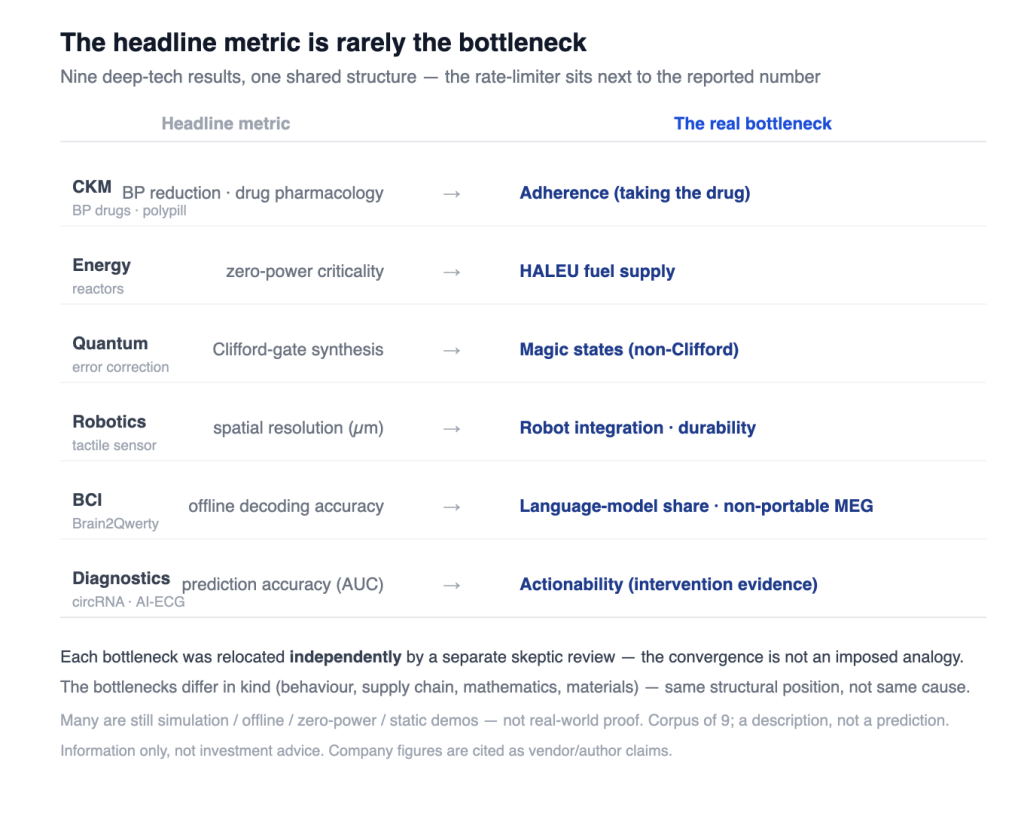
The headline metric is rarely the bottleneck — one structure shared by nine deep-tech results
Evidence-first notes on bioscience and deep tech, at the edge of the lab and the market. A cross-domain synthesis, not a single-paper analysis. Information only — not investment advice. The 30-second version What. Across nine seemingly unrelated deep-tech results we covered over two weeks — blood-pressure drugs and a heart-failure polypill, an ECG-AI biomarker, a…

