Evidence-first notes on bioscience and deep tech, at the edge of the lab and the market. Information only — not investment advice, not medical advice. All success-rate, affinity and kcat/KM figures are attributed to the primary paper (Nature/Science) or company IR, with the media tier noted inline. Reported success rates are relative to the candidates that were experimentally tested, not to all generated candidates. Demonstration of binding or catalytic activity is kept separate from therapeutic validation. As of late 2025 there are zero marketed, approved de novo AI-designed protein drugs.
The 30-second version
- What. “Does AI design ship real function?” is not a single yes/no question — function is a ladder, and the wet-lab bottleneck tightens step by step as you descend. Protein-protein binders sit on top (a target-structure-only pipeline from Cao et al., Nature 2022, plus a deep-learning AlphaFold2/RoseTTAFold filter that raised experimental hit rate roughly 10x — attributed to Bennett et al., Nat Commun 2023 — and BindCraft, Nature 2025, a one-shot nM binder design with 10–100% experimental success). De novo enzymes sit in the middle (a de novo serine hydrolase, Science 2025, kcat/KM up to 2.2×10⁵ M⁻¹s⁻¹ — activity is demonstrated but far below natural enzymes). Antibodies sit at the bottom (RFdiffusion-antibody, Nature 2025 — the paper itself states the success rate is low).
- So what. The honest reading is modality-specific. Binding is close to “solved” for accessible targets; catalysis “works, but weakly” (kcat/KM well under the ~10⁶–10⁸ range typical of natural enzymes); antibodies hit atomic-level structural accuracy but early affinities are only μM to a few hundred nM, and therapeutic-grade nM affinity was reached by wet-lab evolution (OrthoRep), not by the AI design itself. Demonstration of binding or activity is not therapeutic validation — and the final signal of that gap is that there are zero approved de novo AI-designed protein drugs as of late 2025.
- Now what. The lowest rung — therapeutic validation — has not been cleared by anyone. Absci’s ABS-101 (anti-TL1A), one of the most advanced examples, is in Phase 1 (interim safety/PK only, not efficacy), and the company has since decided to seek a partner and pause further internal clinical development. SKYCovione (I53-50 nanoparticle vaccine) is approved but is a Rosetta-based computational scaffold with a natural antigen — distinct from a “de novo AI-designed drug.” The claim that “AI has already solved function / is a discovery engine” is overstated (refuted): it holds for binders, not across the ladder.
The five-minute read
Function is the layer the wet lab bites hardest — and each rung differs
Part 0 split the landscape into three layers (prediction, design engine, function), and Part 2 covered how the design engine (RFdiffusion, ProteinMPNN, BindCraft) builds backbones and sequences. Part 3 is the layer where those outputs are translated into actual function — binding, catalysis, neutralization. The firm’s recurring lens (“the headline is the starting point; the real bottleneck is elsewhere”) bites hardest here. The key insight is that “does AI design ship function?” is not a single yes/no: function is a ladder, and the wet-lab bottleneck tightens step by step as you go down.
Author’s provisional verdict: (1) binding is close to “won” — BindCraft ships nM binders one-shot without high-throughput screening; (2) catalysis “works, but is weak” — activity exists, but kcat/KM is far below natural enzymes; (3) antibodies “get the structure right to atomic resolution but the functional success rate is low” — the primary paper says so itself. And binding or catalytic demonstration is not therapeutic validation — the final signal of that gap is zero approved de novo AI-designed protein drugs.
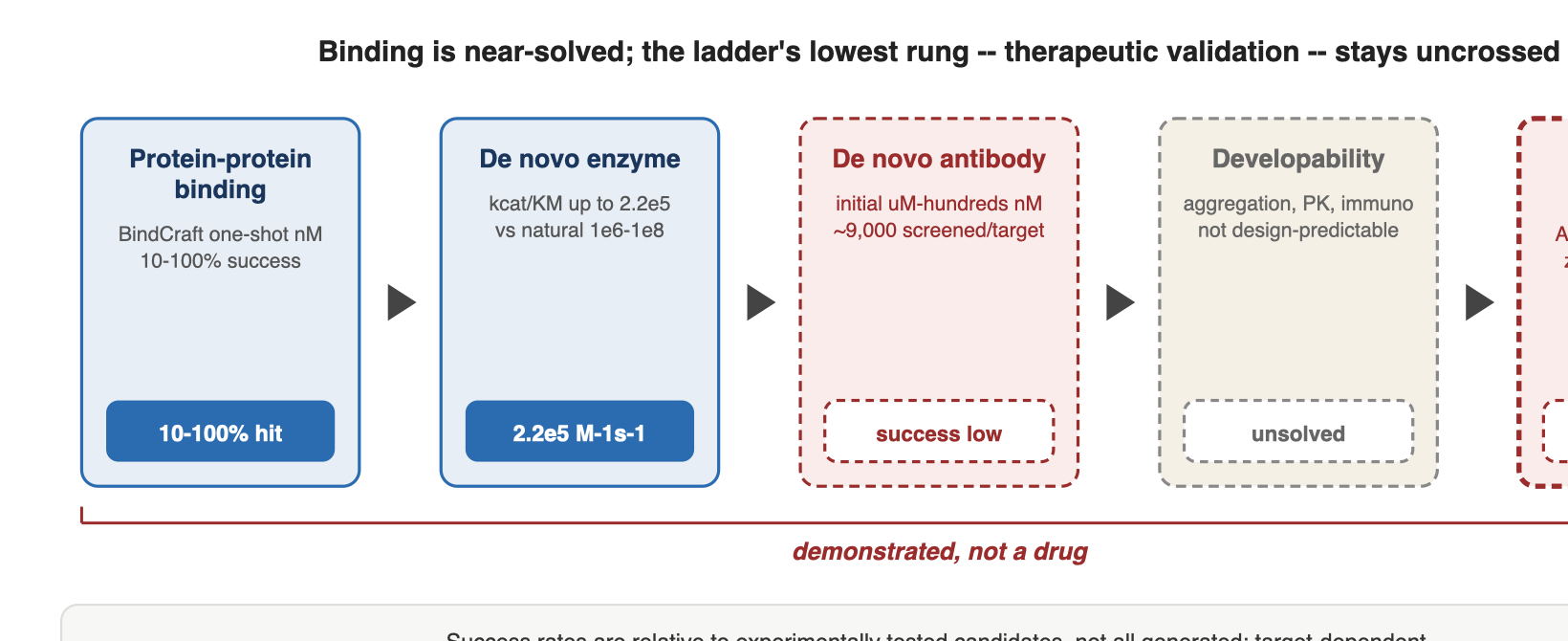
| Ladder rung (top = easier) | Representative achievement | Current position |
|---|---|---|
| ① Protein-protein binding (binder) | Cao 2022 pipeline + AF2/RF filter ~10x (Bennett 2023) + BindCraft 10–100% (2025) | Most mature — close to a discovery engine |
| ② Catalysis (de novo enzyme) | Serine hydrolase kcat/KM up to 2.2×10⁵ (Science 2025) | Activity demonstrated but far below natural enzymes |
| ③ Antibody affinity maturation | RFdiffusion-antibody (Nature 2025): early μM–hundreds nM → single-digit nM via OrthoRep | Paper itself states “success rate low” |
| ④ Developability (aggregation, stability, immunogenicity, PK) | (Not yet reliably predictable at the design stage) | Unsolved — Part 4 |
| ⑤ Therapeutic validation | Absci ABS-101 Phase 1 (interim safety/PK, not efficacy) | Zero approved |
Deep dive
1. Background — the function ladder and why the bottleneck differs by rung
Clinical value from a designed protein flows through a ladder: binding < catalysis < antibody affinity maturation < developability < therapeutic validation. Each rung down, the wet-lab bottleneck tightens. Part 0 mapped “function” as the bottleneck layer; Part 3 decomposes it by modality, because the answer to “does AI design ship function?” changes depending on which rung you stand on. Two disciplines set the pattern: interface geometry (for binders) is easier to preorganize than active-site geometry (for enzymes), which in turn is easier than the two-chain, CDR-loop combinatorics of antibodies. That ordering is the backbone of the whole section.
2. What this landscape establishes — binders on top (peer-reviewed)
Starting point (Cao 2022). The Baker Lab established a pipeline that designs binders from the target structure alone — no immunization, no screening — in “Design of protein-binding proteins from the target structure alone” (Cao et al., Nature 2022, 605:551–560). These are miniprotein binders built backbone-first to fit a target surface. But the initial pipeline’s experimental success rate was low (only a small fraction of tens of thousands of designs bound).
The decisive improvement — an AF2/RF filter for ~10x hit rate (Bennett 2023). What raised the success rate to a practical level was a separate follow-up: “Improving de novo protein binder design with deep learning” (Bennett et al., Nat Commun 2023; Baker Lab blog “Deep learning improves protein binder design tenfold”). Re-folding designed sequences with AlphaFold2/RoseTTAFold to check (i) whether the designed monomer structure forms and (ii) whether it binds the target as designed — an in-silico filter — raised the experimental success rate roughly 10x. About one million experimentally characterized designs (13 targets; 15,000–100,000 per target) validated the filter’s discriminative power.
Attribution precision: Part 0 bundled “AF2/RF filter ~10x” under Cao 2022, but precisely, Cao 2022 = the target-structure-only design pipeline and the ~10x improvement = the deep-learning filter of Bennett et al., Nat Commun 2023. The two contributions are attributed separately (evidence-first).
Latest frontier — BindCraft (Nature 2025). “One-shot design of functional protein binders with BindCraft” (Nature 2025, 646:483–492) uses AlphaFold2 weights directly to design nM-affinity binders one-shot, without high-throughput screening, reporting 10–100% experimental success across diverse targets (cell-surface receptors, allergens, de novo proteins, CRISPR-Cas9). This puts the binder rung closest to a “discovery engine” among all modalities. Skeptic footnote: the “10–100%” also means the target-dependence is extreme — some targets approach 100%, others 10% or lower. The honest statement is not “binders are solved” but “solved for easy target classes; hard targets (small, flat, uncharged epitopes) remain low.” Independent, prospective reproduction and per-target breakdown are deferred to Part 4.
3. De novo enzymes — catalysis works, but is far weaker than natural enzymes (peer-reviewed)
“Computational design of serine hydrolases” (Lauko et al., Science 2025) combined RFdiffusion’s generative capacity with an ensemble evaluation of active-site preorganization along each step of the reaction coordinate, designing a serine hydrolase from a minimal active-site description. Results: catalytic efficiency kcat/KM up to 2.2×10⁵ M⁻¹s⁻¹; crystal structure within Cα RMSD < 1 Å of the design model; and novel catalysts across five folds distinct from natural serine hydrolases — catalytic scaffolds not found in nature. Designing a complex active site that mediates a multi-step reaction (via a covalent intermediate) de novo, with crystallographic confirmation, is a top-of-difficulty achievement that goes beyond a mere demonstration.
Evidence hierarchy — activity ≠ natural-enzyme level: kcat/KM of 2.2×10⁵ demonstrates that activity exists, but it falls well short of the catalytic efficiency of natural enzymes (typically ~10⁶–10⁸ M⁻¹s⁻¹, approaching ~10⁸–10⁹ near the diffusion limit). So “AI designs enzymes” is true, while “AI designs natural-enzyme-grade catalysts” is not yet. The exact fold-over-natural gap is attributed to the paper’s tables and is treated here as unverified (quantified in Part 4). RFdiffusion2-based active-site scaffolding (Nature Methods 2025) is a subsequent line of improvement, but the efficiency gap is regarded as unresolved. Verdict: catalysis is the middle rung — a novel-fold active enzyme (existence proof) was shipped, but catalytic efficiency lags natural enzymes, too early for industrial or therapeutic use; the bottleneck is tighter than for binders because precise active-site preorganization is harder than an interface.
4. De novo antibodies — the paper itself states the success rate is low (peer-reviewed)
“Atomically accurate de novo design of antibodies with RFdiffusion” (Bennett et al., Nature 2025; PMC10983868) used fine-tuned RFdiffusion plus yeast-display screening to design and validate VHH and scFv binders to user-specified epitopes at atomic-level precision. The structural confirmation is striking: an influenza HA-binding VHH at backbone RMSD 1.45 Å vs cryo-EM (0.84 Å on the CDR3 prediction); a TcdB-binding scFv6 at fold RMSD 0.9 Å (0.2–1.1 Å per CDR).
But the paper states the success rate is low. Initial design affinities were modest — influenza HA 78 nM, TcdB 262 nM (initial), RSV site III 1.4 μM, SARS-CoV-2 RBD 5.5 μM — and roughly 9,000 VHH designs were screened per target to obtain a small number of validated binders. OrthoRep affinity maturation then reached single-digit nM (about two orders of improvement) while retaining epitope specificity. The paper’s explicit acknowledgement (quote ≤150 chars):
“the quite low experimental success rates currently necessitate the relatively high-throughput screening methods used in this study”
Three reasons the antibody sits at the bottom of the ladder. (1) Affinity-maturation bottleneck: initial designs are μM to a few hundred nM (weak); therapeutic-grade nM was reached by experimental evolution (OrthoRep), not by the AI design — so much of the key functional value (affinity) is the wet lab’s contribution. (2) Low success rate: 9,000 screened per target yielded few, in contrast to BindCraft’s one-shot binders — antibodies still require high-throughput screening (a hypothesis-generator character). And scFv (two chains) is combinatorially harder than VHH (single chain), requiring additional heavy-light chain pairing strategies. (3) Developability unverified: binding and epitope specificity were shown, but aggregation, stability, immunogenicity and PK — the real bottlenecks of therapeutic antibodies — are not reliably predictable at the design stage (Part 4). Verdict: antibodies have established atomic-level structural accuracy but functional success rate, affinity maturation and developability remain bottlenecks; conflating structural design with functional success rate turns “AI designs antibodies” into an overstatement.
5. Therapeutic and vaccine scaffolds — scaffolds have reached the field, but that is not a “de novo AI drug”
Computationally designed nanoparticle vaccine — SKYCovione (GBP510). A self-assembling two-component nanoparticle scaffold (I53-50) designed by the IPD (Baker/King Lab), displaying 60 copies of the SARS-CoV-2 RBD, developed by SK bioscience with AS03 adjuvant; approved in South Korea on 2022-06-29. In Phase 3 it induced roughly 3x the antibody response vs Oxford-AZ (interim, eClinicalMedicine 2023) — a rare case of a computationally designed protein scaffold reaching an approved product.
Distinction from a “de novo AI drug” (a core discipline): for SKYCovione the scaffold (I53-50) is computationally designed but via Rosetta-based deterministic docking (2010s) — not RFdiffusion / generative-AI diffusion — and the antigen (RBD) is natural, not de novo. So “computational protein design reached approval as a vaccine scaffold” is true, while “generative AI made and got approval for a de novo functional protein drug” is not; the two must not be conflated. (Note: production was indefinitely halted in 2022-11 on low demand — commercial failure is a separate tier from scientific achievement.)
Therapeutic antibody — Absci ABS-101 (Phase 1, company-IR tier). Absci positions its anti-TL1A antibody ABS-101 as de novo designed/optimized with generative AI (target structure → epitope specification → AI lead optimization). First-in-human Phase 1 dosing began 2025-05 (randomized, placebo-controlled, healthy volunteers). 2025-11 (Q3 IR) interim: an extended half-life vs first-generation anti-TL1A (though not an advantage vs next-generation programs), with zero SAEs and no ADA impact on PK. The company subsequently decided to seek a partner and pause additional internal clinical development after completing the ongoing Phase 1 (company IR).
Three-fold discipline: (1) binding/PK demonstration ≠ efficacy (therapeutic validation) — the ABS-101 interim is safety/PK, not IBD efficacy; Phase 1 is not an efficacy endpoint. (2) Attribution tier: the figures above are company IR (not peer-reviewed) — “best-in-class potential” is the company’s wording. (3) Design-modality honesty: Absci labels this “de novo generative-AI design/optimization,” but whether it is the same method as an RFdiffusion-type diffusion-backbone antibody cannot be asserted from public evidence (AI-optimization-centric); the precise meaning of “de novo” is attributed to the vendor. Decisive fact: as of late 2025 there are zero marketed, approved de novo AI-designed protein drugs. ABS-101 (one of the most advanced) is Phase 1, and after the interim it shifted to pausing internal development and seeking a partner. The lowest rung (therapeutic validation) has not been cleared by anyone.
6. The skeptic’s bottom line (proceed-with-caveats — conditional)
- Ladder position differs by modality: “AI ships function” is strong for binders, weak for enzymes (efficiency shortfall) and structure-only for antibodies (low functional success rate). Conflating these into one claim is an overstatement.
- The denominator of “success rate”: reported rates are relative to experimentally tested candidates (e.g., RFdiffusion-antibody screened ~9,000 per target), not to all generated candidates, and are target-dependent (BindCraft 10–100%).
- Activity ≠ natural-enzyme level: serine-hydrolase kcat/KM 2.2×10⁵ demonstrates activity but falls short of natural-enzyme efficiency (quantified gap in Part 4).
- Affinity maturation is the wet lab’s contribution: therapeutic-grade nM antibody affinity was reached by OrthoRep experimental evolution, not by the AI design.
- Demonstration ≠ therapeutic validation: binding/PK (ABS-101 Phase 1 interim) is not efficacy. There are zero approved de novo AI-designed protein drugs. SKYCovione is a computationally designed scaffold (Rosetta-based, natural antigen), distinct from a “de novo AI drug.”
- Cross-tool/vendor claims: different benches and targets are reported — no superiority ranking; vendor IR (Absci) figures are attributed and not peer-reviewed.
- Refuted: the claim that “AI design has already solved function / is a discovery engine that ships therapeutic-grade antibody affinity and natural-enzyme-grade catalysis” is overstated (antibody success rate stated low; therapeutic nM via OrthoRep; enzyme efficiency below natural; therapeutic validation zero).
7. What to watch (falsifiable)
- P1 (binders stay on top): by 2027, independent (non-original-author) groups will reproduce double-digit-% hit rates with BindCraft/AF2-filter methods across many novel targets, but small, flat, low-charge epitopes will drop below 10% (target-dependence persists). (Falsified by uniform high success rate regardless of target, or by broad independent-reproduction failure — tested in Part 4.)
- P2 (catalysis gap persists): de novo enzyme kcat/KM stays step-wise inferior to natural enzymes through 2027; improvement comes from fold diversity and reaction-type expansion, not from reaching natural-enzyme-grade efficiency. (Falsified if de novo enzymes repeatedly hit natural-enzyme-grade kcat/KM on new reactions.)
- P3 (movement of the “therapeutic validation zero”): the first de novo AI-designed protein (binder/enzyme/antibody) to move beyond binding/activity demonstration to a clinical efficacy readout (Phase 2+) would be decisive evidence of the “hypothesis-generator → discovery-engine” shift. With zero approvals today, the first efficacy readout is the touchstone (Absci/Xaira/Generate pipelines). ABS-101’s shift to pausing internal development / seeking a partner reads as an early signal that binding/PK does not translate directly into clinical success, but as a single program’s business decision it must not be over-extrapolated to modality failure.
References
- Cao et al. 2022. “Design of protein-binding proteins from the target structure alone.” Nature 605:551–560. https://www.nature.com/articles/s41586-022-04654-9
- Bennett et al. 2023. “Improving de novo protein binder design with deep learning.” Nature Communications (AF2/RF filter, ~10x hit rate). https://www.nature.com/articles/s41467-023-38328-5
- Baker Lab. 2023. “Deep learning improves protein binder design tenfold” (blog — vendor/lab tier). https://www.bakerlab.org/2023/05/08/deep-learning-improves-protein-binder-design-tenfold/
- 2025. “One-shot design of functional protein binders with BindCraft.” Nature 646:483–492 (10–100% experimental success). https://www.nature.com/articles/s41586-025-09429-6
- Lauko et al. 2025. “Computational design of serine hydrolases.” Science (kcat/KM up to 2.2×10⁵). https://www.science.org/doi/10.1126/science.adu2454
- Bennett et al. 2025. “Atomically accurate de novo design of antibodies with RFdiffusion.” Nature (paper states success rate is low). https://www.nature.com/articles/s41586-025-09721-5
- RFdiffusion-antibody, PubMed Central mirror (PMC10983868). https://pmc.ncbi.nlm.nih.gov/articles/PMC10983868/
- Absci. 2025. “Business Updates and Third Quarter 2025 Financial Results” (ABS-101 Phase 1 interim — company IR, not peer-reviewed). investors.absci.com/…/third-quarter-2025-financial
- Absci. 2025. “First Participants Dosed in Phase 1 Clinical Trial of ABS-101” (GlobeNewswire, 2025-05-13 — company). globenewswire.com/…/ABS-101-Phase-1-first-participants-dosed
- “Skycovione” (SKYCovione / GBP510 — I53-50 nanoparticle, South Korea approval 2022-06-29). Wikipedia. https://en.wikipedia.org/wiki/Skycovione
- UW Medicine. “UW Medicine COVID-19 vaccine wins South Korea approval” (SKYCovione approval). https://newsroom.uw.edu/news-releases/uw-medicine-covid-19-vaccine-wins-south-korea-approval
Disclosure
This post is for information only and is not investment advice, and not medical advice. Treatment decisions should always be made with your own clinician.
COI note: this post describes listed and private organizations in AI protein design (Baker Lab / Institute for Protein Design [IPD], Absci [ABSI], Meta/EvolutionaryScale, NVIDIA, SK bioscience, and private platforms Generate Biomedicines, Xaira Therapeutics, Profluent) in a descriptive, neutral context. Every success-rate, affinity and kcat/KM figure is attributed to its primary source, with the media tier labeled — peer-reviewed (Nature/Science) vs preprint vs company blog/IR. Absci ABS-101 figures are company IR (not peer-reviewed); “best-in-class potential” is the company’s wording. Reported success rates are relative to experimentally tested candidates, not to all generated candidates. Any figures or tables are re-drawn, not redistributed from the original papers. Quantitative claims are attributed to the vendor, author or preprint. Demonstration of binding or catalytic activity is not therapeutic validation; there are zero approved de novo AI-designed protein drugs as of late 2025. Competitive and platform statements are factual, neutral descriptions and are not buy/sell implications for any security. The author holds no position in, and has no financial interest in, the companies named.


Leave a comment