Evidence-first notes on bioscience and deep tech, at the edge of the lab and the market. Information only — not investment advice, not medical advice. All reduction and outcome figures are attributed to the sponsoring trial or company; some are company press releases rather than peer-reviewed data (noted inline). The eplontersen result below is a top-line press release only — full data are pending at ESC 2026-08.
The 30-second version
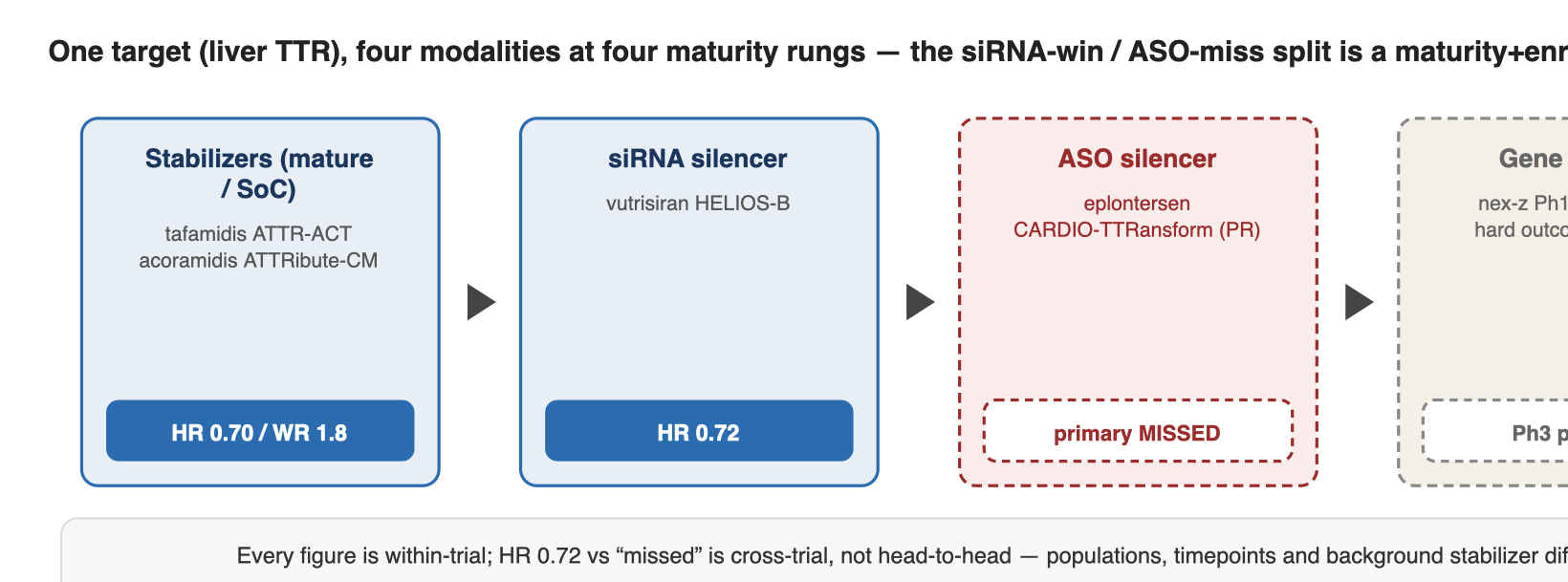
- What. Transthyretin amyloid cardiomyopathy (ATTR-CM) is a progressive heart-failure phenotype in which liver-made transthyretin (TTR) misfolds and deposits in the myocardium. The target is a single protein, yet four modalities compete at once: (1) tetramer stabilizers (tafamidis, acoramidis), (2) siRNA silencers (vutrisiran), (3) antisense oligonucleotide (ASO) silencers (eplontersen), and (4) one-shot gene editing (nex-z / NTLA-2001). Because the target is shared, this is a rare natural experiment in whether how you hit TTR actually changes hard outcomes.
- So what. The event that triggered this series: the same “silencer” idea split. siRNA (vutrisiran) succeeded in HELIOS-B (overall HR 0.72, p=0.01; NEJM 2025), while ASO (eplontersen) missed its primary endpoint in CARDIO-TTRansform (AZ/Ionis press release, 2026-07-09). The key point: this split is NOT settled by modality — there is no head-to-head trial; every comparison here is cross-trial. The likelier driver is trial design and enrollment: HELIOS-B ran ~60% stabilizer-free (monotherapy), whereas CARDIO-TTRansform ran ~81% on a background stabilizer — a much higher bar to prove add-on benefit.
- Now what. eplontersen’s monotherapy subgroup HR 0.71 is a nominal figure under a FAILED primary endpoint — multiplicity-uncorrected and hypothesis-generating, not confirmatory (provenance: Businesswire PR, 2026-07-08; full data ESC 2026-08). Separately, the editing arm’s FDA holds on the MAGNITUDE program (Grade 4 liver event, one death) have since been LIFTED (MAGNITUDE-2 January 2026, MAGNITUDE March 2026) with liver mitigations; the death’s direct cause is attributed to septic shock, and editing causality is not established — this must not be read as “editing killed the patient.”
The five-minute read
One target, four modalities — and why the split matters
ATTR-CM starts upstream of the heart. The TTR tetramer, made in the liver, dissociates into monomers that misfold, aggregate and deposit as amyloid in the myocardium, producing wall thickening, restrictive physiology and an HFpEF/HFmrEF (preserved / mildly-reduced ejection fraction) heart-failure phenotype. Two forms exist: wild-type (ATTRwt, older men, most common) and hereditary/variant (ATTRv, e.g. V122I, T60A). Long under-diagnosed, ATTR-CM is better described as a large, under-recognized market than a truly rare one — screening HFpEF patients with left-ventricular wall thickening has flagged roughly 13% as undiagnosed ATTRwt. Non-invasive bone scintigraphy (Tc-99m-PYP/DPD; Perugini grade II/III uptake plus exclusion of a monoclonal gammopathy) now allows diagnosis without biopsy — the demand-side engine behind the market.
Because the target (TTR) is shared, the interesting question is not “what to hit” but “does the way you hit it separate on hard outcomes (death, cardiovascular events)?” The firm’s recurring lens applies: the headline reads “siRNA wins, ASO loses,” but the bottleneck may sit one layer below, in trial structure and enrolled population. [diagram placeholder]
What separated siRNA-success from ASO-miss — the leading hypothesis
Attribution first: all figures below are within-trial. HR 0.72 (vutrisiran) versus “missed” (eplontersen) is cross-trial, not head-to-head — populations, timepoints and background therapy differ, so no superiority can be declared. With that guardrail, three hypotheses narrow the split.
| Hypothesis | Evidence | Verdict |
|---|---|---|
| (a) Modality itself (siRNA vs ASO) | Both silence liver TTR production to ~80%+ (from neuropathy programs); a head-to-head serum-TTR comparison in the CM population is unverified | Weak driver |
| (b) Trial design / background therapy | HELIOS-B ~40% on tafamidis, ~60% (395) monotherapy (prespecified monotherapy HR 0.67); CARDIO-TTRansform ~81% on a stabilizer (57% baseline + 24% on-study) | Leading driver |
| (c) Timepoint / endpoint / power | CARDIO primary at Week 140 (~2.7y) vs HELIOS-B up to 42 months; CV-death+recurrent-CV vs all-cause-death+recurrent-CV (different denominators) | Contributory |
Deep dive
1. Background — disease, target, diagnosis and the CKM contact
ATTR-CM is the heart-failure extreme of the cardio-kidney-metabolic (CKM) spectrum, the Principal’s Medical-Affairs axis. Unlike the metabolic heart failure that SGLT2 inhibitors, GLP-1 agonists and finerenone address, here the misfolding of a single protein is the cause, giving these agents a clearer disease-modifying character. Pathophysiology: TTR tetramer → monomer dissociation → misfolding/aggregation → myocardial extracellular amyloid → wall thickening and restrictive physiology → HFpEF/HFmrEF. Epidemiology is dominated by under-diagnosis; the non-invasive PYP/DPD scintigraphy pathway (Perugini II/III uptake plus gammopathy exclusion) converts recognition into treatable demand. Korean HFpEF/HFmrEF cohorts have also reported ATTR-CM detection, giving the topic a regional CKM contact.
2. What this landscape establishes — trials, endpoints and results (trial-attributed)
Principle: every figure is reported as in the source and attributed to its trial; within-trial results are not head-to-head comparisons.
| Modality | Drug (brand / company) | Phase 3 | Key result (source) |
|---|---|---|---|
| Stabilizer | tafamidis (Vyndaqel/Vyndamax, Pfizer) | ATTR-ACT (N=441, 30 mo) | Hierarchical composite P=0.0006; all-cause mortality HR 0.70 (0.51–0.96), P=0.0259; CV hospitalization RRR 0.68 (0.56–0.81). NEJM 2018 |
| Stabilizer (next-gen) | acoramidis (Attruby, BridgeBio) | ATTRibute-CM | Win Ratio 1.8 (p<0.0001); 30-month observed survival 80.7% (treatment arm). NEJM 2024-01 |
| siRNA | vutrisiran (Amvuttra, Alnylam) | HELIOS-B (N=655, 25 mg SC q12w) | Overall HR 0.72 (0.56–0.93), p=0.01; monotherapy HR 0.67 (0.49–0.93), p=0.016; all-cause death (42 mo) HR 0.65 (0.46–0.90). NEJM 2025 (392:33–44) |
| ASO | eplontersen (Wainua, AZ/Ionis) | CARDIO-TTRansform (N=1,432, 45 mg SC q4w) | ★ Primary endpoint MISSED (CV-death + recurrent CV events, Week 140; no statistical significance); monotherapy subgroup HR 0.71 (nominal); no effect observed on the stabilizer background. AZ/Ionis PR 2026-07-09; monotherapy figure via Businesswire PR 2026-07-08; full data ESC 2026-08 |
| Gene editing | nex-z / nexiguran ziclumeran (NTLA-2001, Intellia) | MAGNITUDE (Ph3, N≈1,200, 2:1, single 55 mg; primary = CV-death + recurrent CV) | Phase 1: single dose → mean serum TTR −87% (sustained to 36 mo, N=36); 24-month cardiac markers mostly stable. Hard outcome pending. FDA holds LIFTED (MAGNITUDE-2 2026-01, MAGNITUDE 2026-03). Ph1 data AHA 2025-11 |
3. The core scientific question — what separated siRNA-success from ASO-miss
(a) Modality itself? Weak support. Both vutrisiran (siRNA) and eplontersen (ASO) are understood to lower hepatic TTR production into the ~80%+ range (from the neuropathy programs), so a decisive knockdown-depth gap is unlikely — though a head-to-head serum-TTR comparison within the CM population is unverified (deferred to Part 2).
(b) Trial design / background therapy — the leading hypothesis. HELIOS-B enrolled ~40% on tafamidis and ~60% (395 patients) as monotherapy, and that prespecified monotherapy subgroup was robust (HR 0.67). CARDIO-TTRansform, by the press-release description, ran mostly on a background stabilizer — ~81% (57% at baseline plus 24% starting on-study) — so a diluting “stabilizer-already-treated” stratum dominated the sample. Notably, eplontersen’s own monotherapy subgroup HR (0.71) is close in direction and magnitude to vutrisiran monotherapy (0.67). The reading is less “ASO does not work” and more “in an era where a stabilizer is already standard of care, the threshold to prove add-on benefit has jumped” — the central hypothesis of this landscape.
(c) Timepoint / endpoint / power. The CARDIO-TTRansform primary was assessed at Week 140 (~2.7 years); HELIOS-B observed up to 42 months. Amyloid reversal is slow, so a shorter observation window can close before event curves separate. The endpoints also differ — CV-death + recurrent-CV (CARDIO) vs all-cause-death + recurrent-CV (HELIOS-B) — i.e. different denominators.
Statistical fragility (no overstatement). eplontersen’s monotherapy HR 0.71 is the nominal significance of a prespecified subgroup, but the primary endpoint already failed within the multiplicity hierarchy — so any subgroup p-value beneath it is hypothesis-generating, not confirmatory. “It works in monotherapy” cannot be asserted before the full data (ESC 2026-08). By contrast, HELIOS-B monotherapy (0.67) is also a prespecified subgroup, but sits beneath a successful primary (overall 0.72) — a different epistemic standing.
4. Neighbouring domains — the in-vivo editing connection
The editing arm links this landscape directly to the firm’s in-vivo gene-editing series. nex-z (NTLA-2001) is a CRISPR nuclease that knocks out liver TTR permanently with a single dose — the “treat once and stop” extreme against the chronic-silencer model. The competitive question is whether one-shot, permanent knockout beats a chronically dosed silencer on durability, and whether the liver-safety profile (the MAGNITUDE event) becomes the real adoption bottleneck. Note the reconciliation: the FDA holds on MAGNITUDE/MAGNITUDE-2 (placed after one Grade 4 liver toxicity) were lifted in Q1 2026 with liver mitigations; the death’s direct cause is attributed to septic shock, editing causality is not established, and “editing killed the patient” must not be stated (unverified). Details are confirmed in Part 3.
5. Commercialization and competitive context (TRL, companies)
- Maturity (TRL frame): stabilizers and siRNA carry hard-outcome evidence (mature); the ASO CM claim is now pending on full data; editing is Phase-3, hard-outcome-pending. The gating layers differ by modality — add-on efficacy proof (silencers/ASO) versus liver safety and irreversibility (editing).
- Pfizer (PFE): tafamidis (Vyndaqel/Vyndamax) is the incumbent standard of care and the first agent with an ATTR-CM mortality signal (ATTR-ACT).
- BridgeBio (BBIO): acoramidis (Attruby) is the next-gen stabilizer (ATTRibute-CM Win Ratio 1.8); the intra-stabilizer incremental benefit is a Part 1 question.
- Alnylam (ALNY): vutrisiran (Amvuttra) is the siRNA with a positive HELIOS-B hard-outcome readout (overall HR 0.72).
- AstraZeneca (AZN) / Ionis (IONS): eplontersen (Wainua) missed the CARDIO-TTRansform primary endpoint (top-line PR); the monotherapy subgroup signal (HR 0.71) is hypothesis-generating and awaits full data at ESC 2026-08.
- Intellia (NTLA): nex-z / NTLA-2001 is the one-shot editing program; MAGNITUDE is ongoing with FDA holds lifted under liver-monitoring mitigations.
- Company statements here are limited to neutral, trial-attributed description; competitive or efficacy-ranking wording is not a buy/sell signal for any security.
6. The skeptic’s bottom line
- PR-only: the eplontersen miss is a top-line press release — the full effect size and CI are not public (ESC 2026-08).
- Multiplicity-uncorrected subgroup: the monotherapy HR 0.71 sits under a failed primary and is hypothesis-generating, not confirmatory.
- Cross-trial, not head-to-head: siRNA-vs-ASO superiority cannot be declared — populations and background therapy differ. The likelier separator is the add-on-on-stabilizer enrollment threshold (HELIOS-B ~60% monotherapy vs CARDIO-TTRansform ~81% stabilizer).
- Do not adjudicate the death: the MAGNITUDE death is attributed to septic shock; editing causality is not established. “Editing killed the patient” is unverified and must not be stated. The FDA holds have been lifted.
- Neutral-framing note: to prevent misreading listed-company (PFE, BBIO, ALNY, AZN, IONS, NTLA) pipeline outcomes as security signals.
7. What to watch (falsifiable)
- P1: if the ESC 2026-08 full data reproduce eplontersen monotherapy with an upper CI bound <1.0, the “add-on threshold” hypothesis strengthens; if benefit vanishes even in monotherapy, interpretation shifts toward a modality/drug-specific failure. (Verify: 2026-08.)
- P2: once serum-TTR reduction in the CM population is aligned, the siRNA-vs-ASO gap will trace to dosing/durability/trial background rather than knockdown depth. (Confirmed/refuted in Part 2.)
- P3: if the nex-z program stays off hold and progresses, one-shot permanent knockout will lead on durability, but the liver-safety profile will remain the real adoption bottleneck versus chronic silencers. (Part 3.)
- Also watch: the intra-stabilizer incremental benefit (Part 1) and whether any modality separates on hard outcomes head-to-head (Part 4 — none exists today).
References
- AstraZeneca. 2026. “Update on CARDIO-TTRansform Phase III trial” (eplontersen primary endpoint not met; full data ESC 2026-08). Press release, 2026-07-09. astrazeneca.com/…/update-cardio-ttransform-phase-iii-trial
- Ionis Pharmaceuticals. 2026. “Update on CARDIO-TTRansform Phase 3 trial of eplontersen in adults.” Press release, 2026-07-09. ir.ionis.com/…/update-cardio-ttransform-phase-3-trial-eplontersen-adults
- ATTRibute-CM (acoramidis) primary publication and program. Journal of the American College of Cardiology. https://www.jacc.org/doi/10.1016/j.jacc.2025.04.008
- European Society of Cardiology. “Vutrisiran offers a new lifeline to patients with a progressive heart condition” (HELIOS-B). Press release. escardio.org/…/Vutrisiran-offers-a-new-lifeline…
- BridgeBio. “ATTRibute-CM NEJM publication” (acoramidis; Win Ratio 1.8; 30-month survival 80.7%). Press release. https://bridgebio.com/news/nejm-pr-post/
- Pfizer. 2018. “Tafamidis Phase 3 ATTR-ACT study results presented as late-breaking data at ESC Congress 2018” (all-cause mortality HR 0.70; hierarchical composite P=0.0006). Press release. pfizer.com/…/tafamidis_phase_3_attr_act_esc_2018
- Intellia Therapeutics. 2025. “Positive Longer-Term Phase 1 Data of Nexiguran Ziclumeran (nex-z) in ATTR Amyloidosis with Cardiomyopathy” (TTR −87%; 36-month data; N=36). GlobeNewswire, 2025-11-10. globenewswire.com/…/nex-z-longer-term-phase-1-data
- CGTLive. 2025. “Intellia Phase 3 trials of transthyretin amyloidosis gene-editing therapy nex-z on hold after Grade 4 liver AE” (FDA hold; Grade 4 liver event; holds later lifted). https://www.cgtlive.com/view/intellia-phase-3-trials-transthyretin-amyloidosis-gene-editing-therapy-nex-z-hold-grade-4-liver-ae
- Businesswire. 2026. eplontersen CARDIO-TTRansform top-line, 2026-07-08 (monotherapy subgroup HR 0.71, nominal; provenance for the subgroup figure). Full data pending ESC 2026-08 [PR-only, not peer-reviewed].
Disclosure
This post is for information only and is not investment advice, and not medical advice. Treatment decisions should always be made with your own clinician.
COI note: this post describes listed companies (Pfizer PFE, BridgeBio BBIO, Alnylam ALNY, AstraZeneca AZN, Ionis IONS, Intellia NTLA) and their sponsored trials in a descriptive, neutral context. Every efficacy and outcome figure is attributed to the sponsoring trial or company press release; the eplontersen CARDIO-TTRansform result is a top-line press release only, with full data pending at ESC 2026-08 (PR-only, and the monotherapy HR 0.71 is a multiplicity-uncorrected, hypothesis-generating subgroup under a failed primary endpoint). The MAGNITUDE death’s direct cause is attributed to septic shock; editing causality is not established and must not be framed as “editing killed the patient.” The FDA holds have since been lifted. All quantitative claims are attributed to the vendor, trial or press release. Comparisons are cross-trial, not head-to-head. Competitive and efficacy statements are factual, neutral descriptions and are not buy/sell implications for any security. The author holds no position in, and has no financial interest in, the companies named.


Leave a Reply