Evidence-first notes on bioscience and deep tech, at the edge of the lab and the market. Information only — not investment advice. All cell specifications, prices and deployment figures are attributed to the company, trial or agency that reported them (IEA, BloombergNEF/BNEF, DOE); many are company claims or agency projections rather than peer-reviewed or independently reproduced data (noted inline). Announced capacity is not shipped product.
The 30-second version
- What. Energy storage is a four-way tradeoff — energy density × cost × cycle life × safety — and no single chemistry wins all four at once. On today’s outcome layer, the only chemistry that has actually won at scale is lithium iron phosphate (LFP): it holds roughly 90% of grid battery deployments (IEA) and the volume-weighted average lithium-ion pack fell to $115/kWh in 2024, down about 20% year over year — the largest drop since 2017 (BNEF). The much-discussed next-generation chemistries — QuantumScape’s QSE-5 solid-state, CATL’s Naxtra sodium-ion, Form Energy’s iron-air — remain lab, sample or early-commercial. Their headline specs are not a mass-produced product.
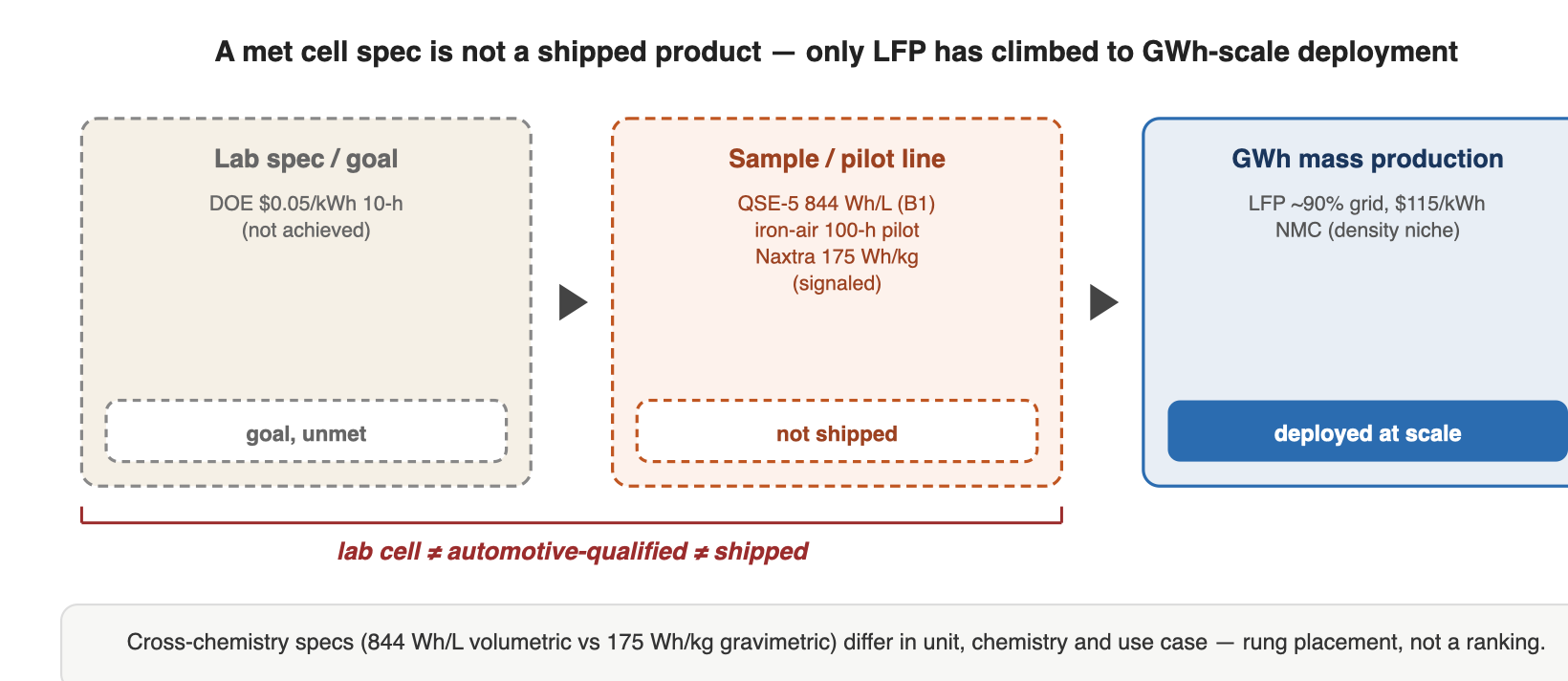
- So what. The headline (a single cell hitting a density, charge-time or cycle-count target) is the starting point; the real bottleneck is the outcome layer — GWh-scale manufacturability, real-world $/kWh, in-use cycle life and safety. A lab or coin cell is not automotive-qualified, and automotive-qualified is not shipped. Because no chemistry dominates all four axes, the landscape flows toward use-case differentiation (density for EVs, cost-per-duration for the grid), not one universal winner.
- Now what. The central falsifiable question of this series is whether any next-generation chemistry actually displaces LFP at scale this decade, or whether LFP’s cost and manufacturing moat holds while next-gen splits off narrow niches (premium EVs for solid-state, low-cost/cold-weather for sodium-ion, multi-day grid firming for LDES). Current data favors the second reading. A common hype error to reject up front: solid-state is not in mass production or installed in EVs — as of 2025–2026 every solid-state program is pre-commercial (QuantumScape is at B-sample and pilot-line stage, Cobra pilot line signaled 2026-02).
The five-minute read
Three scale axes — and what is rate-limiting on each
Storage is not one problem. It splits into three scales, each rate-limited by something different. EV/mobility is limited by energy density per unit weight and volume: NMC (nickel-manganese-cobalt) offers high density for premium, long-range vehicles; LFP (lithium iron phosphate) offers lower density but lower cost and longer cycle life for the standard and mass-market tier. Here the promise of solid-state is “higher density plus fast charge plus safety.” Short-duration grid is limited by cost per power for daily peak-shifting (2–4 hours); per the IEA, around 80% of new 2025 battery storage is utility-scale, most projects cluster near ~2-hour duration, and LFP takes roughly 90% of grid deployments — Li-ion LFP effectively dominates. Long-duration/LDES is limited by cost per duration for multi-day discharge, where Li-ion economics break because $/kWh rises roughly linearly as you add hours; this is the gap that iron-air, flow and thermal chemistries target, and which the DOE Long Duration Storage Shot codified as a policy goal.
The headline is a cell spec; the bottleneck is GWh-scale translation
The firm’s recurring lens — “the headline is the starting point; the real bottleneck is elsewhere” — applies cleanly. On all three axes, “a cell hit its spec target” is a true headline, but the outcome that decides the market is whether that cell is manufactured at GWh scale and satisfies in-use cost, life and safety. LFP is the only chemistry that has crossed that line at scale. Everything else is a claim awaiting reproduction. The table below separates the chemistry, its reported specs (attributed), and — critically — its production status.
| Class / chemistry (company) | Reported specs (attributed) | Status (mass-produced vs lab) | Source type |
|---|---|---|---|
| Li-ion incumbent — LFP (CATL, BYD, etc.) | ~90% of grid deployments; low cost, long cycle life, no Co/Ni; lower density than NMC | Mass-produced, dominant | IEA (agency) |
| Li-ion incumbent — NMC | High energy density (premium, long-range EV); Co/Ni-dependent, higher cost | Mass-produced | Industry general (secondary) |
| Pack-price benchmark — Li-ion pack (all-average) | 2024 volume-weighted average $115/kWh, −20% YoY (largest drop since 2017); China average $94/kWh | Market data | BNEF (primary) |
| Next-gen: solid-state — QSE-5 (QuantumScape) | 844 Wh/L, 5 Ah, 10→80% in 12.2 min; PowerCo road test >95% capacity retained after 1,000 cycles (company/PowerCo claim) | B1 sample, pilot line (not mass production; Cobra pilot signaled 2026-02) | Company/trade press |
| Next-gen: Na-ion — Naxtra (CATL) | 175 Wh/kg (LFP-class), 500 km range claim, >10,000 cycles claim, 90% capacity at −40°C, 5C peak; passed GB 38031-2025 | Mass production signaled 2025-12; Changan Nevo A06 fitment announced | Company/trade press |
| LDES: iron-air — Form Energy 100-h system | 100-hour duration; ~$20/kWh target (vs a vendor-cited ~$176/kWh for 6h Li-ion); rust (iron oxide) chemistry | Pilot / early-commercial (Cambridge, MN broke ground 2024-08; Weirton, WV plant) | Company/Utility Dive |
| LDES: flow, thermal, gravity | Vanadium flow, molten-salt thermal, etc.; duration-cheap (power/energy decoupled), low density, low round-trip efficiency | Demonstration to early-commercial (Part 3) | Industry general (secondary) |
| Policy anchor — DOE Long Duration Storage Shot | −90% cost for 10+ hour storage (vs 2020 Li-ion), $0.05/kWh target (announced 2021-09) | Agency goal (not achieved) | DOE (primary) |
Deep dive
1. Background — one axis, three scales, four tradeoff dimensions
Energy storage reproduces the firm’s core lens in a materials domain: the headline is almost always a single cell property (energy density in Wh/L or Wh/kg, fast-charge minutes, cycle count from a coin or lab cell), while the real bottleneck is the outcome layer — whether that cell is produced at GWh scale, passes automotive qualification, and simultaneously meets $/kWh, cycle life and safety in real use. Unlike a series that converges on one question, storage is irreducibly a four-way tradeoff (energy density × cost × cycle life × safety), and no single chemistry beats all four at once. So the landscape does not resolve to “one winner” but to use-case differentiation: EV/mobility is density-limited, long-duration grid is cost-per-duration-limited. The scope here places the Li-ion incumbent (LFP vs NMC) at the core, with next-generation (solid-state, sodium-ion) and long-duration (LDES: flow, iron-air, thermal) as adjacent axes — grouped together because all three share the same outcome-layer bottleneck of lab-spec headline versus GWh-scale, real-world manufacturing.
2. What this landscape establishes — chemistry, key specs and status (cell/announcement-attributed)
Principle: every spec, price and deployment figure is reported as in the source; company claims and agency projections are separated from independently reproduced data (of which there is little at cell level here); and cross-chemistry figures are not head-to-head.
- Li-ion incumbent (class 1) — the only chemistry that has already won at the outcome layer. LFP demonstrates a cost and manufacturing moat: ~90% of grid deployments (IEA) and a $115/kWh pack in 2024 (BNEF). It is both the benchmark and the falsification target for everything else. NMC persists where density matters (premium, long-range EV) at the cost of Co/Ni dependence.
- Next-generation (class 2) — lab/sample specs are strong, but mass production and qualification are incomplete. QuantumScape’s QSE-5 is at pilot-line (signaled 2026-02) and B-sample stage — not mass production. CATL’s Naxtra sodium-ion has mass production signaled, but early volume and real-world validation are deferred. This is the archetype of “spec headline is not GWh production.”
- LDES (class 3) — targets the multi-day gap Li-ion cannot fill. The duration-cheap cost structure is attractive, but round-trip efficiency, early-commercial track record and scale-up are unproven. Form Energy’s $20/kWh is a target and company claim, not a realized cost.
Attribution note: the specs above are within-cell values. QSE-5 844 Wh/L (volumetric) versus Naxtra 175 Wh/kg (gravimetric) differ in unit, chemistry and use case, so they are cross-claims, not a head-to-head ranking. Company spec claims are treated as lab/sample level until a third party reproduces them under the same protocol (reproducibility is examined in Parts 1–2).
3. The central science and commercial question — is the LFP moat breached? (falsifiable)
LFP has already won at the outcome layer (~90% of grid, $115/kWh pack). So where do the strong lab specs of next-gen and LDES lead? Three hypotheses, narrowed by evidence, each stating what observation would falsify it.
- (a) LFP moat holds + next-gen niche differentiation. LFP keeps the mass market while next-gen splits off use-case niches. Basis: LFP’s ~90% grid share, $115/kWh pack and Co/Ni-free cost structure are proven at GWh scale; solid-state is at pilot stage, sodium-ion mass production is early. If true, next-gen gains share only in specific niches (premium EV for solid-state, low-cost/cold-weather for sodium-ion, multi-day grid for LDES) while LFP holds the mass market. Falsified if solid-state or sodium-ion actually displaces LFP in the standard EV/grid market on GWh scale, automotive qualification and $/kWh (tested in Parts 1–2).
- (b) Next-gen displacement. Solid-state/sodium-ion surpass Li-ion at scale on density, safety and cost. Basis: QSE-5 844 Wh/L and 12.2-min charge (density plus speed); Naxtra 175 Wh/kg, >10,000 cycles, −40°C (cost plus cold). If production, qualification and cost follow, the incumbent could be replaced. Weakened if yield, cost or cycle life fail to beat LFP at GWh scale, or the “five years away” roadmap slips again (solid-state has an “always five years away” history — tested in Parts 1 and 4).
- (c) LDES opens a separate market. Not competing with Li-ion but creating a new multi-day gap. Basis: Li-ion $/kWh rises linearly with duration, ruling out multi-day; the DOE LDES Shot ($0.05/kWh) and Form Energy iron-air ($20/kWh target, 100h) sit on a different cost curve. Data-center 24/7 and seasonal demand are the drivers. Weakened if LDES round-trip efficiency or early-commercial results disappoint, or Li-ion duration extension and SMR baseload fill the gap first (tested in Part 3).
Current provisional position: none of the three can be excluded, but (a) best fits current data — LFP’s outcome-layer dominance is confirmed, next-gen is at pilot/early stage. The deciding evidence for (b) is solid-state pilot→GWh yield and cost; for (c) it is LDES early-commercial results and round-trip efficiency. Part 0 does not adjudicate; it juxtaposes the three falsifiably.
4. The scale-up and manufacturing bottleneck (the outcome layer the firm’s lens bites)
- Lab cell ≠ automotive-qualified ≠ shipped. Coin/single-cell specs (844 Wh/L, etc.) are small-area, ideal-condition results. Automotive qualification demands thousands of cycles, temperature range, fast charge, abuse safety (penetration, crush) and yield at large area and volume. The real solid-state bottleneck is dendrite growth, interface stability and ceramic-separator manufacturing yield (Part 1). Between “spec announcement” and “GWh-line production” sits this outcome layer.
- Announced capacity ≠ shipped product. Gigafactory announced capacity differs from actual shipment (utilization, yield, ramp delays). As the Northvolt case suggests, European cell manufacturing has a history of foundering on capital and yield (fact-checked in Parts 2 and 4).
- The real shape of the $/kWh curve. The BNEF $115/kWh (2024, −20%) is a composite of cell overcapacity, LFP adoption and falling metal prices (BNEF). Whether that decline is structural learning-curve progress or temporary oversupply is decomposed in Part 4.
- Critical minerals upstream. Li, Co, Ni and graphite supply rate-limits chemistry choice. The commercial logic of sodium-ion and iron-air is itself “critical-mineral independence” (crust-abundant elements) — so chemistry competition is also a supply-chain and materials competition, symmetric to the HALEU bottleneck in the firm’s energy-reactor thread.
5. Commercialization and competitive context (TRL frame, related companies)
- Maturity (TRL frame): LFP is at the outcome layer (mass-produced, cost-proven — effectively TRL 9). Next-gen sits far lower on the outcome axis: solid-state specs are demonstrated at cell level but production/qualification is pre-commercial (roughly TRL 5–6 on the outcome), sodium-ion has production signaled but early real-world validation, LDES is pilot/early-commercial with unproven round-trip economics.
- Li-ion incumbents — CATL (300750.SZ), BYD: the LFP scale leaders; the cost/manufacturing moat is theirs. CATL also carries the Naxtra sodium-ion program.
- Solid-state — QuantumScape (QS), Toyota (TM), Samsung SDI (006400.KS), Solid Power (SLDP): QSE-5 is at B-sample and pilot-line stage (Cobra signaled 2026-02), not mass production. Toyota, Samsung SDI and Solid Power solid-state timelines are unverified and examined in Part 1.
- Sodium-ion — CATL (Naxtra): mass production signaled 2025-12, Changan Nevo A06 fitment announced; the $10/kWh-class cost is a vendor target, and real-world 10,000-cycle reproduction is deferred to Part 2.
- LDES — Form Energy (private): iron-air, 100h, $20/kWh target; Cambridge, MN early-commercial (broke ground 2024-08); independent round-trip efficiency and realized-cost data are deferred to Part 3.
- Amprius (AMPX): silicon-anode high-density cells, tracked alongside the next-gen density axis.
- Company implications are limited to neutral, cell/announcement-attributed description; competitive or roadmap statements are not buy/sell signals. QuantumScape in particular is a pre-revenue pure play whose share price is sensitive to cell-spec news — a reason to keep the framing strictly neutral.
6. The skeptic’s bottom line
- Only LFP has won at the outcome layer: the incumbent facts (LFP ~90%, $115/kWh, 108 GW deployed) are agency/primary-confirmed; every next-gen advantage remains a lab/sample or vendor-target claim.
- Company-spec skew, no independent reproduction: QSE-5, Naxtra and Form Energy figures are company or trade-press claims; QSE-5’s “>95% after 1,000 cycles” rests on company/PowerCo data only, not independent third-party reproduction.
- “Always five years away”: solid-state has a history of slipping roadmaps; a spec announcement is not GWh production. Reject the hype error that solid-state is already mass-produced or installed in EVs — it is pre-commercial.
- Vendor targets are not costs: sodium-ion and iron-air cost figures ($10/kWh-class, $20/kWh) are vendor targets; realized $/kWh and round-trip efficiency are unverified.
- Cross-claims, not head-to-head: cell specs across chemistries differ in unit, chemistry and use case and must not be ranked. Part 0 rests on company, agency and trade-press sources — not peer review.
- Neutral-framing note: to prevent misreading listed-company (QS, AMPX, CATL, TM, Samsung SDI) success/failure or the “beyond Li-ion” narrative as security signals.
7. What to watch (falsifiable)
- P1 — solid-state pilot→GWh: if QuantumScape (or Toyota/Samsung SDI/Solid Power) displaces LFP in the standard EV market on automotive qualification, GWh yield and $/kWh, hypothesis (b) strengthens; if the roadmap slips again or stays niche, the reading shifts to (a) LFP moat holds. (Tested in Part 1.)
- P2 — sodium-ion cost and real use: if Naxtra-class sodium-ion actually delivers $/kWh at or below LFP at GWh scale and reproduces 10,000 cycles in use, that signals low-cost/cold-weather niche→mass expansion; if early volume and cost miss the target, it stays niche-confined (a↔b). (Tested in Part 2.)
- P3 — LDES multi-day gap: if Form Energy iron-air and other LDES demonstrate round-trip efficiency and $/kWh targets in early commercial deployment and absorb data-center 24/7 and seasonal firming demand as real contracts, hypothesis (c) strengthens — confirming a structure where storage, data-center power demand (computing) and SMR baseload (energy-reactor) compete for the same always-on grid demand. (Tested in Parts 3 and 5.)
- Also watch: whether the BNEF pack-price decline proves structural learning-curve progress or temporary oversupply; and whether any announced next-gen gigafactory converts announced capacity into shipped product.
References
- BloombergNEF. 2024. “Lithium-Ion Battery Pack Prices See Largest Drop Since 2017, Falling to $115 per Kilowatt-Hour.” (2024 volume-weighted average $115/kWh, −20% YoY; China average $94/kWh.) about.bnef.com/…/lithium-ion-battery-pack-prices-see-largest-drop-since-2017
- International Energy Agency (IEA). “Battery storage is scaling up and taking on a larger system role.” (Grid deployments ~90% LFP; ~80% of new 2025 storage utility-scale, mostly ~2h duration; 108 GW deployed.) iea.org/commentaries/battery-storage-is-scaling-up-and-taking-on-a-larger-system-role
- U.S. Department of Energy (DOE). “Storage Innovations 2030 / Long Duration Storage Shot.” (10+ hour storage cost −90%, $0.05/kWh target, announced 2021-09.) energy.gov/oe/storage-innovations-2030
- Electrive. 2025. “Solid-state batteries: QuantumScape ready to launch its pilot line.” (Cobra pilot line signaled 2026-02.) electrive.com/2025/12/10/solid-state-batteries-quantumscape-ready-to-launch-its-pilot-line
- Electric Cars Report. 2025. “QuantumScape ships B1 samples of its QSE-5 solid-state battery.” (844 Wh/L, 5 Ah, 10→80% in 12.2 min; B1 sample shipment 2025-10.) electriccarsreport.com/2025/10/quantumscape-ships-b1-samples-of-its-qse-5-solid-state-battery
- CATL. News release. (Naxtra sodium-ion program.) catl.com/en/news/6720.html
- CarNewsChina. 2025. “CATL’s Naxtra sodium-ion passes new national safety standards, ready for mass production.” (175 Wh/kg, >10,000 cycles, 90% capacity at −40°C, GB 38031-2025, mass production 2025-12, Changan Nevo A06.) carnewschina.com/2025/09/08/catls-naxtra-sodium-ion-passes-new-national-safety-standards
- Form Energy. “Battery technology” (iron-air, 100-hour duration, ~$20/kWh target). formenergy.com/technology/battery-technology
- Utility Dive. “Form Energy’s 20kWh, 100-hour iron-air battery could be a substantial breakthrough.” (Cambridge, MN 2024-08 groundbreaking; Weirton, WV plant.) utilitydive.com/news/form-energys-20kwh-100-hour-iron-air-battery-…/603877
Disclosure
This post is for information only and is not investment advice.
COI note: this post describes listed companies (QuantumScape QS, Amprius AMPX, Solid Power SLDP, CATL 300750.SZ, BYD, Toyota TM, Samsung SDI 006400.KS) and a private company (Form Energy) in a descriptive, neutral context. Every cell specification, price and deployment figure is attributed to the company or agency (IEA, BloombergNEF/BNEF, DOE) that reported it; many are company claims or agency projections rather than peer-reviewed or independently reproduced data, and are labeled as such. Announced capacity is not shipped product; a lab or sample cell is not automotive-qualified. QuantumScape in particular is a pre-revenue pure play whose share price is sensitive to cell-spec news. Quantitative claims are attributed to the vendor, agency or preprint/press release. Competitive and roadmap statements are factual, neutral descriptions and are not buy/sell implications for any security. The author holds no position in, and has no financial interest in, the companies named.


Leave a Reply