Evidence-first notes on bioscience and deep tech, at the edge of the lab and the market. Information only — not investment advice. All performance and cost figures are attributed to the project or company that announced them; many are company targets, vendor headlines, trade-press or institutional statistics rather than peer-reviewed or independently measured data (noted inline). A target is not an achieved value, and a pilot is not a commercial deployment.
The 30-second version
- What. Long-duration energy storage (LDES) targets the multi-day gap that lithium-ion cannot fill economically: as you lengthen duration, Li-ion cost rises roughly linearly in $/kWh, so the economics break down. LDES chemistries (iron-air, flow, thermal) compete on a different axis — $/kWh-energy, not $/kW-power — by decoupling power (stack) from energy (tank) and building the energy tank from cheap materials (iron, water, air). The signature headline is Form Energy’s iron-air battery at ~$20/kWh and 100 hours of duration (a company target/vendor comparison, not an independently measured price).
- So what. The headline (duration and material cost) is the starting point; the real bottleneck is the results layer — measured round-trip efficiency (RTE), realized cost, and the gap from pilot to GWh-scale commercial deployment. Iron-air’s RTE is reported below 50% (~40–50%), roughly half of Li-ion’s ~85%. That low efficiency is an intentional tradeoff — offset by charging on near-free surplus/curtailed power plus ultra-low capex — but only if curtailment (free charging power) is actually abundant, the $20/kWh capex is realized, and RTE/durability hold at scale. All three remain unverified.
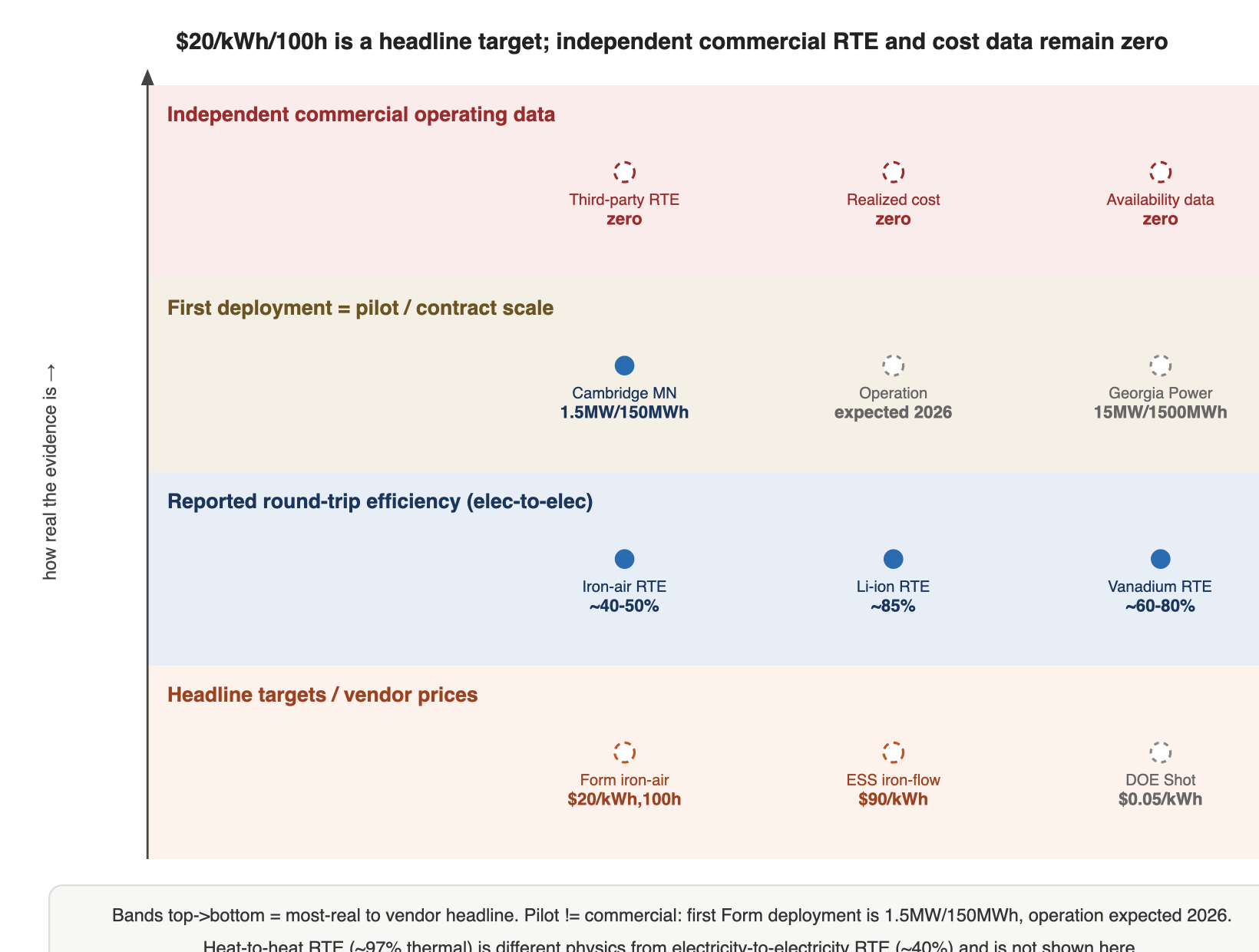
- Now what. The first commercial deployment is pilot-scale: Form Energy’s Cambridge, Minnesota project (Great River Energy) is 1.5 MW / 150 MWh, with deployment begun October 2025 and operation expected in 2026. There is zero independent third-party RTE or realized-cost data to date — a “100-hour battery running on the grid” is a pilot expected to operate in 2026, not a completed commercial demonstration. Headline prices ($20/kWh Form, $90/kWh ESS, $0.05/kWh DOE) are mostly targets or vendor headlines.
The five-minute read
The gap Li-ion can’t fill — and the economics of that gap
The storage problem splits by scale: EV energy density, short-duration grid balancing, and long-duration (multi-day) grid firming. Four-hour Li-ion dominates daily peak-shifting (the IEA reports grid deployment is ~90% LFP), but for multi-day continuous firming the cost keeps climbing as you enlarge the energy tank. That is the structural limit LDES targets. Crucially, LDES competes on a different axis: short-duration BESS competes on $/kW-power (cost of output), while LDES competes on $/kWh-energy (cost of stored energy). Flow and iron-air chemistries can design power (the stack) and energy (the tank) separately, so scaling the energy tank with cheap materials makes the per-duration cost curve rise more gently than Li-ion’s. That decoupling is the logic that opens the multi-day window.
The headline is the start; the bottleneck is the results layer
The firm’s recurring lens — “the headline is the starting point; the real bottleneck is elsewhere” — applies cleanly. The headline is “$20/kWh, 100 hours” (Form Energy); the real bottleneck is (1) measured RTE, (2) realized cost ($20 is a target), and (3) the pilot-to-GWh commercial scale-up. Iron-air’s RTE is reported below 50% (~40–50%), about half of Li-ion’s ~85%. The falsifiable question of this part is whether that low efficiency is an intentional tradeoff — you charge on near-free surplus power and offset the loss with ultra-low capex — or a genuine drag on the economics. It works only when three assumptions hold at once: charging power is genuinely near-free (enough curtailment occurs), the $20/kWh capex is realized (currently a target), and RTE and lifetime hold from pilot to commercial scale. Right now all three are unmeasured — the Cambridge MN pilot began deployment in October 2025 and is expected to operate in 2026, with zero independent operating data. [diagram placeholder]
| Class (lead, listing) | Key figures (attributed, tier) | Round-trip efficiency (RTE) | Status (pilot vs commercial) |
|---|---|---|---|
| Iron-air — Form Energy (private) | 100h duration; ~$20/kWh target (vendor comparison vs 6h Li-ion); iron, water, air (rust/oxidation) | <50% (reported ~40–50%) — about half of Li-ion ~85%; electricity-to-electricity | Pilot deployment begun (Cambridge MN 1.5MW/150MWh; deployment from Oct 2025, operation expected 2026) |
| Iron flow — ESS Tech (GWH, listed) | Energy Base 12–14h (for 8–24h use); ~20,000 cycles / 25-yr life; $90/kWh (vendor headline) | Not disclosed (improvement claimed); electricity-to-electricity | Early commercial (Google/SRP New Horizon 5MW/50MWh, delivery target Dec 2027); going-concern, revenue collapsed |
| Vanadium redox flow — multiple vendors | Power/energy decoupled; reusable vanadium electrolyte; vanadium supply/cost is the rate limiter (not crust-abundant, unlike iron) | ~60–80% (typical); electricity-to-electricity | Commercial deployments exist (mainly China); shown here as factual context only |
| Thermal (electricity storage) — Antora Energy (private) | Carbon blocks storing up to 2,400°C; 1,800°C heat + 40% conversion efficiency (2023 milestone); TPV (thermophotovoltaic) for power output | ~40% electricity-to-electricity (heat output is separate) | System launch (industrial heat / decarbonization focus) |
| Thermal (industrial heat) — Rondo Energy (private) | Firebrick >1000°C (refractory limit ~1300°C); ~97% heat round-trip (100MWh commercial Oct 2025, secondary source); capex ~$20–30/kWh-thermal (secondary) | ~97% heat-to-heat — NOT electricity; power conversion is separate | Commercial deployment (industrial-heat replacement) |
| Gravity / mechanical — Energy Vault (NRGV, listed) | Gravity storage; crane/block stacking | 75–80% (company claim); third-party skepticism coexists | Pivoted from gravity to Li-ion (2025); crane-design skepticism persists |
| Policy anchor — DOE Long Duration Storage Shot | 10+h storage cost −90% (vs 2020 Li-ion) / $0.05/kWh target (Sept 2021) | — | Policy target (not achieved) |
Deep dive
1. Background — Li-ion’s gap and the economics of the multi-day window
The storage landscape splits into three scales — EV density, short-duration grid, and long-duration (multi-day) grid. In the long-duration regime, Li-ion cost rises roughly linearly in $/kWh as you extend duration, so the economics collapse. Four-hour Li-ion is dominant for daily peak-shifting (IEA: ~90% LFP across grid deployment), but for multi-day continuous firming the cost keeps accruing as the energy tank grows. LDES competes on a different axis: short-duration BESS competes on $/kW-power, while LDES competes on $/kWh-energy. Flow and iron-air chemistries decouple power (stack) from energy (tank), so scaling the energy tank with cheap materials — iron, water, air — flattens the per-duration cost curve relative to Li-ion. This is the structural logic that opens the multi-day window. The scope here places iron-air (Form Energy) at the core, alongside flow (ESS iron-flow, vanadium redox), thermal (Antora, Rondo), and gravity/mechanical (Energy Vault — skepticism justified). All four share the same results-layer bottleneck: “duration-cheap headline vs measured RTE and early-commercial reality.”
2. What this part establishes — iron-air economics and why the low RTE is by design (and its refutation)
The most counterintuitive point about iron-air is its round-trip efficiency below 50% (reported ~40–50%): of 10 MWh in, only ~4 MWh comes back — half of Li-ion’s ~85%. In ordinary storage that is disqualifying, but in LDES economics it is justified as an intentional tradeoff, resting on three assumptions:
- It only works when charging power is nearly free. LDES charges during surplus/curtailment hours (wasted solar and wind). If the marginal cost of charging power is near zero, the cost of the efficiency loss is also near zero — what is lost would have been curtailed anyway.
- Capex must be low enough to sit idle. Multi-day storage discharges rarely but for long stretches (tens of times per year). Because the asset is mostly idle, the $/kWh-energy capex must be low — which is exactly what Form’s $20/kWh target addresses.
- Why it competes on $/kWh-energy. The longer the duration, the more the energy (tank) share dominates cost and the more the power (stack) share is diluted. So LDES is a $/kWh-energy game, and the iron-air/flow tank-stack separation is what gentles that curve.
★The firm lens’s refutation point: this logic works only if all three assumptions hold simultaneously — charging power really is near-free (enough curtailment occurs), the $20/kWh capex is realized (currently a target), and RTE/lifetime hold from pilot to commercial scale. Refutation condition: if the first commercial project’s (Cambridge MN and others) measured RTE, realized cost, or availability fall short of target, or if the economics break in markets where charging power is not free (insufficient curtailment), the “multi-day gap” hypothesis weakens. At present all three are unverified — Cambridge MN began deployment October 2025 and is expected to operate in 2026, with zero independent operating data.
3. Pilot ≠ commercial deployment — the deployment reality
The largest hype risk in LDES is reading a “material property / target headline” as a “commercial deployment.” Separating the facts by tier:
Form Energy (iron-air) — deployment facts: Cambridge MN (Great River Energy) is a 1.5 MW / 150 MWh pilot — groundbreaking August 2024, deployment begun October 2025, operation expected 2026 (Form/GRE). It is Form’s first commercial deployment, but the scale is pilot. Contract pipeline exceeds 200 MW; H1 2025 produced ~100,000 electrodes (~100 km); the Weirton WV factory (550,000 sq ft, planned expansion to 1 million sq ft by 2028) (Latitude Media, Oct 2025). A Georgia Power 15 MW / 1500 MWh project targets an accelerated 2026 operation (trade press). Form has raised $405M with a GE Vernova collaboration (Utility Dive/Canary) — private capital-raising and a commercial partnership are facts.
ESS Tech (iron flow, GWH listed) — early commercial plus the financial results layer: the company transitioned to the Energy Base product (2025), discontinuing two older small units; 12–14h (for 8–24h use), ~20,000 cycles / 25 years. A June 2025 material substitution improved RTE, durability and iron plating, demonstrating a rated 12.2h / low-power 17.8h and claiming an “accelerated 18-month roadmap” (company). A Google / Salt River Project “Project New Horizon” 5 MW / 50 MWh is in manufacturing 2026 with a delivery target of December 2027 (trade press). In April 2026 ESS added a US-made sodium-ion 8.5 GWh portfolio (ess-news), diversifying beyond single iron-flow. ★Financial results layer (facts, strictly neutral): 2025 revenue $1.6M (down from $6.3M in 2024), net loss $63.4M, cash $22.0M, with a going-concern statement; cash and short-term investments ~$13.6M at end-May 2026; an NYSE minimum-price deficiency notice and a 1-for-15 reverse split (SEC 10-K / trade press). This is a case where the bottleneck is the capital/commercialization results layer, not the cell chemistry.
Antora / Rondo (thermal) — separating the RTE definition is essential: Antora stores up to 2,400°C in carbon blocks, delivers 1,800°C heat at 40% conversion efficiency (2023), and outputs power via TPV; its primary market is industrial-heat (steel, cement) decarbonization, and its electricity-storage RTE is ~40%. Rondo uses firebrick >1000°C (refractory limit ~1300°C) with a ~97% heat round-trip (100MWh commercial Oct 2025, secondary source) and capex ~$20–30/kWh-thermal (secondary). ★The ~97% is heat-to-heat — converting back to electricity drops sharply toward the Carnot limit. Calling it a “97%-efficient battery” is a misread.
Energy Vault (gravity, NRGV listed) — skepticism justified, plus a self-pivot: in 2025 Energy Vault pivoted from gravity storage to Li-ion, and in October 2025 secured a $300M Orion Infrastructure preferred equity for survival (Latitude/Canary). Gravity RTE of >75% (small Swiss unit) / >80% expected is a company claim; critics (e.g., Michael Barnard) argue crane-and-block stacking cannot deliver meaningful output. ★The strongest signal is that the company itself set gravity aside to sell Li-ion.
★Core isolation (analysis-standards §2): every first deployment is either pilot-scale (1.5MW/150MWh) or at the contract stage, and independent third-party operating RTE, realized-cost and availability data = zero. “A 100-hour battery running on the grid” is a pilot expected to operate in 2026, not a commercial demonstration. $20/kWh and $90/kWh are targets/vendor headlines.
4. Scale-up and results-layer bottlenecks (where the firm lens bites)
- RTE-definition confusion is the biggest hype vector. Heat-to-heat (~97% Rondo) versus electricity-to-electricity (~40% iron-air / Antora-TPV) is different physics. Mixing them in one table creates the illusion that thermal storage dominates batteries. The input/output form must always be stated explicitly.
- Target cost ≠ realized cost. Form $20/kWh, ESS $90/kWh, Rondo $20–30/kWh-thermal are targets/vendor headlines; DOE’s LDES Shot $0.05/kWh (10+h) is a policy target (not achieved). Realization hinges on mass-production yield, material prices and field installation cost.
- Pilot-to-GWh scale. Iron-air chemistry itself is old, well-understood (rust), but air-electrode durability and yield are the scale-up bottleneck; for flow it is stack lifetime and electrolyte management. Announced capacity (200MW+ pipeline) differs from shipped, operating output.
- Capital and commercialization results layer. ESS going-concern and reverse split, and Energy Vault’s post-SPAC pivot, are facts showing that the rate limiter is capital/demand/commercialization, not cell chemistry (the LDES version of “announced capacity ≠ shipped”). Form is private, so public financials are absent — itself an information asymmetry.
- The charging-power assumption. Iron-air economics presume curtailment (free surplus power). In grids with low renewable penetration and little curtailment, the low RTE passes through as a direct cost — the case is market- and region-dependent.
5. Commercialization and competitive context
- Maturity (TRL frame): duration and material cost are demonstrated at pilot (roughly TRL 6–7 on the headline), but commercial-results maturity is early (TRL 4–5 equivalent) because independent operating RTE/cost data is zero. The gating layers are measured RTE, realized cost and scale — not the cell chemistry.
- Form Energy (private): iron-air at 100h with a ~$20/kWh target; first commercial deployment is the Cambridge MN pilot (1.5MW/150MWh), plus a >200 MW pipeline, the Weirton WV factory, $405M raised, and a GE Vernova collaboration. Private, so no public financials — an information asymmetry, and partners/competitors should not be read as security implications for Form.
- ESS Tech (GWH, listed): iron-flow Energy Base (12–14h) is entering early commercial (Google/SRP New Horizon), but the financial results layer — 2025 revenue $1.6M (from $6.3M), net loss $63.4M, going-concern, 1-for-15 reverse split, NYSE deficiency notice — shows the bottleneck is capital and commercialization, not chemistry. ★These are factual, neutral, source-attributed statements about a listed company, not buy/sell implications.
- Energy Vault (NRGV, listed): pivoted from gravity to Li-ion (2025) and secured $300M Orion preferred equity — factual, neutral. The self-pivot refutes optimism about gravity storage as a scale LDES solution.
- GE Vernova (GEV, listed) / Great River Energy: Form’s commercial partner and pilot host — factual, neutral, and not a security signal.
- Company statements are limited to neutral, project-attributed description; competitive or performance-ranking statements are not buy/sell signals. All quantitative claims are attributed to the vendor, company, trade press or institutional source.
6. The skeptic’s bottom line
- Target vs realized: $20/kWh (Form), $90/kWh (ESS) and $0.05/kWh (DOE) are targets/headlines, not realized costs.
- Separate the RTE definition: iron-air / Antora-TPV electricity RTE ~40% versus Rondo heat RTE ~97% is different physics — never compare them in one table without stating the input/output form (heat vs electricity).
- Pilot ≠ commercial: every first deployment is pilot-scale (1.5MW/150MWh) or at the contract stage, with zero independent operating data. “A 100-hour battery running” is a pilot expected to operate in 2026.
- Gravity skepticism is justified: Energy Vault itself set gravity aside and pivoted to Li-ion. Any framing of gravity storage as a scale LDES solution is refuted by that fact.
- Financial results layer: ESS going-concern and reverse split show the bottleneck is capital and commercialization, not cell chemistry — described strictly neutrally and source-attributed.
- Charging-power assumption: iron-air economics presume curtailment (free surplus power) — market- and region-dependent.
7. What to watch (falsifiable)
- P1 (iron-air commercial demonstration): when the first deployments (Cambridge MN, Georgia Power) disclose measured RTE, availability and realized cost after operation, RTE will fall in the ~40–50% range and cost will approach but not yet meet the $20/kWh target — i.e. the chemistry works, but “$20/kWh achieved” is not realized early on. (Falsified if the first commercial hits $20/kWh, or if RTE lands far above/below target.)
- P2 (LDES vs firm generation): for 2027–2028 data-center 24/7 always-on power procurement, SMR baseload, gas + CCS and existing nuclear PPAs will absorb contracts before standalone LDES — LDES remaining a variability-firming adjunct, with the low RTE (~40%) disadvantaged for electricity-to-electricity always-on supply. (Falsified if LDES absorbs large always-on data-center contracts as the primary supply.)
- P3 (chemistry differentiation): through 2028 no single LDES chemistry becomes the outright winner; iron-air (ultra-long-duration grid), flow (daily 8–24h deep cycling) and thermal (industrial heat) differentiate into use-case niches. (Falsified if one chemistry dominates all multi-day grid uses.)
- Also watch: whether any LDES project ever converts a target price into a measured, independently verified realized cost; and whether curtailment stays abundant enough to keep iron-air’s near-free charging assumption valid.
8. Cross-domain — computing-power (data centers) and firm generation (SMR)
LDES is the results layer of a broader grid thread, intersecting two adjacent series. Computing-power (data-center 24/7): the AI-data-center always-on demand narrative is a core driver of LDES demand. The IEA projects data-center consumption roughly doubling to ~945 TWh by 2030 (institutional projection). Four-hour BESS cannot do 24/7 load-matching (SEIA), so LDES is a candidate to firm variable renewables into baseload — but iron-air’s ~40% RTE means 60% loss on the round trip, disadvantaging it against firm generation that supplies always-on power directly. Energy-reactor (SMR baseload): symmetric to the SMR/microreactor thread. SMR supplies firm baseload directly (capacity factor >92.5%, DOE/Deloitte), while LDES firms variability. The same always-on demand pits “firm with storage” against “supply directly with nuclear” — potentially complementary rather than mutually exclusive, but capital, sites and permitting are finite, so allocation competes. Both share the same pilot-milestone-vs-commercial-deployment gap that is the firm lens’s focus.
References
- Utility Dive. “Form Energy’s $20/kWh, 100-hour iron-air battery could be a substantial breakthrough.” https://www.utilitydive.com/news/form-energys-20kwh-100-hour-iron-air-battery-could-be-a-substantial-br/603877/
- Latitude Media. “Form’s first 100-hour batteries are hitting the grid.” https://www.latitudemedia.com/news/forms-first-100-hour-batteries-are-hitting-the-grid/
- Form Energy. “Great River Energy and Form Energy break ground on first-of-its-kind multi-day energy storage project.” https://formenergy.com/great-river-energy-and-form-energy-break-ground-on-first-of-its-kind-multi-day-energy-storage-project/
- Utility Dive. “Iron-air battery developer / long-duration storage: Form Energy — GE Vernova collaboration.” https://www.utilitydive.com/news/iron-air-battery-developer-long-duration-storage-form-energy-collaboration-ge-vernova/730633/
- ESS Inc. “ESS moves closer to delivering green baseload power.” https://essinc.com/ess-moves-closer-to-delivering-green-baseload-power/
- StockTitan. “ESS Tech Inc files annual report (10-K)” (revenue, net loss, going-concern, reverse split). https://www.stocktitan.net/sec-filings/GWH/10-k-ess-tech-inc-files-annual-report-57ce3148aed4.html
- ESS News. 2026. “ESS Tech adds 8.5 GWh of US-made sodium-ion batteries to its portfolio.” https://www.ess-news.com/2026/04/30/ess-tech-adds-8-5-gwh-of-us-made-sodium-ion-batteries-to-its-portfolio/
- Antora Energy. “System launch” (thermal storage; carbon block, TPV). https://www.antora.com/insights/system-launch
- IEEE Spectrum. “Thermal battery for industrial heat” (Rondo firebrick). https://spectrum.ieee.org/thermal-battery-for-industrial-heat
- Latitude Media. “After the SPAC — why storage company Energy Vault pivoted after going public.” https://www.latitudemedia.com/news/after-the-spac-why-storage-company-energy-vault-pivoted-after-going-public/
- SEIA. “Challenges and opportunities for long-duration energy storage in data-center development.” https://seia.org/events/challenges-and-opportunities-for-long-duration-energy-storage-in-data-center-development/
- US DOE. “Storage Innovations 2030 / Long Duration Storage Shot” ($0.05/kWh, 10+h target). https://www.energy.gov/oe/storage-innovations-2030
Disclosure
This post is for information only and is not investment advice.
COI note: this post describes listed and private energy-storage companies (Form Energy [private], ESS Tech [GWH], Antora Energy [private], Rondo Energy [private], Energy Vault [NRGV], GE Vernova [GEV]) in a descriptive, neutral context. Every performance and cost figure is attributed to the project, company or source that announced it; many are company targets, vendor headlines, trade-press or institutional statistics rather than peer-reviewed or independently measured data, and are labeled as such. A target is not an achieved value ($20/kWh Form, $90/kWh ESS, $0.05/kWh DOE are targets/headlines, not realized prices), and a pilot is not a commercial deployment (the first Form deployment is a 1.5MW/150MWh pilot with zero independent operating data). ESS Tech’s going-concern statement, revenue decline ($6.3M→$1.6M) and 1-for-15 reverse split are factual, neutral, source-attributed disclosures about a listed company, described to show that the bottleneck is capital and commercialization — not the cell chemistry — and are not buy/sell implications for any security. Round-trip efficiency definitions are kept separate (Rondo thermal ~97% is heat-to-heat; iron-air / Antora-TPV ~40% is electricity-to-electricity — different physics, not compared in one table). Quantitative claims are attributed to the vendor, company, trade press or institutional source. The author holds no position in, and has no financial interest in, the companies named (default: no interest).


Leave a Reply