Evidence-first notes on bioscience and deep tech, at the edge of the lab and the market. Information only — not investment advice, not medical advice.
The 30-second version
- What. Finerenone is a nonsteroidal mineralocorticoid receptor antagonist (MRA) that targets inflammation and fibrosis rather than blood pressure and volume — a mechanism that does not overlap with the other two cardio-kidney-metabolic (CKM) pillars, SGLT2 inhibitors and GLP-1 agonists. Its kidney-outcome evidence is strong on hard endpoints (kidney failure), while its cardiovascular benefit is driven by morbidity (heart-failure worsening) rather than by cardiovascular death.
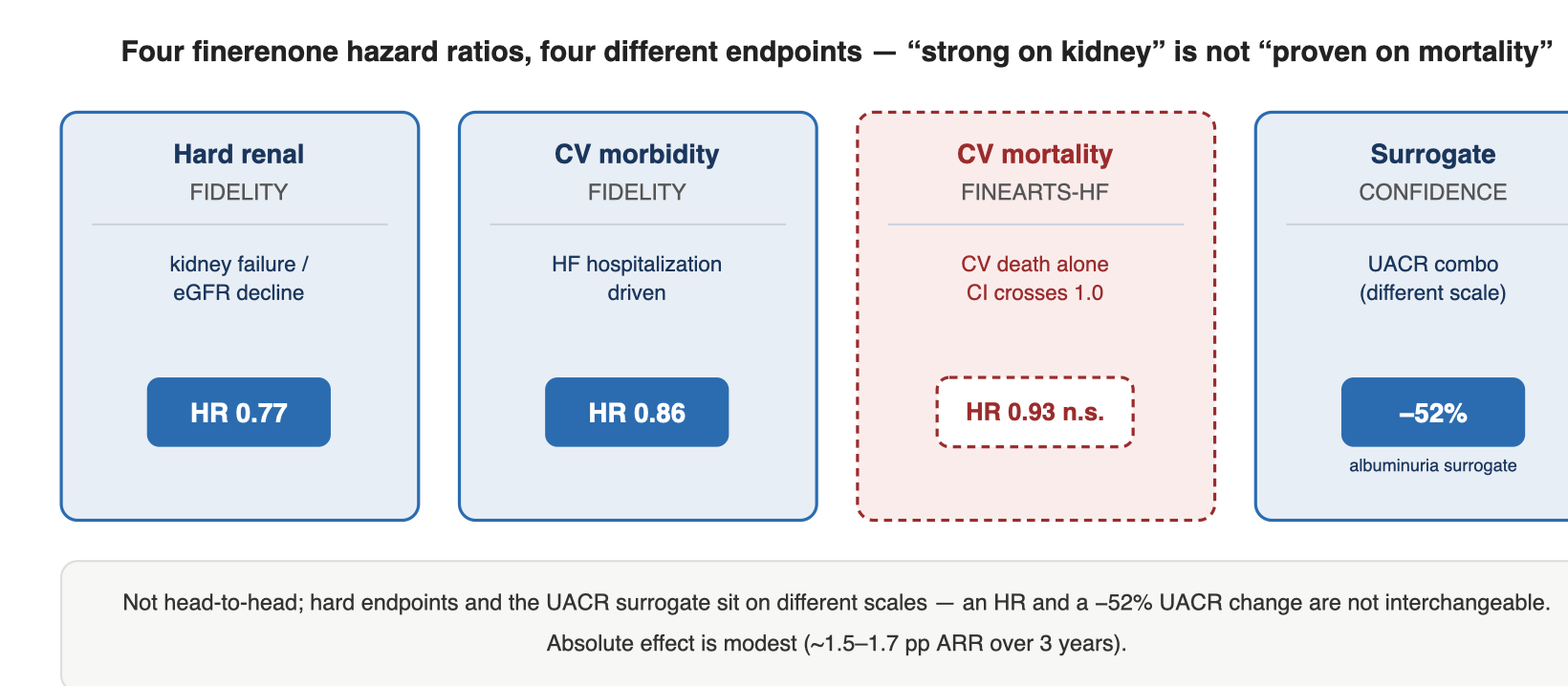
- So what. Read the axes separately. In the pooled FIDELITY analysis (Bayer-sponsored) the kidney composite fell (HR 0.77) and the cardiovascular composite fell (HR 0.86), but in FINEARTS-HF the cardiovascular-death component alone was not significant (HR 0.93). The combination story with SGLT2 inhibitors is so far demonstrated only on a surrogate (albuminuria, UACR), not on hard outcomes.
- Now what. The absolute effect is modest (roughly a 1.5–1.7 percentage-point absolute risk reduction over three years) and hyperkalemia adds real-world friction. Finerenone is best framed as a “modest but robust” third pillar, not a step-change in individual outcomes. Whether triple-pillar simultaneous therapy is superior on hard endpoints remains an open question.
The five-minute read
A pillar that does not overlap with the other two
The prior CKM work in this series framed standard-of-care around three pillars — SGLT2 inhibitors, GLP-1 agonists, and finerenone. The first two lean on hemodynamic/metabolic (SGLT2i) and metabolic/vascular (GLP-1) protection. Finerenone’s distinction is that it is non-hemodynamic: overactivation of the mineralocorticoid receptor (MR) drives tissue inflammation and fibrosis independent of blood pressure and volume, and finerenone targets that pathway. This mechanistic non-overlap is the theoretical basis for an additive effect when it is added on top of the other pillars.
Nonsteroidal MRA differs from the older steroidal MRAs (spironolactone, eplerenone): higher receptor selectivity (little binding to androgen or progesterone receptors, so no gynecomastia or sexual side effects), a more balanced heart-and-kidney tissue distribution, and an emphasis on anti-inflammatory/anti-fibrotic (tissue-protective) rather than diuretic/antihypertensive action. In short, finerenone sits closer to a tissue-protective agent than to a blood-pressure drug.
Two axes split — kidney hard outcomes versus cardiovascular morbidity
The trial program covers complementary populations. FIDELIO-DKD (NEJM 2020) enrolled more advanced diabetic kidney disease and was positive on its kidney primary endpoint (HR 0.82); FIGARO-DKD (NEJM 2021) enrolled earlier-stage disease and was positive on its cardiovascular primary endpoint (HR 0.87, driven largely by fewer heart-failure hospitalizations). The prespecified pooled analysis, FIDELITY (Eur Heart J 2022, N=13,026), showed a cardiovascular composite HR of 0.86 and a kidney composite HR of 0.77. All of these are Bayer-sponsored trials.
FINEARTS-HF (NEJM 2024) then extended finerenone into heart failure with mildly reduced or preserved ejection fraction (LVEF ≥40%), meeting its primary composite (rate ratio 0.84) — but the win was driven by fewer heart-failure worsening events (RR 0.82), while the cardiovascular-death component alone was not significant (HR 0.93, 95% CI 0.78–1.11). This is the key hard-outcome nuance: finerenone reduces morbidity (heart-failure worsening) more clearly than it reduces mortality.
| Kidney axis (hard) | Cardiovascular axis | Combination (3-pillar) | |
|---|---|---|---|
| Evidence | Strong — FIDELITY kidney composite HR 0.77 (0.67–0.88), consistent across trials | Moderate-to-strong, morbidity-driven — FIDELITY CV HR 0.86; FINEARTS heart-failure driven; CV death alone not significant (HR 0.93) | Surrogate only — CONFIDENCE UACR additivity; hard-outcome superiority not yet demonstrated |
The real caveats: modest absolute effect and hyperkalemia friction
Relative risk reductions (HR 0.77–0.87) are robust, but the three-year absolute risk reduction is roughly 1.5–1.7 percentage points — the same “modest absolute effect across a very large CKM population” profile seen with SGLT2 inhibitors and GLP-1 agonists. Hyperkalemia is the class-defining friction: in FIDELITY it occurred in 14.0% versus 6.9% on placebo, with hyperkalemia-related hospitalization 0.9% versus 0.2% and zero fatal cases in either arm. It was managed with potassium monitoring and dose adjustment in trials, but monitoring burden may erode real-world adherence. There is a signal that co-administered SGLT2 inhibitors offset the potassium risk, which would strengthen the combination safety case.
Deep dive
1. Background — mechanism, nonsteroidal versus steroidal MRA
The mineralocorticoid receptor is expressed not only in the distal renal tubule (sodium reabsorption) but also in cardiac, vascular and immune cells. Chronic MR overactivation promotes tissue inflammation and fibrosis independent of blood pressure and volume load, and this is a common pathway of cardio-renal injury.
- Receptor selectivity: spironolactone is low (cross-reacts with androgen/progesterone receptors), eplerenone is intermediate, and finerenone is the highest — almost no binding to androgen or progesterone receptors.
- Characteristic side effects: gynecomastia and sexual dysfunction with spironolactone; those hormonal effects are absent with finerenone.
- Tissue distribution: steroidal MRAs accumulate preferentially in the kidney relative to the heart, whereas finerenone is more balanced between heart and kidney — which relatively eases the renal accumulation / hyperkalemia burden.
- Binding mode and emphasis: finerenone blocks the conformational change and nuclear MR accumulation / cofactor recruitment on binding, and its animal-model profile emphasizes anti-inflammatory/anti-fibrotic (non-hemodynamic) effects over diuresis. Note: how much the anti-fibrotic mechanism contributes to human hard outcomes is itself an open question — the animal-model rationale does not directly explain the observed clinical effect size.
2. What this landscape establishes — hard outcomes versus surrogates (attributed)
Principle: hazard ratios, confidence intervals and P values are reported exactly as in the source; hard endpoints (kidney failure, CV death, heart-failure hospitalization) are separated from surrogates (UACR, eGFR slope); cross-trial comparisons are not head-to-head.
- FIDELIO-DKD (NEJM 2020; NEJMoa2025845), kidney primary: type 2 diabetes plus CKD, on optimized RAS blockade, N=5,674, median 2.6 years. Kidney composite (kidney failure, ≥40% eGFR decline from baseline, renal death) HR 0.82 (95% CI 0.73–0.93; P=0.001); key secondary cardiovascular composite HR 0.86 (0.75–0.99; P=0.03); hyperkalemia 18.3% versus 9.0%.
- FIGARO-DKD (NEJM 2021; NEJMoa2110956), cardiovascular primary: less advanced CKD, N=7,437, median 3.4 years. Cardiovascular composite (CV death, nonfatal MI, nonfatal stroke, heart-failure hospitalization) HR 0.87 (95% CI 0.76–0.98; P=0.03), a 13% relative reduction driven largely by fewer heart-failure hospitalizations; the kidney secondary did not reach significance in this lower-risk population.
- FIDELITY (Eur Heart J 2022), prespecified pooled FIDELIO+FIGARO: N=13,026, median 3.0 years, mean baseline eGFR 57.6. Cardiovascular composite 12.7% versus 14.4%, HR 0.86 (0.78–0.95; P=0.0018); kidney composite (with a stronger ≥57% eGFR-decline definition) 5.5% versus 7.1%, HR 0.77 (0.67–0.88; P=0.0002); hyperkalemia 14.0% versus 6.9%, hyperkalemia hospitalization 0.9% versus 0.2%, fatal hyperkalemia 0% in both arms. Absolute frame: CV composite ARR about 1.7 points over three years, kidney composite about 1.6 points.
- FINEARTS-HF (NEJM 2024; NEJMoa2407107), HFmrEF/HFpEF extension: LVEF ≥40%, NYHA II–IV, elevated NT-proBNP, N=6,001, median 32 months. Primary composite (total worsening heart-failure events + CV death) rate ratio 0.84 (95% CI 0.74–0.95; P=0.007), driven by total worsening heart failure RR 0.82 (0.71–0.94; P=0.006); CV death alone HR 0.93 (0.78–1.11), not significant. An exploratory 24% relative reduction in new-onset diabetes was also seen. FINEARTS reopens the HFpEF territory left uncertain by spironolactone’s TOPCAT and underpins the expansion of finerenone beyond diabetic kidney disease (reflected in FDA approval).
- CONFIDENCE (2025, NDT / presentation; NEJM 2025-06-05 per Part 2), combination (finerenone + empagliflozin): CKD + type 2 diabetes on RAS inhibition, N=800 randomized (818 enrolled/screened per Part 2 correction), three arms (combination / finerenone alone / empagliflozin alone), six months. Primary endpoint is the surrogate UACR: at Day 180 the combination reduced UACR −52%, a 29% additional reduction versus finerenone alone and 32% versus empagliflozin alone; serious adverse events 7.1% (combination) / 6.1% (finerenone) / 6.4% (empagliflozin). Important: the primary endpoint is albuminuria (a surrogate), not kidney failure or CV death — additivity is demonstrated on albuminuria only, and hard-outcome superiority of the combination is not yet demonstrated.
- FINE-HEART pooled (Nat Med 2024), integrating FIDELIO+FIGARO+FINEARTS (about 19,000 participants) for CV death, all-cause death and composite signals — exact figures [unverified], to be confirmed from the source in Part 1.
3. Guideline position — the CKM three-pillar frame
- KDIGO 2024 (Diabetes & CKD): recommends finerenone for type 2 diabetes plus CKD with eGFR ≥25, normal serum potassium, and albuminuria (ACR >30) on maximally tolerated RAS inhibition. The same update elevated SGLT2 inhibitors (eGFR ≥20) and GLP-1 renal protection alongside it — the guideline itself adopts a multi-pillar frame.
- ADA Standards of Care 2024/2025: consider finerenone as an add-on for type 2 diabetes plus CKD, ACR ≥30, potassium ≤4.8–5.0, to reduce cardiovascular and kidney events.
- ESC (heart failure, diabetes, CKD guidance): positions the MRA class; post-FINEARTS-HF discussion of the nonsteroidal MRA role in HFmrEF/HFpEF is ongoing.
Three-pillar additivity, current status: mechanistic non-overlap plus the CONFIDENCE UACR additivity suggests that simultaneous initiation improves the surrogate faster than sequential add-on. But guidelines note the absence of a combination hard-outcome RCT — the hard-endpoint superiority of simultaneous triple therapy is an assumption, not proof. Sequential add-on remains the realistic default in practice.
4. Neighbouring domains — AI-guided combination optimization
Because SGLT2 inhibitors, GLP-1 agonists and finerenone act through non-overlapping mechanisms, the number of possible sequential/simultaneous initiation combinations grows combinatorially. A cross-domain hook is to individualize that choice with EHR-based causal machine learning — CONFIDENCE already hints at a simultaneous-initiation surrogate benefit. This is the CKM-continuum version of the firm’s recurring framing that the bottleneck lies less in any single agent’s headline efficacy than in how the pillars are sequenced and sustained in real-world care.
5. Commercialization and competitive context
- Maturity: finerenone (Kerendia, Bayer) is approved and in indication expansion across diabetic kidney disease and HFmrEF/HFpEF (mature/approved stage). It is currently, in effect, the only nonsteroidal MRA with hard-outcome evidence.
- balcinrenone (AstraZeneca) — an MR modulator. The MIRACLE Phase 2b trial (heart failure + CKD, added to dapagliflozin) was stopped early and underpowered; the UACR signal was dose-dependent but did not reach significance. Follow-on programs such as MIRO-CKD are ongoing [confirmed early-termination / non-significant].
- ocedurenone (KBP-5074) — a nonsteroidal MRA (resistant hypertension + advanced CKD) whose late-stage Phase 3 development was discontinued [confirmed discontinued]. The asset is owned by Novo Nordisk (which acquired KBP Biosciences in October 2023 for up to $1.3B; CLARION-CKD was stopped for futility in June 2024, impairment about $816M, per Part 3 RESOLVED). Note: an earlier draft mislabeled this as “AstraZeneca-licensed,” which was a confusion with balcinrenone and has been corrected [REFUTED / corrected].
- esaxerenone (Minnebro, Daiichi Sankyo) — a nonsteroidal MRA approved for hypertension in Japan, with existing diabetic-kidney-disease UACR-reduction data.
- Company implications are limited to neutral, trial-attributed description; competitive or efficacy-ranking statements are not buy/sell signals.
6. The skeptic’s bottom line
- Hyperkalemia — manageable but adds real-world friction: FIDELITY hyperkalemia 14.0% versus 6.9%, hospitalization 0.9% versus 0.2%, zero fatal cases. Managed with potassium monitoring and dose adjustment in trials, but monitoring burden and discontinuation may reduce adherence in practice. A signal that SGLT2 inhibitors offset hyperkalemia (FIDELITY subanalysis, CONFIDENCE safety) would strengthen the combination safety case.
- Modest absolute effect: relative risk reductions (HR 0.77–0.87) are robust, but the three-year absolute risk reduction is roughly 1.5–1.7 points — the same “modest absolute effect across a large CKM population” logic as SGLT2 inhibitors and GLP-1 agonists, and honestly not a dramatic individual-level effect.
- Combination synergy is demonstrated only on a surrogate: CONFIDENCE measured UACR. The hard superiority of the combination on kidney failure or CV death is not demonstrated, and the rate at which UACR reduction translates into hard outcomes needs separate validation for finerenone.
- Mortality caveat: in FINEARTS-HF the primary win is morbidity (heart-failure worsening); the cardiovascular-death component alone is not significant (HR 0.93). Finerenone is currently better characterized as a morbidity drug than a mortality drug.
- Principle: frame finerenone as a “modest but robust” third CKM pillar rather than a step-change; separate hard outcomes from surrogates, and separate morbidity from mortality.
7. What to watch
- Any finerenone + SGLT2 inhibitor hard-outcome RCT — whether albuminuria additivity translates into superiority on kidney failure or the cardiovascular composite, and whether simultaneous initiation beats sequential add-on.
- Whether follow-on pooled/long-term analyses (including FINE-HEART) ever establish CV-death significance for finerenone, or whether it stays a morbidity drug.
- Whether any new nonsteroidal MRA obtains hard-outcome evidence by 2027 (balcinrenone MIRO/follow-on Phase 3), versus balcinrenone remaining surrogate/early-stage and ocedurenone discontinued.
- Real-world adherence and discontinuation rates under potassium-monitoring requirements.
References
- Bakris, G. L., et al. 2020. “Effect of Finerenone on Chronic Kidney Disease Outcomes in Type 2 Diabetes (FIDELIO-DKD).” New England Journal of Medicine 383: 2219. HR 0.82. https://www.nejm.org/doi/full/10.1056/NEJMoa2025845
- Pitt, B., et al. 2021. “Cardiovascular Events with Finerenone in Kidney Disease and Type 2 Diabetes (FIGARO-DKD).” New England Journal of Medicine 385: 2252. HR 0.87. https://www.nejm.org/doi/full/10.1056/NEJMoa2110956
- Agarwal, R., et al. 2022. “Cardiovascular and Kidney Outcomes with Finerenone in Patients with Type 2 Diabetes and Chronic Kidney Disease: the FIDELITY Pooled Analysis.” European Heart Journal 43(6): 474. HR 0.86 / 0.77. https://academic.oup.com/eurheartj/article/43/6/474/6433104
- Solomon, S. D., et al. 2024. “Finerenone in Heart Failure with Mildly Reduced or Preserved Ejection Fraction (FINEARTS-HF).” New England Journal of Medicine. Rate ratio 0.84; CV death HR 0.93 (NS). https://www.nejm.org/doi/abs/10.1056/NEJMoa2407107
- CONFIDENCE investigators. 2025. Combination finerenone + empagliflozin in CKD and type 2 diabetes (baseline). Nephrology Dialysis Transplantation 40(8): 1559. Primary endpoint UACR (surrogate). https://academic.oup.com/ndt/article/40/8/1559/7997692
- KDIGO. 2024. “Clinical Practice Guideline for the Evaluation and Management of Chronic Kidney Disease.” https://kdigo.org/wp-content/uploads/2024/03/KDIGO-2024-CKD-Guideline.pdf
- MIRACLE investigators. 2024. Balcinrenone in heart failure and chronic kidney disease (Phase 2b). European Journal of Heart Failure 26(8): 1727. https://academic.oup.com/eurjhf/article/26/8/1727/8328729
- FINE-HEART pooled analysis. 2024. Nature Medicine. Exact figures [unverified] — to be confirmed in Part 1.
Disclosure
This post is for information only and is not investment advice, and not medical advice. Treatment decisions should always be made with your own clinician.
COI note: this post describes listed pharmaceutical companies (Bayer BAYN, AstraZeneca AZN, Daiichi Sankyo, Novo Nordisk NVO) and the clinical trials they sponsored in a descriptive context. The finerenone trials (FIDELIO-DKD, FIGARO-DKD, FIDELITY, FINEARTS-HF, CONFIDENCE) are Bayer-sponsored. All efficacy figures are attributed with the trial name and journal, hard endpoints are separated from surrogates (UACR) and morbidity from mortality, and quantitative claims are attributed to the relevant trial or authors. Competitive and efficacy-ranking statements are factual, neutral descriptions and are not buy/sell implications for any security. The author holds no position in, and has no financial interest in, the companies named.


Leave a Reply