Evidence-first notes on bioscience and deep tech, at the edge of the lab and the market. Information only — not investment advice, and not medical advice.
The 30-second version
- What. Finerenone (a non-steroidal mineralocorticoid receptor antagonist) reduced kidney and heart-failure morbidity endpoints consistently across three pooled trial layers. But the single hardest endpoint, cardiovascular death, never reached significance on its own: FINEARTS-HF HR 0.93 (not significant) and FINE-HEART HR 0.89 with P = 0.076, despite pooling 18,991 patients. Only all-cause mortality crossed the line, and only in the pooled analysis (HR 0.91, P = 0.027). (Bayer-sponsored trials.)
- So what. The strong, consistent evidence sits on organ / morbidity protection (kidney composite, heart-failure hospitalisation, eGFR slope) — not on mortality. Hard endpoints (kidney failure, cardiovascular death) must be kept separate from surrogate and near-hard ones (UACR, eGFR slope, symptom scores). Even the kidney composite’s strength leans more on the eGFR-slope component (HR 0.70) than on end-stage kidney disease itself (HR 0.80, upper confidence bound at 0.99).
- Now what. The absolute effect is modest — roughly 1.6–1.7 percentage-point risk reduction over three years, number-needed-to-treat 59–60 (FIDELITY). Finerenone is best framed as a modest-but-durable third CKM pillar whose organ protection is demonstrated while its mortality benefit is suggestive, not confirmed. The metrics to watch are a finerenone-specific mortality-powered trial and end-stage-kidney-disease data in more advanced CKD.
The five-minute read
The question is not “does an outcome curve bend,” but “is it hard or is it morbidity?”
From a CKM (cardio-kidney-metabolic) perspective, the direction of finerenone’s effect is robust: across kidney, heart-failure and mortality endpoints the hazard-ratio point estimates sit below 1, and three pooled layers — FIDELITY (kidney / cardiovascular), FINEARTS-HF (heart failure) and FINE-HEART (mortality) — cross-support one another. What is not robust is the magnitude and the mortality signal. The three-year absolute risk reduction is about 1.6–1.7 percentage points (NNT 59–60 in FIDELITY): a population-health-scale benefit spread thinly across a large CKM population, not a dramatic individual effect. (Bayer-sponsored trials.)
Do not blur hard and surrogate
FIDELITY (European Heart Journal 2022, a pre-specified pool of FIDELIO-DKD and FIGARO-DKD, n = 13,026, median 3.0 years) showed a kidney composite HR of 0.77 (95% CI 0.67–0.88) and a cardiovascular composite HR of 0.86 (0.78–0.95). But opening the composites matters: the kidney headline is lifted mostly by the near-surrogate eGFR-slope component (sustained ≥ 57% eGFR decline, HR 0.70, 0.60–0.83), while the hardest component — end-stage kidney disease — is HR 0.80 with the confidence interval reaching 0.99 (P = 0.040), barely significant because events are sparse. The cardiovascular composite is driven mainly by heart-failure hospitalisation, not by cardiovascular death, myocardial infarction or stroke individually. In FINEARTS-HF (NEJM 2024, HFmrEF/HFpEF, n = 6,001), the primary composite was a rate ratio of 0.84 (P = 0.007) — but that significance came entirely from the heart-failure-worsening (morbidity) component, while cardiovascular death (HR 0.93) and all-cause death (HR 0.93) were both non-significant.
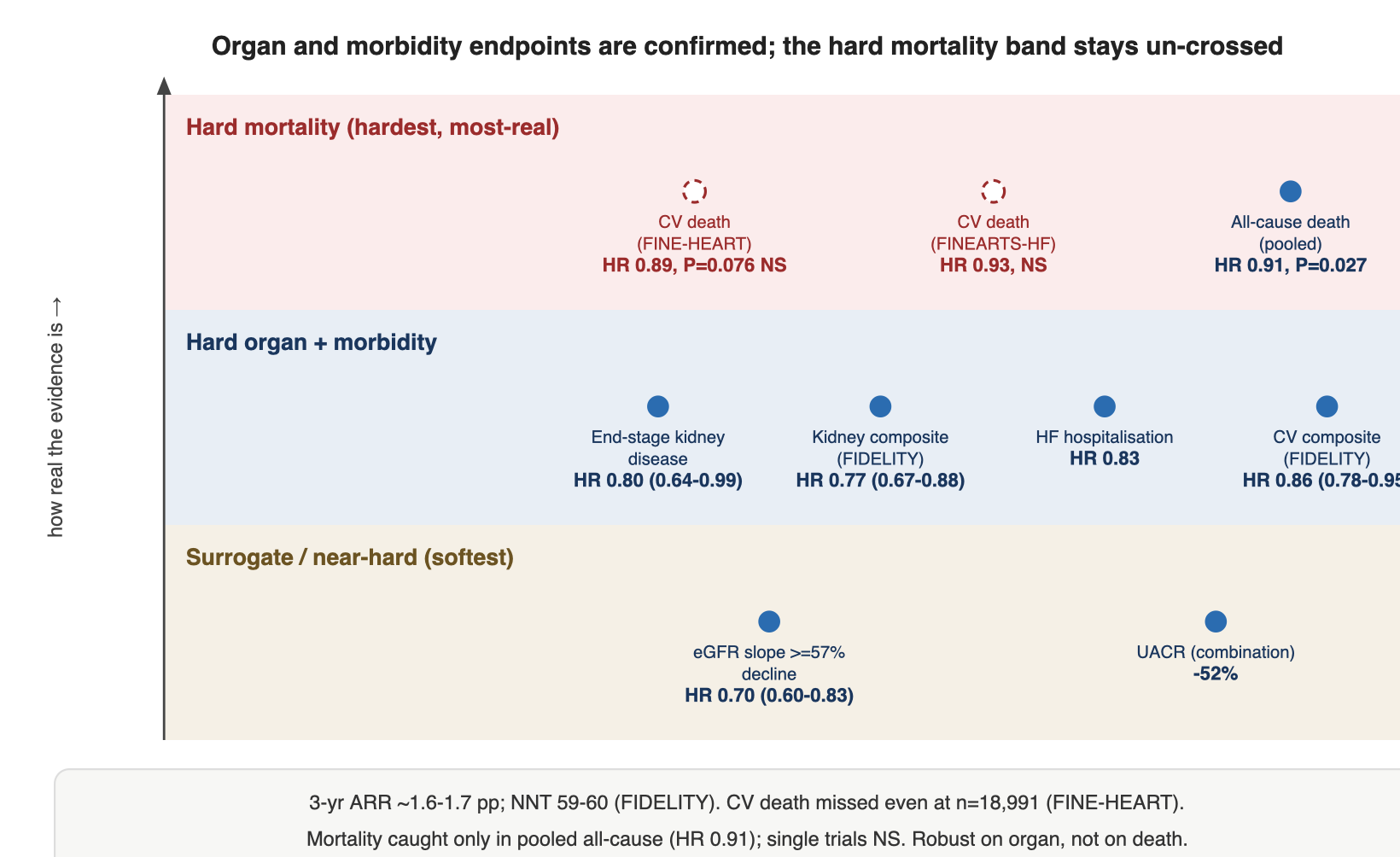
| Endpoint | Character | Key figure (attributed) | Strength |
|---|---|---|---|
| End-stage kidney disease | Hard (top) · FIDELITY | HR 0.80 (0.64–0.99; P=0.040) | Significant, but CI reaches 0.99 |
| Sustained ≥57% eGFR decline | Near-hard (surrogate-adjacent) · FIDELITY | HR 0.70 (0.60–0.83; P<0.0001) | Strong |
| Kidney composite | Hard + near-hard · FIDELITY / FINE-HEART | 0.77 (0.67–0.88) / 0.80 (0.72–0.90) | Strong · consistent |
| Heart-failure hospitalisation | Hard (morbidity) · FINEARTS / FINE-HEART | RR 0.82 / HR 0.83 | Strong · consistent |
| Cardiovascular composite | Hard (HHF-driven) · FIDELITY | HR 0.86 (0.78–0.95; P=0.0018) | Moderate–strong |
| Cardiovascular death | Hard (top) · FINEARTS / FINE-HEART | 0.93 (NS) / 0.89 (P=0.076, NS) | Not demonstrated (direction only) |
| All-cause mortality | Hard (top) · FINEARTS / FINE-HEART | 0.93 (NS) / 0.91 (P=0.027) | Borderline (pooled only) |
| UACR (albuminuria) | Surrogate · (CONFIDENCE, Part 2) | combination −52% | Surrogate only |
The mortality gap, quantified
FINE-HEART (Nature Medicine 2024) pooled FIDELIO-DKD, FIGARO-DKD and FINEARTS-HF into n = 18,991 (median 2.9 years). Even at this power, the primary endpoint — cardiovascular death — missed nominal significance (421 [4.4%] vs 471 [5.0%], HR 0.89, 0.78–1.01, P = 0.076), while all-cause mortality just crossed the line (HR 0.91, 0.84–0.99, P = 0.027). A pre-specified sensitivity analysis adding undetermined deaths reached significance (HR 0.88, P = 0.025), which the authors use to argue the mortality benefit is real — a defensible reading, but the fact that the primary endpoint itself missed nominal significance still stands.
Deep dive
1. Background
Chronic kidney disease, heart failure, type 2 diabetes and cardiovascular disease form a continuum captured by the CKM framework. Steroidal mineralocorticoid receptor antagonists (spironolactone, eplerenone) were limited by hyperkalaemia and, in HFpEF, by ambiguous trial evidence (TOPCAT, confounded by regional variation). Finerenone, a non-steroidal MRA, was developed to reoccupy that space. This piece splits its evidence axis into: (a) whether each endpoint is hard or morbidity / surrogate, (b) where within a composite the signal actually lives, and (c) how the mortality gap shapes its role as a third CKM pillar. All efficacy figures are attributed to the sponsoring trials.
2. What these trials newly established
- FIDELITY (kidney / cardiovascular, deepened): The pooled kidney composite (HR 0.77, 0.67–0.88, three-year ARR 1.7%, NNT 60) and cardiovascular composite (HR 0.86, 0.78–0.95, NNT 59) are confirmed. Component analysis shows the kidney headline is lifted by the eGFR-slope component (HR 0.70) more than by end-stage kidney disease (HR 0.80, CI upper bound 0.99), and the cardiovascular composite is heart-failure-hospitalisation-driven.
- FINEARTS-HF (HFmrEF/HFpEF): Primary composite rate ratio 0.84 (0.74–0.95, P = 0.007), driven by total worsening heart-failure events (RR 0.82, 842 vs 1,024 events). Cardiovascular death (HR 0.93, P = 0.42) and all-cause death (HR 0.93, P = 0.30) were both non-significant. The symptom gain (KCCQ-TSS difference 1.6 points) was statistically significant but below the ~5-point clinically important threshold. This extended the label to HFpEF/HFmrEF on the basis of reduced hospitalisation and worsening — not delayed death.
- FINE-HEART (mortality pooling): n = 18,991 pooled; cardiovascular death HR 0.89 (P = 0.076, NS); all-cause mortality HR 0.91 (P = 0.027); heart-failure hospitalisation HR 0.83 (P < 0.001); kidney composite HR 0.80 (P < 0.001). A 2024-10-28 author correction fixed a “new-onset atrial fibrillation” row in Figure 1 and did not affect the primary or mortality results.
3. Methodological strengths and limits
- Strengths: The direction is consistent across three independent pooled layers, and the kidney and heart-failure-hospitalisation signals cross-support one another. The mortality sensitivity analysis (undetermined deaths) was pre-specified rather than post-hoc.
- Limit 1 — cardiovascular-death gap: The single hardest endpoint missed nominal significance even at n = 18,991 (FINE-HEART P = 0.076). The mortality case rests on pooled all-cause mortality (single trials were non-significant) and on the undetermined-death sensitivity analysis.
- Limit 2 — composite leaning on surrogate: The kidney composite’s strength is carried substantially by the eGFR-slope component (HR 0.70); the hardest component, end-stage kidney disease, is HR 0.80 with the CI reaching 0.99, because event counts are low in a relatively lower-risk population with short follow-up.
- Limit 3 — morbidity-driven, not survival: FINEARTS-HF’s primary significance came entirely from heart-failure-worsening events; the HFpEF/HFmrEF indication basis is “fewer hospitalisations / worsening,” not “fewer deaths.”
- Limit 4 — modest absolute effect: Three-year ARR ~1.6–1.7 percentage points, NNT 59–60. This is a population-scale benefit, not a large individual one.
- Safety: Hyperkalaemia is the main friction — FINE-HEART investigator-reported 12.8% vs 6.2% (laboratory K > 5.5 mmol/L 16.5% vs 7.7%), related discontinuation 1.3% vs 0.5%, related hospitalisation 0.8% vs 0.2%, and fatal hyperkalaemia 0% in both arms. Manageable, but requires monitoring.
4. Neighbouring domains
The mortality asymmetry connects directly to the three-pillar CKM argument. SGLT2 inhibitors (EMPA-KIDNEY, DAPA-CKD) and GLP-1 agents (FLOW, SELECT) have reported significant benefits on all-cause and cardiovascular-death hard endpoints — precisely the axis where finerenone is weakest. This makes a case for outcome complementarity (not just mechanistic non-overlap): a combination partner could shore up the mortality axis where finerenone is thin. This is a cross-trial reading, not a head-to-head comparison. There is also a methodological hook: FINE-HEART’s pattern of missing cardiovascular death while catching all-cause death reflects cause-of-death misclassification (undetermined deaths), which connects to the causal-ML problem of reclassifying undetermined deaths in cause-specific mortality models.
5. Commercialization and market context (TRL, companies)
- TRL: Finerenone (Kerendia) is approved and marketed (TRL 9). The novelty here is the HFpEF/HFmrEF indication expansion (FDA-reflected) and guideline incorporation.
- Listed company: Finerenone belongs to Bayer (BAYN). The FIDELIO-DKD, FIGARO-DKD, FINEARTS-HF and FINE-HEART trials are sponsor-supported, and all efficacy figures are attributed to those trials and their publishing journals.
- Class context: Ocedurenone (KBP-5074) — owned by Novo Nordisk (not AstraZeneca; that was a mix-up with balcinrenone, corrected) — had its CLARION-CKD trial stopped for futility (June 2024). This is covered in Part 3.
- The final peer-reviewed publication venue for CONFIDENCE (the finerenone + SGLT2i combination trial) is within Part 2’s scope and to be confirmed there.
6. The skeptic’s counterpoint
Mandatory caveats inherited from the original deep-dive’s skeptic gate (§6, proceed-with-caveats):
- Keep hard and surrogate separate. The kidney and heart-failure-hospitalisation morbidity signals are strong; the kidney composite headline (HR 0.77) leans on the eGFR-slope surrogate component (HR 0.70) more than on end-stage kidney disease (HR 0.80, CI to 0.99). UACR (Part 2) is a surrogate only.
- Cardiovascular death is not demonstrated. FINEARTS-HF HR 0.93 (NS) and FINE-HEART HR 0.89 (P = 0.076, NS) — even at n = 18,991, cardiovascular death alone missed significance. This must be stated alongside any composite claim.
- Mortality is suggestive, not confirmed. Only pooled all-cause mortality reached significance (HR 0.91, P = 0.027); single trials were non-significant, and the case partly depends on the undetermined-death sensitivity analysis.
- Modest absolute effect. Three-year ARR ~1.6–1.7 percentage points, NNT 59–60.
- Sponsorship attribution. Every cited trial is Bayer-sponsored, and quantitative claims are attributed to the respective trials and journals.
- Falsifiable predictions. (1) In future finerenone-specific mortality-powered trials, the cardiovascular-death CI upper bound will stay near 1 (mortality caught only in pooled all-cause analyses). (2) In more advanced CKD cohorts with longer follow-up, the end-stage-kidney-disease component CI will narrow into stable significance. (3) All-cause mortality direction will replicate in real-world / pooled data but continue to miss significance in single trials.
7. What to watch
- A finerenone-specific mortality-powered trial or long-term follow-up — whether cardiovascular death’s CI upper bound ever drops clearly below 1.
- End-stage-kidney-disease outcomes in more advanced (stage 4–5-approaching) CKD cohorts, where events are less sparse.
- Whether the CONFIDENCE combination’s UACR (surrogate) benefit translates into hard endpoints (Part 2).
- Hard outcomes from a finerenone + SGLT2i + GLP-1 three-pillar combination, and the sequencing question (simultaneous vs sequential initiation).
References
- FIDELITY pooled analysis of FIDELIO-DKD and FIGARO-DKD. European Heart Journal. 2022. https://academic.oup.com/eurheartj/article/43/6/474/6433104 (open access: https://pmc.ncbi.nlm.nih.gov/articles/PMC8830527/)
- Finerenone in Heart Failure with Mildly Reduced or Preserved Ejection Fraction (FINEARTS-HF). New England Journal of Medicine. 2024. https://www.nejm.org/doi/abs/10.1056/NEJMoa2407107
- Finerenone in patients across the spectrum of cardiovascular-kidney-metabolic conditions (FINE-HEART pooled analysis). Nature Medicine. 2024. https://www.nature.com/articles/s41591-024-03264-4 (full text: https://pmc.ncbi.nlm.nih.gov/articles/PMC11645272/)
- FINE-HEART Author Correction (2024-10-28; new-onset atrial fibrillation row; primary and mortality results unchanged). Nature Medicine. 2024. https://www.nature.com/articles/s41591-024-03372-1
Note: individual DOIs/URLs and publication dates should be confirmed against the primary sources. Copyrighted full text from Nature/NEJM and similar is not redistributed; only summary, commentary and quotations ≤ 150 characters are included.
Disclosure
This post is for information only. It is not investment advice, and it is not medical advice — treatment decisions must be made in consultation with a qualified healthcare professional. The author holds no position in the named securities (BAYN, NVO).
COI note: the clinical trials cited in this piece (FIDELIO-DKD, FIGARO-DKD, FINEARTS-HF, FINE-HEART) were conducted with sponsorship from the drug’s manufacturer, Bayer. The efficacy figures (for example FIDELITY kidney composite HR 0.77, FINEARTS-HF primary RR 0.84, FINE-HEART cardiovascular death HR 0.89 / all-cause mortality HR 0.91) are all attributed to those manufacturer-sponsored trials and their publishing journals. This piece does not recommend the superiority of any manufacturer or drug; it explicitly separates demonstrated organ / morbidity protection from an as-yet-unconfirmed mortality benefit.
 Uthando Nethemba
Leave a comment