Evidence-first notes on bioscience and deep tech, at the edge of the lab and the market. Information only — not investment advice, not medical advice.
The 30-second version
- What. The “three-pillar” combination in cardio-kidney-metabolic (CKM) disease stacks three non-overlapping mechanisms — SGLT2 inhibitor (hemodynamic), GLP-1 receptor agonist (metabolic) and finerenone (anti-inflammatory / anti-fibrotic). CONFIDENCE (NEJM 2025-06-05, N=800 randomized, double-blind) proved that simultaneous finerenone + empagliflozin lowers the urinary albumin-to-creatinine ratio (UACR) more than either drug alone — but only to the surrogate endpoint; a hard-outcome benefit of the combination is unproven. The trial authors state plainly that “association is not causation.”
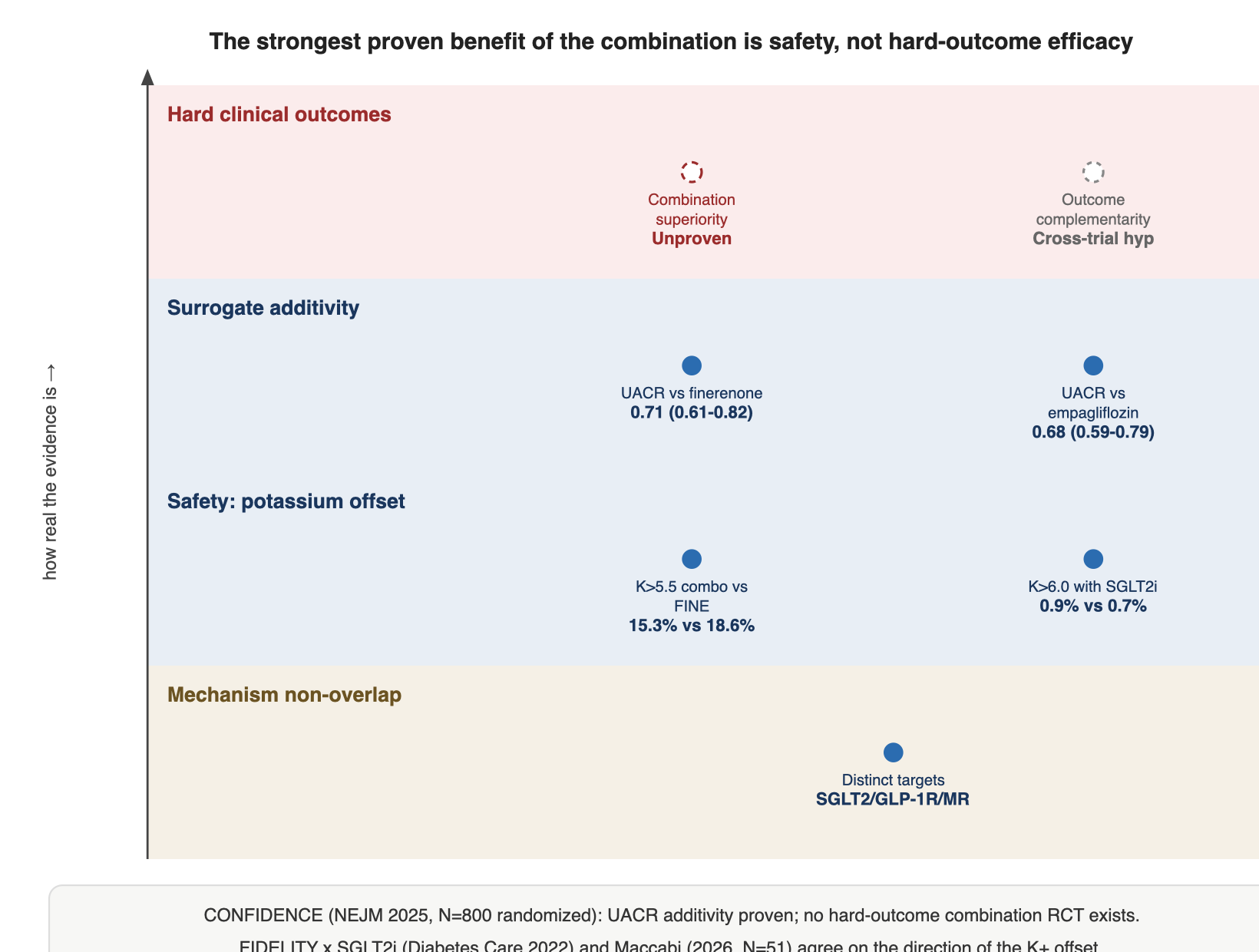
- So what. This is not “three drugs = triple protection.” The evidence splits by layer: UACR additivity is proven (randomized); hard-outcome superiority of the combination over monotherapy is unproven (no head-to-head hard-outcome RCT exists); and outcome complementarity — the idea that SGLT2i and GLP-1 cover finerenone’s weak mortality axis — is a cross-trial hypothesis, not a head-to-head result.
- Now what. The counter-intuitive finding: the single most solidly proven benefit of the combination is not efficacy but safety. Adding an SGLT2 inhibitor lowers finerenone’s hyperkalemia (high-potassium) signal — a direction confirmed in both randomized (CONFIDENCE) and observational (FIDELITY sub-analysis) data. Watch for a genuine hard-outcome combination RCT and for guideline stacking to move from sequential add-on toward simultaneous initiation.
The five-minute read
The three-pillar idea, and its evidence gap
Part 1 of this series established that finerenone’s hard-outcome evidence is asymmetric — thick on kidney and heart-failure morbidity, thin on cardiovascular mortality. The three-pillar story is supposed to fill that gap by pairing finerenone with an SGLT2 inhibitor and a GLP-1 receptor agonist, each targeting a different molecular axis (SGLT2 / GLP-1R / mineralocorticoid receptor). The mechanistic non-overlap is textbook. The clinical question is whether non-overlapping mechanisms actually add up in hard outcomes — and the honest answer is that the proof reaches only as far as a surrogate endpoint.
What CONFIDENCE proved — and what it did not
CONFIDENCE (NEJM 2025-06-05, NEJMoa2410659; presented simultaneously at the 2025 ERA Congress) was a phase 2, randomized, double-blind, three-arm trial (N=800 randomized: combination 269 / finerenone 264 / empagliflozin 267) in CKD plus type 2 diabetes on maximally tolerated renin-angiotensin-system (RAS) inhibition, followed for 180 days. Its primary endpoint was the relative change in UACR at day 180 — a surrogate, not kidney failure or cardiovascular death. Combination therapy lowered UACR by an additional 29% versus finerenone alone (least-squares-mean ratio 0.71, 95% CI 0.61–0.82) and 32% versus empagliflozin alone (0.68, 0.59–0.79). This is the first randomized human confirmation of the “non-overlapping mechanisms → additive” hypothesis — but at the surrogate layer only. No randomized evidence exists that the combination is superior on hard outcomes.
| Claim about the combination | Evidence grade | Source (attributed) |
|---|---|---|
| UACR (surrogate) additivity | Proven (randomized) | CONFIDENCE: vs finerenone 0.71 (0.61–0.82), vs empagliflozin 0.68 (0.59–0.79), NEJM 2025 |
| Hard-outcome superiority (kidney failure, CV death) | Unproven | No head-to-head hard-outcome combination RCT; CONFIDENCE primary = UACR surrogate (“association is not causation”) |
| Mechanistic non-overlap (three axes) | Strong (pharmacological) | Distinct targets SGLT2 / GLP-1R / MR — textbook |
| Outcome complementarity (covering finerenone’s weak mortality axis) | Hypothesis (cross-trial) | Finerenone mortality weak (Part 1) vs SGLT2i / GLP-1 mortality data — not head-to-head |
| Hyperkalemia offset (add SGLT2i) | Proven (randomized + observational, consistent) | CONFIDENCE K>5.5: combination 15.3% < finerenone 18.6%; FIDELITY with SGLT2i K>6.0 0.9% vs 0.7% |
The counter-intuitive part: the strongest proven benefit is safety
Finerenone’s main real-world friction is hyperkalemia. SGLT2 inhibitors increase distal sodium delivery and thereby promote potassium excretion, offsetting the serum-potassium rise from mineralocorticoid-receptor blockade. In CONFIDENCE (randomized), the combination arm had lower hyperkalemia than finerenone alone (investigator-reported 9.3% vs 11.4%; serum K >5.5 mmol/L 15.3% vs 18.6%). In the FIDELITY × SGLT2i sub-analysis (Diabetes Care 2022), when an SGLT2i was present the excess of severe hyperkalemia (K >6.0) almost disappeared (0.9% vs 0.7%, versus 3.4% vs 1.3% without SGLT2i). Three independent sources point the same way — SGLT2 inhibition lowers finerenone’s key usability barrier. This safety complementarity is, on the evidence, sturdier than the efficacy additivity.
Deep dive
1. Background — the three non-overlapping axes
The CKM three-pillar frame positions each drug on a distinct mechanistic axis:
- Hemodynamic (SGLT2 inhibitor): proximal-tubule sodium/glucose excretion lowers intraglomerular pressure via tubuloglomerular feedback; osmotic diuresis reduces preload. Hard-outcome benefit on kidney failure, CV death and heart-failure hospitalization is significant (EMPA-KIDNEY, DAPA-CKD).
- Metabolic (GLP-1 receptor agonist): lowers weight and glucose through appetite and incretin pathways, with vascular anti-inflammatory effects. Hard outcomes reach all-cause mortality (FLOW, SELECT; developed in the sister GLP-1 series).
- Anti-inflammatory / anti-fibrotic (finerenone): blocks mineralocorticoid-receptor over-activation, reducing tissue inflammation and fibrosis — not primarily by lowering pressure or diuresis. Kidney and heart-failure morbidity signals are strong, but the cardiovascular-death signal is unproven (Part 1).
The three primary molecular targets are genuinely distinct, which makes additivity mechanistically plausible. Plausible is not the same as proven.
2. What CONFIDENCE newly established (and a data-reconciliation note)
Core (verified): CONFIDENCE is the first randomized human demonstration that simultaneous finerenone + empagliflozin lowers a surrogate (UACR) more than either drug alone — but it cannot and does not test hard-outcome additivity.
- Publication resolved: the trial’s formal publication, carried as unverified in earlier parts, is confirmed as New England Journal of Medicine, 2025-06-05, NEJMoa2410659.
- Design: phase 2, randomized, double-blind, three-arm. N=800 randomized (combination 269 / finerenone 264 / empagliflozin 267); eGFR 30–90; UACR ≥100 to <5000 mg/g; CKD + type 2 diabetes on maximally tolerated RAS inhibition; 180-day follow-up.
- Data-reconciliation note: an earlier “N=818” figure in the source materials is inconsistent with the randomized N=800 — the 818 is presumed to be an enrollment/screening count. This part uses randomized N=800 (confirmed via NEJM and NephJC).
- Primary endpoint (UACR, day-180 relative change): combination vs finerenone LSM ratio 0.71 (0.61–0.82) = an additional 29% reduction; combination vs empagliflozin 0.68 (0.59–0.79) = an additional 32%; overall combination UACR ≈ −52%.
- Acute eGFR dip (safety / mechanism signal): day-30 >30% eGFR reduction occurred in 6.3% (combination) / 3.8% (finerenone) / 1.1% (empagliflozin). The initial fall was largely reversible on discontinuation; the two agents’ hemodynamic dips add when co-initiated, arguing for eGFR monitoring early after simultaneous start.
- Author-stated limitation: the primary endpoint is a surrogate (UACR), and “association is not causation.” Whether the UACR improvement translates into a hard-outcome benefit is a question this trial does not answer.
3. Mechanistic complementarity — separating the grades of evidence
The “1+1+1>3” narrative must be graded, not asserted:
- Mechanism-level non-overlap: distinct primary targets (SGLT2 / GLP-1R / MR) — confirmed, textbook pharmacology.
- Surrogate-level additivity: CONFIDENCE proved UACR additivity for the hemodynamic (empagliflozin) + anti-fibrotic (finerenone) pair by randomization — confirmed.
- Outcome-level complementarity: the argument that finerenone’s weak axis (mortality) is covered by SGLT2i and GLP-1, each in their own trials, is a cross-trial inference, not a head-to-head combination hard-outcome RCT — hypothesis, unproven. No three-drug (including GLP-1) simultaneous randomized hard-outcome RCT exists.
4. Hyperkalemia offset — the proven safety pillar
Mechanistic hypothesis: SGLT2 inhibitors increase distal sodium delivery, promoting potassium excretion, which offsets the serum-potassium rise from MR blockade. GLP-1 has little direct potassium effect.
- Evidence 1 — CONFIDENCE (randomized): combination hyperkalemia was lower than finerenone alone. Investigator-reported: combination 9.3% < finerenone 11.4% (empagliflozin 3.8%). Serum K >5.5 mmol/L: combination 15.3% < finerenone 18.6% (empagliflozin 9.7%). No new safety signal.
- Evidence 2 — FIDELITY × SGLT2i sub-analysis (Diabetes Care 2022; 45:2991): of 13,026 participants, 877 (6.7%) were on baseline SGLT2i. Stratified finerenone vs placebo hyperkalemia — with SGLT2i: K >5.5 7.9% vs 3.0%, K >6.0 0.9% vs 0.7% (the finerenone excess of severe hyperkalemia nearly vanishes); without SGLT2i: K >5.5 17.4% vs 7.7%, K >6.0 3.4% vs 1.3%. Finerenone’s cardiorenal benefit was consistent regardless of background SGLT2i (P-interaction: CV 0.46, kidney 0.29, UACR 0.17 — all non-significant).
- Evidence 3 — four-pillar real-world (Maccabi, 2026, N=51; observational, small): finerenone added on top of SGLT2i + GLP-1 receptor agonist. UACR −51.3% (95% CI 0.386–0.616; p<0.001), eGFR −3.92, serum K +0.34, with K >5.5 in only 2 patients (3.9%; managed with a potassium binder). The authors advocate a “four-pillar” (RASi + SGLT2i + non-steroidal MRA + GLP-1) strategy.
Caveat: the FIDELITY SGLT2i was background use, not random assignment (6.7%, sparse events, possible healthy-user bias), so the causal strength is weaker than CONFIDENCE’s randomized signal; Maccabi is an N=51 observational cohort, hypothesis-strengthening only. Even so, the three sources agree in direction.
5. Guideline stacking — how KDIGO, ADA and ESC stack three drugs
- KDIGO 2024 (CKD evaluation and management): the document itself adopts a multi-pillar frame. SGLT2 inhibitors are foundational at Level 1A (13 trials, 90,000+ people); finerenone is an add-on at Level 2A (one grade below SGLT2i) for type 2 diabetes + CKD with normal potassium, albuminuria and maximally tolerated RAS inhibition; GLP-1 receptor agonist kidney protection is elevated alongside. The recommended structure is RASi base → SGLT2i first → finerenone / GLP-1 complementary add-on — sequential stacking as the explicit default.
- ADA Standards of Care 2024/2025: finerenone add-on recommended for type 2 diabetes + CKD with ACR ≥30 and K ≤4.8–5.0 (reducing CV and kidney events); SGLT2i, GLP-1, RASi and finerenone are described as a complementary multi-drug approach.
- ESC (heart failure, diabetes, CKD): positions the MRA class; the non-steroidal MRA role in HFmrEF/HFpEF is under discussion following FINEARTS-HF (Part 1).
- KDIGO 2026 Diabetes & CKD update (public-review draft, 2026-03): the draft’s existence is confirmed and appears to strengthen the four-pillar narrative, but this part withholds citation of draft-specific figures (handled in the sister GLP-1 series).
The stacking gap: guidelines recommend each pillar on its own individual hard-outcome evidence, but they do not cite a combination RCT showing that using three drugs together improves hard outcomes (because none exists). The multi-drug recommendation is “each agent is individually beneficial, so combine them,” not “the combination is superior to the sum of the parts.” In practice, sequential add-on remains the realistic default, and CONFIDENCE’s “simultaneous initiation is faster on the surrogate” argument still sits at the surrogate layer.
6. The skeptic’s bottom line
- Verdict: proceed-with-caveats (conditional), not verified-clean. Hard-outcome superiority of the combination is unproven (surrogate only); no three-drug (GLP-1-inclusive) simultaneous randomized hard-outcome RCT exists; the FIDELITY SGLT2i sub-analysis is non-randomized background use (6.7%, sparse events); the Maccabi real-world cohort is N=51.
- What is solid: CONFIDENCE (formal NEJM 2025 publication), the FIDELITY sub-analysis (Diabetes Care 2022) and the guideline grades were confirmed from multiple angles.
- Falsifiable predictions: (1) if a finerenone + SGLT2i (± GLP-1) hard-outcome randomized RCT is run, it is likely to show non-inferiority or a modest additive margin rather than clear superiority over monotherapy on a kidney/CV composite (each drug’s effect is already modest and independent, making power hard to reach). (2) The SGLT2i offset of severe hyperkalemia (K >6.0) should reproduce in adequately powered randomized/real-world cohorts. (3) CONFIDENCE’s “simultaneous-initiation UACR advantage” is likely to stay at the surrogate layer and not translate into a clinically meaningful hard-outcome difference versus sequential initiation (early dip and potassium-management burden may offset the head start).
- Principle: frame the combination as “surrogate and safety are proven, hard-outcome gain is an assumption,” not “three drugs = triple protection.”
7. What to watch
- Any genuine finerenone + SGLT2i (± GLP-1) hard-outcome randomized RCT — whether the combination beats monotherapy on kidney failure / CV composite, or only reaches non-inferiority.
- Whether the SGLT2i offset of severe hyperkalemia (K >6.0) reproduces in larger randomized and real-world cohorts.
- Whether simultaneous initiation shows any long-term hard-outcome or eGFR-slope advantage over sequential add-on.
- The KDIGO 2026 Diabetes & CKD final recommendations (finerenone / GLP-1 grade changes) once the draft is finalized.
- Commercial reframing — how the multi-drug market shifts as finerenone enters as an add-on on top of existing SGLT2i / GLP-1 prescription pools (developed in Part 3).
References
- Agarwal, R., et al. 2025. “Finerenone with Empagliflozin in Chronic Kidney Disease and Type 2 Diabetes (CONFIDENCE).” New England Journal of Medicine, June 5. NEJMoa2410659. https://www.nejm.org/doi/full/10.1056/NEJMoa2410659
- CONFIDENCE kidney-risk-spectrum sub-analysis. 2025. PMC. https://pmc.ncbi.nlm.nih.gov/articles/PMC12722168/
- CONFIDENCE baseline characteristics. 2025. Nephrology Dialysis Transplantation 40 (8): 1559. https://academic.oup.com/ndt/article/40/8/1559/7997692
- NephJC. 2025. “CONFIDENCE — non-steroidal MRA plus SGLT2i” (trial summary). https://www.nephjc.com/news/confidence-nsmra
- Rossing, P., et al. 2022. “Finerenone in Patients with Chronic Kidney Disease and Type 2 Diabetes by SGLT2 Inhibitor Treatment (FIDELITY sub-analysis).” Diabetes Care 45: 2991. https://pmc.ncbi.nlm.nih.gov/articles/PMC9862372/
- FIDELITY by SGLT2i and GLP-1 receptor agonist use. 2025. Kidney International Reports. https://www.kireports.org/article/S2468-0249(25)00715-6/fulltext
- Four-pillar real-world cohort (Maccabi). 2026. PMC. N=51. https://pmc.ncbi.nlm.nih.gov/articles/PMC12653522/
- Kidney Disease: Improving Global Outcomes (KDIGO). 2024. “KDIGO 2024 Clinical Practice Guideline for the Evaluation and Management of Chronic Kidney Disease.” https://kdigo.org/wp-content/uploads/2024/03/KDIGO-2024-CKD-Guideline.pdf
Disclosure
This post is for information only and is not investment advice, and not medical advice. Treatment decisions should always be made with your own clinician.
COI note: this post describes listed pharmaceutical companies (Bayer BAYN, Eli Lilly LLY, Novo Nordisk NVO, AstraZeneca AZN) and the clinical trials they sponsored in a descriptive context. All efficacy figures are attributed to the specific trial and journal, and quantitative claims are attributed to the relevant trial, authors or preprint. The combination market involves finerenone (Bayer), empagliflozin and GLP-1 agents (Lilly / Boehringer Ingelheim, Novo Nordisk) and SGLT2 / next-generation MRA programs (AstraZeneca); statements distinguishing hard versus surrogate endpoints and head-to-head versus cross-trial evidence are factual, neutral descriptions and are not buy/sell implications for any security. The author holds no position in, and has no financial interest in, the companies named.


Leave a Reply