Evidence-first notes on bioscience and deep tech, at the edge of the lab and the market. Information only — not investment or medical advice.
The 30-second version
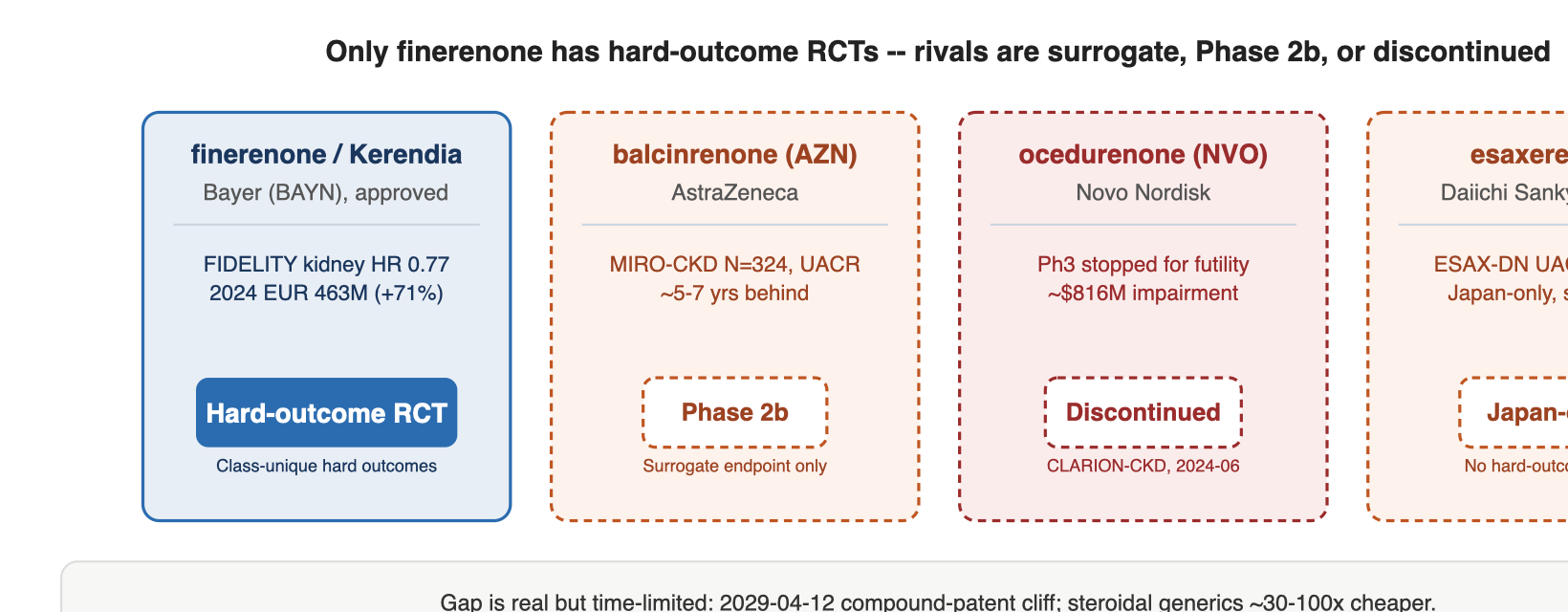
- What. Finerenone (Bayer’s Kerendia) is currently the only nonsteroidal MRA (nsMRA) with hard-outcome RCT evidence. That single fact is its commercial moat: every competitor is on a surrogate endpoint (UACR), in an early phase, or discontinued. Kerendia posted €463M in 2024 (+71% year over year; Bayer/press) and is entering the blockbuster ramp.
- So what. The moat is time-limited and boxed in on three sides. The core compound patent expires 2029-04-12; a crystalline-form patent runs to 2035 but its strength depends on unresolved litigation (10+ generic ANDA challengers). Below it, steroidal generics (spironolactone, eplerenone) sit at roughly 30–100× lower cost. Above it, the premium narrative hits a ceiling because cardiovascular-death benefit was not demonstrated (Part 1) — value rests on morbidity/organ protection, not mortality.
- Now what. The competitive gap should hold for now: balcinrenone (AstraZeneca) is still Phase 2b surrogate; esaxerenone (Daiichi Sankyo) is Japan-only surrogate; and ocedurenone is owned by Novo Nordisk (not AstraZeneca — a correction), and its Phase 3 CLARION-CKD was stopped for futility (2024-06; ~$816M impairment). Watch the effective loss-of-exclusivity band (2029 vs 2035) and the BalanceD-CKD Phase 3 readout. This post is for information only and is not investment or medical advice.
Evidence-stage note. “Peak sales” figures here are projections, not booked revenue: Bayer’s own target is >€3B ($3.2B; company), while analyst GlobalData estimates ~$2.6B (2031 peak; estimate) — a ~20% gap. Competitor “pipeline” reads as unapproved Phase 2b / discontinued, not commercial entries. Patent-defense strength (the 2035 crystalline patent) is unadjudicated — a legal option, not confirmed exclusivity.
The five-minute read
The headline is “only nsMRA with hard outcomes”; the reality is “high-growth-early × time-limited monopoly”
Finerenone is the single nonsteroidal MRA that has hard cardiorenal outcome trials behind its label (FIDELIO, FIGARO, FIDELITY, FINEARTS). That “only-one” status — paired with guideline adoption (KDIGO 2024, ADA) — sustains a premium price (US list ~$13,200/year). Kerendia revenue was €463M in 2024 (+71%; Bayer/FiercePharma), €161M ($179M) in Q1 2025 (+89%; Bayer), and Bayer’s FY2025 annual report names it, with Nubeqa, as a core growth driver of the €17,829M Pharmaceuticals segment. But note: the growth rate (+70–90%) is steep while the absolute base is only just crossing the $1B blockbuster threshold. “High-growth early curve” is not the same as “already a blockbuster.”
Price: a 30–100× premium that is only partly defensible
Finerenone (branded) runs about $670–950/month cash (list ~$13,200/year), versus generic spironolactone at ~$4–20/month and eplerenone at ~$15–60/month — a roughly 30–100× premium (GoodRx/SingleCare). What justifies the premium: steroidal MRAs have no dedicated hard-outcome RCT in T2D+CKD, whereas finerenone earned its label on FIDELITY (kidney composite HR 0.77) and FINEARTS (HF morbidity); and finerenone avoids spironolactone’s hormonal side effects. What does not justify it: there is no head-to-head RCT versus spironolactone (the “better than generic” claim is cross-trial inference, not proof), and the mortality ceiling — premiums are usually anchored in life extension, but CV death was not demonstrated (Part 1).
| Drug (class) | Approx. monthly cost (US) | Hard-outcome RCT in T2D+CKD |
|---|---|---|
| spironolactone (steroidal MRA, generic) | ~$4–20 | None (HFrEF RALES exists; DKD outcome absent) |
| eplerenone (steroidal MRA, generic) | ~$15–60 | None (HFrEF EMPHASIS-HF exists; DKD outcome absent) |
| finerenone / Kerendia (nsMRA, branded) | ~$670–950 (cash); ~$13,200/yr list | FIDELITY kidney HR 0.77 · FINEARTS HF morbidity — class-unique |
The patent cliff: 2029 baseline, 2035 as a discounted ceiling
US new-chemical-entity regulatory exclusivity expired around 2026-07-09 (the trigger for generic ANDA challenges). The core compound patent (naphthyridinamide) expires 2029-04-12 — the real cliff, and the most defensible protection. A crystalline-form patent (RE49,826) runs to 2035-07-29 but is secondary/”evergreening” in character and vulnerable to challenge. In Q4 2025, amid a broad ANDA-litigation wave, Bayer was among the most-sued, defending RE’826 against 10+ generic makers (Teva, Aurobindo, Dr. Reddy’s; Bloomberg Law). The Dr. Reddy’s matter was voluntarily dismissed without prejudice (2026-02-06) — plausibly settlement/consolidation, but with no ruling on the merits, so crystalline-patent strength remains unproven. The conservative baseline is the 2029 compound cliff; 2035 is an upside ceiling to be discounted, not taken at face value.
Deep dive
1. Background — from clinical profile to defensibility
Part 1 of this series fixed finerenone as “a modest pillar with organ/morbidity protection demonstrated but mortality unproven.” Part 3 asks how defensible a market position that clinical profile creates. The thesis, stated up front, is three-layered: the moat is real but rests on a single fact (“only nsMRA with hard outcomes”); the moat is time-limited (2029 compound cliff); and the moat is modest (steroidal generics press from below, the mortality gap from above). In short, finerenone’s commercial case is “only-one × premium,” boxed in by a 2029 cliff, a generic floor, and a mortality ceiling.
2. What this synthesis newly clarifies — a corrected competitive map
The most consequential correction in this part concerns competitor ownership. Ocedurenone (KBP-5074) is owned by Novo Nordisk — which acquired KBP Biosciences in October 2023 (up to $1.3B) — not AstraZeneca. Earlier notes (Part 0 §4 / Part 1) that called it an “AstraZeneca license” are refuted; the two nsMRAs (ocedurenone vs AstraZeneca’s balcinrenone) were conflated. Novo Nordisk’s Phase 3 CLARION-CKD was stopped in June 2024 for pre-specified futility (primary 12-week systolic-BP change not met), and Novo recognized a ~DKK 5.7B (≈$816M) impairment on the intangible (Q2 2024; ClinicalTrialsArena). That a major acquired an asset for $1.3B and then wrote off $816M on a Phase 3 futility illustrates the development difficulty of the nsMRA class — and, inversely, why finerenone’s hard-outcome evidence carries defensive value.
3. Strengths and limits of the method — attribution and unresolved items
The source asset’s strength is that each quantitative claim is attributed by source type (company IR vs analyst estimate vs press/patent database) and separates hard outcomes from surrogates. As both a limit and a required caveat, three items remain unverified.
- Unverified ①: the exact 2023 Kerendia revenue (back-calculated ~€271M; primary source not confirmed).
- Unverified ②: the strength of the crystalline-form patent (RE49,826, 2035) — the effective loss-of-exclusivity will settle somewhere in the 2029–2035 band depending on ongoing ANDA outcomes (undetermined).
- Unverified ③: the non-diabetic CKD (FIND-CKD) indication-expansion details and timeline.
4. Neighbouring domains
- Semiconductors / IP strategy. The dual structure of a compound patent (2029) plus a crystalline-form/polymorph patent (2035) is structurally isomorphic to extending a chip monopoly with process-node and packaging patents after the core-architecture patent expires — “evergreening.” In both domains, the real defensive strength of secondary IP must be discounted by invalidation/litigation risk. This is precisely why a 2035 scenario for finerenone should not be taken at face value (defensive IP ≠ confirmed exclusivity).
- Health economics / payer policy. The 30–100× premium over add-on generic spironolactone, with no head-to-head, keeps the incremental-value (ICER) question permanently live from a payer standpoint — payer pressure is a constant even before the 2029 cliff.
5. Commercialization and investment view (TRL, companies)
Quantitative claims are attributed by source and timepoint. Company IR/press figures are “company data,” analyst projections are “estimates.” Trial stage is marked by phase. The table below is a neutral compilation of public information, not a ranking or superiority judgment.
| Company / asset | Position (timepoint) | Evidence status | Open questions |
|---|---|---|---|
| Bayer (BAYN) — finerenone / Kerendia | Only marketed nsMRA with hard outcomes; 2024 €463M (+71%; company/press); Q1 2025 +89% | Approved (T2D+CKD 2021; HF LVEF≥40% FDA 2025-07-14, FINEARTS basis); EU HF filing submitted | 2029 compound-patent cliff; 2035 crystalline patent unadjudicated; peak target €3B (company) vs $2.6B est. (GlobalData) |
| AstraZeneca (AZN) — balcinrenone | MR modulator / nsMRA, +SGLT2i concept; ~5–7 years behind finerenone | Phase 2b (surrogate). MIRO-CKD N=324, 12-wk UACR primary, Lancet 2025-11-08 / ASN 2025 (added UACR reduction vs dapagliflozin, no hyperkalemia rise — company claim) | Phase 3 BalanceD-CKD (CKD 3b·4, NCT07624305) is planned; hard outcomes not before late 2020s–~2030 |
| Novo Nordisk (NVO) — ocedurenone (KBP-5074) | Effectively exited the competitive field | Phase 3 discontinued. Acquired via KBP Biosciences (2023-10, up to $1.3B); CLARION-CKD stopped for futility 2024-06; ~$816M (DKK 5.7B) impairment | Corrects prior “AstraZeneca license” error; illustrates nsMRA-class development difficulty |
| Daiichi Sankyo (4568.T) — esaxerenone / Minnebro | Japan-only; not directly competing globally with finerenone | Surrogate. Japan hypertension approval 2019-01; T2D microalbuminuria added; ESAX-DN UACR −58.3% vs +8.3%, progression 1.4% vs 7.5% | No CV/renal hard-outcome RCT; not approved in US/EU |
Moat and erosion, candidly. Defensive factors: a class-unique hard-outcome RCT portfolio; guideline adoption (KDIGO 2024, ADA 2024/25 add-on); indication breadth (DKD → HFpEF/HFmrEF 2025 → non-diabetic CKD in progress); and a competitive vacuum (balcinrenone Phase 2b, ocedurenone discontinued, esaxerenone local/surrogate) likely to persist into the late 2020s. Erosion factors: the 2029 compound cliff (2035 defense litigation-dependent); the low-cost steroidal-generic floor (30–100× premium with no head-to-head); the mortality ceiling; and hyperkalemia-monitoring friction on real-world persistence. Most competitors are unapproved Phase 2b or discontinued — counted as “competitors,” but not approvals or revenue.
6. The skeptic’s bottom line
Inherits and quotes the §6 skeptic gate of the source asset (verdict: proceed-with-caveats).
- Guard against “next blockbuster” overstatement. Peak-sales figures are projections, not booked revenue, and the company target (€3B) exceeds the analyst estimate ($2.6B, 2031) by ~20% — driven by different assumptions on indication expansion (HF) and cliff timing. Absolute revenue is only just crossing the $1B threshold; separate “high-growth early” from “already a blockbuster.”
- Doubts on patent durability. The effective loss-of-exclusivity is a 2029–2035 band. The 2029 compound patent is the defensible baseline; the 2035 crystalline patent is evergreening in character, faces multiple ANDA challenges, and its defense is unproven (the Dr. Reddy’s dismissal was without a ruling on the merits). Do not take a 2035 scenario at face value.
- Premium justification is partial. The premium is defensible on dedicated hard-outcome evidence and hormonal safety, but the ceiling is set by the absence of a head-to-head vs spironolactone and by unproven mortality benefit (Part 1). Payer pressure toward low-cost generics is a constant, even before 2029.
- Class-difficulty realism. Ocedurenone’s $816M write-off after a $1.3B acquisition shows nsMRA development is hard to reproduce; balcinrenone remains a Phase 2b surrogate ~5–7 years behind. The competitive gap is real but is a snapshot, not a permanent state.
7. What to watch (three falsifiable predictions)
- [Patent cliff] Effective generic entry for Kerendia begins around 2029 (compound patent); the 2035 crystalline patent likely fails to fully block entry under evergreening challenges. Falsified if Bayer defends RE’826 in the ongoing ANDA suits and blocks generics through 2035.
- [Competitive vacuum] No nsMRA rival with comparable hard outcomes emerges before 2028 — balcinrenone is at Phase 3 start/progress, ocedurenone discontinued, esaxerenone local/surrogate. Falsified if balcinrenone’s Phase 3 reports early hard-endpoint success.
- [Peak sales] Kerendia’s peak lands closer to the analyst estimate ($2.6B) than to Bayer’s target (€3B), as the 2029 cliff and generic pressure cap the top of the curve. Falsified if HF and non-diabetic CKD expansion overshoot to €3B+.
References
- Bayer. 2026. “Annual Report 2025 — Pharmaceuticals division.” link
- FiercePharma. 2025. “Booming sales of Bayer’s Kerendia, Nubeqa overcome decline of Xarelto” (Kerendia 2024 €463M, +71%). link
- Bayer. 2025. “FDA approves Kerendia” (HF LVEF≥40% approval, 2025-07-14). link
- Pharsight (GreyB). “Kerendia patent expiration.” link
- DrugPatentWatch. “KERENDIA patent profile.” link
- Bloomberg Law. 2025. “Bayer sues Teva, Aurobindo to block Kerendia kidney drug copies.” link
- The Lancet. 2025. “MIRO-CKD: balcinrenone plus dapagliflozin” (2025-11-08). link
- ClinicalTrials.gov. “BalanceD-CKD (NCT07624305).” link
- Novo Nordisk / GlobeNewswire. 2024. “Novo Nordisk stops the ocedurenone CLARION-CKD trial and recognises impairment loss” (2024-06-26). link
- Clinical Trials Arena. 2024. “Novo Nordisk ocedurenone flop, ~$816M impairment.” link
- GoodRx. “Kerendia price and coupons.” link
Disclosure
This post is for information only and is not investment or medical advice. Statements about revenue, market position, patents, competitive standing and pipeline should be read as neutral framing in particular, and must not be interpreted as buy/sell implications for any security. Hard outcomes (kidney failure, CV death, HF hospitalization) are kept distinct from surrogate endpoints (UACR).
The author’s position in the mentioned securities (Bayer BAYN, AstraZeneca AZN, Novo Nordisk NVO, Daiichi Sankyo 4568.T, and others) is none.
COI note (inherited from the source-asset frontmatter coi): this content describes listed pharmaceutical companies and their products, revenues, patents and pipelines factually and neutrally. Company IR/press figures are attributed as “company data,” analyst projections (e.g., GlobalData $2.6B peak) as “estimates,” and patent-expiry dates to patent databases and litigation records. Quantitative claims specify company vs analyst source and timepoint; items that could not be confirmed (2023 exact revenue, 2035 crystalline-patent strength, FIND-CKD details) are flagged as unverified (no softening language).
Source knowledge-asset verification grade: VERIFIED (26 confirmed / 1 refuted / 3 unverified). The refuted item — the prior “ocedurenone = AstraZeneca license” claim — is corrected here: the owner is Novo Nordisk. Inherited skeptic verdict: proceed-with-caveats (conditional) — the peak-projection gap, the 2029–2035 patent-cliff band, and the head-to-head-absent premium caveats govern the published narrative, so insertion of these required caveats is a condition.


Leave a comment