Evidence-first notes on bioscience and deep tech, at the edge of the lab and the market. Information only — not investment advice, and not medical advice.
The 30-second version
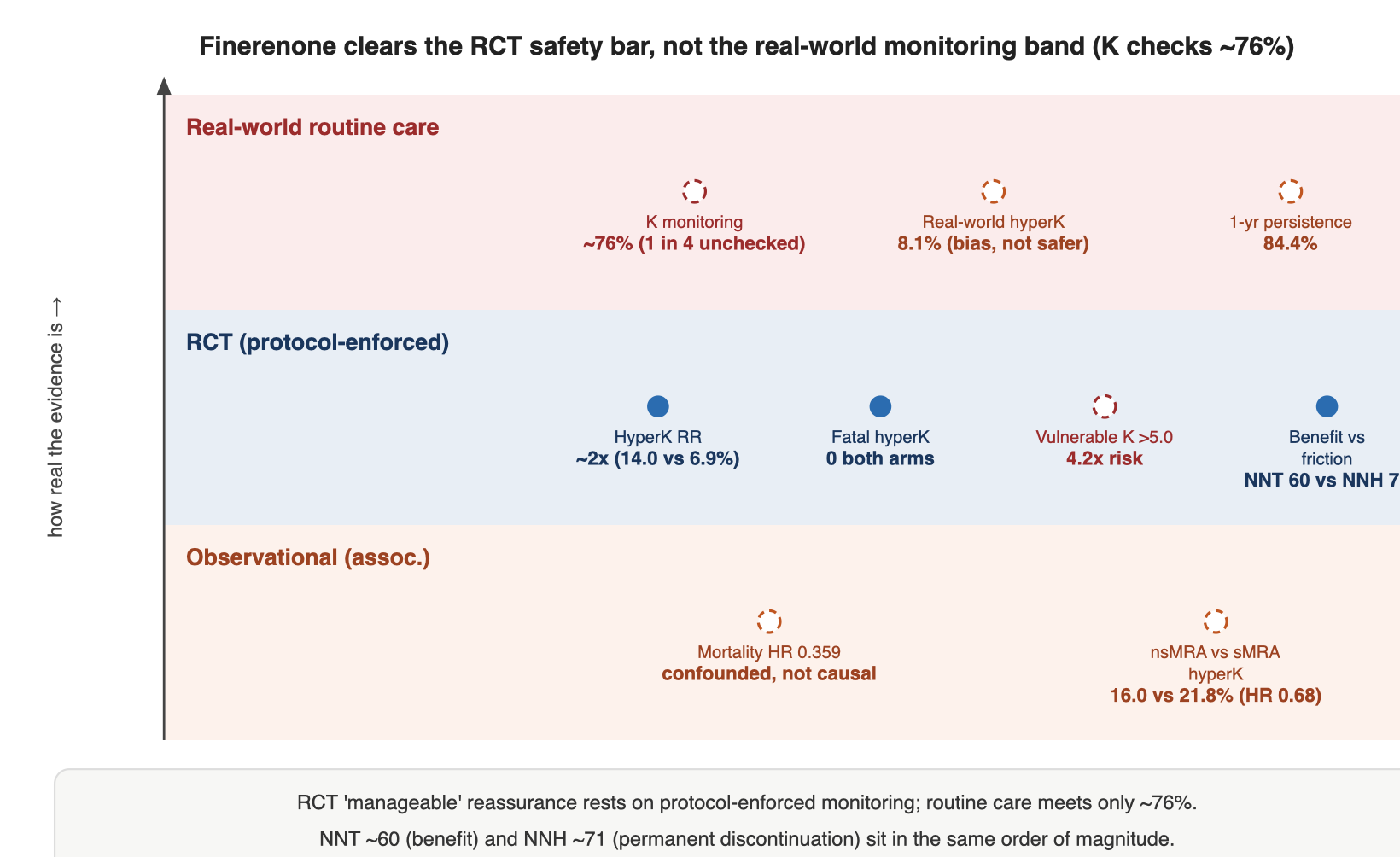
- What. Behind finerenone’s headline hazard ratios sits a clinical cost that is not dramatic harm but friction. Across RCTs, hyperkalemia occurs at roughly 2× the placebo rate, yet fatal cases are 0 and hospitalizations are under 1% — but in the renally vulnerable (baseline serum potassium >5.0 mmol/L) the risk rises to about 4.2×. The absolute benefit is modest (NNT ~59–60 over three years), and the real bottleneck is real-world monitoring: only about 76% of patients received the potassium checks the label requires, so roughly one in four is dosed without the mandated surveillance.
- So what. The benefit and the friction sit in the same order of magnitude: NNT ~59–60 to prevent one event versus NNH ~71 for permanent discontinuation. The “manageable hyperkalemia” reassurance was earned on top of protocol-enforced monitoring; in routine care that premise partly breaks. Costs must be read by tier — RCT hard evidence versus observational data — and by absolute versus relative risk.
- Now what. The balance is to neither overstate a controllable safety profile nor understate the amplified risk in frail kidneys and the monitoring gap. One observational number in particular — an all-cause mortality HR of 0.359 for finerenone versus steroidal MRAs — is almost certainly confounding-by-indication and is isolated here as not causal (unverified). Metrics to watch: (1) hyperkalemia rates in low-eGFR/high-potassium subgroups; (2) whether monitoring gaps translate into symptomatic events; (3) whether the anti-fibrotic story ever translates into a mortality signal.
The underlying knowledge asset carries a skeptic verdict of proceed-with-caveats (conditional) — neither verified-clean nor hold. It is a conditional go, contingent on the mandatory caveats below.
The five-minute read
Discussion of finerenone usually centers on its hazard ratios in kidney and heart-failure trials. This piece flips the question to “at what clinical cost is that benefit obtained.” Behind the headline sit three categories of cost, each resting on evidence of differing strength: hyperkalemia (manageable but amplified in the vulnerable), a modest absolute effect, and a real-world monitoring gap that is the true bottleneck.
Hyperkalemia — 2× on average, but 4.2× in frail kidneys
Across the pivotal RCTs, finerenone roughly doubles hyperkalemia versus placebo: 18.3% vs 9.0% in FIDELIO-DKD, 14.0% vs 6.9% in the pooled FIDELITY analysis (N=13,026), and investigator-reported 12.8% vs 6.2% in the pooled FINE-HEART analysis (N=18,991). The honest RCT summary is “common but mostly mild and resolved by management”: drug discontinuation for hyperkalemia runs 1–2%, hospitalization under 1%, and fatal cases were 0 in both arms. But hyperkalemia is not evenly distributed. A FIDELIO-DKD post-hoc analysis showed baseline strongly stratifies risk: baseline eGFR 25–<45 carries about 2× the risk of eGFR ≥60, and baseline serum potassium of 4.8–5.0 carries 2.8× and >5.0 carries 4.2×. Permanent discontinuation, however, remains rare — roughly one per 71 patients treated (NNH ~71).
Modest absolute benefit, and the monitoring gap that is the real bottleneck
The absolute effect is gentle: a three-year absolute risk reduction of about 1.6–1.7 percentage points, NNT ~59–60, and in non-diabetic CKD (FIND-CKD) an eGFR-slope difference of just 0.7 mL/min/1.73m²/year. This is population-health arithmetic — a thin benefit across a very large population — not a dramatic individual-level effect. Crucially, NNT ~60 versus NNH ~71 means benefit and friction are the same order of magnitude. The real-world data make the friction concrete: one-year persistence is a reasonable 84.4% (FINE-REAL), but potassium-monitoring adherence is only about 76% — roughly one in four patients is dosed without the surveillance the label requires. The RCT reassurance of “manageable” rested on protocol-enforced monitoring; in routine care a quarter of that premise is missing.
| Cost / signal | Strongest evidence tier | Actual size / caveat |
|---|---|---|
| Hyperkalemia — relative risk | RCT | ~2× placebo, consistent across trials (FIDELITY 14.0 vs 6.9%) |
| Hyperkalemia — absolute/fatal | RCT | Low: discontinuation 1–2%, hospitalization <1%, fatal 0 |
| Hyperkalemia — vulnerable subgroup | RCT sub-analysis | Amplified: eGFR 25–45 ~2×; baseline K >5.0 4.2×; permanent-discontinuation NNH ~71 |
| Hyperkalemia — real-world | Observational | Observed lower (FINE-REAL 8.1%) — but measurement/selection bias likely, not “safer” |
| nsMRA vs steroidal MRA (hyperK) | Observational | Directionally lower (16.0 vs 21.8%, HR 0.68); mortality HR 0.359 is confounded — not causal [unverified] |
| Absolute benefit size | RCT | Modest: ARR 1.6–1.7pp, NNT 59–60; FIND-CKD slope 0.7 mL/min/yr |
| Persistence / adherence | Observational | Good but with gap: 1-yr persistence 84.4%, discontinuation 13.1% |
| Monitoring adherence | Observational | Partial non-compliance: K/eGFR checks ~76% — one in four unmonitored |
| Non-hemodynamic story → mortality | RCT pooled | Not translated: CV death FINEARTS HR 0.93, FINE-HEART HR 0.89 (NS) |
Deep dive
1. Background: shifting the question from “how strong” to “at what cost”
Earlier parts of this series framed finerenone as a “gentle but robust third pillar” of cardio-renal-metabolic (CKM) care, with organ and morbidity protection demonstrated while mortality remained only suggestive. This part applies a skeptic lens to the back of that robustness — the cost that patients and the health system actually pay. One principle governs throughout: separate, sentence by sentence, absolute risk from relative risk, and the RCT tier from the observational tier; observational causal interpretation is prohibited and confounding is stated alongside. All figures are attributed to source, and direct quotation is kept under 150 characters. The thesis in one line: finerenone’s clinical cost is “not fatal, but high-friction” — a modest benefit obtained at the price of repeated measurement, dose titration, and discontinuation risk.
2. What this asset compiled — the actual size of the hyperkalemia cost
RCT tier — relative risk ~2×, absolute and fatal low. The pattern is consistent: FIDELIO-DKD 18.3% vs 9.0%, FIDELITY (pooled N=13,026) 14.0% vs 6.9% (discontinuation 1.7% vs 0.6%, hospitalization 0.9% vs 0.2%), FINEARTS-HF 14.3% vs 6.9%, and FINE-HEART (pooled N=18,991) laboratory K>5.5 at 16.5% vs 7.7% with investigator-reported 12.8% vs 6.2%. In every trial, hyperkalemia-related fatalities were 0 in both arms. This clean profile, however, was obtained on top of protocol-mandated potassium monitoring, dose titration, and stopping rules — a premise that matters when reading the real-world gap.
Vulnerable subgroup — risk doubles in frail kidneys. The FIDELIO-DKD post-hoc analysis showed baseline eGFR 25–<45 carried about 2× the hyperkalemia risk of eGFR ≥60, and baseline serum potassium stratified sharply: 4.5–<4.8 at 1.5×, 4.8–5.0 at 2.8×, and >5.0 at 4.2×. Permanent discontinuation was rare (NNH ~71), and only one placebo-arm patient across the whole trial required dialysis-related hospitalization for hyperkalemia. The skeptic implication: the headline 14–18% is an average, and the KDIGO/ADA gating of finerenone to normal potassium and eGFR ≥25 exists precisely to exclude this vulnerable tail — which real-world renal populations skew toward.
Real-world tier — a lower rate that is a trap, not reassurance. In FINE-REAL (prospective, non-interventional phase 4, N=1,916, median follow-up 260 days), hyperkalemia was 8.1% (156/1,916), discontinuation 1.0%, hospitalization 0.3% (5 patients), fatal 0; laboratory K>5.5 was 6.3% and K>6.0 was 1.5%. At first glance this is less than half the RCT rate — but reading it as “real-world is safer” is an error. Observational studies sample and report potassium less often (ascertainment bias), prescribers preferentially start lower-risk patients (baseline K 3.6–5.0 in 90.4%), and follow-up is short (~9 months). The RCT 14% and the real-world 8% are not a contradiction; they are products of different tiers.
3. Methodological strengths and limits — tier decides the conclusion
| Axis | Evidence tier | Verdict / caveat |
|---|---|---|
| Hyperkalemia relative risk | RCT | ~2× consistent (FIDELITY 14.0 vs 6.9%; FINE-HEART lab 16.5 vs 7.7%) |
| Hyperkalemia absolute/fatal | RCT | Low: discontinuation 1–2%, hospitalization <1%, fatal 0 |
| Vulnerable subgroup | RCT sub-analysis | Doubled/quadrupled: eGFR 25–45 ~2×, baseline K >5.0 4.2×, permanent-discontinuation NNH ~71 |
| Real-world hyperkalemia | Observational | Observed lower (FINE-REAL 8.1%) — measurement/selection bias, not “safer” |
| nsMRA vs steroidal MRA | Observational (TriNetX, PS-matched 780 vs 780, 12 mo) | Direction only: hyperK >5.5 16.0 vs 21.8% (HR 0.683, 0.542–0.861); all-cause mortality HR 0.359 and arrhythmia HR 0.596 are confounding-by-indication — not to be read causally [unverified] |
| Absolute effect size | RCT | Modest: ARR 1.6–1.7pp, NNT 59–60 (95% CI 38–142), FIND-CKD slope 0.7 mL/min/yr (P<0.001) |
| Persistence / adherence | Observational | Good with gap: 1-yr persistence 84.4%, discontinuation 13.1%, medication adherence 92.1% |
| Monitoring adherence | Observational | Partial non-compliance: post-initiation eGFR check 77.1%, paired K check 76.4% — one in four unmonitored |
| Non-hemodynamic → mortality | RCT pooled | Not translated: CV death FINEARTS HR 0.93, FINE-HEART HR 0.89 (P=0.076, NS) |
The strength here is separating, for each axis, the strongest evidence tier from the actual size, so that a “signal” is never confused with “causation” and an “average” is never confused with a “subgroup.” The limits: the observational lower real-world hyperkalemia rate reflects measurement and selection, not greater safety; the class claim that non-steroidal MRAs cause less hyperkalemia than steroidal ones aligns with pharmacology and observational direction but lacks a head-to-head hard-outcome RCT; and the large observational mortality HR (0.359) is almost certainly confounding-by-indication (steroidal MRAs are used in more advanced HFrEF and sicker patients) and must not be read as causal.
4. The modest absolute effect — NNT and population logic
Two skeptic readings collide on the same number. The population-health reading (defense): NNT 60 is not failure; CKD and HFpEF are tens-of-millions-scale populations, so a thin ARR still translates into large event avoidance at the population level — the same gentle profile as SGLT2 inhibitor and GLP-1 outcome trials. The individual-benefit reading (skepticism): for a single patient or prescriber, “60 people dosed for three years to avoid one event” means all 60 carry the monitoring burden and the ~14% hyperkalemia risk, and NNT 60 versus NNH ~71 puts benefit and friction in the same order of magnitude. The modest absolute effect is not a defect but the intrinsic profile of a CKM preventive drug; the problem is that this modesty competes, one order of magnitude to one, with the monitoring friction. Adoption therefore hinges not on “the drug being powerful” but on “whether the system can bear the compliance cost.”
5. Adherence and the monitoring gap — label ideal versus real use
In FINE-REAL, one-year continuous dosing was 84.4% (1,618/1,916), temporary interruption 6.2%, and permanent discontinuation 13.1% (251 patients); 80.8% started at 10 mg and only 26.1% of them up-titrated to 20 mg, while a separate real-world dataset reported medication adherence of 92.1% at a mean 15.1 mg/day. One-year persistence of 84% is not bad for a chronic preventive drug — but the 13% permanent discontinuation further shaves the already-thin ARR in real use, a source of the gap between the trial’s intention-to-treat effect and real-world effectiveness. The sharper problem is monitoring. The label requires potassium and eGFR measurement before initiation, at about four weeks, and periodically (up-titration to 20 mg requires eGFR fall ≤30% and K ≤4.8), yet real-world compliance was 77.1% for post-initiation eGFR and 76.4% for paired potassium — meaning about one in four is dosed without the mandated surveillance. The “hyperkalemia is manageable” reassurance presupposes protocol-enforced monitoring; if a quarter of that premise collapses in routine care, the basis for manageability holds only in part. This is finerenone’s most tangible clinical cost — not the price of the pill but the burden of the surveillance infrastructure (repeated blood draws and follow-up), and it is heaviest in primary-care and resource-constrained settings.
6. The other side (balance — the counter-case)
For balance, the counter-arguments that the costs are overstated. First, hyperkalemia-related fatalities were 0 across multiple large RCTs and hospitalizations under 1%; on tier and absolute risk this is a controllable, non-catastrophic profile, and one-year persistence of 84% is respectable for a chronic preventive. Second, the modest absolute effect is the shared signature of CKM preventive medicine (SGLT2 inhibitors, GLP-1s), not a finerenone-specific weakness, and at population scale a thin ARR still averts large numbers of events. Third, the non-hemodynamic pharmacology (selective, balanced cardiac-renal distribution, minimal blood-pressure effect — serum K rose only ~0.12 mmol/L in FIND-CKD) is consistently supported, so the drug’s mechanism claim is not hype. Fourth, in the three-pillar CKM framing, SGLT2 inhibitor co-administration appears to buffer potassium risk (FIDELITY subanalysis, CONFIDENCE safety), giving combination therapy a safety-complementarity argument on top of efficacy complementarity — though this still rests on the absence of a combination hard-outcome RCT. The source asset’s skeptic gate being proceed-with-caveats rather than hold reflects exactly this balance.
7. What to watch (falsifiable predictions)
- Vulnerable-subgroup hyperkalemia: a real-world analysis restricted to baseline eGFR <45 and K ≥4.8 should show a hyperkalemia rate above the trial average of ~14% (selective initiation masks the vulnerable tail behind a lower mean). Falsified if the low-eGFR subgroup stays below average.
- Monitoring → events: cohorts with lower potassium-monitoring adherence should show more symptomatic hyperkalemia events (rather than pre-emptive stopping), i.e., the surveillance gap translating into safety events. Falsified if monitoring adherence and hyperkalemia hospitalization are unrelated.
- Mortality remains untranslated: in future long-term follow-up and new pooled analyses, the CV-death-alone HR upper CI should remain near 1 despite the anti-fibrotic narrative (organ/morbidity protection only). Falsified if a new large dataset establishes a significant CV-death-alone signal.
References
- FINE-REAL (second interim analysis). 2025. Clinical Kidney Journal 18(11): sfaf305. link
- FINE-REAL (first interim analysis). PMC11649709. link
- FIND-CKD (non-diabetic CKD). 2025. New England Journal of Medicine. NEJMoa2604625. link
- Bayer. “Kerendia for non-diabetic chronic kidney disease” (FIND-CKD press release). link
- FIDELIO-DKD hyperkalemia sub-analysis. PMC8763180. link
- nsMRA vs steroidal MRA real-world comparison (TriNetX, observational). PMC12641577. link
- FIDELITY pooled analysis. 2022. European Heart Journal 43(6): 474. link
- FINE-HEART pooled analysis. 2024. Nature Medicine. link
Disclosure
This post is for information only. It is not investment advice and not medical advice — treatment decisions must be made with your own clinician. The author holds no position in, and has no direct financial interest in, the listed companies mentioned (Bayer BAYN, AstraZeneca AZN). Much of the efficacy and safety data cited here was generated in trials sponsored by a listed pharmaceutical company (Bayer, including the FINE-REAL and FIND-CKD programs); sponsored-trial and real-world figures are attributed accordingly, together with the evidence tier (RCT hard / RCT sub-analysis / observational). Observational studies represent association, not causation; relative and absolute risks are stated together, and hard endpoints (kidney failure, CV death, heart-failure hospitalization) are kept separate from surrogates (UACR, eGFR slope). The safety-signal descriptions are a neutral account of evidence status, not a negative implication about any specific security.
Mandatory caveats (inherited from the source asset’s skeptic gate): (1) the observational all-cause mortality HR of 0.359 for finerenone versus steroidal MRAs is strongly suspected of confounding-by-indication and is not to be read as causal (unverified) — only the directional lower-hyperkalemia signal is adopted; (2) hyperkalemia relative risk (~2×) is stated together with absolute risk (fatal 0, hospitalization <1%) and with the vulnerable-subgroup amplification (baseline K >5.0 at 4.2×); (3) the RCT tier and the observational tier are kept separate throughout, and the lower real-world hyperkalemia rate (8.1%) is read as measurement/selection, not greater safety; (4) the benefit (NNT ~59–60) and the friction (permanent-discontinuation NNH ~71, monitoring adherence ~76%) are stated as the same order of magnitude to avoid overstating either benefit or harm.
Skeptic verdict inherited: proceed-with-caveats (conditional). This is a conditional go contingent on the four caveats above — neither verified-clean nor hold. Publication status: HOLD — neutral framing to be confirmed with the Principal given safety-signal implications for a listed pharmaceutical company (Bayer BAYN; charter §Escalation). No publication before Principal approval.


Leave a Reply