Evidence-first notes on bioscience and deep tech, at the edge of the lab and the market. Information only — not investment advice, not medical advice.
The 30-second version
- What. Finerenone completes the cardio-kidney-metabolic (CKM) “three-pillar” standard of care alongside SGLT2 inhibitors and GLP-1 agonists through a non-overlapping anti-inflammatory / anti-fibrotic axis. But the real substance of that complementarity is a division of outcomes: finerenone’s weak axis (mortality) is covered by partners whose hard evidence is strong — in the same CKD population, GLP-1 (FLOW) showed cardiovascular death HR 0.71 and all-cause death HR 0.80, while finerenone’s own cardiovascular-death signal is unproven (FINE-HEART HR 0.89, P=0.076). All figures are cross-trial, not head-to-head.
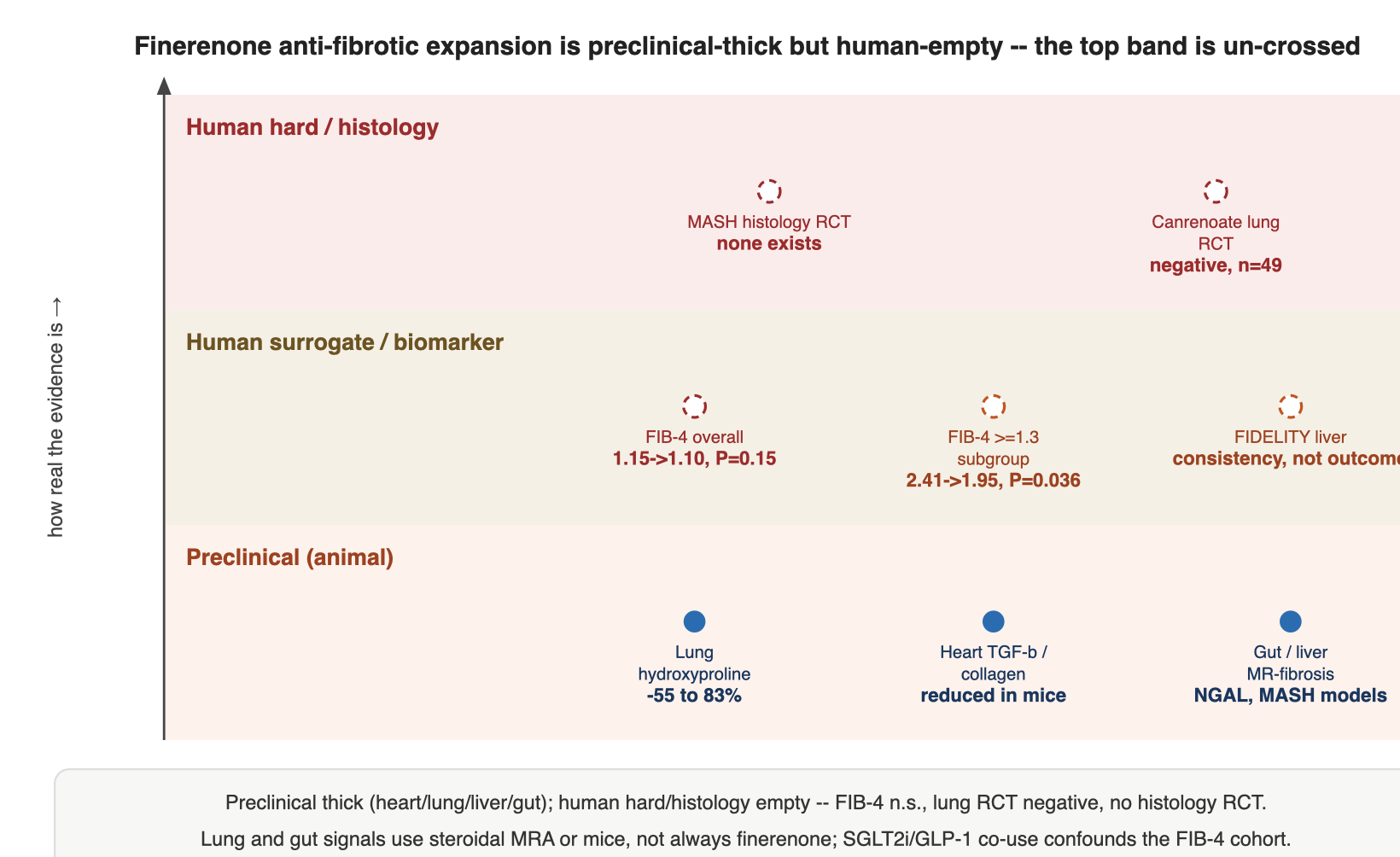
- So what. The anti-fibrotic identity that differentiates finerenone is claimed to extend beyond heart and kidney into liver (MASH) and lung. The preclinical / mechanistic evidence is thick, but the human hard-outcome and histology evidence is essentially empty (a retrospective FIB-4 cohort was non-significant, a human mineralocorticoid-receptor-antagonist lung-fibrosis RCT was negative, and no prospective MASH histology RCT exists). This is a hypothesis, not a demonstration.
- Now what. In guidelines, finerenone sits as a conditional add-on (RAS inhibitor + SGLT2i first, then GLP-1 or finerenone), and reimbursement opens through a disease label (T2D + CKD + albuminuria), not a “CKM syndrome” code. The headline reads “third pillar complete,” but the true bottlenecks remain unproven mortality, unproven combination hard outcomes, a modest absolute effect, the anti-fibrotic human-evidence gap, and hyperkalemia friction.
The five-minute read
Finerenone completes a three-pillar architecture — but on a different axis
The CKM standard of care now rests on three pillars with non-overlapping mechanisms: SGLT2 inhibitors (hemodynamic / osmotic, lowering intraglomerular pressure), GLP-1 agonists (metabolic, vascular, anti-inflammatory), and finerenone, a non-steroidal mineralocorticoid-receptor antagonist that acts through an anti-inflammatory and anti-fibrotic, non-hemodynamic mechanism. The conventional argument is “different mechanisms, so they add up.” That is the starting point, not the substance.
An earlier part of this series established that finerenone’s robustness rests on kidney and heart-failure morbidity, with a hole at cardiovascular death (FINE-HEART cardiovascular death HR 0.89, P=0.076, not significant; all-cause death borderline in the pooled analysis only, HR 0.91, P=0.027). Cross that profile with the partners’ evidence and the complementarity turns out to live on the outcome axis, not the mechanism axis.
Complementarity means “the strong cover the weak,” not “no overlap”
The point where finerenone is weakest — cardiovascular and all-cause death — is exactly where GLP-1 has hard evidence in the same CKD / albuminuria population. In FLOW, semaglutide showed cardiovascular death HR 0.71 (0.56–0.89) and all-cause death HR 0.80 (0.67–0.95). So the “hard outcome” narrative of three-pillar combination therapy rests substantially on the mortality evidence of the partners (GLP-1, SGLT2i), not on finerenone itself. In return, finerenone adds a tissue-fibrosis axis the partners do not directly target. That is the two-way division of labor. Important caveat: whether this is genuinely additive on hard endpoints is proven only to the level of surrogate markers (UACR, the CONFIDENCE trial) — no combination hard-outcome RCT exists.
| Pillar | Mechanism axis | Kidney hard outcome | Cardiovascular death | All-cause death |
|---|---|---|---|---|
| SGLT2i | Hemodynamic / osmotic | Strong (DAPA-CKD, EMPA-KIDNEY) | Significant signal | Significant (DAPA-CKD HR 0.69*) |
| GLP-1 (sema) | Metabolic, vascular, anti-inflammatory | Strong (FLOW) | Significant HR 0.71 (0.56–0.89) | Significant HR 0.80 (0.67–0.95) |
| finerenone | Anti-inflammatory / anti-fibrotic (non-hemodynamic) | Strong (FIDELITY HR 0.77) | Unproven (FINE-HEART 0.89, P=0.076) | Borderline (pooled only, 0.91, P=0.027) |
The anti-fibrotic expansion: thick preclinical signal, empty human evidence
Because fibrosis (the TGF-β, collagen, galectin-3 and NGAL pathways) is an organ-independent injury route, there is a plausible hypothesis that “if it works in heart and kidney, it works in liver, lung and gut.” The preclinical signal is consistent and multi-organ. The human hard-outcome and histology evidence, however, is essentially empty — and in one case negative. That gap between a thick hypothesis and empty evidence is the central skeptic point of this synthesis.
Deep dive
1. Background — two real questions under a “completed three-pillar” headline
An earlier part of this series framed finerenone as a “modest but robust third CKM pillar,” and a later part nailed down that the robustness loads onto kidney and heart-failure morbidity with a hole at cardiovascular death. This synthesis widens the view to two cross-domain questions:
- What exactly is the complementarity of the CKM three pillars? “Non-overlapping mechanisms” is only the start. The substance is a division of outcomes — finerenone’s weak axis (mortality) is filled by partners (GLP-1, SGLT2i) that are hard-strong there. And which taxonomy and guideline the three pillars ride on is the channel through which that complementarity translates into practice and reimbursement.
- Does the anti-fibrotic mechanism extend beyond heart and kidney? Finerenone’s differentiator (non-hemodynamic tissue protection) is claimed to expand into liver (MASH) and lung. Separating the thick preclinical signal from the essentially empty human hard / histology evidence is the skeptic axis here.
2. What this synthesis establishes — complementarity as a division of outcomes
Core (verified): the complementarity is not “no overlap” but “mutual coverage of weaknesses.” The point where finerenone is weakest (cardiovascular death, all-cause death) is exactly where GLP-1 (FLOW: cardiovascular death HR 0.71, all-cause 0.80) has hard evidence in the same CKD / albuminuria population. So the combination’s hard-outcome narrative rests substantially on partner mortality evidence, not on finerenone itself. In return, finerenone adds a tissue-fibrosis axis the partners do not directly target. But whether this is additive on hard endpoints is proven only to surrogate level (UACR, CONFIDENCE) — the “map” shows mechanism and monotherapy-outcome overlap, not proof of combination hard-outcome superiority.
3. Definitional power — where finerenone rides in taxonomy and guidelines
A parallel firm series on CKM-versus-SMD framing argues that “whoever names the disease governs the standard of care, reimbursement and label,” and found that definitional power reaches the guideline layer within about three years but stalls at the ICD-code / reimbursement layer (no dedicated CKM code exists). Placed in that frame, finerenone shows three things:
- Guideline layer — finerenone settles as a conditional add-on. The 2026 AHA/ACC/ADA/ASN CKM multidisciplinary guideline (JACC 2026-06-09) makes RAS inhibitor + SGLT2i first-line in CKD with diabetes / proteinuria, then adds GLP-1 or finerenone if proteinuria persists. KDIGO 2024 also gives finerenone a dedicated recommendation (eGFR ≥25, normal potassium, ACR >30). Finerenone’s taxonomy position is thus a third-line-style add-on, not first-line — aligned with its outcome profile (weak mortality, strong morbidity): guidelines place it as a layer on residual risk, not as a foundation.
- Code / reimbursement layer — finerenone also opens through a disease label, not a taxonomy. Just as GLP-1 reimbursement opens through individual FDA labels (MACE, OSA) rather than a “CKM stage,” finerenone’s trigger is the existing disease label T2D + CKD + albuminuria, not an overarching “CKM syndrome.” The code / reimbursement lag applies here too.
- Where CKM and SMD diverge — the liver could decide finerenone’s taxonomy membership (hypothesis). The US CKM construct incorporates the liver only as a FIB-4 risk indicator, whereas the European EAS SMD (2025) explicitly includes the liver in staging. If the anti-fibrotic-liver expansion (see §4) ever gains human evidence, finerenone might map more naturally onto the liver-foregrounding SMD frame. This is currently a taxonomy hypothesis with no supporting human evidence, held as unverified — no forced linkage.
4. Neighbouring domain — the anti-fibrotic expansion
Finerenone’s identity is a tissue anti-fibrotic agent rather than a blood-pressure drug. Separating the evidence by tier makes the picture clear: the preclinical layer is thick, the human layer is essentially empty.
4-1. Preclinical (animal / mechanistic) — thick multi-organ signal [confirmed, but preclinical tier].
- Heart: finerenone significantly reduced TGF-β and collagen 3α1 expression and myocardial fibrosis in Rac1-overexpressing transgenic mice (a left-ventricular fibrosis model) — direct evidence for finerenone itself (Biochem Pharmacol 2019).
- Lung: in a bleomycin rodent pulmonary-fibrosis model, mineralocorticoid-receptor antagonists (spironolactone, eplerenone) reduced hydroxyproline by 55–83% (Eur J Pharmacol 2013). Note this was steroidal MRA, not finerenone, and animal-only.
- Liver (MASLD/MASH): aldosterone / MR contributes to MASLD via inflammation and fibrosis regulation, and MR blockade improved MASH and fibrosis in experimental models (review 2025). The mechanistic rationale is clear.
- Gut: MR activation induced intestinal fibrosis via NGAL (Nat Commun 2025) — an organ-expansion signal for the MR–fibrosis axis.
4-2. Human — hard / histology evidence essentially empty, some negative [confirmed, central].
- Retrospective FIB-4 cohort (finerenone, T2D + CKD): single-center, single-arm, no control, 52 completers. Overall FIB-4 median 1.15 → 1.10, P=0.15 (non-significant). Only the FIB-4 ≥1.3 subgroup (17 patients) reached 2.41 → 1.95, P=0.036. The authors concluded no definitive conclusion on anti-fibrotic activity is possible and the finding is hypothesis-generating (PMC12929166). No histology or elastography; SGLT2i / GLP-1 co-use is a confounder.
- FIDELITY liver subgroup (407-P, ADA 2023): cardio-renal efficacy was consistent in patients with abnormal liver steatosis / fibrosis markers. That means “the drug still works in patients with poor liver status,” not “finerenone reverses liver fibrosis.” The endpoints were cardiovascular / kidney, not liver histology.
- The human MRA lung-fibrosis RCT was negative: a randomized placebo-controlled trial of potassium canrenoate (a steroidal MRA) in COVID pneumonia / pulmonary fibrosis (n=49) showed no reduction in CT fibrotic change and no clinical benefit (only some inflammatory markers moved) (PMC8874492). A human example of “biomarker movement ≠ clinical fibrosis benefit.”
- No prospective histology RCT: no prospective RCT of finerenone with a MASH histology endpoint is identified. The MASLD-related registered trial NCT07585526 studies CKD prevention (a kidney endpoint) in MASLD-cirrhosis / ascites patients — it looks at the kidney, not liver histology.
Verdict — the hypothesis is thick and the evidence is empty. The liver / lung / gut expansion of anti-fibrosis is consistently supported at the preclinical / mechanistic tier but, at the human hard / histology tier, resolves into (a) non-significance (retrospective FIB-4), (b) subgroup consistency rather than an outcome (FIDELITY liver), (c) a negative result (canrenoate lung) and (d) an absence of any prospective histology RCT. “Finerenone expands into MASH and lung fibrosis” is a textbook point where marketing narrative can run ahead of evidence; the honest current label is “mechanistically promising, human-unproven (hypothesis).”
5. Commercialization and investment context (TRL, companies)
- Maturity: finerenone (Kerendia, Bayer) is approved with a dedicated CKD / albuminuria label and guideline add-on position (TRL 9 in its approved indication). The anti-fibrotic liver / lung expansion remains at a preclinical-to-hypothesis stage (low TRL for those indications).
- The three-pillar sponsors: the pillars map to listed sponsors — Bayer (finerenone), Novo Nordisk (semaglutide / GLP-1), AstraZeneca and Boehringer (SGLT2i), Eli Lilly (metabolic pipeline). Product-ranking and combination narratives could be misread as security implications; they are described here neutrally and are not buy/sell signals.
- Where the hard-outcome weight sits: the mortality center of gravity of the three-pillar story lies with the partners (GLP-1, SGLT2i), not with finerenone — a factual, neutral read of cross-trial evidence, not a competitive ranking.
6. The skeptic’s bottom line — headline versus true bottleneck
Inheriting the firm’s recurring discipline that “the headline points one way and the rate-limiting step lies elsewhere,” applied to finerenone:
- Outcome: headline “cardio-renal hard-outcome improvement, three-pillar complete”; true bottleneck — cardiovascular death and all-cause death unproven (FINE-HEART 0.89, P=0.076), and the mortality benefit depends on the partners.
- Combination: headline “additive with SGLT2i / GLP-1”; true bottleneck — proven only to surrogate level (UACR, CONFIDENCE), no combination hard-outcome RCT.
- Effect size: headline “20–23% relative risk reduction (HR)”; true bottleneck — a modest three-year absolute risk reduction of about 1.6–1.7 percentage points, number-needed-to-treat 59–60 (population-health scale).
- Expansion: headline “anti-fibrotic reach into liver and lung”; true bottleneck — human hard / histology gap (FIB-4 non-significant, lung RCT negative, no prospective histology RCT).
- Definitional power: headline “third CKM pillar”; true bottleneck — a guideline add-on (third-line), reimbursement only through a disease label, no dedicated CKM code.
- Safety: headline “manageable”; true bottleneck — hyperkalemia friction (FINE-HEART laboratory potassium >5.5: 16.5% versus 7.7%) and real-world adherence.
- Principle: “three-pillar complete” is true, but the completeness is high at the surrogate-marker and guideline-hierarchy layers and low at the hard-outcome and combination-proof layers.
7. What to watch
- Combination hard outcomes: a finerenone + SGLT2i (± GLP-1) hard-outcome RCT — whether it shows additivity on kidney-failure / cardiovascular composites, or only improves the surrogate (UACR) and fails on hard endpoints.
- Anti-fibrotic liver expansion: whether a prospective MASH histology-endpoint RCT is run, and whether fibrosis improvement appears at the histology-stage level rather than only in a biomarker (FIB-4).
- Definitional-power mapping: whether any regulator or payer writes “CKM stage” or “SMD liver inclusion” into finerenone use criteria by 2027, or whether it remains a “T2D + CKD + albuminuria” disease-label add-on.
- Series triangle: finerenone completes the last side of the three-pillar triangle joining the GLP-1 (metabolic / mortality) axis and the CKM-versus-SMD (definitional-power) axis; the consistent conclusion across all three is that the CKM headline is established while the real contest lies underneath (combination hard proof, mortality attribution, reimbursement codes, anti-fibrotic human evidence).
References
- Mann, J. F. E., et al. 2025. “Cardiovascular Outcomes with Semaglutide by CKD Severity (FLOW).” European Heart Journal 46 (12): 1096. All-cause death HR 0.80 (0.67–0.95); cardiovascular death HR 0.71 (0.56–0.89). https://academic.oup.com/eurheartj/article/46/12/1096/7745056
- Vaduganathan, M., et al. 2024. “Finerenone in Heart Failure and Cardio-Kidney Disease (FINE-HEART pooled analysis).” Nature Medicine. Cardiovascular death HR 0.89 (0.78–1.01, P=0.076). https://pmc.ncbi.nlm.nih.gov/articles/PMC11645272/
- 2026 AHA/ACC/ADA/ASN Cardiovascular-Kidney-Metabolic (CKM) Guideline. Journal of the American College of Cardiology (2026-06-09). https://www.jacc.org/doi/10.1016/j.jacc.2026.03.056
- Review. 2025. “Aldosterone / Mineralocorticoid Receptor in MASLD.” PMC. https://pmc.ncbi.nlm.nih.gov/articles/PMC12383379/
- Mineralocorticoid-receptor antagonism in bleomycin rodent pulmonary fibrosis. 2013. European Journal of Pharmacology. Hydroxyproline reduced 55–83%. https://pubmed.ncbi.nlm.nih.gov/24012780/
- Finerenone and Rac1-driven cardiac fibrosis (transgenic mouse). 2019. Biochemical Pharmacology. https://www.sciencedirect.com/science/article/abs/pii/S0006295219302564
- Mineralocorticoid receptor and NGAL-mediated intestinal fibrosis. 2025. Nature Communications. https://www.nature.com/articles/s41467-025-61401-0
- Finerenone and FIB-4 (retrospective cohort, n=52). PMC. Overall FIB-4 1.15 → 1.10, P=0.15; hypothesis-generating. https://pmc.ncbi.nlm.nih.gov/articles/PMC12929166/
- Potassium canrenoate in COVID pneumonia / pulmonary fibrosis (RCT, n=49). PMC. No reduction in CT fibrotic change (negative). https://pmc.ncbi.nlm.nih.gov/articles/PMC8874492/
- Finerenone in MASLD-cirrhosis / ascites — CKD prevention (kidney endpoint), investigator-initiated. NCT07585526. https://clinicaltrials.gov/study/NCT07585526
- FIDELITY liver subgroup (407-P). Diabetes 72 (Suppl 1): 407-P. ADA 2023. https://diabetesjournals.org/diabetes/article/72/Supplement_1/407-P/149136
Disclosure
This post is for information only and is not investment advice, and not medical advice. Treatment decisions should always be made with your own clinician.
COI note: this post describes listed pharmaceutical companies (Bayer BAYN, Novo Nordisk NVO, Eli Lilly LLY, AstraZeneca, Boehringer Ingelheim) and the clinical trials and guideline bodies (KDIGO, ADA, AHA/ACC, EAS, ESC) associated with them in a descriptive, neutral context. All efficacy figures are attributed to the specific trial, pooled analysis or journal. Hard endpoints (kidney failure, cardiovascular death, heart-failure hospitalization) are distinguished from surrogates (UACR, FIB-4, eGFR slope); cross-trial comparisons are distinguished from head-to-head; preclinical (animal) evidence is separated by tier from human evidence. Quantitative claims about the anti-fibrotic expansion are attributed to their preclinical models or hypothesis-generating human studies and are not presented as demonstrated clinical benefit. Competitive, product-ranking and combination statements are factual, neutral descriptions and are not buy/sell implications for any security. The author holds no position in, and has no financial interest in, the companies named.


Leave a Reply