Evidence-first notes on bioscience and deep tech, at the edge of the lab and the market. Information only — not investment advice.
The 30-second version
- What. Capital and clinical proof in AI drug discovery point in opposite directions. The best-financed pure-AI drug shops — Isomorphic Labs (a $2.1B Series B in May 2026), Xaira ($1B+ launch), Eikon (~$1.5B) — carry zero clinical assets, while the only firm with a validated human clinical proof-of-concept (Insilico, ~$800M, comparatively under-capitalized) sits below the top of the capital stack. And the number of FDA-approved drugs discovered by AI to date is zero.
- So what. The deal headlines are bio-dollars, not realized cash: Isomorphic–Lilly “>$1.7B” and Isomorphic–Novartis “~$1.2B” are success-contingent milestone totals, and only the upfronts ($45M and $37.5M) are committed. The one structurally decoupled position is the arms dealer — Schrödinger’s hosted-license software revenue and NVIDIA’s BioNeMo collect a toll on design and training regardless of which candidate wins the clinic. Schrödinger is the only listed name whose revenue is partly detached from a single asset’s clinical fate.
- Now what. This closes the firm’s six-part AI×Bio series with one through-line: the real bottleneck is always the biology at the outcome layer. AI/compute wins where iteration is cheap (design, in-silico, preclinical, Phase 1 chemistry) and turns ordinary where iteration is expensive (Phase 2 efficacy, hard endpoints). Capital is pre-placed on a translation that has not been completed anywhere.
(Note: financials below are attributed to SEC 8-K / IR primary filings; capital and deal figures to primary press/newsroom; milestone totals, analyst consensus, and forward-looking dates are isolated and labeled unverified. Capital raised is an option on breaking a bottleneck, not a completed proof.)
The five-minute read
Capital is buying an option, not a proof
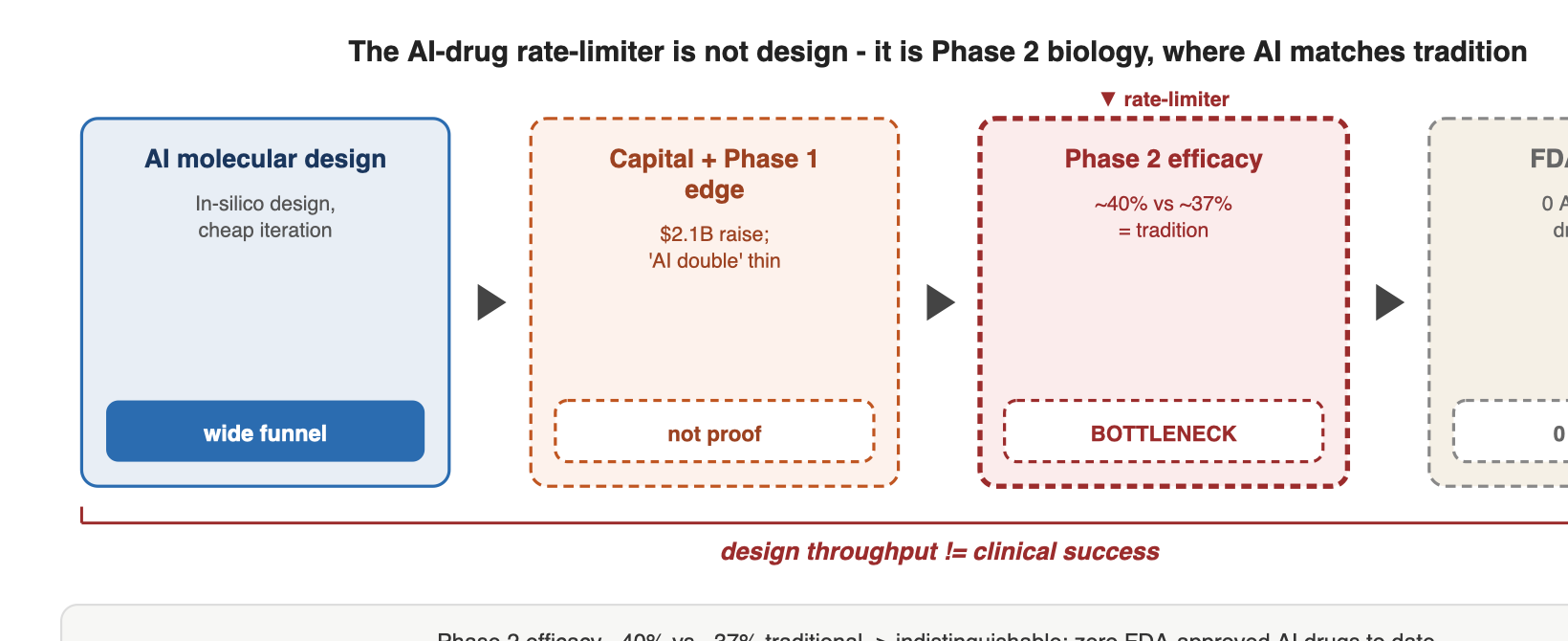
The commercial landscape for AI-designed drugs is genuinely hot. Isomorphic Labs (an Alphabet-affiliated company) raised a $2.1B Series B on 2026-05-12 — reported as the second-largest biotech raise after Altos — on top of a $600M round in 2025 and pharma deals with Eli Lilly, Novartis, and J&J. Xaira launched with $1B+ in 2024. Insilico Medicine ended 2025 with a $293M Hong Kong IPO. Among listed names, Recursion (RXRX) reported $665.2M cash and runway into early 2028; Relay (RLAY) reported ~$710M and runway into 2029. But what that capital buys is not a finished demonstration — it is an option on breaking a bottleneck. AI-derived candidates enter the clinic and appear to clear Phase 1 (which screens chemistry and drug-like properties) at a favorable rate, but in Phase 2 — where the biology lives — their success rate is indistinguishable from tradition (roughly 40% versus ~37%).
The inversion: most money, least clinic
Trace the capital stack and it runs backwards against the evidence. The thickest pools of capital (Eikon ~$1.5B, Xaira ~$1.3B, Isomorphic’s ~$3B in deals plus $2.1B raised) sit behind zero clinical assets, while the one firm with a clinically validated AI-discovered asset — Insilico — is comparatively under-capitalized. As one capital-stack survey put it (≤150-char quote): “Insilico is the only one on this list with a clinically validated AI-discovered asset.” The most-financed frontier is the least clinically proven in public.
| Firm | Capital (attributed) | Clinical stage |
|---|---|---|
| Isomorphic Labs | $2.1B raise + ~$3B deals | Zero (FIH target end-2026, unverified) |
| Eikon | ~$1.5B | Early |
| Xaira | ~$1.3B (record launch) | Preclinical (no public clinic) |
| Insilico Medicine | ~$800M (comparatively small) | Only human clinical PoC |
| Schrödinger (arms dealer) | Listed; SW + drug-discovery revenue | Toll, decoupled from any single asset |
What not to misread
A raise is not a readout, and a deal headline is not a wire transfer. The Isomorphic–Lilly “>$1.7B” and –Novartis “~$1.2B” figures are success-contingent bio-dollars — only the upfronts ($45M, $37.5M) are committed. Even the frontier clinical asset, Insilico’s rentosertib, ran a Phase 2a whose primary endpoint was safety (TEAE), not efficacy — the lung-function readout was secondary/exploratory. Equating capital scale, or a milestone total, with demonstrated clinical efficacy is the signature hype vector of this layer.
Deep dive
1. Background — capital placed on top of an unfinished translation
The through-line of the AI-drug-clinical-readout series has been a single question inherited from the bio-foundation-models work: does AI actually translate into treatment (the clinic)? Part 5 overlays the commercial and investment angle. The one-sentence thesis: capital is deployed on top of the headline “AI refines molecular design,” but no company has completed the evidence that this design refinement translates into Phase 2 efficacy — and, more sharply, the capital points the wrong way, with the largest pools (Xaira, Isomorphic, Eikon) holding zero clinical assets and the only clinical proof-of-concept (Insilico) sitting at comparatively modest capital. This inversion is the same structure observed in the firm’s bio-FM Part 5, repeated more starkly at the clinical layer.
2. What this synthesis newly established
A three-vote adversarial fan-out (2026-07-12) closed at 16 confirmed / 0 refuted / 7 unverified. Confirmed items (cross-checked against SEC 8-K, IR, and primary press/newsroom):
- Listed financials (CONFIRMED, SEC/IR): Recursion Q1 2026 cash $665.2M (down from $753.9M), 2026 burn <$390M, runway into early 2028, Q1 revenue $6.5M (a consensus miss), net loss $117.5M; REC-4881 Phase 2 polyp median ~43% reduction at Week 13; REC-1245 Phase 1 zero DLTs (n=16). Schrödinger Q1 2026 revenue $58.6M (−2% YoY), software $35.6M (−21%), drug-discovery revenue $22.9M (more than doubled), ACV $201M trailing, 2026 ACV guidance $218–228M. Relay Q1 2025 cash ~$710M, runway into 2029, R&D −30.5%; RLY-2608 Phase 3 ReDiscover-2 initiated.
- Capital events (CONFIRMED, press): Isomorphic $2.1B Series B (2026-05-12, Thrive-led) plus $600M (2025) and Lilly/Novartis/J&J deals; Xaira $1B launch (2024-04, David Baker / RFdiffusion); Insilico Hong Kong IPO ~$293M (2025-12); capital-stack ordering (Eikon ~$1.5B, Xaira ~$1.3B, Insilico ~$800M as the only clinically validated); the existence of Lilly/Novartis deals and their upfronts ($45M, $37.5M); no FDA-approved AI-discovered drug.
- Held as bio-dollar / forward-looking (UNVERIFIED): deal milestone totals (Lilly “>$1.7B”, Novartis “~$1.2B”) are success-contingent bio-dollars, not realized cash; Isomorphic first-in-human target of end-2026 (slipped from end-2025); Recursion 2026 revenue consensus ~$85M (analyst); Insilico market cap ~$2.7B (early-listing volatility); Relay ASCO PFS ~10.3mo (source conflict, pending Part 0/1); individual capital-stack totals (secondary editorial source); the “AI-derived Phase 1 success roughly double” claim (Part 0 carry, thin sample).
3. Strengths and limits of the method
Strengths — listed financials, cash, burn, and runway were cross-checked against SEC 8-K and IR primaries; capital and deal figures against first-party press; deal milestone totals were separated by tier from committed upfronts. Limits — (a) milestone totals and forward-looking dates (Isomorphic FIH) are isolated and unverified; (b) the “arms-dealer stability” claim is structural inference, not a measured outcome; (c) the “AI Phase 1 double” and “capital↔clinic inversion” claims rest on thin samples and a secondary capital-stack source and are attributed as such; (d) design throughput is not clinical success — more in-silico iteration does not resolve a biology bottleneck.
[Skeptic mandatory caveat, inherited] The deal milestone totals (Lilly “>$1.7B”, Novartis “~$1.2B”) are success-contingent bio-dollars minus the upfronts ($45M, $37.5M) — not realized cash; the narrative equating capital or deal size with clinical proof is prohibited. The “AI-derived Phase 1 success roughly double” and the capital↔clinic inversion claims must carry their sample and attribution weaknesses and must not be headlined. Capital raised is an option, not a completed proof, and no listed-equity implication should be read into these figures.
4. Neighbouring domains
To the bio-FM series (model as hypothesis generator, now clinical): bio-FM Part 5 concluded that a model’s commercial justification is not absolute predictive accuracy but cheaply widening the experimental funnel (signal L-S01). The clinic is the downstream test of that frame: even when a design engine mass-produces candidates cheaply (a wider funnel mouth), the pass rate at the funnel exit (Phase 2 efficacy) is indistinguishable from tradition (~40% vs ~37%). Design refinement at the entrance does not translate into clinical success at the exit. To the computing series (arms-dealer decoupling): the computing lesson — “the real bottleneck is memory, interconnect, power,” and the arms dealer is the stable position — is inherited here. Schrödinger’s hosted-license shift and NVIDIA’s BioNeMo collect a toll on design and training whichever candidate wins, partly decoupled from clinical outcome risk; the clinical version of “compute scale ≠ performance” is “design throughput ≠ clinical success.” To the CKM series (GLP-1 / finerenone as the hard-outcome baseline): the firm’s already-verified GLP-1 and finerenone work is the baseline for a completed translation — established mechanism plus hard endpoints (FLOW all-cause mortality −20%, KDIGO 2026 GLP-1 Level 1A; finerenone FIDELIO/FIGARO cardiorenal composites). These stand on the last rung (outcome); AI drugs sit on the first-to-second rungs (design, Phase 1 safety). The distance between AI drugs and completed CKM therapies is the distance between design innovation and hard outcomes — and closing it is a matter of biology and the clinic, not compute.
5. Commercialization and investment context (as structural map)
- Recursion (RXRX, Nasdaq): $665.2M cash, runway into early 2028, 2026 burn <$390M; Q1 revenue $6.5M (a consensus miss) with a large net loss; REC-4881 Phase 2 polyp readout ~43% at Week 13, REC-1245 Phase 1 zero DLTs. Long runway reflects markets pricing long-dated option value ahead of clinical outcomes; revenue substance is small. Contains negative facts (revenue miss, cash draw) — neutral framing required.
- Schrödinger (SDGR, Nasdaq): Q1 revenue $58.6M, software $35.6M, drug-discovery $22.9M (more than doubled), ACV $201M trailing, 2026 guidance $218–228M; hosted-license shift and an agentic “co-scientist” (Bunsen) early access. The only listed name with a two-sided software + drug-discovery revenue base — the arms-dealer position, partly decoupled from clinical outcome.
- Relay Therapeutics (RLAY, Nasdaq): ~$710M cash, runway into 2029, R&D −30.5%; RLY-2608 + fulvestrant Phase 3 ReDiscover-2 initiated (vs capivasertib); ASCO 2025 PFS ~10.3mo / ORR 39% (source conflict, pending).
- Insilico Medicine (Hong Kong-listed, 2025-12): IPO ~$293M raised, market cap ~$2.7B (early-listing, unverified); rentosertib (Nature Medicine) and ISM5411 Phase 1 IBD; claims of 30 programs / 10+ INDs. The only firm with a human clinical PoC — yet rentosertib’s Phase 2a primary endpoint was safety, not efficacy.
- Isomorphic Labs / Xaira / Eikon / insitro (private): Isomorphic $2.1B (2026-05), zero clinical assets, closed AF3→IsoDDE engine, FIH target end-2026 (forward-looking, unverified); Xaira $1B+ launch, preclinical; Eikon ~$1.5B; insitro $643M+. The most-capitalized layer with the least clinical proof.
- NVIDIA (NVDA): BioNeMo platform as the arms-dealer toll on training and hosting, decoupled from any single candidate’s clinical fate.
(The company references above are factual statements of position on a structural map, not a recommendation to buy or sell any security. Financials are attributed to SEC/IR; forward-looking items are labeled unverified.)
6. The opposing view (skeptic block, quoted)
The core of the source asset’s §6 skeptic gate holds three items on HOLD:
“(1) The completed narrative that ‘AI has (clinically) validated a drug’ or that ‘capital scale equals proof’ — approvals to date: zero, and Phase 2 is indistinguishable from tradition. (2) Headlining rentosertib’s ‘positive Phase 2a’ as an efficacy result — the primary endpoint was safety. (3) Stating Isomorphic’s end-2026 first-in-human or the ‘AI Phase 1 double’ as settled — both are forward-looking or thin-sample.”
The deepest structural skeptic signal is that capital and clinical proof run in reverse: the largest pool of capital sits behind zero clinical assets, while the only human clinical proof-of-concept sits at comparatively modest capital — so the money and the evidence disagree.
7. What to watch (falsifiable predictions from the source asset)
- Among the best-financed pure-AI drug shops (Xaira, Isomorphic, Eikon), zero to one report a self-originated candidate passing a Phase 2 efficacy readout on a hard endpoint within 24 months. Falsifiable via company disclosure / peer review (capital advantage ≠ clinical translation).
- AI-derived Phase 2 success rates converge on the traditional ~37% as sample size grows, with no significant correlation between capital/deal size and clinical success. Falsifiable by later large-scale aggregation.
- The arms-dealer position (Schrödinger drug-discovery + software, NVIDIA BioNeMo) sustains revenue growth regardless of any single candidate’s clinical fate (decoupling). Falsifiable via quarterly results and ACV trends.
References
(Inherited from the source asset’s sources field. URLs are reproduced as provided; where a first-party primary link was not provided, the item is labeled by source name and context and not fabricated.)
- Recursion Investor Relations. Q1 2026 Financial Results (cash $665.2M; 2026 burn <$390M; runway into early 2028; REC-4881 polyp median ~43% at Wk13). ir.recursion.com
- SEC. Recursion Pharmaceuticals 8-K FY2026. sec.gov/Archives/edgar/data/1601830
- Schrödinger Investor Relations. 2026-05-05. Q1 2026 Results (revenue $58.6M; drug discovery $22.9M; ACV $201M trailing; 2026 guidance ACV $218–228M). ir.schrodinger.com
- SEC. Schrödinger 8-K 2026-03-31. sec.gov/Archives/edgar/data/1490978
- PR Newswire. 2026-05-12. “Isomorphic Labs Secures $2.1 Billion Funding.” prnewswire.com/news-releases/isomorphic-labs-secures-2-1-billion-funding-302769674.html
- Forbes (Amy Feldman). 2026-05-13. Isomorphic $2.1B — second-largest biotech raise.
- Fierce Biotech. Alphabet’s Isomorphic stacks Lilly/Novartis deals ~$3B (Lilly milestones >$1.7B / $45M upfront; Novartis ~$1.2B / $37.5M upfront; 2024-01). fiercebiotech.com
- Relay Therapeutics Investor Relations. Q1 2025 Results (cash ~$710M; runway into 2029; R&D −30.5%; RLY-2608 Phase 3 ReDiscover-2). ir.relaytx.com
- Pharmaphorum; Forbes. 2025-12-30. “Insilico ends 2025 with $293m Hong Kong IPO” (market cap ~$2.7B).
- OnHealthcare. 2026-04. “The AI Drug Discovery Capital Stack” (Eikon ~$1.5B; Xaira ~$1.3B; Insilico ~$800M; only Insilico clinically validated; no FDA-approved AI drug). onhealthcare.tech/p/the-ai-drug-discovery-capital-stack
- Fierce Biotech. 2024-04. “Xaira launches with $1B” (David Baker / RFdiffusion). fiercebiotech.com
- Series spine: part0-landscape.md; README.md; bio-foundation-models/part5-commercial-crossdomain-synthesis.md; convergence-ledger L-S01.
Disclosure
This post is for information only and is not investment advice. The author holds no position and no financial interest in the companies mentioned (Recursion, Schrödinger, Relay Therapeutics, Insilico Medicine, NVIDIA, Eli Lilly, Novartis, and the private companies Isomorphic Labs, Xaira, Eikon, insitro).
COI note. This post describes listed and private AI-drug companies and pharma deals factually and neutrally, with no easing or advocacy language. Listed financials (cash, revenue, runway) are attributed to SEC/IR primaries; capital and deals to primary press/newsroom; deal milestone totals, analyst consensus, and forward-looking dates (Isomorphic first-in-human) are isolated as bio-dollar or company/vendor claims and labeled unverified. No superiority implication for any security is intended, and no price target is offered.


Leave a Reply