Evidence-first notes on bioscience and deep tech, at the edge of the lab and the market. Information only — not investment advice, not medical advice. All success-rate, hit-rate and efficiency figures are attributed to the reporting paper or company; some are company blogs or preprints rather than peer-reviewed data (noted inline). In-silico design metrics (pLDDT, ipTM, self-consistency) are kept strictly separate from wet-lab-validated function (expression, binding, catalysis). Quotes are 150 characters or fewer.
The 30-second version
- What. AI protein work splits into two waves. Structure prediction — AlphaFold2 (2021), AlphaFold3 (2024, co-folding) and ESMFold (2023) — has, at the headline, largely solved sequence-to-3D-structure for single static structures; the 2024 Nobel Prize in Chemistry recognized this (Hassabis/Jumper for prediction, Baker for computational design). Generative de novo design — RFdiffusion (backbone generation), ProteinMPNN (sequence/inverse folding) and Chroma (programmable generation) — now builds proteins that do not exist in nature and has validated binders and enzymes in the wet lab (crystallography/cryo-EM), so it is past a pure demo.
- So what. The headline (single-structure prediction) is close to solved; the real bottleneck is elsewhere — the gap between high in-silico design metrics and low wet-lab experimental success. Generative pipelines score impressively on pLDDT/ipTM/AlphaFold2 self-consistency, yet a large share of filter-passing candidates still fail on expression, non-specific binding or undetectable affinity. The central falsifiable question is whether generative design is a discovery engine or a low-hit-rate hypothesis generator — and the evidence leans toward a metric-reality gap (self-consistency predicts “folds,” not “function”). As of late 2025 there are zero approved de novo AI-designed protein drugs; every figure above is a lab or in-silico metric, not a clinical outcome.
- Now what. The decisive test is independent, prospective, leakage-controlled experimental success rates from non-originator groups, plus whether in-silico-metric-to-wet-lab correlation generalizes to novel targets. An independent evaluation across six targets (bioRxiv 2025) reported many RFdiffusion binders failing (low expression, non-specific, undetectable affinity), and the RFdiffusion-antibody paper (Nature 2025) itself states success rates are “currently low.” Until those readouts arrive, “AI has solved protein design / is a discovery engine” is an overstatement to be avoided.
The five-minute read
Two waves — prediction is near-solved, generative design is validated but rate-limited
AI protein work reproduces the firm’s recurring lens — “the headline is the starting point; the real bottleneck is in the outcome layer” — more cleanly than almost any other AI-times-Bio interface. The first wave, structure prediction, has largely solved sequence-to-structure at a practical level: AlphaFold2 broke through at CASP14, AlphaFold3 added co-folding (protein plus ligand, nucleic acid and ions), and ESMFold predicts fast without alignments. What remains unsolved sits outside the single static structure — disorder, conformational ensembles, protein-protein interfaces and ligands (covered in Part 1). The second wave, generative de novo design, builds proteins from scratch: RFdiffusion generates backbones, ProteinMPNN designs sequences (inverse folding), and Chroma generates under programmable constraints. These have produced real binders and enzymes confirmed by crystallography and cryo-EM — this is past a demo (it clears analysis-standards Section 2).
The headline is near-solved; the bottleneck is metric-to-function translation
The pipeline is: generate thousands to tens of thousands of candidates, filter them in-silico (AlphaFold2 self-consistency — does the designed sequence re-fold to the intended backbone?), then make only a small subset (dozens to hundreds). This filtering raised success rates substantially — the de novo binder work (Cao 2022) reports that AF2/RF filtering improved success roughly tenfold — but filter-passing candidates still drop out on expression failure, non-specific binding and undetectable affinity. So the reported “success rate” is relative to candidates tested, not candidates generated, and swings widely by target and epitope. The RFdiffusion-antibody paper (Nature 2025) itself states success rates are “currently low”; antibodies stack CDR-loop, humanization and expression problems on top of the binder bottleneck. The honest reading is that in-silico filtering raises hit rate but does not remove the wet-lab bottleneck.
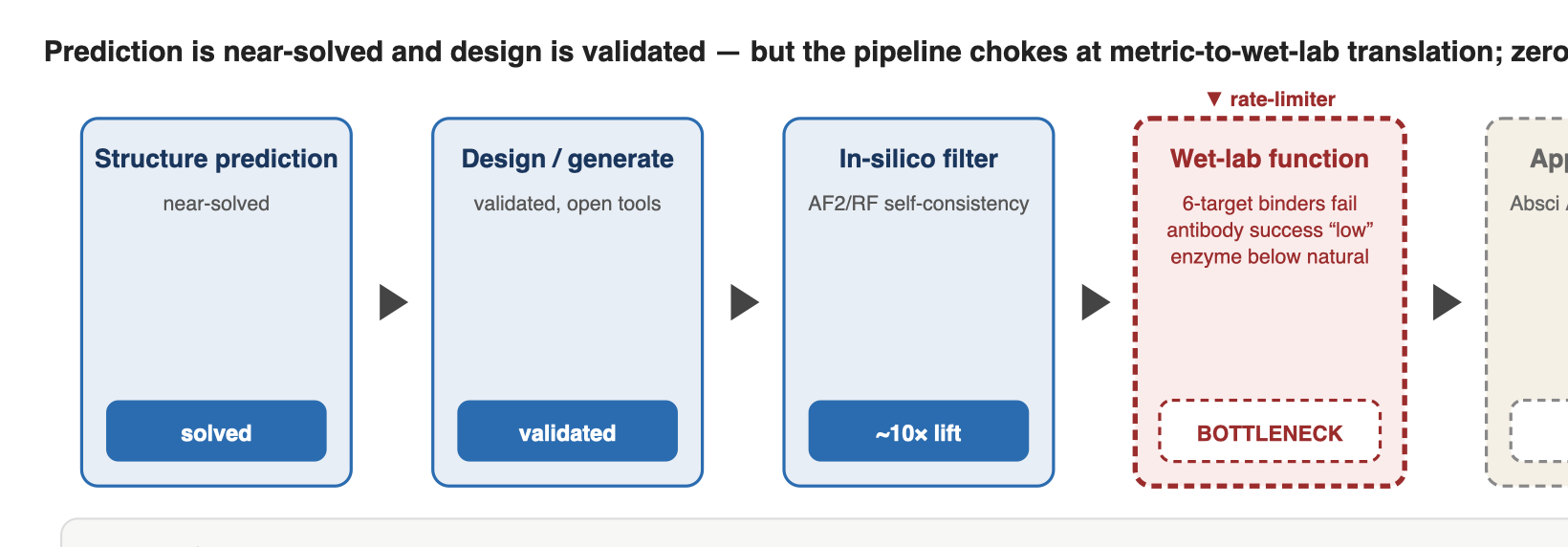
| Layer | Status (2026-07) | Verdict |
|---|---|---|
| Structure prediction (single structure) | AF2 (Nature 2021), AF3 co-folding (Nature 2024), ESMFold (Science 2023); 2024 Nobel Chemistry | Near-solved (demonstrated) |
| Prediction, unsolved edge (disorder, ensemble, PPI, ligand) | Baseline advantage disappears on antibody/nucleic-acid; data-leakage debate (bio-FM Part 1) | Unsolved |
| Design engine reproducibility (code/weights) | RFdiffusion, ProteinMPNN, Chroma all open on GitHub | Open, a strength |
| De novo binder / enzyme wet-lab validation | Cao 2022 (hundreds characterized), RFdiffusion cryo-EM match; serine hydrolase kcat/Km up to 2.2×10^5 M^-1 s^-1 (below natural) | Validated (not a demo) |
| Generative-design experimental success rate | Independent 6-target eval — many failures (bioRxiv 2025); RFdiffusion-antibody “currently low” (Nature 2025) | Low — bottleneck |
| In-silico metric → wet-lab translation | AF2 filter ~10x improvement, but filter-passing candidates still drop out; target-dependent | Partial, target-dependent |
| Approved de novo AI-designed protein drug | Zero (end of 2025); Absci ABS-101 at Phase 1 | None yet |
Deep dive
1. Background — three layers: prediction, design engine, function
The landscape resolves into three layers, and the key is how they chain together.
- Layer 1 — Structure prediction: sequence to 3D structure, including co-folding (protein plus ligand plus nucleic acid). Tools: AlphaFold2/3, ESMFold, RoseTTAFold. Near-solved for single structures; unsolved for disorder, ensembles, PPI and ligands (Part 1).
- Layer 2 — Design engine: backbone generation plus sequence design (inverse folding). Tools: RFdiffusion and RFdiffusion-AA, Chroma, ProteinMPNN and LigandMPNN, Genie. De novo generation, with in-silico filters selecting candidates (Part 2).
- Layer 3 — Function: real binders, enzymes, antibodies and therapeutics. Examples: de novo binder (Cao 2022), de novo serine hydrolase (2025), RFdiffusion-antibody (2025). Wet-lab success rate is the bottleneck (Parts 3-4).
The core structure: Layer 2’s output is filtered in-silico by Layer 1 (self-consistency — does the designed sequence re-fold to the original backbone?), then made in Layer 3. This pipeline raised success rates substantially (Cao 2022: AF2/RF filtering ~10x), but many filter-passing candidates still fail in the wet lab on expression, non-specific binding or undetectable affinity (Section on the bottleneck below). In-silico filtering lifts hit rate; it does not remove the wet-lab bottleneck.
2. What this landscape establishes — tools, contributions and publication venue (attributed)
Principle: publication venue is labeled peer-reviewed (Nature/Science) vs preprint (bioRxiv) vs company; success-rate and efficiency numbers are attributed to the reporting source.
- AlphaFold2 (Google DeepMind), prediction — CASP14 breakthrough on sequence-to-structure, ~90%-accuracy class; 2M+ users across 190 countries (as of 2024-10, Nobel material). Jumper et al., Nature 2021 (peer-reviewed).
- AlphaFold3 (DeepMind/Isomorphic), prediction — co-folding: unified prediction of protein plus ligand plus nucleic acid plus ion complexes. Abramson et al., Nature 2024.
- ESMFold / ESM-2 (Meta to EvolutionaryScale), prediction — ~15B-parameter protein language model, fast alignment-free prediction; ESM Metagenomic Atlas of 600M+ proteins. Lin et al., Science 2023.
- RFdiffusion (Baker Lab/IPD), design — RoseTTAFold retrained as a denoising diffusion model to generate backbones; an influenza-HA binder matched the design model closely by cryo-EM. Watson et al., Nature 2023 (this is the base, non-all-atom RFdiffusion).
- ProteinMPNN (Baker Lab), design — deep-learning inverse folding (structure to sequence), higher sequence recovery and lower compute than physics-based methods. Dauparas et al., Science 2022.
- Chroma (Generate Biomedicines), design — programmable generative model conditioned on symmetry, shape, semantics and natural language; near-linear all-atom scaling. Ingraham et al., Nature 2023 (vol 623).
- De novo binder (Baker Lab), function — binders designed from target structure alone, hundreds characterized experimentally; AF2/RF filtering reported ~10x higher success. Cao et al., Nature 2022 (605:551-560).
- De novo serine hydrolase (Baker Lab), function — enzyme designed with RFdiffusion plus an active-site ensemble, kcat/Km up to 2.2×10^5 M^-1 s^-1 (a fold distinct from natural enzymes; activity still on the low side). Science 2025.
- RFdiffusion-antibody (Baker Lab), function — first structural validation of de novo antibodies; the paper states success rates are “currently low.” Bennett et al., Nature 2025.
Layer character: prediction (1-3) is consistent with bio-FM Part 1 — AF3 leads most tasks but loses its baseline advantage on antibodies and nucleic acids, amid a data-leakage debate; this series inherits that conclusion and extends it to design. Design engines (4-6) — diffusion (backbone) plus inverse folding (sequence) is effectively the standard pipeline, and all are open code/weights on GitHub (a reproducibility strength). Function (7-9) reaches wet-lab validation (crystallography/cryo-EM), so it is not a demo — but success rate and activity magnitude are the bottleneck (the serine hydrolase is on the low-activity side versus natural enzymes; the antibody paper labels its success rate “low”). These tools were reported on different benchmarks, targets and metrics — cross-tool ranking is not warranted without a same-benchmark head-to-head (a discipline inherited from bio-FM).
3. The central science question — discovery engine, or low-hit-rate hypothesis generator? (falsifiable)
Generative de novo design scores impressively on in-silico metrics (pLDDT, ipTM, AF2 self-consistency, pae). The falsifiable question at the center of this series: does experimental success rate clear the bar to call it a discovery engine, or is it still a low-wet-lab-hit-rate hypothesis generator? Three hypotheses, with the observation that would falsify each:
- (a) Discovery engine — in-silico filters lifted hit rate to a practical level. Support: Cao 2022 (~10x improvement), RFdiffusion binder near-matching the design model by cryo-EM, serine hydrolase yielding an active enzyme on a novel fold. Falsified if independent (non-originator) labs reproduce low hit rates across many novel targets under the same protocol (Parts 3-4).
- (b) Low-hit-rate hypothesis generator — in-silico scores do not translate to the wet lab. Support: an independent evaluation (bioRxiv 2025.02.07.636769) found many RFdiffusion binders across six targets failing (low expression, non-specific, undetectable affinity); the RFdiffusion-antibody paper states success is “currently low.” Falsified if reproducible double-digit-percent hit rates appear across many novel targets, from several independent groups, under leakage-controlled prospective design (Part 4).
- (c) Metric-reality gap — surrogate metrics such as self-consistency are themselves flawed. Support: this is isomorphic to bio-FM Part 1’s leakage/memorization signals; the AF2 self-consistency used as a design filter may predict “folding” but not “function” (binding, catalysis). Falsified if the in-silico-metric-to-wet-lab correlation holds strongly (predictively) on novel targets; strengthened if the correlation is confined to targets near the training set (Part 4).
Current provisional position: none of the three is excluded. The prediction axis leans toward (a) and is close to settled; the design axis cannot yet exclude (b) or (c), and the post-series work (below) shifts weight toward (c), the metric-reality gap. The decider is independent-group prospective, leakage-controlled experimental success rates and whether the in-silico-to-wet-lab correlation generalizes to novel targets. Part 0 does not assert any one and keeps all three falsifiable.
4. In-silico metric vs wet-lab-validated function — anatomy of the bottleneck
Firm discipline (analysis-standards Section 2): separate the surrogate metric from validated function. The mapping is direct.
| In-silico surrogate (design stage) | Wet-lab-validated function (outcome layer) |
|---|---|
| pLDDT / pTM / ipTM (prediction confidence) | Recombinant expression success |
| AF2 self-consistency (re-fold RMSD) | Target-specific binding and affinity (Kd) |
| pae (interface error estimate) | Catalytic activity (kcat/Km) and functional assay |
| Design diversity / novelty score | Structural confirmation (X-ray / cryo-EM) |
5. Commercialization and competitive context (TRL, related companies)
- Maturity (TRL frame): prediction is settled and validated; generative design is wet-lab-validated (not a demo) but rate-limited on experimental success, activity magnitude and translation. The gating layers are success rate and metric-to-function translation, not scientific novelty.
- Listed: Alphabet (Google DeepMind; Isomorphic Labs parent), Meta (EvolutionaryScale origin), NVIDIA, Recursion (RXRX), Schrodinger (SDGR), Absci (ABSI). Absci’s ABS-101 (TL1A, IBD) is at Phase 1, with ABS-201 entering — the clinical front is AI-optimized antibodies, not fully de novo backbones.
- Private: Generate Biomedicines, Xaira Therapeutics (2024 launch, over $1B; Baker/Tessier-Lavigne), EvolutionaryScale (launch $142M, ESM3), Profluent (Series B $106M, $150M+ cumulative), Chai Discovery, Cradle. Chai’s Series B (~$130M), Cradle funding, and Generate’s IPO size/timing are [unverified] and deferred to Part 5.
- The commercial reality: roughly $10^9 of capital (Xaira over $1B; Isomorphic $600M-plus with milestones) versus zero approved de novo AI-designed protein drugs at end of 2025. The clinical front is AI-optimized antibodies (Generate Phase 3, Absci Phase 1), not fully de novo backbones — an illustration at commercial scale of the “AI as hypothesis generator” thesis (convergence L-S01).
- Company statements are limited to neutral, source-attributed description; vendor blog/preprint success-rate and funding figures are attributed and await independent verification. These are not buy/sell signals for any security.
6. The skeptic’s bottom line
- In-silico metric is not wet-lab hit rate: an independent six-target evaluation reported many failures; high self-consistency does not guarantee expression, binding or catalysis.
- Denominator caution: reported success rates are relative to candidates tested, not candidates generated — the framing inflates apparent performance.
- No cross-tool ranking: tools were reported on different benchmarks and targets; without a same-benchmark head-to-head, ranking is not warranted.
- Zero approved products: there are no marketed de novo AI-designed protein drugs as of late 2025 — the final outcome-layer signal.
- Refuted overstatement: the claim that “generative de novo design is already a high-success, validated discovery engine” is an overstatement. The independent evaluation reports low wet-lab success, the antibody paper concedes “currently low,” and approved products are zero. In-silico scores must not be read as experimental success.
- Neutral-framing note: vendor claims of large improvements (“16-20% hit rate,” “100x improvement,” “20 candidates per target”) arriving through non-peer-reviewed channels are treated as benchmark-hacking / data-leakage suspects and attributed, not adopted.
7. What to watch (falsifiable)
- P1: if independent (non-originator) groups report reproducible double-digit-percent experimental success across many novel targets under prospective, leakage-controlled design, hypothesis (a) discovery engine is strengthened; if low expression / non-specific / undetectable failures reproduce, (b) is strengthened. (Parts 3-4)
- P2: if the in-silico-metric-to-wet-lab correlation (AF2 self-consistency and similar) holds predictively beyond near-training-set targets to novel targets, the (c) metric-reality gap weakens; if it is confined to near targets, (c) strengthens. (Part 4, inheriting bio-FM Part 4 leakage methodology.)
- P3: if a de novo AI-designed protein (binder/enzyme/antibody) enters the clinic (Phase 1 to efficacy readout) and shows a benefit signal, that is the decisive case for a “hypothesis generator to discovery engine” shift. With approved products at zero, the first efficacy readout (Absci/Xaira/Generate pipelines) is the touchstone. (Part 5, linked to the ai-drug-clinical-readout axis.)
- Post-series update (Part 1-5 integration): the central question shifts weight toward (c) metric-reality gap — independent six-target reproduction failure (bioRxiv 636769), 3,766-binder precision spanning 0.1-1.0 by target, and a peer-reviewed finding (Protein Science 2026) that refolding metrics carry false positives together indicate self-consistency is “a surrogate for folding, not for function.” Separately, BindCraft (Nature 2025) reported one-shot experimental success of 10-100% (target-dependent) — the top-line generative-binder result, still target-dependent and not yet independently reproduced across many sites.
References
- Abramson et al. 2024. AlphaFold3 — co-folding of protein-ligand-nucleic-acid complexes. Nature. https://www.nature.com/articles/s41586-024-07487-w
- Lin et al. 2023. ESMFold / ESM-2 — language-model protein structure prediction; ESM Metagenomic Atlas. Science. https://www.science.org/doi/10.1126/science.ade2574
- The Nobel Prize in Chemistry 2024 (Baker for computational protein design; Hassabis and Jumper for protein-structure prediction). Press release. https://www.nobelprize.org/prizes/chemistry/2024/press-release/
- Watson et al. 2023. RFdiffusion — backbone generation by denoising diffusion (base, non-all-atom). Nature. https://www.nature.com/articles/s41586-023-06415-8
- Dauparas et al. 2022. ProteinMPNN — deep-learning inverse folding. Science. https://www.science.org/doi/10.1126/science.add2187
- Cao et al. 2022. De novo binder design from target structure; AF2/RF filtering ~10x success. Nature 605:551-560. https://www.nature.com/articles/s41586-022-04654-9
- Ingraham et al. 2023. Chroma — programmable generative protein model. Nature 623. https://www.nature.com/articles/s41586-023-06728-8
- Baker Lab et al. 2025. De novo serine hydrolase — RFdiffusion plus active-site ensemble; kcat/Km up to 2.2×10^5 M^-1 s^-1. Science. https://www.science.org/doi/abs/10.1126/science.adu2454
- Bennett et al. 2025. RFdiffusion-antibody — first structural validation of de novo antibodies; success “currently low.” Nature. https://www.nature.com/articles/s41586-025-09721-5
- Independent evaluation. 2025. RFdiffusion binders across six targets (Strep-Tag II, STAT3, FGF4, EGF, PDGF-BB, CD4) — many low-expression / non-specific / undetectable-affinity failures. bioRxiv (preprint). https://www.biorxiv.org/content/10.1101/2025.02.07.636769v1
Disclosure
This post is for information only and is not investment advice, and not medical advice. Treatment decisions should always be made with your own clinician.
COI note: this post describes listed companies (Alphabet [Google DeepMind; Isomorphic Labs parent], Meta [EvolutionaryScale origin], NVIDIA, Recursion RXRX, Schrodinger SDGR, Absci ABSI) and private companies (Xaira Therapeutics, Generate Biomedicines, Profluent, Chai Discovery, Cradle) in a descriptive, neutral context. Every success-rate, hit-rate and efficiency figure is attributed to the reporting paper or company, and publication venue is labeled peer-reviewed (Nature/Science) vs preprint (bioRxiv) vs company blog. In-silico design metrics (pLDDT, ipTM, AF2 self-consistency) are stated as surrogates and kept separate from wet-lab-validated function. Vendor blog and preprint claims (for example “16-20% hit rate” or “100x improvement”) are attributed and flagged as awaiting independent verification. There are zero approved de novo AI-designed protein drugs as of late 2025. Competitive and capability statements are factual, neutral descriptions and are not buy/sell implications for any security. The author holds no position in, and has no financial interest in, the companies named.
 Uthando Nethemba
Leave a comment