Evidence-first notes on bioscience and deep tech, at the edge of the lab and the market. Information only — not investment advice, not medical advice. All accuracy figures (CASP GDT, pLDDT, pTM, PoseBusters) are attributed to the primary paper or its sponsor; peer-reviewed results are separated inline from preprints and company blogs. Benchmark accuracy is not the same thing as real-world / functional utility, and that distinction is kept explicit throughout.
The 30-second version
- What. Predicting a protein’s three-dimensional shape from its amino-acid sequence has, at the level of single-domain, static, single structures, essentially been solved. AlphaFold2 (DeepMind) reached near-experimental accuracy at CASP14 (median GDT ~90; Nature 2021), AlphaFold3 (DeepMind/Isomorphic) extended this to co-folding — protein plus ligand, nucleic acid and ion in one framework (Nature 2024) — ESMFold (Meta → EvolutionaryScale) removed the alignment step for metagenome-scale speed (Science 2023), and the 2024 Nobel Prize in Chemistry recognized both prediction and design.
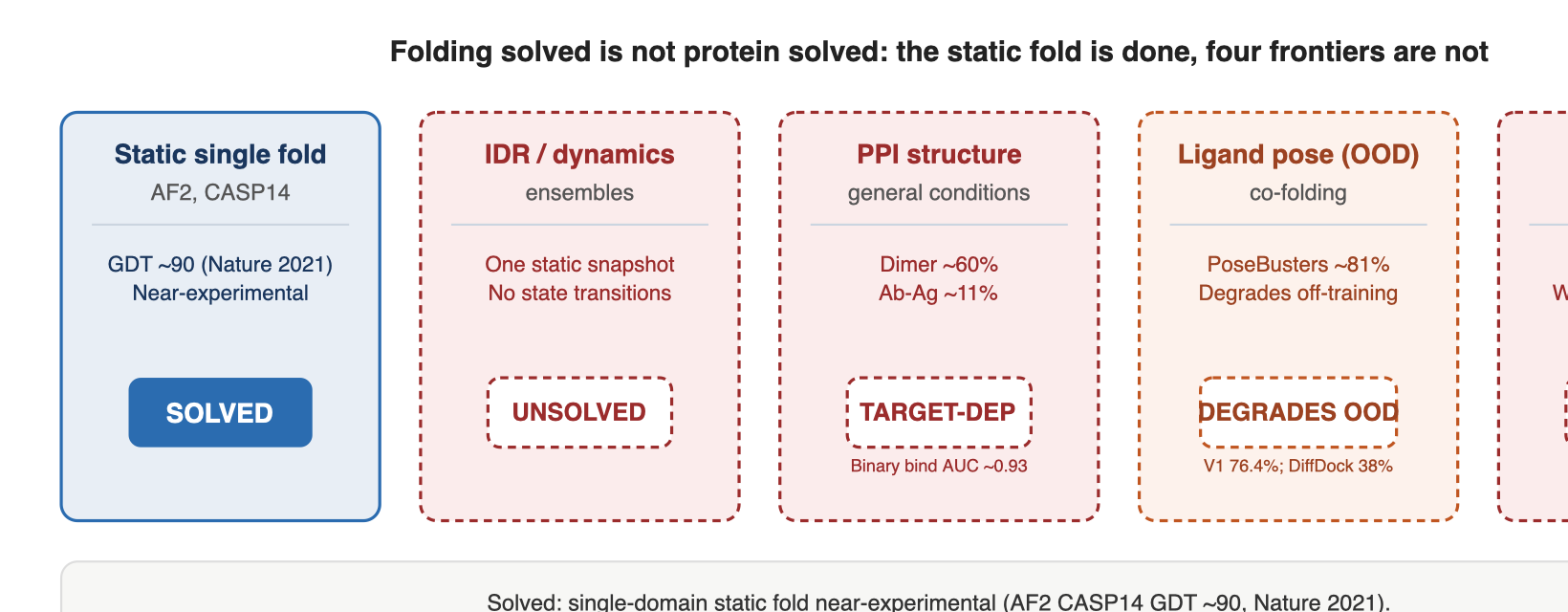
- So what. The headline is real, but it is narrow. What is solved is the single-domain, static, single fold. The things a protein actually does — the fluctuation of disordered regions, conformational ensembles and dynamics, binding to partners (PPI), ligand and cofactor coordination, and the effect of mutations on stability (ΔΔG) — all sit outside the static single structure, and accuracy diverges the moment that assumption breaks. “Folding solved” is not the same as “the protein problem solved.”
- Now what. Five residual frontiers cluster exactly where biology matters most: (a) intrinsic disorder / ensembles, (b) conformational dynamics (the output is one snapshot), (c) protein–protein interaction structure (strongly target-dependent), (d) ligand pose (benchmarks high but degrading out-of-distribution), and (e) mutation ΔΔG (the weakest point; pLDDT–stability correlation ~0.17). And AF3’s restricted release of code and weights adds a reproducibility layer on top. The overstated claim to retire — “AlphaFold predicts the true structure, so it captures function, dynamics and stability too” — is refuted here.
The five-minute read
Three tools, and what exactly they solved
Three peer-reviewed systems carry the headline. AlphaFold2 (Jumper et al., Nature 2021) broke through at CASP14 with a median GDT around 90, folding sequence to a single structure at near-experimental accuracy via an MSA-plus-template Evoformer. AlphaFold3 (Abramson et al., Nature 2024) generalized this to co-folding — protein, ligand, nucleic acid and ion in one framework — using a simplified Evoformer plus a diffusion-based coordinate module. ESMFold / ESM-2 (Lin et al., Science 2023) used a ~15-billion-parameter protein language model to fold without an MSA, trading some accuracy for the speed to build the ESM Metagenomic Atlas of more than 600 million structures.
The firm’s recurring lens — “the headline is the starting point; the real bottleneck is elsewhere” — applies cleanly. What was solved is the single-domain globular static structure (AF2 at CASP14), extended in scope to non-protein partners (AF3 co-folding) and in scale and speed by removing the MSA (ESMFold). Relative accuracy between tools should not be asserted without same-benchmark head-to-head comparison — ESMFold is widely reported as less accurate than AF2 on hard targets, but the precise gap is left unverified here.
What is not solved — five frontiers beyond the static single structure
The residual bottlenecks are not at the margin; they cluster where biology is most consequential. Intrinsic disorder makes up a large fraction of the eukaryotic proteome, signalling runs on PPI and dynamics, drug discovery turns on ligand coordination, and protein engineering turns on ΔΔG. Each frontier can post a good benchmark number and still diverge the moment the static-single-structure assumption is violated.
| Layer | Status (2026-07) | Verdict |
|---|---|---|
| Single-domain static structure (headline) | AF2 CASP14 median GDT ~90; near-experimental accuracy (Nature 2021) | Essentially solved |
| Co-folding (protein + ligand + nucleic acid) | AF3 unifies complexes in one framework (Nature 2024) | Demonstrated (scope up) |
| MSA-free, large-scale, fast prediction | ESMFold; Metagenomic Atlas >600M structures (Science 2023) | Demonstrated |
| (a) Intrinsic disorder (IDR) ensembles | IDR drawn as one static loop; ensemble not reproduced (Nat Commun 2025) | Unsolved |
| (b) Conformational dynamics | Default output is one snapshot; no state transitions | Unsolved |
| (c) PPI structure (general conditions) | Dimer ~60%, antibody–antigen ~11%; binary detection AUC ~0.93 | Partial, target-dependent |
| (d) Ligand pose (novel / OOD targets) | PoseBusters ~81% but degrades on dissimilar complexes (Nat Commun 2025) | Partial, OOD degradation |
| (e) Mutation effect ΔΔG / function | pLDDT–ΔΔG correlation ~0.17; weak GFP functional correlation (PLOS One 2023) | Weak (hard to use directly) |
| AF3 reproducibility (code / weights) | Initially server-only, non-commercial, weights on request (GitHub terms) | Restricted release |
Deep dive
1. Background — what “solved” precisely means
Structure prediction shows the firm’s cross-cutting lens (“the headline is the starting point; the bottleneck is the outcome layer”) more sharply than almost any other AI×Bio area. The headline is genuine: AF2 folded sequence to 3D at near-experimental accuracy, AF3 extended the framework to protein–ligand–nucleic-acid–ion co-folding, and ESMFold lifted throughput by dropping the multiple-sequence alignment (MSA). But the precise boundary of “what was solved” is the single-domain, static, single structure. Everything a protein actually does in cells lives beyond that boundary, and the tools were built and benchmarked on the static case.
Author’s verdict for Part 1: the prediction axis is close to “won” at the single-structure level (consistent with the 2024 Nobel and with the firm’s bio-foundation-models series). But the leap from “the folding problem is solved” to “the protein problem is solved” is an overstatement — the residual bottlenecks are concentrated in the biologically most important regions, and AF3’s restricted release of code and weights adds a reproducibility caveat.
2. The five frontiers beyond the static single structure
- (a) Intrinsic disorder (IDR) — an ensemble, not a single structure. AF2 typically draws an intrinsically disordered region as one long extended loop around the structured core — a single static form. But by definition an IDR exists as an interconverting conformational ensemble; drawing a static structure at all is described as “a fundamental limitation” (Nature Communications 2025, s41467-025-56572-9, peer-reviewed). In practice a low pLDDT is used as a proxy signal for disorder (flagging “no structure” rather than a structure), so AF2 is useful for disorder identification but does not reproduce the disordered ensemble. Follow-on tools (AFflecto, AlphaFlex, 2024–2025) that bolt an ensemble onto AF are themselves evidence the base predictor leaves this open.
- (b) Conformational dynamics — one snapshot. Proteins move between apo/holo, active/inactive and allosteric states. The default AF2/AF3 output is a single snapshot and does not capture state transitions or dynamics. MSA-subsampling and related tricks can coax out some alternative states, but these are hacks that presuppose the base model does not represent the ensemble intrinsically.
- (c) Protein–protein interaction (PPI) — strongly target- and complexity-dependent. CASP15 assembly-interface success jumped to 90% (from 31% at CASP14; Wiley Protein Science 2024, prot.26598, peer-reviewed), but that was the result of a pipeline — AF2-Multimer plus custom MSAs and manual subcomplex assembly. Under automatic, general conditions the spread is wide: benchmark dimer success ~60%, degrading as chain count rises, and antibody–antigen complexes around 11%. Meanwhile binary interacting-vs-non-interacting discrimination reaches AUC ~0.93 (iPTM-based; JCIM 2024) — a two-sided picture in which “whether they bind” is predicted well but “the binding structure” remains target-dependent.
- (d) Ligand and cofactor accuracy — high on benchmark, collapsing out-of-distribution. AF3 reaches ~81% on PoseBusters V2 (native pose within 2 Å; vs DiffDock 38%) and 76.4% on V1, ahead of docking-specialized models (Nature 2024 and follow-ons). But accuracy degrades substantially on complexes dissimilar to the training data (the Runs N’ Poses line of evaluation; Nature Communications 2025, s41467-025-63947-5, peer-reviewed — which questions whether the co-folding model learned the physics of interaction at all). A high benchmark score is not generalization to novel targets, and this connects directly to the data-leakage boundary (PDB structures in the training set).
- (e) Mutation effect ΔΔG — the weakest point. Predicting how a point mutation affects stability (ΔΔG) or function is where the predictors are weakest. The correlation between AF2 confidence (pLDDT at the mutated residue) and stability effect is about 0.17, and the correlation with functional effect measured by GFP fluorescence assay is very weak too (PLOS One 2023, journal.pone.0282689, peer-reviewed). The central protein-engineering question — which mutation raises stability — cannot be answered by using the predicted structure directly; a separate ΔΔG predictor is needed, and that itself is a bottleneck.
The firm’s lens: these five frontiers are not peripheral. Disorder is a large fraction of the eukaryotic proteome; signalling is PPI and dynamics; drug discovery is ligand coordination; engineering is ΔΔG. “The single structure is solved” is a fact, but “the protein is solved” is an overstatement — the outcome layer sits outside the static single structure.
3. Method strengths and limits — the reproducibility layer (AF3 code/weights)
The firm evaluates reproducibility separately from novelty. AF2 released code and weights without restriction, driving explosive adoption. By contrast AF3 launched (Nature, May 2024) with no code and a restricted server.
- Initial restrictions (fact): an online server only, a per-researcher daily cap on the number of predictions, and no prediction of protein–novel-drug interactions — with observers noting a possible competitive shield around DeepMind’s spinout Isomorphic Labs. (Nature news d41586-024-01463-0, news/commentary; Retraction Watch 2024-05-14, blog/commentary — both reported the community pushback and open letter over “publication without code.”)
- Partial opening (fact): on 2024-11-11 DeepMind released the code, but for non-commercial use only, with weights on a request basis (GitHub WEIGHTS_TERMS_OF_USE.md, company terms; Nature news d41586-024-03708-4 reporting a “more open” step).
- Open alternatives (fact): open-source re-implementations appeared — ByteDance Protenix (Apache 2.0), the AlQuraishi Lab OpenFold-3 (MIT), and Boltz-1/2 (MIT). Whether these reach AF3 accuracy on the same benchmark, head-to-head, is left unverified here.
Firm verdict: AF2 (open) and AF3 (restricted) carry different reproducibility grades. AF3’s performance claims are confirmed by the primary paper (Nature 2024), but independent verification and reproduction are constrained by the weight restriction and commercial terms — a governance/openness caveat, not a performance defect, and stated as fact, neutrally, with media attribution so it is not misread as a competitive or security implication.
4. Neighbouring domains — the 2024 Nobel, and the bridge to generative design
The 2024 Nobel Prize in Chemistry (NobelPrize.org press release) went half to David Baker for computational protein design and half to Demis Hassabis and John Jumper for protein structure prediction (AlphaFold) — prediction and design recognized in the same year. The firm’s discipline: a Nobel recognizes a scientific achievement; it is not proof that every sub-problem is solved. The award was for structure prediction, and the disorder, ensemble, PPI, ligand and ΔΔG frontiers of section 2 remain open. Reading the Nobel as “the protein problem is closed” is a framing the firm explicitly guards against.
The forward bridge: generative design (RFdiffusion, ProteinMPNN, treated in the next parts of this series) reuses the predictors (AF2/AF3) as an in-silico filter — refolding a designed sequence to check backbone self-consistency. But as section 2 shows, the predictor captures the fold well while missing disorder, dynamics, ΔΔG and function. So that filter also risks screening for “the fold” while letting “the function (binding, catalysis)” through — the structural root of the metric–reality gap that a later part of this series examines.
5. Commercialization context
- Maturity (TRL frame): single-domain static prediction is mature and in wide production use (high-TRL on the benchmark), while the five frontiers (disorder, dynamics, PPI structure, OOD ligand pose, ΔΔG) are early — the gating layers, not benchmark accuracy.
- Alphabet / Google DeepMind / Isomorphic Labs: AlphaFold2/3 are DeepMind systems; Isomorphic Labs is the drug-discovery spinout under the same parent. AF3’s structure-based drug-discovery value depends on the OOD generalization of ligand-pose accuracy — PoseBusters ~81% on benchmark versus degradation on training-dissimilar complexes is the touchstone.
- Meta / EvolutionaryScale: ESMFold and the ESM-2 language model originated at Meta and continued in the EvolutionaryScale spinout; the MSA-free approach trades some accuracy for metagenome-scale throughput.
- ByteDance and open re-implementers: Protenix (ByteDance, Apache 2.0), OpenFold-3 (MIT) and Boltz (MIT) provide open alternatives to AF3; whether they match AF3 accuracy head-to-head is unverified.
- Company statements here are limited to neutral, source-attributed description of openness and accuracy; competitive or ranking statements are not buy/sell signals for any security. Tickers, market caps and valuation implications are out of scope for this knowledge asset.
6. The skeptic’s bottom line
- Benchmark ≠ deployment: PoseBusters ~81% is measured on training-set-similar complexes and degrades out-of-distribution (Nat Commun 2025). A high benchmark number is not novel-target generalization.
- Data-leakage boundary: PDB structures sit in the training set, so a “prediction” may be partly a “memorisation” — to be re-checked with the bio-FM leakage methodology in a later part.
- No cross-tool winner claimed: AF2 vs ESMFold and similar comparisons are not same-benchmark head-to-head; the ESMFold–AF2 accuracy gap on hard targets is left unverified.
- PPI is two-sided: binary “do they bind” (AUC ~0.93) is separate from “the binding structure” (~60% dimer, ~11% antibody–antigen).
- Reproducibility grades differ: AF2 (open) versus AF3 (restricted code/weights) — stated as a governance caveat, neutrally and with media attribution.
- The refuted overstatement: “AlphaFold predicts the true single structure, so it captures function, dynamics and stability too” is overstated and refuted — the output is a static single snapshot, so it does not reproduce IDR ensembles (Nat Commun 2025), correlates weakly with ΔΔG and function (pLDDT ~0.17, PLOS One 2023), gives target-dependent PPI structure, and degrades on OOD ligand pose. What is solved is the single-domain static single structure only.
7. What to watch (falsifiable)
- P1 (ligand OOD generalization): if AF3 pose success stays significantly below its benchmark (~81%) on novel, leakage-controlled target–ligand complexes phylogenetically far from the training set, frontier (d) — “benchmark ≠ deployment,” leakage — is strengthened; if it stays near benchmark on novel targets, weakened. Test: Runs N’ Poses-type extensions with the bio-FM leakage methodology.
- P2 (IDR ensemble): if the AF family reproduces the experimental conformational distribution of an IDR (against NMR/SAXS) using the base architecture alone (no external ensemble hack), frontier (a) is weakened; if it depends on downstream tools (AlphaFlex-type), strengthened. Test: peer-reviewed ensemble benchmarks.
- P3 (ΔΔG directness): if the predicted structure — with no separate ΔΔG predictor — ranks mutation stability/function on novel proteins at a usable level (e.g. ρ > 0.6), frontier (e) is weakened; if it stays around ~0.17, strengthened. Test: large-scale deep mutational scanning (DMS).
- Also watch CASP16 (2024) latest prediction/assembly results and whether open re-implementations (Protenix, OpenFold-3, Boltz) close the head-to-head accuracy gap with AF3 — both currently unverified.
References
- Jumper, John, et al. 2021. “Highly Accurate Protein Structure Prediction with AlphaFold.” Nature. https://www.nature.com/articles/s41586-021-03819-2
- Abramson, Josh, et al. 2024. “Accurate Structure Prediction of Biomolecular Interactions with AlphaFold3.” Nature. https://www.nature.com/articles/s41586-024-07487-w
- Lin, Zeming, et al. 2023. “Evolutionary-Scale Prediction of Atomic-Level Protein Structure with a Language Model” (ESMFold / ESM-2). Science. https://www.science.org/doi/10.1126/science.ade2574
- The Nobel Prize in Chemistry 2024 (Baker; Hassabis and Jumper). NobelPrize.org press release. https://www.nobelprize.org/prizes/chemistry/2024/press-release/
- Nature news. 2024. AlphaFold3 code/server-access debate. d41586-024-01463-0. https://www.nature.com/articles/d41586-024-01463-0
- Nature news. 2024. AlphaFold3 code released (more open). d41586-024-03708-4. https://www.nature.com/articles/d41586-024-03708-4
- Retraction Watch. 2024-05-14. “Nature earns ire over lack of code availability for Google DeepMind protein-folding paper” (blog/commentary). https://retractionwatch.com/2024/05/14/nature-earns-ire-over-lack-of-code-availability-for-google-deepmind-protein-folding-paper/
- Google DeepMind. AlphaFold3 weights terms of use (company terms). GitHub. https://github.com/google-deepmind/alphafold3/blob/main/WEIGHTS_TERMS_OF_USE.md
- Nature Communications. 2025. Co-folding accuracy degrades on out-of-distribution complexes (Runs N’ Poses line). s41467-025-63947-5. https://www.nature.com/articles/s41467-025-63947-5
- PLOS One. 2023. AF2 pLDDT–mutation stability correlation (~0.17) and weak GFP functional correlation. journal.pone.0282689. https://journals.plos.org/plosone/article?id=10.1371%2Fjournal.pone.0282689
- Nature Communications. 2025. AF2 represents IDRs as static loops; ensembles not reproduced. s41467-025-56572-9. https://www.nature.com/articles/s41467-025-56572-9
- Wiley, Protein Science. 2024. CASP15 assembly-interface success (90% vs CASP14 31%; custom MSA / manual assembly). prot.26598. https://onlinelibrary.wiley.com/doi/full/10.1002/prot.26598
Disclosure
This post is for information only and is not investment advice, and not medical advice.
COI note: this post describes listed and private organizations in the structure-prediction field — Alphabet / Google DeepMind and its drug-discovery spinout Isomorphic Labs (AlphaFold2/3), Meta and its spinout EvolutionaryScale (ESMFold / ESM-2), and ByteDance and open re-implementers (Protenix, OpenFold-3, Boltz) — in a descriptive, neutral context. Accuracy figures (AF3 PoseBusters ~81%, CASP15 assembly 90%, CASP14 GDT ~90) are attributed to the primary paper and, where relevant, its sponsor (the AF3 accuracy and PoseBusters numbers to the DeepMind-sponsored Nature 2024 paper); data-leakage and out-of-distribution degradation claims are attributed to independent preprint/peer-reviewed work. Sources are labeled as peer-reviewed (Nature/Science/Nature Communications/PLOS One/Protein Science), preprint, or news/company-blog/company-terms (Nature news, Retraction Watch, GitHub terms) so the reader can weight them accordingly. Quantitative claims are attributed to the vendor, author or preprint. Company openness and accuracy statements are factual, neutral descriptions and are not buy/sell implications for any security.


Leave a Reply