Evidence-first notes on bioscience and deep tech, at the edge of the lab and the market. Information only — not investment advice, not medical advice. All revenue, prescription, pricing and reduction figures are attributed to the company’s own results (press release / SEC), to the ICER report, or to market-analysis reporting. The acoramidis-versus-tafamidis real-world comparison (43%, etc.) is a company/medRxiv-preprint observational, MAIC (indirect) comparison — not a head-to-head RCT — and is labeled as such throughout.
The 30-second version
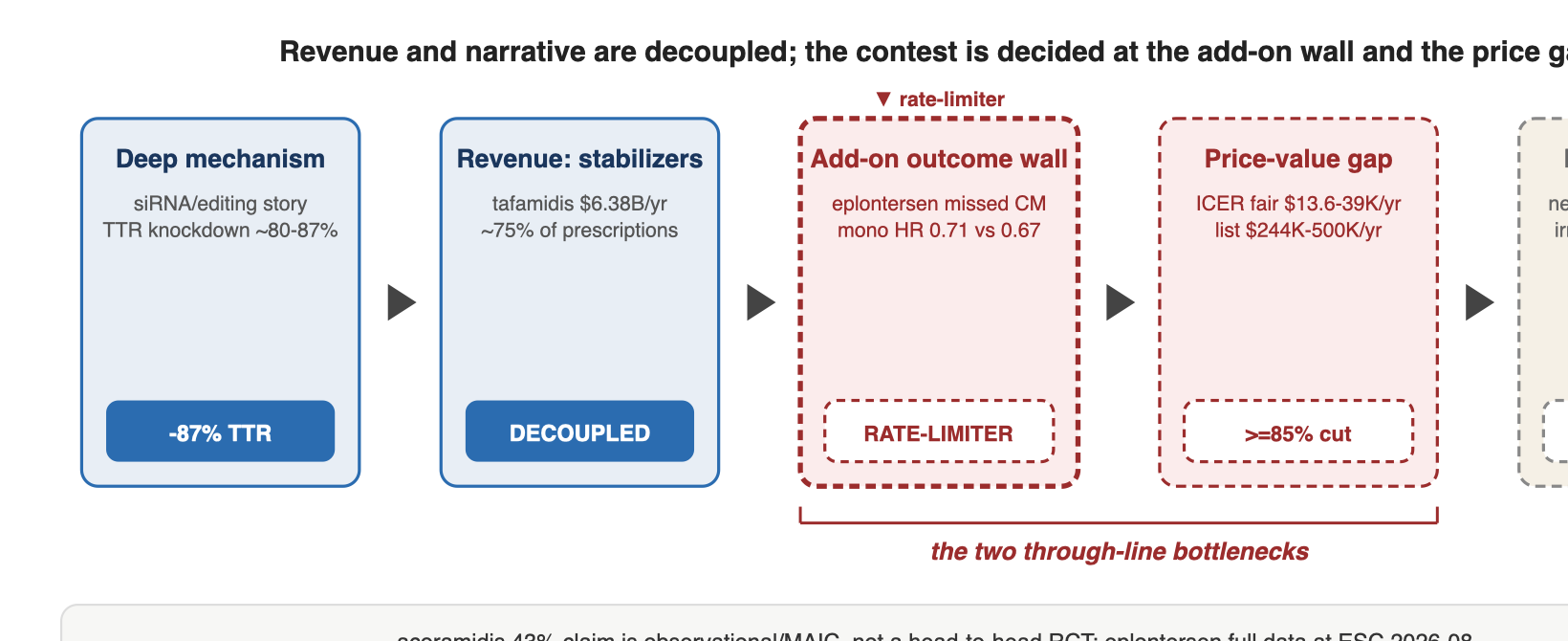
- What. ATTR-CM is the rare arena where a single target (transthyretin, TTR) is contested by four drug modalities — stabilizer, siRNA, ASO and in-vivo editing. Its commercial paradox is that revenue and scientific narrative are decoupled: the stabilizers own the money (Pfizer’s tafamidis franchise $6.38B in 2025, +17% YoY, ~75% of prescriptions; BridgeBio’s acoramidis launch accelerating at $180.6M US net sales in Q1 2026), while the siRNA carries the disease-modifying story and becomes a blockbuster (Alnylam’s vutrisiran $889.9M in Q1 2026, +187% YoY). The ASO (eplontersen) missed its ATTR-CM primary, and editing (nex-z) is clinical-stage with price undisclosed (all figures company-attributed).
- So what. The headline is a “modality war,” but the two through-line bottlenecks are elsewhere: (a) the add-on hard-outcome proof threshold — in an era where a stabilizer is already standard of care (SoC), proving an incremental hard outcome on top of it is the statistical/design barrier (the likely cause of the eplontersen miss); and (b) the price-value gap — ICER’s fair price of $13,600–39,000/yr against list prices of $244K–500K/yr (tafamidis judged to need a discount of ≥85%). Mechanistic superiority does not translate directly into commercial or clinical advantage.
- Now what. The CKM convergence axis to watch is one-shot, permanent in-vivo editing maturing simultaneously in the heart (nex-z / TTR) and in lipids (CTX320 / Lp(a) up to ~73% down; CTX310 / ANGPTL3) — directly tying ATTR-CM into the firm’s in-vivo-editing and Lp(a) series. The adoption gate for that axis is not efficacy but irreversible-safety plus pricing model. Note the acoramidis “43% reduction vs tafamidis” claim is observational / MAIC (indirect), not a head-to-head RCT — the cross-trial caveat applies to the commercial claim too.
The five-minute read
Revenue and narrative are decoupled
The paradox of the ATTR-CM commercial map is that the modality owning revenue and prescriptions (the stabilizer) is separate from the modality carrying the scientific narrative (the silencer and the editor). The Pfizer tafamidis franchise essentially built the category alone at $6.38B in 2025 (+17% YoY) and still holds roughly 75% of prescriptions by volume. Yet the incremental hard-outcome story is driven by the next-generation stabilizer (acoramidis), the siRNA (vutrisiran) and one-shot editing (nex-z). Translating the science of the series into commerce, the through-line lens sharpens: the headline says “modality war,” but the contest is decided at the bottlenecks — the add-on outcome threshold and the price-value gap. This is the skeptic posture inherited from the firm’s GLP-1 and computing series: a deeper mechanism does not automatically win the market or the clinic.
The four bottlenecks to expose at Tier 1
Four caveats sit at the surface of any responsible reading. First, the ASO commercial path for ATTR-CM is undetermined — eplontersen (Wainua, AstraZeneca/Ionis) missed the CARDIO-TTRansform primary (a press-release-only result), with full data awaited at ESC (August 2026); its separate neuropathy approval is unaffected. Second, the editing (nex-z) pricing model is undisclosed — clinical-stage after a hold was lifted, with enrollment completion targeted H1 2026 and an ATTRv-PN BLA targeted 2028. Third, acoramidis superiority is observational/MAIC, not an RCT head-to-head. Fourth, price and value are misaligned per ICER. A refuted item, caught by the skeptic pass, illustrates the discipline: a market-research vendor’s figure of “US ATTR treatment market 2025 = $65.4M” contradicts Pfizer’s tafamidis alone at $6.38B by roughly 100x and is therefore excluded.
| Modality | Drug (brand / company) | Route | Commercial position (attributed) |
|---|---|---|---|
| Stabilizer | tafamidis (Vyndamax, Pfizer / PFE) | Oral, chronic | Market leader — 2025 franchise $6.38B (+17%), ~75% of prescriptions |
| Stabilizer (next-gen) | acoramidis (Attruby, BridgeBio / BBIO) | Oral, chronic | Launch accelerating — Q1 2026 US net sales $180.6M (total revenue $194.5M); 7,804 prescriptions to 2026-02-20, ~161 new/week |
| siRNA | vutrisiran (Amvuttra, Alnylam / ALNY) | SC q12w | Becoming a blockbuster — Q1 2026 global $889.9M (+187%), 76% of total revenue; FY 2026 TTR-franchise guidance $4.4–4.7B |
| ASO | eplontersen (Wainua, AstraZeneca / AZN · Ionis / IONS) | SC q4w | ATTR-CM primary missed (neuropathy indication separately approved); CM path deferred to full data (ESC 2026-08) |
| Editing | nex-z (NTLA-2001, Intellia / NTLA) | IV, one-shot | Clinical-stage (price undisclosed); hold lifted, enrollment completion targeted H1 2026, ATTRv-PN BLA targeted 2028 |
Deep dive
1. Background — the commercial map by company and modality (all trial/results-attributed)
- Pfizer (stabilizer, first-mover): ahead of the 2028 US exclusivity expiry, Pfizer reached settlements with generic manufacturers and projects a “relatively stable” revenue flow through mid-2028–2031. Low-dose Vyndaqel was discontinued in the US at end-2025, consolidating onto Vyndamax (61 mg, one capsule daily). First-mover advantage, oral convenience and volume are the defensive axis.
- BridgeBio (next-gen stabilizer, differentiation): acoramidis is marketed on real-world differentiation vs tafamidis — in company/medRxiv-preprint observational and MAIC comparisons: diuretic intensification 43% lower, composite events 34% lower, CV hospitalization 34% lower, all-cause mortality 28% lower (vs tafamidis). Critically, these are observational / indirect (MAIC), not a head-to-head RCT, so the cross-trial caution applies to the commercial claim (§6). An external analyst (Evercore) raised its 2026 worldwide estimate from $828M to $1.02B and its peak from $2.9B to $3.5B (external analyst estimate, attributed).
- Alnylam (siRNA, disease-modifying story): on top of the HELIOS-B hard outcome (overall HR 0.72), quarterly revenue crossed $1B within a year of launch — evidence that a silencer is penetrating both as add-on and as substitute to a stabilizer.
- AstraZeneca / Ionis (ASO, miss): with the CM primary missed, the commercial path for this indication awaits full data. The neuropathy (ATTRv-PN) product Wainua is a separately approved indication, so the franchise itself is not extinguished (indications are separable).
- Intellia (editing, one-shot permanent): price is still undisclosed. A one-time IV edit’s pricing model is fundamentally different accounting from the cumulative cost of a chronic SC silencer (several years x hundreds of thousands of dollars) — treated in §2 and §6.
2. The CKM cross-domain — where ATTR-CM sits in the firm’s series
ATTR-CM is the heart-failure extreme of the CKM spectrum (a protein-misfolding HFpEF/HFmrEF). Placed on the firm’s CKM map, its position is clear.
- glp1-incretin / finerenone / ckm-vs-smd-hegemony: the chronic add-on lineage of metabolic, inflammatory and hemodynamic pathways. ATTR-CM differs — it removes the causal protein (TTR) itself, a distinctly disease-modifying character — the extreme case of CKM therapy moving from “risk-factor control” to “cause removal.”
- lp-a / in-vivo-gene-editing (the core convergence axis): ATTR editing (nex-z) and lipid editing (CTX320 → Lp(a), Phase 1 up to ~73% down; CTX310 → ANGPTL3) are maturing the same modality — liver-targeted, one-shot IV, permanent knockout — in the heart and in lipids simultaneously. The firm’s in-vivo-editing axis therefore converges on one line across TTR and Lp(a), and “chronic silencer/antibody vs one-shot edit” becomes the common CKM-wide value-proposition question.
- One-shot-permanent vs chronic (accounting / adherence): a chronic silencer (vutrisiran SC q12w, list estimated ~$500K/yr) carries cumulative-cost and adherence risk but is stoppable (reversible). A one-shot edit (nex-z) removes the adherence problem and caps cumulative cost but is irreversible, so the safety bottleneck (a Grade 4 hepatotoxicity history and hold-then-lift) is the real adoption gate. That trade-off transfers directly to Lp(a) and ANGPTL3 editing — a structural choice common across the CKM domain.
3. The through-line lens — headline vs bottleneck (inherited from the firm’s series)
| Headline (the starting point) | Real bottleneck (beneath it) |
|---|---|
| “siRNA succeeds / ASO fails → modality superiority” | Add-on background-therapy threshold — the barrier of proving an incremental hard outcome on top of a stabilizer SoC (Part 0 §3, leading hypothesis). Even eplontersen’s monotherapy subgroup was HR 0.71 (nominal), close to vutrisiran monotherapy (0.67) |
| “one-shot editing = the final solution” | Irreversible safety (hepatotoxicity), pricing model undetermined, long-term durability unproven — the hold history is the adoption gate |
| “next-gen stabilizer is superior (43% down)” | Observational / MAIC comparison (not an RCT) — residual confounding, selection bias; the cross-trial caution applies to the commercial claim |
| “a rare-disease market” | Diagnosis bottleneck is the market — PYP scintigraphy uptake and HFpEF screening are the real growth drivers (resolving under-diagnosis) |
| “list price = value” | ICER fair-price gap — stabilizer HBPB $13,600–39,000 vs list ~$268K (tafamidis) / ~$244K (acoramidis) / ~$500K (vutrisiran); tafamidis judged to need a ≥85% discount |
4. Overall judgment — the final siRNA-vs-ASO reading and the limits of modality ranking
The siRNA-vs-ASO puzzle, resolved (series conclusion): gathering the evidence, the modality proposition “siRNA is superior to ASO” is weakly supported. (i) Both silencers lower liver TTR deeply, into the ~80%s (knockdown depth is not decisive); (ii) eplontersen too shows a monotherapy subgroup HR 0.71, close in direction and size to vutrisiran monotherapy (0.67); (iii) the leading variables for the difference are population and background-therapy composition (HELIOS-B ~60% monotherapy vs CARDIO-TTRansform mostly stabilizer co-treatment) and timepoint/endpoint definition (all-cause vs CV death denominator). The central contrast converges not on “the modality decided it” but on “the add-on proof threshold of the stabilizer era decided it.” The definitive version of this conclusion still hinges on eplontersen full data (ESC 2026-08), so the present reading is press-release-only and hypothesis-generating (§6, §7).
The limits of modality ranking: ranking four modalities directly on hard outcomes is impossible for lack of head-to-head RCTs. Stabilizers and siRNA each demonstrate hard outcomes in their own trials; the ASO missed its primary (PR); editing has demonstrated only a Phase 1 biomarker (TTR −87%) with hard outcomes undetermined. The intuition “the deeper the mechanism, the more superior” is unproven — indeed the fact that the shallowest intervention (an oral stabilizer) leads on revenue, evidence and convenience refutes it.
5. The verdict table
| Item | Status | Basis |
|---|---|---|
| Stabilizer market dominance (revenue, share) | Demonstrated | tafamidis $6.38B, ~75% of prescriptions; acoramidis launch accelerating $180.6M/Q |
| siRNA commercial success | Demonstrated | Amvuttra Q1 2026 $889.9M (+187%), TTR guidance $4.4–4.7B |
| ASO (eplontersen) CM commercial path | Undetermined | Primary missed (PR-only), full data ESC 2026-08 |
| Editing (nex-z) commercial model / price | Undisclosed | Clinical-stage, hold lifted, enrollment completion targeted H1 2026 |
| acoramidis > tafamidis superiority (43% down, etc.) | Company / observational-MAIC (undetermined) | Not an RCT head-to-head; residual confounding |
| Price-value alignment | Gap (ICER) | Stabilizer HBPB $13,600–39,000 vs list $244K–500K |
| Modality superiority ranking | Cannot be asserted | No head-to-head; cross-trial |
| CKM one-shot-editing convergence axis (ATTR + Lp(a)) | Established (early) | nex-z and CTX320 maturing the same modality simultaneously |
6. The skeptic’s gate (rubric)
- verified-clean: the financial facts (revenue, prescriptions, guidance, patent settlements) are confirmed from primary results releases / SEC — this portion is clean.
- proceed-with-caveats (verdict): (i) the acoramidis-vs-tafamidis superiority claim is observational / MAIC (indirect), not an RCT — apply the Part 1 cross-trial caution to the commercial claim; do not assert “superior.” (ii) The eplontersen CM miss is PR-only; the monotherapy signal is a multiplicity-uncorrected subgroup beneath a primary failure (hypothesis-generating). (iii) nex-z price, long-term durability and irreversible safety are undetermined — do not over-trust the “one-shot and done” story. (iv) The vendor market-size estimate of $65.4M contradicts results by ~100x → refuted, excluded. (v) The ICER fair price depends on methodology (discount rate, utility assumptions) — do not misread the “fair price” as an absolute.
- hold: not needed. But statements about the revenue, success/failure and superiority of the listed companies are held to neutral, trial-attributed description — not buy/sell implications for any security.
7. Three falsifiable predictions
- P1: if the eplontersen full data at ESC 2026-08 reproduce a monotherapy HR with the CI upper bound <1.0, the “background-therapy threshold” hypothesis (§4) is strengthened; if the benefit disappears even in monotherapy, the interpretation moves to a modality/drug-specific failure. (Test: 2026-08.)
- P2: if acoramidis-vs-tafamidis differentiation is not reproduced beyond observational/MAIC — by a prospective head-to-head or robust RWE — the “43% down”-type superiority claims will shrink toward selection bias / residual confounding. (Test: subsequent RWE.)
- P3: once nex-z (and CTX320) one-shot editing enters an approval path, the adoption bottleneck will prove to be not efficacy (deep knockout) but irreversible safety (hepatotoxicity), long-term durability and pricing model (one-time reimbursement) — the reversibility and split cost of a chronic silencer may keep an early-adoption edge. (Test: at BLA/launch.)
8. Series-closing retrospective (Parts 0–5) and ATTR-CM’s place in the firm’s CKM series
The attr-cm series, synthesized: the series traced the rare arena of four modalities contesting one target (TTR) through landscape (Part 0) → stabilizer (Part 1) → silencers, siRNA/ASO (Part 2) → editing (Part 3) → hard outcomes (Part 4) → commercial/CKM (Part 5). Three through-line conclusions:
- The modality-superiority thesis does not hold. With no hard-outcome head-to-head and the siRNA/ASO gap most likely driven by background therapy, population and timepoint, “deep mechanism = superior” is unproven. What separated the siRNA success from the ASO miss was the background-therapy threshold, not the mechanism. The fact that the shallowest intervention (an oral stabilizer) leads on revenue, convenience and evidence refutes the thesis.
- The real bottlenecks are two — (a) the add-on hard-outcome proof threshold in the stabilizer era (the likely cause of the eplontersen miss), and (b) the price-value gap (ICER fair price vs list). The headlines (percentages, “first,” “one-shot”) are entry points only.
- One-shot-permanent vs chronic extends to a CKM-wide structural choice — irreversible safety is the gate for editing adoption.
ATTR-CM’s place in the firm’s CKM series: attr-cm ties directly to the in-vivo-gene-editing and Lp(a) series on one axis (liver-targeted, one-shot permanent knockout), and forms a contrast axis (cause-protein removal) against the “chronic add-on, risk-factor control” lineage of glp1-incretin, finerenone and ckm-vs-smd-hegemony. In the firm’s CKM map, ATTR-CM sits as “the extreme of disease-modifying therapy and the cardiac entry point of the in-vivo editing modality.” The final answer to the siRNA-vs-ASO puzzle (§4: not the modality but the background-therapy threshold) is the value to feed into the knowledge-index and convergence-ledger as a “mechanism-headline vs trial-design-bottleneck” signal.
References
- Pfizer / reporting. 2026. “Pfizer Protects a $6.4B Heart Franchise.” Yahoo Finance (tafamidis 2025 $6.38B, +17%). https://finance.yahoo.com/sectors/healthcare/articles/pfizer-protects-6-4bn-heart-165924977.html
- FiercePharma. “Pfizer to Discontinue Low-Dose ATTR Drug Vyndaqel in the US Ahead of 2028 Patent Loss.” https://www.fiercepharma.com/pharma/pfizer-discontinue-low-dose-attr-drug-vyndaqel-us-ahead-2028-patent-loss
- FiercePharma. “Pfizer Fends Off Generic Competition to Blockbuster Vyndamax with 3 Settlements.” https://www.fiercepharma.com/pharma/pfizer-fends-generic-competition-blockbuster-vyndamax-3-settlements
- BridgeBio. 2026. “BridgeBio Reports First Quarter 2026 Financial Results and Corporate Updates” (Attruby $180.6M US net sales, total $194.5M). GlobeNewswire, 7 May 2026. https://www.globenewswire.com/news-release/2026/05/07/3290504/0/en/BridgeBio-Reports-First-Quarter-2026-Financial-Results-and-Corporate-Updates.html
- FiercePharma. “BridgeBio’s Launch of Attruby Accelerates, CEO Says Company Will Rely on Its Differentiation.” https://www.fiercepharma.com/pharma/bridgebios-launch-attruby-accelerates-ceo-says-company-will-rely-its-differentiation
- medRxiv preprint. 2026. acoramidis-vs-tafamidis real-world / MAIC observational comparison (43% diuretic intensification, etc. — not an RCT). https://www.medrxiv.org/content/10.64898/2026.04.24.26351684v3.full
- Alnylam. 2026. “Alnylam Pharmaceuticals Reports First Quarter 2026 Financial Results” (Amvuttra $889.9M, +187%; TTR guidance $4.4–4.7B). StockTitan. https://www.stocktitan.net/news/ALNY/alnylam-pharmaceuticals-reports-first-quarter-2026-financial-results-3v8b0litlahu.html
- ICER. “ICER Publishes Final Evidence Report on ATTR-CM” (stabilizer HBPB $13,600–39,000; tafamidis ≥85% discount). https://icer.org/news-insights/press-releases/icer-publishes-final-evidence-report-attr-cm/
- JACC. 2025. ATTR-CM list-price / cost-effectiveness context. Journal of the American College of Cardiology. https://www.jacc.org/doi/10.1016/j.jacc.2025.07.001
- AstraZeneca. 2026. “Update on CARDIO-TTRansform Phase III Trial” (eplontersen CM primary missed; full data ESC 2026-08). Press release, 9 July 2026. https://www.astrazeneca.com/media-centre/press-releases/2026/update-cardio-ttransform-phase-iii-trial.html
- Intellia Therapeutics. “Intellia Provides Update on MAGNITUDE Clinical Trials” (nex-z hold lifted; enrollment completion H1 2026; ATTRv-PN BLA 2028). https://ir.intelliatx.com/news-releases/news-release-details/intellia-therapeutics-provides-update-magnitude-clinical-trials
- CRISPR Therapeutics. “CRISPR Therapeutics Announces Positive Phase 1 Clinical Data” (CTX320 Lp(a) up to ~73% down; CTX310 ANGPTL3; company-presented, not peer-reviewed). https://ir.crisprtx.com/news-releases/news-release-details/crispr-therapeutics-announces-positive-phase-1-clinical-data/
Disclosure
This post is for information only and is not investment advice, and not medical advice. Treatment decisions should always be made with your own clinician.
COI note: this post describes listed companies (Pfizer PFE, BridgeBio BBIO, Alnylam ALNY, AstraZeneca AZN, Ionis IONS, Intellia NTLA) and their sponsored trials in a descriptive, neutral context. Every revenue, prescription, guidance and pricing figure is attributed to the company’s own results (press release / SEC), to the ICER report, or to market-analysis reporting; external analyst figures (e.g. Evercore estimates) are labeled as such. The acoramidis-versus-tafamidis comparison (43%, etc.) is a company/medRxiv-preprint observational, MAIC (indirect) comparison — not a head-to-head RCT — and is labeled as such throughout. A vendor’s “US ATTR market 2025 = $65.4M” is refuted (it contradicts tafamidis alone at $6.38B by ~100x) and excluded. Competitive and success/failure statements are factual, neutral descriptions and are not buy/sell implications for any security. The author holds no position in, and has no financial interest in, the companies named.


Leave a Reply