Evidence-first notes on bioscience and deep tech, at the edge of the lab and the market. Information only — not investment advice, not medical advice. Every hard-outcome figure is attributed to its own trial’s primary paper or press release; the eplontersen miss and monotherapy signal are attributed to the AstraZeneca/Ionis press release of 2026-07-09 (press-release only, full data awaited at ESC 2026-08). No two of these numbers come from a head-to-head comparison.
The 30-second version
- What. All four ATTR-CM modalities claim hard outcomes — all-cause mortality (ACM), cardiovascular (CV) death, CV hospitalization. Within their own trials the existence or absence of a hard-outcome benefit is settled: tafamidis lowered all-cause mortality (HR 0.70, ATTR-ACT), vutrisiran lowered 42-month all-cause mortality (HR 0.64, HELIOS-B), acoramidis won on a hierarchical Win Ratio of 1.8 (ATTRibute-CM), while eplontersen MISSED its primary CV-death composite endpoint (CARDIO-TTRansform, press release).
- So what. Whether one modality is superior to another is undeterminable, because there is not a single head-to-head randomized trial in ATTR-CM — every comparison is cross-trial. Three axes contaminate any side-by-side read: population (the fraction of patients already on a background stabilizer differs), era (later trials have a healthier, stabilizer-protected placebo arm), and endpoint (all-cause vs CV death, and Win Ratio vs hazard ratio are different measurement scales). So the vertical comparison “HR 0.72 vs a miss” is forbidden.
- Now what. The late-entrant disadvantage is harsher at the hard-outcome layer than at the surrogate layer: a stabilizer standard-of-care lowers placebo-arm events and structurally compresses the statistical power of any add-on drug. So eplontersen’s miss is plausibly “an add-on-era hard-endpoint design aimed at a stabilizer-dominated population” rather than “because it is an ASO” — but the monotherapy effect size is undisclosed, so this is not settled. Full data at ESC 2026-08.
The five-minute read
Hard outcomes are only true inside the trial that produced them
Every ATTR-CM program frames itself around hard outcomes — death and CV events — and within each trial those numbers are trustworthy first-source facts. The problem begins the moment they are lined up next to each other. ATTR-CM has zero head-to-head RCTs: no trial has ever randomized patients between two of these drugs. So “tafamidis HR 0.70 vs vutrisiran HR 0.72 vs eplontersen miss” is not a ranking — it is a juxtaposition of parallel trials whose populations, eras and endpoint definitions all differ. The honest reading direction is horizontal-per-column (“did this trial demonstrate a hard-outcome benefit, yes or no”) and never vertical (“whose hazard ratio is smaller”).
Same conclusion as the surrogate layer, only harsher
Earlier parts of this series argued that once a stabilizer became standard of care, the bar to prove an add-on benefit rose sharply. That thesis is confirmed here on the hard-outcome layer — and it bites harder. Death and CV events accrue more slowly and more rarely than a biomarker, so a fixed observation window (CARDIO-TTRansform’s Week 140 ≈ 2.7 years) can close before the curves separate; and a stabilizer that already slows deposition lowers placebo-arm events, structurally cutting the power to reach statistical significance. Both forces stack, so the later the trial and the more background stabilizer it carries, the harder a hard-outcome win becomes. Eplontersen’s primary miss is therefore plausibly a design consequence of that era — not proof that the ASO mechanism fails — though with the monotherapy effect size undisclosed this cannot be confirmed.
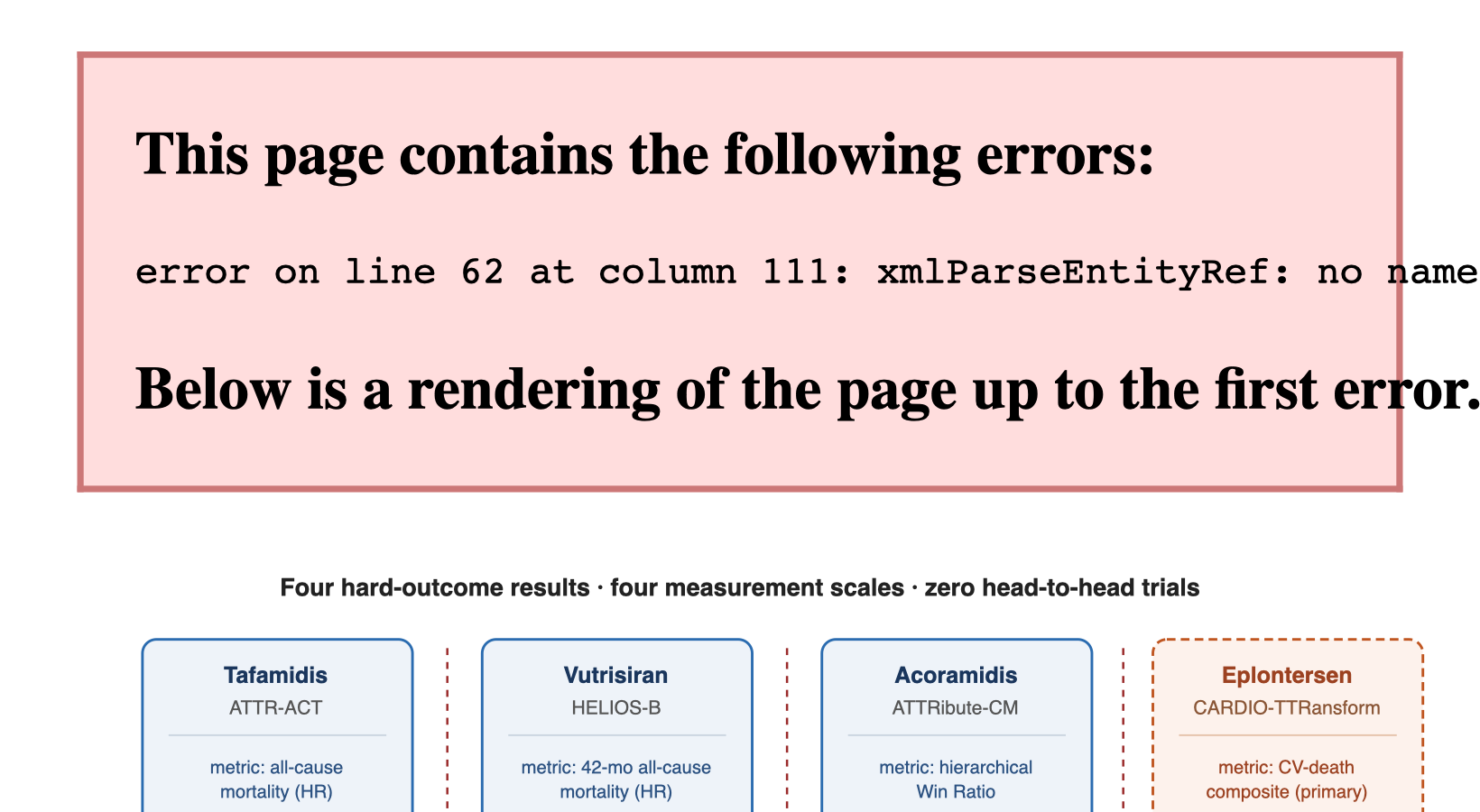
| Trial | Drug (modality) | Primary endpoint | Key HR / measure (as reported) | Hard-outcome character |
|---|---|---|---|---|
| ATTR-ACT | tafamidis (stabilizer) | ACM + CV-hospitalization hierarchical composite | Hierarchical P=0.0006; all-cause mortality HR 0.70 (0.51–0.96) | Hard, first (mortality lowered as a standalone component) |
| ATTRibute-CM | acoramidis (stabilizer) | ACM + CVH + NT-proBNP + 6MWD Win Ratio | Win Ratio 1.8 (1.4–2.2) p<0.001; ACM+CVH HR 0.64 | Hard component + surrogate mix (Win Ratio) |
| HELIOS-B | vutrisiran (siRNA) | All-cause mortality + recurrent CV events | Overall HR 0.72 (0.56–0.93); all-cause 42-mo HR 0.64 (0.46–0.88) | Hard, pivotal (all-cause mortality included) |
| CARDIO-TTRansform | eplontersen (ASO) | CV death + recurrent CV events (Wk 140) | ★ MISSED; monotherapy signal, effect size undisclosed | Hard endpoint, primary miss (press-release only) |
| MAGNITUDE | nex-z (gene editing) | Hard outcomes (ongoing) | Ph1 serum TTR −87% (surrogate only) | Hard outcome not yet measured (ongoing) |
Deep dive
1. Background — each trial’s hard-outcome numbers, attributed within-trial
Read each block as true only inside its own trial. The figures are reported exactly as in the source.
- ATTR-ACT — tafamidis (stabilizer, NEJM 2018). Primary: hierarchical composite of ACM + CV hospitalization (Finkelstein-Schoenfeld) → P=0.0006. All-cause mortality HR 0.70 (95% CI 0.51–0.96), P=0.0259 — the first and reference point across all four modalities for lowering death itself as a standalone component. CV-hospitalization relative risk ratio 0.68 (0.56–0.81). N=441, 30 months. Character: hard (mortality), pivotal, first.
- ATTRibute-CM — acoramidis (next-generation stabilizer, NEJM 2024-01). Primary: a four-step hierarchical composite of ACM, CV hospitalization, NT-proBNP and 6MWD → Win Ratio 1.8 (1.4–2.2), p<0.001. ACM or first CV hospitalization: 35.9% vs placebo 50.5%, HR 0.64. CV-hospitalization annual frequency relative risk ~50% (0.36–0.70), p<0.0001. 30-month observed survival 80.7% (treatment). Character: hard component included but the primary is a hierarchical composite (Win Ratio) — the standalone mortality HR is not as sharply pre-specified/powered as in tafamidis (see §2).
- HELIOS-B — vutrisiran (siRNA, NEJM 2025;392:33–44). Primary: composite of all-cause mortality + recurrent CV events → overall HR 0.72 (0.56–0.93), p=0.01 (N=654). Monotherapy (no background stabilizer) HR 0.67 (0.49–0.93), p≈0.02 (N=395, pre-specified). All-cause mortality (42 months) HR 0.64 (0.46–0.88) — the evidence that the siRNA lowered death itself. (Note: this series has also shown HR 0.65 (0.46–0.90) from a different data cut — primary paper vs an updated cut, same direction; reconciled as a cut difference, §9.) CV death + CV composite HR 0.72 (0.55–0.94); CV-hospitalization rate ratio 0.75 (0.62–0.91); HF-hospitalization RR 0.67 (0.52–0.86); urgent HF visit RR 0.54 (0.30–0.98). Character: hard (all-cause mortality included), pivotal.
- CARDIO-TTRansform — eplontersen (ASO, AstraZeneca/Ionis press release 2026-07-09). Primary: composite of CV death + recurrent CV events (Week 140) → ★ MISSED (no statistical significance). Pre-specified subgroup: monotherapy suggested fewer events, no effect in the stabilizer-combination arm — ★ but the press release did not disclose the effect size or p-value (per HCPLive/touchCARDIO). Any “monotherapy HR 0.71 nominal” figure circulating in secondary coverage has unclear provenance and must not be treated as confirmed before ESC 2026-08. N=1,432, 45 mg SC q4w. Full data at ESC 2026-08. Character: a hard (CV-death) endpoint but a primary failure (press-release only).
- MAGNITUDE — nex-z (gene editing, ongoing). Phase 1: a single dose cut serum TTR −87% (sustained to 36 months, N=36) — surrogate only. The Phase 3 hard-outcome endpoint and N are not finalized (FDA hold, conditionally lifted 2026-01/03). Character: hard outcome not yet measured.
2. The cross-trial trap — three misaligned axes
- (a) Population — the background-stabilizer fraction differs. ATTR-ACT (2018) and ATTRibute-CM used the stabilizer as the study drug, so a “background stabilizer use” concept does not apply (placebo-controlled, pre-standard-of-care era). HELIOS-B ran ~40% on tafamidis / ~60% (395 patients) monotherapy. CARDIO-TTRansform, per its press release, treated most patients on top of a stabilizer — so the two silencer trials sit on opposite substrata. Placing vutrisiran’s HR 0.72 (a monotherapy-heavy population) next to eplontersen’s miss (a stabilizer-combination-dominated population) is comparing two different control groups.
- (b) Era — the standard of care evolved. ATTR-ACT’s benefit is against the natural history of a 2013–2018 era with no effective treatment; CARDIO-TTRansform’s benefit is against a 2020s add-on baseline in which tafamidis is already standard of care. Even under identical placebo control, the placebo arm’s prognosis differs — the later trial’s placebo arm is already protected by a stabilizer, so its event rate is lower and the residual risk an add-on drug must separate is smaller.
- (c) Endpoint definition — the denominator differs. ATTR-ACT = ACM + CV-hospitalization hierarchical composite; ATTRibute-CM = ACM + CVH + NT-proBNP + 6MWD four-step Win Ratio; HELIOS-B = all-cause + recurrent CV; CARDIO = CV death + recurrent CV. All-cause vs CV death have different numerators (whether non-CV death is included), and Win Ratio vs HR are different statistical scales (a Win Ratio is a hierarchically weighted rank comparison that does not convert to an HR). “Win Ratio 1.8” and “HR 0.72” are numbers in different units.
3. Evolving standard of care = a structural late-entrant disadvantage
The “add-on bar rises” thesis this series developed at the surrogate layer (TTR knockdown, NT-proBNP) operates more harshly at the hard-outcome layer, for three reasons. (1) Death and CV events accrue more slowly and rarely than a biomarker, so a shorter observation window (CARDIO Week 140 ≈ 2.7 years vs HELIOS-B up to 42 months) can close before the curves separate. (2) A stabilizer that already slows deposition lowers placebo-arm events, structurally cutting the drug’s power to reach significance. (3) These forces stack, so the later the trial and the more background stabilizer it carries, the harder a hard-outcome win becomes. Eplontersen’s primary miss is therefore plausibly a consequence of “aiming an add-on-era hard endpoint at a stabilizer-dominated population” rather than “because it is an ASO” — though, with the monotherapy effect size undisclosed, this is not confirmed. It is the same pattern this firm’s GLP-1 work noted: an evolving standard of care compresses the absolute increment a new add-on can show.
4. The absence of head-to-head trials — why there are none, and why they are needed
- Absence: ATTR-CM has zero drug-versus-drug randomized trials. Every comparison is cross-trial. The compound cause is rare-disease numbers, ethics (withholding standard of care from a placebo arm is hard), cost, and the absence of commercial incentive (an incumbent avoids a comparative trial).
- Necessity: the real answer to modality superiority (stabilizer vs silencer vs editor) exists only under the same population, same era and same endpoint. For example, “the hard-outcome increment of adding vutrisiran to tafamidis versus tafamidis alone” is only indirectly suggested by HELIOS-B’s ~40% combination subgroup — not a pre-specified head-to-head.
- Pragmatic alternatives: individual-patient-data (IPD) meta-analysis, matching-adjusted indirect comparison (MAIC), common-placebo network meta-analysis. But these only statistically adjust for population/era heterogeneity — they do not remove it. Cross-trial contamination is fundamentally a design problem, solvable only by design.
5. Commercialization and CKM framing
- Why hard outcomes matter commercially: hard outcomes are the key that opens guidelines and markets. Surrogates alone yield limited ESC/ACC upgrade and reimbursement expansion, but a demonstrated mortality reduction (tafamidis 0.70, vutrisiran 0.64) promotes ATTR-CM to an actionable target in HFpEF/HFmrEF etiology screening — directly on the Principal’s CKM/heart-failure axis.
- What the numbers cannot answer: “which drug lowers death more” is unanswerable given the absence of head-to-head trials. Real-world choice will turn not on a hard-outcome ranking but on dosing convenience (oral vs SC vs one-time), safety, cost, and the diagnostic bottleneck (PYP scintigraphy).
- TRL / maturity frame: tafamidis, acoramidis and vutrisiran carry mature, peer-reviewed hard-outcome evidence (regulatory/approval stage); eplontersen’s hard-endpoint program is at a primary-miss/full-data-pending stage (press-release only); nex-z has not yet measured a hard outcome (Phase 3 ongoing, endpoint unfinalized).
- Company statements (Pfizer, BridgeBio, Alnylam, AstraZeneca, Ionis, Intellia and their sponsored trials) are limited to factual, neutral, trial-attributed description; the pass/fail of a listed company’s hard outcome is not a buy/sell signal. Eplontersen’s miss, the monotherapy signal, and any “acoramidis vs vutrisiran” superiority read carry high misreading risk and are explicitly not framed as security implications.
6. The skeptic’s bottom line
- Within-trial hard-outcome numbers are first-source confirmed (verdict: proceed-with-caveats). But four caveats must sit at the Tier-1 level.
- No head-to-head: the absence of any head-to-head RCT means modality superiority must not be asserted.
- Eplontersen is press-release only: the miss and monotherapy signal have an undisclosed effect size; any “HR 0.71” has unclear provenance and must not be confirmed before the full ESC 2026-08 data.
- Different scales: “all-cause vs CV death” and “HR vs Win Ratio” are numbers in different units — not rankable.
- nex-z has no hard outcome measured — it belongs to the surrogate layer only.
- Neutral-framing note: the pass/fail of a listed pharma’s hard outcome (PFE, BBIO, ALNY, AZN, IONS, NTLA) is stated as fact, neutral and trial-attributed only, to prevent misreading as a security signal.
7. What to watch (falsifiable)
- P1: at ESC 2026-08, if the eplontersen monotherapy subgroup’s actual effect size and CI are disclosed with an upper bound <1.0, the “add-on bar” hard-outcome hypothesis strengthens; if there is no benefit even in monotherapy, interpretation shifts toward a modality/drug-specific hard failure. (Verification point: 2026-08.)
- P2: if a common-placebo network meta-analysis / MAIC adjusts for population and era, most of the hard-outcome HR gap between silencers and stabilizers will resolve as a function of the background-stabilizer fraction and observation-window length, not of modality.
- P3: when MAGNITUDE (nex-z) reads its hard outcome, if its placebo/control arm is a 2027–2028 population already protected by stabilizer plus silencer, even a one-time edit will meet the same statistical bar to prove an add-on increment — editing’s durability advantage will not translate directly into a hard-outcome significance win. (Links to the firm’s in-vivo editing series.)
References
- Pfizer. 2018. “Tafamidis Phase 3 ATTR-ACT study results presented as late-breaking data at ESC Congress 2018.” Press release. pfizer.com/…/attr-act-esc-2018
- Maurer et al. 2018. Tafamidis Treatment for Patients with Transthyretin Amyloid Cardiomyopathy (ATTR-ACT). New England Journal of Medicine. NEJMoa1805689. https://www.nejm.org/doi/full/10.1056/NEJMoa1805689
- Gillmore et al. 2024. Acoramidis in Transthyretin Amyloid Cardiomyopathy (ATTRibute-CM). New England Journal of Medicine. NEJMoa2305434. https://www.nejm.org/doi/pdf/10.1056/NEJMoa2305434
- ATTRibute-CM supporting analysis. 2024. Journal of the American College of Cardiology / ScienceDirect. sciencedirect.com/…/S0735109724105566
- HELIOS-B / vutrisiran analysis. 2025. Journal of the American College of Cardiology. https://www.jacc.org/doi/10.1016/j.jacc.2025.04.008
- HELIOS-B further data. 2025. Nature Medicine. s41591-025-03851-z. https://www.nature.com/articles/s41591-025-03851-z
- Alnylam Pharmaceuticals. 2025. HELIOS-B vutrisiran press release. investors.alnylam.com/press-release?id=29256
- Ionis Pharmaceuticals. 2026. “Update on CARDIO-TTRansform Phase 3 Trial of Eplontersen in Adults” (primary miss, press release 2026-07-09). ir.ionis.com/…/update-cardio-ttransform-phase-3-trial-eplontersen-adults
- HCPLive. 2026. “Eplontersen Misses Primary Endpoint in Phase 3 ATTR-CM Trial.” https://www.hcplive.com/view/eplontersen-misses-primary-endpoint-in-phase-3-attr-cm-trial
- touchCARDIO. 2026. “Eplontersen Misses Primary Endpoint in Phase 3 CARDIO-TTRansform Trial for ATTR Cardiomyopathy.” touchcardio.com/…/cardio-ttransform-trial-for-attr-cardiomyopathy
Disclosure
This post is for information only and is not investment advice, and not medical advice. Treatment decisions should always be made with your own clinician.
COI note: this post describes listed companies (Pfizer PFE, BridgeBio BBIO, Alnylam ALNY, AstraZeneca AZN, Ionis IONS) and their sponsored trials in a descriptive, neutral context. Every hard-outcome figure is attributed to its own trial’s primary paper or press release; the eplontersen miss and monotherapy signal are attributed to the AstraZeneca/Ionis press release of 2026-07-09 and are press-release only, with the effect size undisclosed and full data awaited at ESC 2026-08. No two of these figures come from a head-to-head comparison, so no modality-superiority claim is made. Quantitative claims are attributed to the vendor, author or trial/press release. The pass/fail of any listed company’s hard outcome — including eplontersen’s miss, the monotherapy signal, and any “acoramidis vs vutrisiran” superiority read — is a factual, neutral description and is not a buy/sell implication for any security. The author holds no position in, and has no financial interest in, the companies named.


Leave a Reply