Evidence-first notes on bioscience and deep tech, at the edge of the lab and the market. Information only — not investment advice, not medical advice. All knockdown, hazard-ratio and subgroup figures are attributed to the sponsoring trial, journal or company; several eplontersen numbers are a company press release rather than peer-reviewed data (noted inline), with full data pending. These are cross-trial observations, not head-to-head comparisons.
The 30-second version
- What. Two liver-directed TTR silencers knock down transthyretin to nearly the same depth — eplontersen (an antisense oligonucleotide, ASO) −84%, vutrisiran (an siRNA) −88%, patisiran >80% — yet in hard-outcome cardiomyopathy trials they split: vutrisiran succeeded in HELIOS-B (overall HR 0.72, p=0.01) while eplontersen missed its primary endpoint in CARDIO-TTRansform (AstraZeneca/Ionis press release, 2026-07-08). The surface headline reads “siRNA wins, ASO loses.”
- So what. That headline is not supported by the evidence. Knockdown is equivalent, so neither modality nor knockdown depth is the deciding variable. The monotherapy (no-stabilizer) subgroup hazard ratios are near-identical — vutrisiran 0.67 vs eplontersen 0.71 — and both lose their effect in the stabilizer-combination stratum (HELIOS-B combination HR 0.79, non-significant; CARDIO-TTRansform “no effect observed in the stabilizer arm”). The deciding variable is the background-therapy mix — the threshold of proving an add-on benefit on top of a tetramer stabilizer that has become standard of care — not the molecule.
- Now what. The hidden variable is enrollment-era standard-of-care drift: HELIOS-B enrolled a ~60%-monotherapy population and succeeded; CARDIO-TTRansform enrolled a more recent population with ~81% stabilizer exposure (57% at baseline plus 24% starting on-study) and missed. The eplontersen monotherapy HR 0.71 is a nominal subgroup sitting under a failed primary endpoint (multiplicity-uncorrected → hypothesis-generating), disclosed PR-only (Businesswire, 2026-07-08); decisive full data are due at ESC 2026-08. The honest verdict is proceed-with-caveats: “ASO-inferior / siRNA-superior” is not established.
The five-minute read
Same silencer target, same knockdown depth, split outcomes
This series’ central puzzle: two drugs that both silence hepatic TTR production deeply (into the 80s of percent) reached opposite conclusions in cardiomyopathy hard-outcome trials. The siRNA vutrisiran succeeded in HELIOS-B (overall HR 0.72, p=0.01); the ASO eplontersen missed its primary endpoint in CARDIO-TTRansform (AstraZeneca/Ionis press release, 2026-07-08 to -09). Read the two trials against their own subgroups, however, and a different account emerges: the variable that split success from miss was not the modality (siRNA vs ASO) and not knockdown depth, but the threshold of proving an add-on benefit on top of a stabilizer that had become standard of care. The decisive alignment is that the two drugs’ monotherapy subgroups are almost identical — vutrisiran HR 0.67 vs eplontersen HR 0.71.
One caveat belongs up front, at headline level. The eplontersen numbers are press-release-only. The full effect size and confidence intervals are pending ESC 2026-08. The monotherapy HR 0.71 quoted below is a nominal subgroup under a failed primary endpoint — hypothesis-generating, not confirmatory. And the 0.67-vs-0.71 proximity is a cross-trial observation (different endpoints, timepoints and sample sizes), not a head-to-head test.
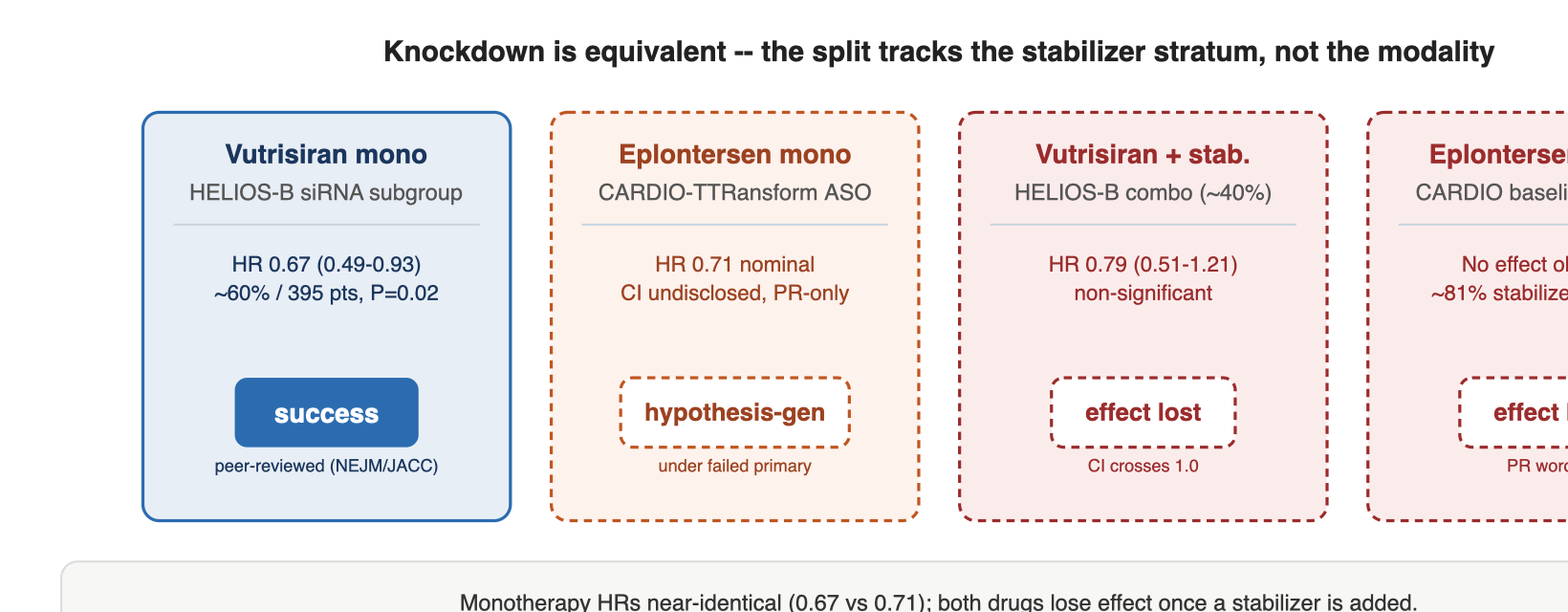
| Drug (modality) | Overall result | Monotherapy (no-stabilizer) subgroup | Stabilizer-combination stratum |
|---|---|---|---|
| vutrisiran (siRNA) — HELIOS-B | HR 0.72 (0.56–0.93), p=0.01; all-cause death 0.65 (0.46–0.90) — success | HR 0.67 (0.49–0.93), P=0.02 (~60%, 395 patients) | HR 0.79 (0.51–1.21) — non-significant (diluted) |
| eplontersen (ASO) — CARDIO-TTRansform | Primary endpoint missed (PR-only; full data ESC 2026-08) | HR 0.71 nominal (CI undisclosed; under a failed primary → hypothesis-generating) | “No treatment effect observed” (PR) |
| Knockdown depth (neuropathy population) | eplontersen −84% (18 mo) ≈ vutrisiran −88% (18 mo) ≈ patisiran >80% (max 96%) — equivalent; cardiomyopathy head-to-head is unverified | ||
Deep dive
1. Background — vutrisiran’s HELIOS-B (success)
Trial: N=655, vutrisiran 25 mg subcutaneous once every 12 weeks (quarterly); primary endpoint = composite of all-cause death plus recurrent cardiovascular events; follow-up to 42 months (NEJM 2025;392:33–44 / JACC 2025).
- Overall: HR 0.72 (95% CI 0.56–0.93), p=0.01; all-cause death at 42 months HR 0.65 (0.46–0.90).
- Monotherapy subgroup (no baseline tafamidis, ~60% / 395 patients): HR 0.67 (0.49–0.93), P=0.02 (NEJM reports p=0.016). CV events alone: RR 0.68 (0.53–0.86), P<0.01.
- Tafamidis-combination subgroup (~40%): HR 0.79 (0.51–1.21) — same direction but non-significant (CI crosses 1.0).
The point worth emphasizing first: even within HELIOS-B, the stabilizer-combination stratum was already diluted (0.79, non-significant). The reason HELIOS-B succeeded overall is that ~60% of its sample was monotherapy and that stratum was robust (0.67), pulling the pooled result up. In other words, “success versus miss” already looks like a function of the background-therapy mix from inside this single trial.
2. What this analysis newly establishes — eplontersen’s CARDIO-TTRansform (missed, PR-only)
Trial: N=1,432, eplontersen 45 mg subcutaneous once every 4 weeks (monthly), 130 sites across 20 countries, 1:1 randomization; primary endpoint = composite of CV death plus recurrent CV events at Week 140 (≈2.7 years). Stratification: NYHA (I/II vs III), genotype (wild-type vs variant), 6-minute walk (≤350 vs >350 m), and stabilizer use (yes vs no) (AstraZeneca/Ionis press release 2026-07-08 to -09; baseline characteristics in EJHF).
- Primary endpoint: not met. Adding eplontersen on top of modern standard of care (most patients on a stabilizer) “did not provide a significant benefit” (PR wording).
- Background therapy (the key numbers): 57% of each arm was on a stabilizer at baseline, with a further 24% starting a stabilizer on-study → effectively ~81% stabilizer exposure. Pure monotherapy was a minority (~19%).
- Baseline-stabilizer arm: no treatment effect observed (PR).
- Monotherapy (no-stabilizer) subgroup: HR 0.71 (nominal) — but a subgroup under a failed primary endpoint, so multiplicity-uncorrected and hypothesis-generating. The CI is not disclosed in the PR (unverified).
The PR-only boundary matters: the monotherapy 0.71 is a point estimate only. The CI, p-value and event counts cannot be checked until the full data at ESC 2026-08. The statement “it works in monotherapy” is not confirmable at this time.
3. Strengths and limits — testing the causal hypothesis: background-therapy threshold vs modality vs knockdown
Three hypotheses, narrowed on the evidence.
(a) Did the modality itself (siRNA vs ASO) decide it? — weak support. The mechanisms differ: eplontersen is an ASO that recruits RNase H to cleave TTR mRNA, while vutrisiran is an siRNA using Argonaute 2 (Ago2); both are GalNAc-conjugated for liver targeting. But knockdown depth is effectively equivalent — eplontersen serum TTR −84% (18 months, NEURO-TTRansform, neuropathy), vutrisiran −88% (18 months, HELIOS-A, neuropathy), patisiran >80% (up to 96%). A review states the clinical differences come “from trial design, population and dosing schedule, not molecular mechanism” (Medicine mini-review, 2024). This points toward rejecting the modality/depth hypothesis. (Caveat: the head-to-head knockdown in the cardiomyopathy population remains unverified — the figures above are from neuropathy populations.)
(b) The add-on-on-stabilizer threshold (most likely) — strong support. The decisive alignment: the two drugs’ monotherapy HRs are near-identical — vutrisiran 0.67 vs eplontersen 0.71. Conversely, both lose their effect in the stabilizer-combination stratum — HELIOS-B combination 0.79 (non-significant), CARDIO combination “no effect observed.” The two trials show the same-direction biology; only the sample’s stabilizer mix differs:
- HELIOS-B: ~60% monotherapy → pooled success.
- CARDIO-TTRansform: ~81% stabilizer exposure → the diluted stratum dominates the sample → pooled miss.
The hidden variable is enrollment-era standard-of-care drift. HELIOS-B enrolled when tafamidis penetration was low, so monotherapy predominated; CARDIO-TTRansform enrolled a more recent population in which stabilizers had hardened into standard of care. The same drug was therefore tested against a higher bar — “add-on on top of a stabilizer.” This reads not as “ASO does not work” but as a trial-epidemiology problem: it has become harder to demonstrate incremental benefit when knockdown is layered onto a heart whose tetramer is already stabilized.
(c) Timepoint, endpoint definition, power — secondary variables. CARDIO’s primary timepoint of Week 140 (≈2.7 years) vs HELIOS-B’s up to 42 months — amyloid deposition reverses slowly, so a shorter observation window can close before event curves separate. The endpoint denominators also differ: HELIOS-B all-cause death + CV vs CARDIO CV death + CV. In a population whose CV death has already been lowered by stabilizers, a CV-death-based composite has sparse events, which can erode power — a secondary factor that interacts with the background-therapy threshold.
Conclusion: the primary variable that split the outcomes was not modality and not knockdown depth but the background-therapy mix (the add-on threshold), amplified by endpoint definition and observation window. Declaring “ASO inferior” is not supported by the evidence.
4. Neighbouring domains — patisiran (APOLLO-B): surrogate vs hard outcome
Patisiran (a first-generation siRNA, IV every 3 weeks) tested APOLLO-B (N=360, 21 countries) with a primary endpoint of 12-month change in 6-minute walk (6MWT) — a surrogate/functional endpoint. Result: a median between-group difference of 14.69 m (95% CI 0.69–28.69), P=0.02, plus KCCQ quality-of-life P=0.0397, both met. Yet the FDA issued a Complete Response Letter (non-approval) in October 2023 — the reason was not safety or quality but “insufficient evidence of clinical meaningfulness and short cardiomyopathy follow-up.” Two lessons follow: (1) meeting 6MWT ≠ hard-outcome approval — regulators require separate evidence that a surrogate is clinically meaningful; (2) so the subsequent silencer trials (HELIOS-B, CARDIO) raised the bar to death/CV hard composites, and in doing so surfaced the add-on threshold problem. Patisiran’s surrogate success followed by non-approval effectively foreshadowed the rising threshold of the hard-outcome era.
5. Commercialization and competitive context
- Maturity: vutrisiran (Alnylam, ALNY) carries an approved hard-outcome result in ATTR-CM; eplontersen (AstraZeneca AZN / Ionis IONS) missed its cardiomyopathy primary endpoint, with full data pending ESC 2026-08. These are neutral, trial-attributed facts, not efficacy rankings.
- The disclosure asymmetry: HELIOS-B is peer-reviewed (NEJM 2025; JACC 2025); the eplontersen CARDIO-TTRansform result is press-release-only (AstraZeneca/Ionis/Businesswire, 2026-07-08 to -09), with the decisive effect size and confidence intervals still to come at ESC 2026-08. Any commercial read should wait for the full data.
- Read-through for the modality debate: because knockdown is equivalent and the monotherapy HRs are near-identical, a plausible design implication is that future silencer trials may need to enroll stabilizer-naive/monotherapy populations deliberately to demonstrate a hard-outcome benefit — a trial-design question, not a molecule-ranking one.
- Company statements are limited to neutral, trial-attributed description; competitive or efficacy-ranking statements are not buy/sell signals. The eplontersen effect size and CIs are [unverified] pending ESC 2026-08.
6. The skeptic’s bottom line
- PR-only boundary: the eplontersen miss and the monotherapy HR 0.71 are press-release-only with undisclosed CIs; decisive data are due ESC 2026-08.
- Subgroups, not confirmations: the monotherapy signals (in both trials) are subgroups — and CARDIO’s sits under a failed primary endpoint, so it is multiplicity-uncorrected and hypothesis-generating.
- Knockdown comparison is off-population: the 84%/88% figures are from neuropathy populations; the cardiomyopathy head-to-head is unverified.
- Cross-trial, not head-to-head: the 0.67-vs-0.71 proximity spans different endpoints, timepoints and sample sizes — do not treat it as a quantitative identity.
- Neutral-framing note: the ALNY success vs AZN/IONS miss must be stated as factual and neutral. “siRNA superior / ASO inferior” as a security implication is blocked.
7. What to watch (falsifiable)
- P1 — ESC 2026-08 full data: if the eplontersen monotherapy HR reproduces with an upper CI bound <1.0 while the stabilizer stratum is flat → the add-on-threshold hypothesis is strengthened. If the benefit also disappears in monotherapy → the reading shifts toward a drug/modality-specific failure. (Verification point: 2026-08.)
- P2 — deliberate enrollment: if a future silencer trial intentionally enrolls a stabilizer-naive/monotherapy population and hits a hard outcome → the threshold hypothesis is validated; failure in such a population would falsify it.
- P3 — cardiomyopathy head-to-head knockdown: aligning serum-TTR reduction in the cardiomyopathy population should show that any siRNA-vs-ASO difference lies in dosing/durability, not depth. A significant depth gap would revive hypothesis (a).
- Also watch: how, absent a head-to-head, cross-trial hazard ratios can be compared honestly — whether synthetic control arms or adaptive designs are the answer (carried to Part 4’s methodology axis).
References
- Fontana, M., et al. 2025. HELIOS-B: vutrisiran in ATTR amyloidosis with cardiomyopathy. Journal of the American College of Cardiology. https://www.jacc.org/doi/10.1016/j.jacc.2025.04.008
- HELIOS-B secondary analysis. 2025. Journal of the American College of Cardiology (ScienceDirect). https://www.sciencedirect.com/science/article/pii/S0735109725061704
- AstraZeneca. 2026. “Update on CARDIO-TTRansform Phase III trial.” Press release (primary endpoint not met). https://www.astrazeneca.com/media-centre/press-releases/2026/update-cardio-ttransform-phase-iii-trial.html
- Ionis Pharmaceuticals. 2026. “Update on CARDIO-TTRansform Phase 3 trial of eplontersen.” Press release. https://ir.ionis.com/news-releases/news-release-details/update-cardio-ttransform-phase-3-trial-eplontersen-adults
- Businesswire. 2026-07-08. “Update on CARDIO-TTRansform Phase 3 trial of eplontersen in adults with transthyretin-mediated amyloid cardiomyopathy” (monotherapy HR 0.71 nominal; PR-only). businesswire.com/…/CARDIO-TTRansform-eplontersen
- CARDIO-TTRansform baseline characteristics. Circulation: Heart Failure. https://www.ahajournals.org/doi/10.1161/CIRCHEARTFAILURE.126.014205
- CARDIO-TTRansform design/baseline. European Journal of Heart Failure. https://doi.org/10.1093/ejhf/xuag168
- Maurer, M.S., et al. APOLLO-B: patisiran in ATTR amyloidosis with cardiomyopathy (6MWT 14.69 m, P=0.02; KCCQ P=0.0397). New England Journal of Medicine. NEJMoa2300757. https://www.nejm.org/doi/full/10.1056/NEJMoa2300757
- Alnylam Pharmaceuticals. HELIOS-B / vutrisiran investor release. https://investors.alnylam.com/press-release?id=27741
- Mini-review of vutrisiran and eplontersen (clinical differences arise from design/population/dosing, not mechanism). Medicine, 2024. journals.lww.com/md-journal/…/vutrisiran-and-eplontersen
Disclosure
This post is for information only and is not investment advice, and not medical advice. Treatment decisions should always be made with your own clinician.
COI note: this post describes listed companies (Alnylam ALNY, AstraZeneca AZN, Ionis IONS) and their sponsored trials in a descriptive, neutral context. Every knockdown, hazard-ratio and subgroup figure is attributed to the sponsoring trial, journal (NEJM, JACC) or company. The eplontersen CARDIO-TTRansform result — the primary-endpoint miss and the monotherapy HR 0.71 — is a company press release (AstraZeneca/Ionis/Businesswire, 2026-07-08 to -09), not peer-reviewed data; the full effect size and confidence intervals are pending ESC 2026-08 and are labeled PR-only and [unverified]. The monotherapy subgroup sits under a failed primary endpoint and is multiplicity-uncorrected (hypothesis-generating). The knockdown figures (−84% / −88% / >80%) are from neuropathy populations; the cardiomyopathy head-to-head is unverified. All quantitative claims are attributed to the vendor, author, trial or press release. Cross-trial observations (including the 0.67-vs-0.71 proximity) are not head-to-head comparisons, and “siRNA superior / ASO inferior” is not established and must not be framed as a security implication. Competitive and outcome statements are factual, neutral descriptions and are not buy/sell implications for any security. The author holds no position in, and has no financial interest in, the companies named.


Leave a Reply