Evidence-first notes on bioscience and deep tech, at the edge of the lab and the market. Information only — not investment advice.
The 30-second version
- What. Capital and reproducibility in biology’s foundation models flow in opposite directions: the largest raise sits behind the most closed engine (Isomorphic Labs, a $2.1B Series B in May 2026, closed commercial IsoDDE), while the highest reproducibility sits with a non-profit’s open-weight, open-data release (Arc Institute’s Evo2/STATE). The best-financed frontier is the least verifiable in public.
- So what. The structurally most stable position is neither model owner nor drug-maker but the arms dealer — NVIDIA’s BioNeMo platform captures a toll on training and hosting regardless of which bio-FM wins. Meanwhile IsoDDE’s headline claim of roughly double AlphaFold3 accuracy (50% vs 23.3%) was measured in a <20% training-similarity cohort — a vendor technical report, not peer-reviewed, and therefore held out of the headline.
- Now what. The number of marketed drugs designed by a bio-FM to date is zero. The honest frame is that these systems are hypothesis generators, not oracles — their commercial value is in cheaply widening the experimental funnel, not in absolute predictive accuracy.
(Note: capital and deal figures below are attributed to primary press/newsroom sources; vendor performance and forward-looking claims are isolated and labeled unverified. Capital raised is an option on breaking a bottleneck, not a completed proof.)
The five-minute read
Capital is buying an option, not a proof
The commercial landscape for biology’s foundation models is genuinely hot: Isomorphic Labs (an Alphabet-affiliated company) raised a $2.1B Series B on 2026-05-12, after a $600M first external round in 2025, on top of pharma deals with Eli Lilly and Novartis worth up to roughly $3B combined. But what that capital purchases is not a finished demonstration — it is an option on breaking a bottleneck. Across the series, the firm found the underlying evidence is uneven by axis: partial Yes for proteins (with a memorization caveat), partial Yes for genomes (with a short-range blind spot), and No — not yet — for cells, where a 2025 Nature Methods study found deep-learning perturbation models underperforming a linear baseline.
Three business models, and the toll-collector wins on structure
The field splits cleanly into three layers. Closed, vertically integrated drug-makers (Isomorphic/IsoDDE) keep weights and servers private and capture value in the therapeutic asset. Open-weight, open-data commons (Arc’s Evo2/STATE, EvolutionaryScale’s ESM3-open under a non-commercial license) favour reproducibility but have weak direct monetization. And the arms dealer (NVIDIA BioNeMo) collects a toll on training and hosting whoever wins — the one position whose value is decoupled from any single model’s success, and therefore the most structurally stable.
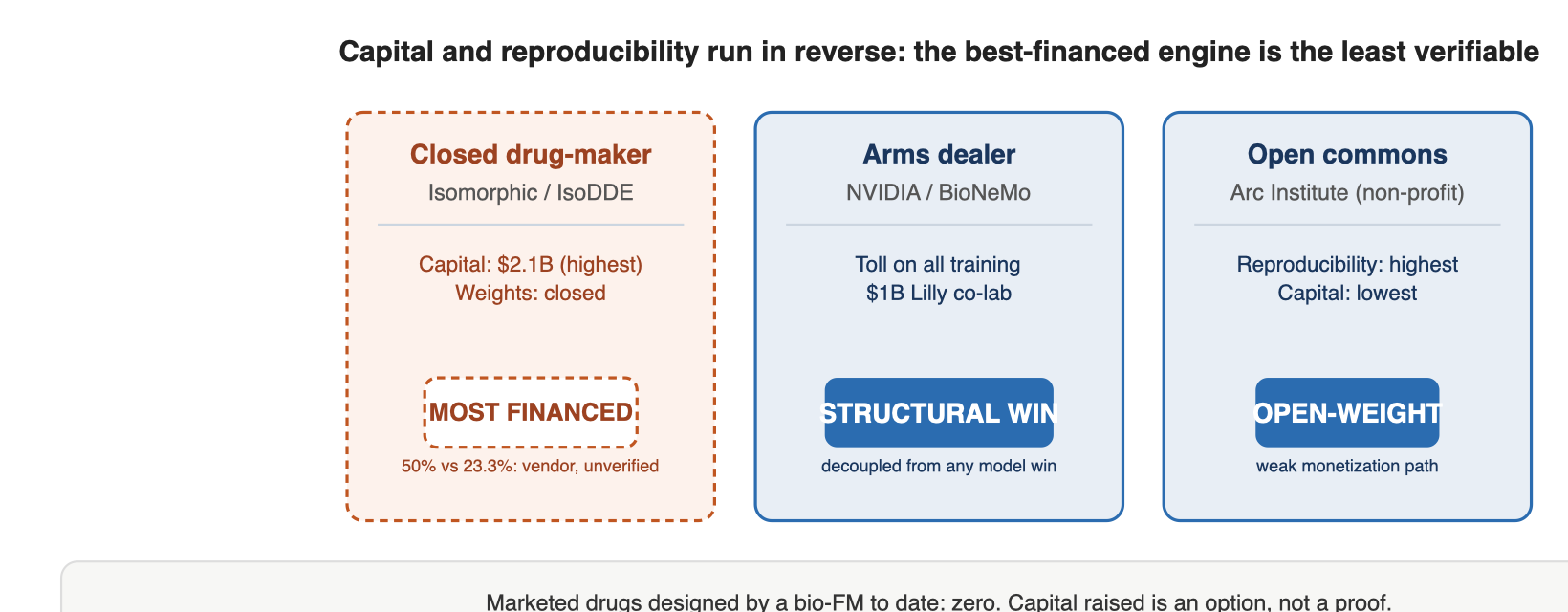
| Layer | Example | Capital | Reproducibility |
|---|---|---|---|
| Closed integrated drug-maker | Isomorphic / IsoDDE | Highest ($2.1B) | Lowest (closed weights) |
| Arms dealer (platform) | NVIDIA / BioNeMo | Toll, decoupled | N/A (infrastructure) |
| Open-weight commons | Arc / Evo2, STATE | Lowest (non-profit) | Highest (open data) |
What not to misread
A raise is not a readout. IsoDDE’s “double AF3” figure is a self-reported vendor number aimed precisely at the memorization critique the firm flagged in earlier parts — if it were independently reproduced under leakage-controlled benchmarks it would be a strong counter-example, but it has not been, and we do not headline it. And “open wins” is not what the money says: the capital flows toward closure while reproducibility stays with the non-profit commons.
Deep dive
1. Background — capital placed on top of uneven evidence
The through-line of the bio-foundation-models series has been a single testable question: does a bio-FM actually beat a domain-specific baseline? Part 5 overlays the commercial angle. The one-sentence thesis: capital is deployed on top of the headline “we beat the baseline,” but the evidence the firm confirmed in Part 0 differs by axis (partial Yes for protein, partial Yes for genome, No for cell), and the commercial frontier (IsoDDE) has itself redefined the real test — not benchmark scores, but generalization to novel targets unlike the training set, and translation into the wet lab and clinic. Neither has yet been completed on any axis. This part decomposes the option into hype and evidence; clinical readouts belong to a separate series (AI-designed drugs), so only the model/platform/capital angle is treated here.
2. What this synthesis newly established
A three-vote adversarial fan-out (2026-07-12) closed at 12 confirmed / 6 unverified-vendor / 1 needs-followup. Confirmed items (cross-checked against primary press/newsroom/primary sources):
- Capital events (CONFIRMED): Isomorphic $600M (2025-03) and $2.1B Series B (2026-05-12, investor list including Thrive, Alphabet, GV, MGX, Temasek, CapitalG, UK Sovereign AI Fund); EvolutionaryScale $142M seed (2024-06); Lilly–NVIDIA up to $1B co-innovation AI lab; Recursion–Exscientia merger (JPM 2025).
- Model/licensing facts (CONFIRMED): ESM3-open under a non-commercial license; Arc Evo2/STATE open-weight and open-data (Tahoe-100M released); NVIDIA BioNeMo Recipes (2026-01-12); Recursion hosting on BioNeMo.
- Held as vendor / forward-looking (UNVERIFIED): IsoDDE “50% vs 23.3% in the <20% similarity cohort” and “exceeds gold-standard physics”; Isomorphic first-in-human target of end-2026; Recursion $1.1B deal value and ~18% R&D-cost reduction (company-attributed); STATE +50% and ESM3 “1 trillion teraflops” phrasing (Part 0 carry).
- Needs follow-up: EvolutionaryScale’s apparent 2025 absorption into Chan Zuckerberg Biohub with a research-oriented pivot — a single search hit, described only as a circumstantial signal, not fabricated.
3. Strengths and limits of the method
Strengths — capital and deal figures were cross-checked against first-party press and newsrooms and separated by tier from performance claims; open-weight vs. closed-commercial framing is grounded in license facts. Limits — (a) vendor performance claims (IsoDDE) and forward-looking dates (first-in-human) are isolated and unverified; (b) the “arms-dealer stability” claim is structural inference, not a performance measurement; (c) one item (EvolutionaryScale absorption) rests on a single source and is graded medium confidence; (d) compute scale is not evidence — Part 0’s finding that Evo2’s 40B gives little gain over 7B shows that more compute does not automatically translate into performance.
[Skeptic mandatory caveat, inherited] IsoDDE’s “roughly double AF3 accuracy (<20% similarity cohort)” is a non-peer-reviewed vendor technical report and must not be headlined before independent reproduction. Capital raised is an option, not a completed proof — it must not be equated with demonstrated efficacy, and no listed-equity implication should be read into these figures.
4. Neighbouring domains
To the computing series: bio-FMs are a new axis of compute demand (ESM3 >1×10²⁴ FLOPS, Evo2 40B params over 9.3T nucleotides, the Lilly–NVIDIA lab). The arms-dealer position is structurally stable precisely because the computing series’ “real bottleneck — memory, interconnect, power” is inherited here: whichever model wins, training still runs on GPUs. But compute scale is not scientific advantage. To therapeutic translation: no bio-FM-designed drug is yet marketed. As a completed-translation benchmark, the firm’s own verified GLP-1 / finerenone work sits at the last rung of the ladder (hard endpoints — FLOW all-cause mortality −20%, KDIGO 2026 Level 1A), whereas bio-FMs sit at the first rung (target/structure in silico). The cardio-renal-metabolic (CKM) transfer is left unverified and not fabricated, since the cell axis still fails to beat a linear baseline. To convergence signal L-S01 (“treat AI as a hypothesis generator, not a predictor”): IsoDDE’s self-description — identifying novel binding pockets from sequence alone — is a textbook hypothesis-generator frame, strengthening L-S01 by one grounded instance while remaining speculative.
5. Commercialization and market context (as structural map)
- Isomorphic Labs (private, Alphabet-affiliated): $2.1B Series B (2026-05), closed commercial IsoDDE, value captured in the therapeutic asset; first-in-human target end-2026 (forward-looking, unverified).
- NVIDIA (NVDA): BioNeMo platform and BioNeMo Recipes; arms-dealer position decoupled from any single model’s win; up to $1B Lilly co-innovation lab; prior Recursion stake ($50M, 2023, Part 0 carry).
- EvolutionaryScale (private): $142M seed (2024-06); ESM3 as open 1.4B plus a commercial API; apparent 2025 absorption into CZ Biohub (medium confidence, single source).
- Recursion (RXRX): Exscientia merger (JPM 2025), ~120 AI-led programs; Phenom-1 phenomics FM over 5+ PB of imaging; $1.1B deal value and ~18% R&D reduction are company/analyst-attributed.
- Arc Institute / CZI (non-profit): Evo2/STATE open-weight and open-data, NVIDIA collaboration; the highest-reproducibility layer, with the weakest direct monetization path.
(The company references above are factual statements of position on a structural map, not a recommendation to buy or sell any security.)
6. The opposing view (skeptic block, quoted)
The core of the source asset’s §6 skeptic gate holds three items on HOLD:
“(1) Headlining IsoDDE’s ‘double AF3’ vendor claim — withhold until independent peer review. (2) ‘The virtual cell beats the baseline’ — the Part 0 refutation still stands. (3) The completed narrative that ‘AI designed a drug’ — marketed drugs to date: zero.”
The deepest structural skeptic signal is that capital and evidence run in reverse: the largest pool of capital sits behind the most closed engine, while the highest reproducibility sits with a non-profit — so the “open wins” narrative and the money flow disagree.
7. What to watch (falsifiable predictions from the source asset)
- IsoDDE’s “50% in the low-similarity cohort” advantage shrinks significantly when reproduced on an independent, leakage-controlled benchmark (FoldBench-style). Falsified by third-party reproduction / peer review; if confirmed, the memorization critique holds even at the commercial frontier.
- Among bio-FM-derived candidates, zero pass a Phase 2 efficacy readout on a hard endpoint within 24 months. Falsifiable via Isomorphic / Recursion pipeline disclosures.
- Pure open-weight bio-FM commercial firms converge on non-profit absorption or arms-dealer dependence within 18 months absent a new $100M+ round under a for-profit structure. Falsifiable by market events (generalizing the EvolutionaryScale → CZ Biohub signal).
References
(Inherited from the source asset’s sources field. URLs are reproduced as provided; where a first-party primary link was not provided, the item is labeled by source name and context and not fabricated.)
- PR Newswire. 2026-05-12. “Isomorphic Labs Secures $2.1 Billion Funding to Scale Its AI Drug Design Engine.” prnewswire.com/news-releases/isomorphic-labs-secures-2-1-billion-funding-to-scale-its-ai-drug-design-engine-302769674.html
- Fierce Biotech. 2026-05. “Alphabet’s AI biotech Isomorphic Labs bags $2.1B Series B.” fiercebiotech.com/biotech/alphabets-ai-biotech-isomorphic-labs-bags-21b-series-b
- PR Newswire; TechCrunch. 2025-03-31. Isomorphic Labs $600M first external round.
- Isomorphic Labs. 2026-02-10. “The Isomorphic Labs Drug Design Engine unlocks a new frontier” (IsoDDE technical report; vendor, non-peer-reviewed). isomorphiclabs.com/articles/the-isomorphic-labs-drug-design-engine-unlocks-a-new-frontier
- NVIDIA Newsroom. 2026-01-12. “NVIDIA BioNeMo platform adopted by life sciences leaders.” nvidianews.nvidia.com/news/nvidia-bionemo-platform-adopted-by-life-sciences-leaders
- TechCrunch. 2024-06-25. EvolutionaryScale $142M seed.
- EvolutionaryScale. ESM3 license (open, non-commercial). github.com/evolutionaryscale/esm/blob/main/LICENSE.md
- Bio-IT World. 2025-02-04. Recursion × Exscientia merger (JPM 2025). bio-itworld.com/news/2025/02/04
- SEC. Recursion (RXRX) 10-K FY2025. sec.gov
- Arc Institute. Evo2 / STATE (open-weight / open-data, Tahoe-100M). arcinstitute.org
- Nature Methods. 2025. Deep-learning perturbation models underperform a linear baseline (cell axis, primary).
- Series spine: part0-landscape.md; convergence-ledger L-S01.
Disclosure
This post is for information only and is not investment advice. The author holds no position and no financial interest in the companies mentioned (Alphabet, NVIDIA, Recursion, Eli Lilly, Novartis, and the private companies Isomorphic Labs, EvolutionaryScale, Arc Institute).
COI note. This post describes listed and private AI-bio companies and vendor technical reports factually and neutrally, with no easing or advocacy language. Capital and deal figures are attributed to primary press/newsroom sources; performance and forward-looking claims (IsoDDE accuracy, first-in-human timing, deal values) are isolated as vendor or company claims and labeled unverified. No superiority implication for any security is intended.
 Uthando Nethemba
Leave a comment