Evidence-first notes on bioscience and medical affairs, at the edge of the clinic and the market. Information only — not investment advice, not medical advice.
The 30-second version
- What. Part 1 identified the largest gap in the US CKM standard as the absence of the liver. The European/global axis attacks exactly that gap: the EAS SMD (Systemic Metabolic Disorder, EAS 2025) consensus explicitly enrolls the liver (MASH) into its staging (Stage 2), and the EASL-led MASLD renaming (2023) redefines fatty liver as a member of the “metabolic continuum.” But the European axis is not a single frame — it is a society-by-society dispersion across EAS (SMD), EASL (MASLD), ESC/EASD (diabetes-CVD) and KDIGO (kidney), running in parallel rather than under one umbrella.
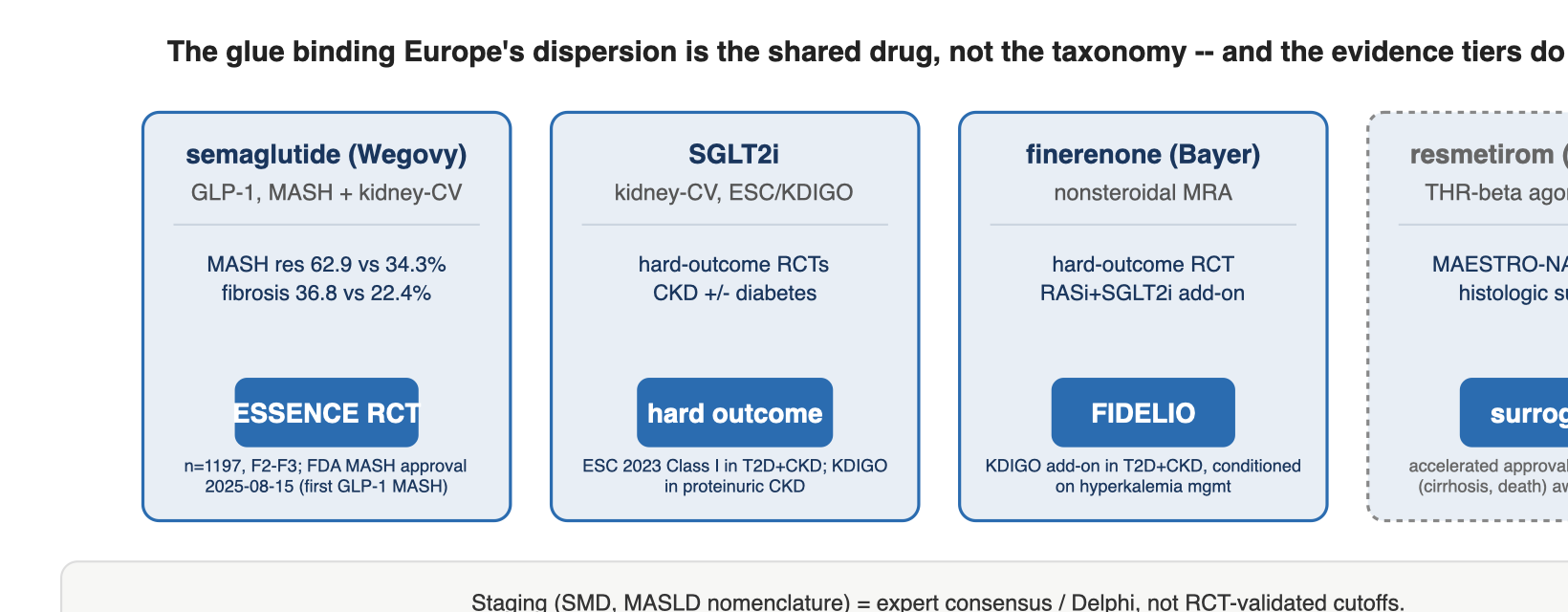
- So what. If the US integrates top-down through one definition (the CKM umbrella), the European/global axis is integrated bottom-up through shared drugs: the practical glue is not the taxonomy but the same medicines — resmetirom, semaglutide, SGLT2i and finerenone — crossing society boundaries to treat the same patient. Two 2025 regulatory events made the liver a real battleground: resmetirom received EMA/EC conditional marketing authorization (2025-08-19), the first MASH drug in the EU, and the FDA approved semaglutide (Wegovy) for MASH with fibrosis (2025-08-15), the first GLP-1 MASH approval.
- Now what. Do not merge the evidence tiers. Staging definitions (SMD, MASLD nomenclature) = expert consensus / Delphi, not RCT-validated cutoffs; drug efficacy splits by tier — semaglutide MASH (ESSENCE, RCT histology) and SGLT2i/GLP-1 kidney-CV (hard-outcome RCTs) are strong, but resmetirom rests on a histologic surrogate under accelerated approval, with hard outcomes pending 54-month data. Also note: whether the EMA has absorbed the EAS SMD staging system into regulatory taxonomy is unverified — EMA labels operate at the disease-unit level (MASH, T2D+CKD, obesity), and SMD remains a society-consensus layer.
The five-minute read
Attacking the gap — putting the liver into the staging
Part 1 pinned the largest gap in the US CKM standard as the absence of the liver: while the AHA CKM frame converged four societies (AHA, ACC, ADA, ASN), it did not enroll liver biomarkers (FIB-4, hepatic fibrosis) into its Stage 0–4 staging. The European/global axis attacks precisely this. The EAS SMD (Systemic Metabolic Disorder, 2025) consensus places MASH explicitly in staging (Stage 2), and the EASL-led MASLD renaming (2023) changes the very definition of fatty liver into a “metabolic continuum,” promoting the liver to a full member of metabolic disease.
But the European axis is a dispersion, not a single umbrella
Unlike the US single roof, the European/global axis is a society-by-society system: the liver belongs to EAS and EASL, the kidney to KDIGO, and diabetes-CVD to ESC and EASD. Where the US converged on “one guideline (2026 AHA/ACC/ADA/ASN),” Europe/global is “several consensuses in parallel.” So the real question is not “does Europe have an integrated frame to answer CKM,” but “what actually binds this dispersion into one” — and the answer of this Part is that the glue is not the taxonomy but the same drugs (resmetirom, semaglutide, SGLT2i, finerenone).
| Stage | Definition | Where the liver enters |
|---|---|---|
| Stage 1 | Metabolic abnormality without organ damage — dysfunctional adiposity, dyslipidemia, insulin resistance, hypertension | Hepatic steatosis = marker of early ectopic fat |
| Stage 2 | Early organ damage — T2D, subclinical diastolic dysfunction, MASH, CKD | MASH named as a formal staging event of early organ damage |
| Stage 3 | Advanced multi-organ damage — heart failure, cirrhosis/liver failure, CKD progression, ASCVD | Cirrhosis / liver failure = end-organ damage |
Pathophysiologic starting point (the core diff vs CKM): SMD begins staging not from “risk factors” but from a mechanism — sustained positive energy balance → ectopic fat in liver, heart, muscle, pancreas, kidney → insulin resistance and systemic inflammation. The liver is named as the first storage organ of that ectopic fat, so steatosis → MASH falls naturally into the staging.
Do not mix the evidence tiers
Layers of differing evidential strength coexist. Staging definitions (SMD, MASLD nomenclature) are expert consensus / Delphi — not RCT-validated diagnostic cutoffs. Drug efficacy splits by tier: semaglutide MASH (ESSENCE, RCT histologic endpoints) and SGLT2i/GLP-1 kidney-CV (hard-outcome RCTs) are strong evidence, but resmetirom is an accelerated approval on a histologic surrogate — hard outcomes (cardiovascular, cirrhosis, death) await 54-month data. Do not conflate “the liver was put into the staging” with “liver treatment changes hard outcomes.”
Deep dive
1. Background — the European axis attacks the liver gap, but is itself not a single frame
Part 1 specified the largest gap in the US CKM standard as the absence of the liver. The observation of Part 2 is double. First (the attack): the European/global axis attacks exactly this gap. EAS SMD explicitly enrolls MASH into Stage 2, and the EASL-led MASLD renaming changes the definition of fatty liver itself into a “metabolic continuum,” promoting the liver to a formal member of metabolic disease. Second (but dispersed): the European axis is not a single umbrella like US CKM. The liver belongs to EAS and EASL, the kidney to KDIGO, and diabetes-CVD to ESC and EASD — a society-by-society system. The US converged on one guideline; Europe/global remains several consensuses in parallel.
2. What this development newly establishes — EAS SMD staging and EASL MASLD nomenclature
Primary document (SMD): “Clinical staging to guide management of metabolic disorders and their sequelae: a European Atherosclerosis Society consensus statement.” European Heart Journal 2025;46(38):3685–3713. DOI 10.1093/eurheartj/ehaf314 (online 2025-05-07). Co-chairs: Stefano Romeo, Antonio Vidal-Puig, Mansoor Husain (PMC12500331).
The decisive diff versus CKM is the status of the liver. CKM Stage 1 starts from “adipose-tissue dysfunction” and SMD Stage 1 from “ectopic fat” — superficially similar. But in CKM the liver is not a staging marker, whereas in SMD the liver has its own progression axis inside the staging: steatosis (Stage 1) → MASH (Stage 2) → cirrhosis (Stage 3). SMD is essentially the structure “CKM + a liver axis,” and the staging design itself shows the European axis staking its differentiation from the US on the liver.
Primary document (MASLD nomenclature): Rinella ME, et al. “A multisociety Delphi consensus statement on new fatty liver disease nomenclature.” Journal of Hepatology 2023 (S0168-8278(23)00418-X). Led by AASLD, EASL and ALEH. It creates the superordinate term SLD (steatotic liver disease), replaces NAFLD with MASLD and NASH with MASH, and adds the alcohol-overlap category MetALD.
The heart of the taxonomy — from “exclusion” to “metabolic.” NAFLD was defined by the exclusion of other liver diseases — a passive, residual category. MASLD inverts that into a positive definition: “hepatic steatosis + at least one cardiometabolic risk factor.” This inversion relocates the liver from “fatty liver of unknown cause” to the “hepatic manifestation of metabolic disease,” enrolling it as a formal member of the metabolic continuum.
The five cardiometabolic criteria of MASLD (adult thresholds; at least one required):
- BMI ≥25 kg/m² or waist circumference >94 cm (men) / >80 cm (women), ethnicity-adjusted; or overweight/obesity.
- Fasting glucose ≥5.6 mmol/L (100 mg/dL), or 2-hour post-load ≥7.8 mmol/L, or HbA1c ≥5.7%, or T2D (including treated).
- Blood pressure ≥130/85 mmHg or antihypertensive treatment.
- Triglycerides ≥1.70 mmol/L (150 mg/dL) or lipid-lowering treatment.
- HDL-C ≤1.0 mmol/L (40 mg/dL, men) / ≤1.3 mmol/L (50 mg/dL, women) or lipid-lowering treatment.
These five criteria are essentially the same item set as the CKM risk factors and the SMD Stage 1 criteria — the three taxonomies (CKM, SMD, MASLD) differ only in where they place the liver on the same cardiometabolic axis. The follow-on management guidance, the EASL–EASD–EASO MASLD CPG (J Hepatol 2024, S0168-8278(24)00329-5), notably has EASD (diabetes) and EASO (obesity) co-authoring with EASL (liver) — the liver society did not act alone, but pulled in the metabolic and obesity societies to frame “the liver as metabolic disease.” It places FIB-4 and imaging-based non-invasive risk stratification as the first gate.
3. Methodological strengths and limits — the drugs that made the liver a “treatable stage”
A definition alone does not open a market. Two drugs attached hard data to the MASLD/SMD frame in 2024–2025, and the liver became a real battleground.
- resmetirom (Rezdiffra, Madrigal) — a THR-β (thyroid hormone receptor-β) agonist. FDA 2024-03-14, the first approved drug for non-cirrhotic MASH F2–F3. Evidence: MAESTRO-NASH phase 3 (n=966, F1B–F3), meeting both primary endpoints (MASH resolution, fibrosis improvement). Crucially, this is an accelerated approval based on a histologic surrogate — not a clinical outcome — with a 54-month outcome dataset expected to convert it to full approval.
- resmetirom EMA pathway (the key evidence of European regulatory absorption) — CHMP positive opinion 2025-06-20 → European Commission conditional marketing authorization 2025-08-19, the first and only MASH treatment in the EU, valid across 27 member states plus Iceland, Liechtenstein and Norway, with a phased launch from Germany in Q4 2025. That the EMA/EC adopted the term “MASH” in the label is direct evidence that European regulation has absorbed the EASL MASLD nomenclature.
- semaglutide (Wegovy, Novo Nordisk) — ESSENCE (NEJM 2025-04-30, n=1197, F2–F3): MASH resolution 62.9% vs placebo 34.3%, fibrosis improvement 36.8% vs 22.4% → FDA approved semaglutide for MASH with fibrosis on 2025-08-15, the first GLP-1 MASH approval. On one liver stage, a “liver-targeted drug” (resmetirom) and a “systemic metabolic drug” (GLP-1) now compete head to head.
The surrogate trap. Much of the evidence enrolling the liver into MASLD/SMD staging rests on histologic and biomarker surrogates. Whether surrogate improvement translates into clinical outcomes (liver transplant, liver cancer, death) is unresolved — the long-term outcome data for both resmetirom and semaglutide will retrospectively validate (or not) the legitimacy of the taxonomy.
4. Neighbouring domains — the kidney/CVD axis, where the US and Europe converge
If the liver belongs to EAS and EASL, the kidney and CVD axis is shared by ESC, EASD and KDIGO — and here the US and Europe/global converge.
- ESC 2023 (diabetes-CVD): “2023 ESC Guidelines for the management of cardiovascular disease in patients with diabetes.” It introduces SCORE2-Diabetes, combining traditional risk factors (age, smoking, SBP, total/HDL-C) with diabetes-specific variables (age at diagnosis, HbA1c, eGFR) — the same design philosophy as US PREVENT, which embeds the kidney (eGFR) into the CV risk engine. It gives a Class I recommendation for GLP-1RA/SGLT2i independent of glucose control to reduce CV risk in diabetes plus ASCVD, and recommends SGLT2i (canagliflozin, empagliflozin, dapagliflozin) in T2D+CKD (eGFR ≥20) to reduce CVD and kidney-failure risk.
- KDIGO 2024 CKD guideline + 2025 focused update (the global kidney standard): recommends SGLT2i in proteinuric CKD regardless of diabetes status; positions finerenone (nonsteroidal MRA, Bayer) as an add-on to RASi + SGLT2i in T2D+CKD, conditioned on hyperkalemia management (normokalemic selection, monitoring). The 2025 focused update (in progress) re-examines the evidence for SGLT2i, GLP-1 and nonsteroidal MRA in non-diabetic CKD — the kidney axis expanding from “a subset of diabetes” toward an independent metabolic organ. (Final document unverified.)
Both ESC and KDIGO absorb the kidney (eGFR, UACR) into CV/metabolic risk stratification, the same direction as US PREVENT and CKM. So on the kidney axis the US and Europe/global converge; the only axis that diverges is the liver — that is the real boundary between the two.
5. Commercialization and market context (TRL, companies)
The taxonomy can function as normative infrastructure that assigns specific drug classes a “place to be sold” (a stage). Related listed pharma (facts, neutral): MASH — Madrigal (resmetirom), Novo Nordisk (semaglutide); GLP-1 class — Novo Nordisk, Eli Lilly; SGLT2i — AstraZeneca, Boehringer Ingelheim; nonsteroidal MRA finerenone — Bayer. But two things must be separated.
- Drug evidence tiers differ: SGLT2i, GLP-1 and finerenone are approved medicines validated by hard-outcome RCTs (SELECT, FLOW, FIDELIO and others), and semaglutide MASH rests on an RCT histologic endpoint (ESSENCE). But resmetirom is an accelerated approval on a histologic surrogate (per Madrigal IR and the MAESTRO-NASH publication) — its hard outcomes (cirrhosis, liver-related death) await the 54-month dataset (≤2028).
- Regulatory absorption of the taxonomy: what is confirmed is that the EMA/EC approved resmetirom under the term “MASH” (conditional MA, 2025-08), i.e., the EASL MASLD/MASH nomenclature was absorbed into the label wording. What is unverified is any adoption of the EAS “SMD” staging system itself into a regulatory taxonomy — no evidence for that was confirmed in this pass. SMD remains a society-consensus layer, and EMA labels operate at the disease-unit level (MASH, T2D+CKD, obesity).
Attribution of quantitative claims: the ESSENCE percentages, MAESTRO-NASH sample sizes and approval dates above are attributed to peer-reviewed publications (NEJM, J Hepatol), company IR (Madrigal, Novo Nordisk) and regulatory statements — not to manufacturer marketing figures. Quantitative claims are attributed to “vendor / author / preprint” where applicable.
6. The skeptic’s bottom line
This section inherits the skeptic gate of the source deep-dive.
- The weakness of fragmentation: the European/global axis lacks the single governance of US CKM. EAS SMD, EASL MASLD, ESC and KDIGO each name and stage the same pathophysiology — for the clinician, “one patient, multiple staging tables (SMD Stage 2 = MASLD = KDIGO G3a = ESC high-risk)” poses a structural risk of coding and reimbursement confusion. The taxonomy inflation flagged earlier deepens on the European axis.
- Evidence-tier separation (applied strictly): staging definitions (SMD, MASLD nomenclature) are expert consensus/Delphi, not RCT-validated cutoffs. Drug efficacy splits: semaglutide MASH (ESSENCE, RCT histology) and SGLT2i/GLP-1 kidney-CV (hard-outcome RCTs) are strong, but resmetirom is an accelerated approval on a histologic surrogate — hard outcomes pending 54-month data. Do not conflate “the liver was put into the staging” with “liver treatment changes hard outcomes.”
- Commercial conflict of interest: that the MASLD renaming (2023), the EASL-EASD-EASO CPG (2024) and the resmetirom/semaglutide approvals (2024–25) chained within three years means scientific maturation and market opening occurred simultaneously. The temporal alignment of naming, staging and approval is itself a boundary case for conflict-of-interest scrutiny (sponsorship and author industry relationships require checking against the primary COI disclosures).
- Verdict: this inherits the source part’s skeptic verdict of proceed-with-caveats (conditional). The basis: (1) with 13 core documents/figures confirmed, the factual skeleton is solid, but (2) staging = consensus while drug efficacy splits by tier (especially the resmetirom surrogate), the coding risk of European dispersion, and the EMA’s non-adoption of SMD (unverified) must be stated explicitly, and (3) listed-pharma implications (Madrigal, Novo, Bayer, AstraZeneca, Boehringer) keep the escalation standing. It is neither a hold (no factual error/fabrication) nor verified-clean (two unverified items, a surrogate warning and a standing escalation remain).
7. What to watch (falsifiable predictions)
- The European axis’s “drug integration” advantage: without a single guideline umbrella, Europe/global will likely form a de-facto integrated treatment pathway through shared drugs (GLP-1, SGLT2i, resmetirom, finerenone) crossing society boundaries. Falsification: if EAS SMD (or a similar single frame) is elevated into a superordinate guideline integrating ESC, EASL and KDIGO (top-down integration), the thesis “dispersion is bound by the glue of drugs” is partly rejected.
- Backflow of liver enrollment into US CKM: the pressure from the semaglutide MASH approval (2025-08) and resmetirom’s spread may push the next CKM revision (≤2029) to enroll FIB-4 / hepatic fibrosis into staging, converging the US and European axes on the liver. If not, the liver stays fixed as the proprietary territory of the European SMD/EASL axis.
- Hard-outcome validation of the resmetirom surrogate: if MAESTRO-NASH 54-month (≤2028) outcomes demonstrate reductions in cirrhosis / liver-related death, the clinical legitimacy of the MASLD taxonomy is retrospectively established. If not (surrogate improvement fails to convert into outcomes), the evidential strength of the entire “liver enrollment” taxonomy is downgraded — surrogate risk transfers into frame risk.
References
- Marx, Nikolaus, et al. (EAS consensus). 2025. “Clinical staging to guide management of metabolic disorders and their sequelae: a European Atherosclerosis Society consensus statement.” European Heart Journal 46 (38): 3685–3713. DOI 10.1093/eurheartj/ehaf314. https://academic.oup.com/eurheartj/article/46/38/3685/8125503 · https://pmc.ncbi.nlm.nih.gov/articles/PMC12500331/
- Rinella, Mary E., et al. 2023. “A multisociety Delphi consensus statement on new fatty liver disease nomenclature.” Journal of Hepatology (S0168-8278(23)00418-X). https://www.journal-of-hepatology.eu/article/S0168-8278(23)00418-X/fulltext
- European Association for the Study of the Liver / EASD / EASO. 2024. “EASL–EASD–EASO Clinical Practice Guidelines on the management of metabolic dysfunction-associated steatotic liver disease (MASLD).” Journal of Hepatology (S0168-8278(24)00329-5). https://www.journal-of-hepatology.eu/article/S0168-8278(24)00329-5/fulltext
- Madrigal Pharmaceuticals. 2024. “Madrigal Pharmaceuticals Announces FDA Approval of Rezdiffra (resmetirom).” https://ir.madrigalpharma.com/news-releases/news-release-details/madrigal-pharmaceuticals-announces-fda-approval-rezdiffratm
- Madrigal Pharmaceuticals. 2025. “Madrigal Receives European Commission Approval of Rezdiffra (resmetirom).” (Conditional marketing authorization, 2025-08-19.) https://ir.madrigalpharma.com/news-releases/news-release-details/madrigal-receives-european-commission-approval-rezdiffratm
- Newsome, Philip N., et al. (ESSENCE). 2025. “Semaglutide in Metabolic Dysfunction-Associated Steatohepatitis.” New England Journal of Medicine (published online 2025-04-30). DOI 10.1056/NEJMoa2413258. https://www.nejm.org/doi/10.1056/NEJMoa2413258
- AJMC. 2025. “FDA Approves Semaglutide for MASH With Fibrosis.” (First GLP-1 MASH approval, 2025-08-15.) https://www.ajmc.com/view/fda-approves-semaglutide-for-mash-with-fibrosis
- KDIGO. 2024. “KDIGO 2024 Clinical Practice Guideline for the Evaluation and Management of Chronic Kidney Disease.” https://kdigo.org/wp-content/uploads/2024/03/KDIGO-2024-CKD-Guideline.pdf · 2025 focused update announcement: https://kdigo.org/kdigo-announces-update-to-2024-ckd-guideline/
- European Society of Cardiology. 2023. “2023 ESC Guidelines for the management of cardiovascular disease in patients with diabetes.” https://www.escardio.org/Congresses-Events/ESC-Congress/Congress-resources/Congress-news/2023-esc-clinical-practice-guidelines-for-the-management-of-cardiovascular-disease-in-patients-with-diabetes
Unverified items (paywalled primary text / independent confirmation failed): (A) EMA/EC adoption of the EAS SMD staging system into regulatory taxonomy — no evidence in this pass; SMD remains a society-consensus layer; (B) EAS SMD guideline elevation and real-world clinical adoption rate; (C) KDIGO 2025 focused-update final document for non-diabetic CKD.
Disclosure
This post is for information and knowledge-asset purposes only. It is not investment advice and not medical advice. The author holds no position in the named securities. COI note (inherited from the source analysis frontmatter coi): descriptions of the societies named (EAS, EASL, EASD, EASO, ESC, KDIGO), the regulators (EMA, EC, FDA), and the listed pharma (Madrigal for resmetirom; Novo Nordisk for semaglutide; Eli Lilly in the GLP-1 class; AstraZeneca, Boehringer Ingelheim for SGLT2i; Bayer for finerenone) are stated as facts and neutrally, with no mitigating or advocacy language. Industry sponsorship of the SMD/MASLD consensus and CPG committees, and individual-author conflicts, must be checked separately against the primary disclosures. Quantitative claims (ESSENCE and MAESTRO-NASH figures, approval dates) are attributed to peer-reviewed publications, company IR and regulatory statements — not to manufacturer marketing figures.


Leave a Reply