Evidence-first notes on bioscience and medical affairs, at the edge of the clinic and the market. Information only — not investment advice, not medical advice.
The 30-second version
- What. Reading the actual approved labels of the CKM/SMD-defining drug classes — GLP-1 (semaglutide, tirzepatide), SGLT2i (empagliflozin, dapagliflozin), the first MASH drug resmetirom, and finerenone — against their primary FDA/EMA regulatory documents. The single hardest finding: no FDA or EMA label uses the words “CKM” or “SMD” in its indication. Every label is still written in disease/outcome units (obesity + MACE, T2D + CKD, noncirrhotic MASH F2–F3, HF with LVEF ≥40%). Labels, approval dates and quoted phrases are attributed to primary regulatory documents (≤150-char quotes).
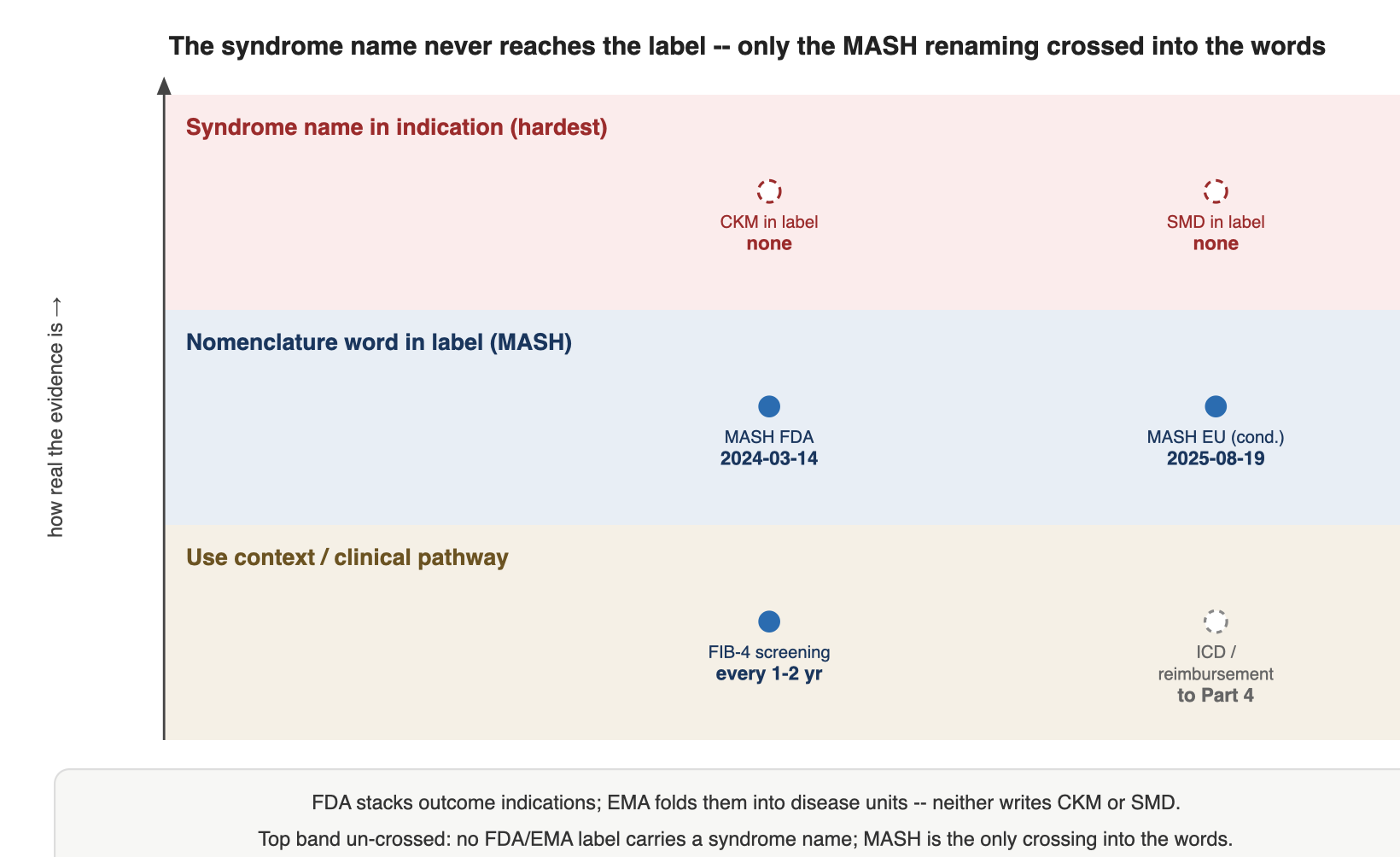
- So what. Definition-setting power therefore does not write the label directly — it governs the label’s use context (which specialty prescribes which drug at which disease stage). There is exactly one exception: the nomenclature layer. The 2023 MASLD/MASH renaming penetrated the label text itself — resmetirom is labeled “MASH,” not “NASH,” on both sides of the Atlantic. The syndrome layer (CKM/SMD) reaches only the use-context; the nomenclature layer (MASH) reaches the words. Taxonomy penetration is layer-dependent in depth.
- Now what. Two structural differences to watch. FDA stacks outcomes (it adds CV and kidney as separate, individual indications); EMA folds them into disease units (it absorbs the same evidence into an existing indication rather than creating a new one — e.g., Wegovy’s CV use in the EU). And a Part 1 correction: this pass partially refines the earlier claim that the US CKM frame has “no liver” — the liver is still absent from the syndrome name and staging axis, but the 2026 CKM guideline does fold MASLD in at the screening layer via FIB-4. Absent from the definition, present in the pathway.
The five-minute read
Labels do not “write” the taxonomy — they fix its use context
An earlier part of this series left one proposition unverified: that regulatory labels still operate in disease units, and that supra-taxonomies like CKM/SMD govern not the words on a label but its use. This part settles that proposition against the primary documents. The result is unambiguous in one direction: every label examined is trial-driven and written in a disease-or-outcome unit (established CVD + MACE reduction; T2D + kidney protection; noncirrhotic MASH with fibrosis; HF across an ejection-fraction band). Labels are a function of the RCT enrolment population and the primary outcome — not of the syndrome taxonomy sitting above them. What the taxonomy does is decide who picks a given label up, and at which stage.
One exception — the nomenclature layer went all the way to the words
The single case where taxonomy rewrote label text is resmetirom. The FDA accelerated approval (2024-03-14) reads (≤150 chars): “for the treatment of adults with noncirrhotic MASH with moderate to advanced liver fibrosis.” The word is MASH, not NASH — the 2023 MASLD/MASH Delphi renaming was adopted directly into the regulatory label, and then into the EU label too (EC conditional approval, 2025-08-19, “noncirrhotic MASH”). The syndrome layer (CKM/SMD) never entered a label; the nomenclature layer (MASLD/MASH) did. This is the sharpest observation of the pass: taxonomic penetration of labels begins with renaming, not with syndrome architecture.
FDA stacks, EMA folds
The clearest regulator-to-regulator contrast is Wegovy. The FDA added a separate MACE-reduction indication (2024-03-08) on top of obesity. The EMA/CHMP reviewed the same SELECT evidence but did not create a standalone CV indication — it judged CV use already contained within the existing weight-management indication. FDA = outcome-unit stacking; EMA = disease-unit folding. The FDA label architecture therefore carries the multi-organ CKM frame closer to the surface (as label line-items), while the EMA folds it below the surface, where taxonomy leaves fewer visible traces.
| Molecule (brand) | FDA — outcome stacking | EMA — disease folding |
|---|---|---|
| semaglutide 2.4 (Wegovy) | obesity + separate MACE-reduction indication (2024-03) | no separate CV indication; CV use folded into weight management (BMI ≥27) |
| semaglutide 1.0 (Ozempic) | T2D + separate CKD/kidney-protection indication (2025-01) | T2D-based (kidney extension not cross-checked — unverified) |
| finerenone (Kerendia) | CKD-in-T2D (2021) + HF LVEF ≥40% (2025-07); outcomes enumerated (eGFR, ESKD, CV death…) | compressed to a disease entity: “CKD (with albuminuria) associated with T2D” + HF LVEF ≥40% |
| resmetirom (Rezdiffra) | noncirrhotic MASH F2–F3 (2024-03) | noncirrhotic MASH, conditional (2025-08) |
The one thing that crosses both columns intact: the MASH nomenclature — the syndrome names (CKM/SMD) never appear.
Deep dive
1. Background — the proposition carried forward from Part 0
An earlier part of this series posited that “definition-setting power does not write the label; it governs the label’s use,” and left it unverified. This part tests it by contrasting the actual FDA and EMA label phrasing of the CKM/SMD-relevant drug classes against primary regulatory documents and first-party press releases. Three conclusions frame the pass. (1) No FDA or EMA label uses the syndrome name “CKM” or “SMD” in its indication — all remain in disease/outcome units. (2) The nomenclature-layer taxonomy MASLD/MASH (2023 Delphi) did penetrate the label, in resmetirom, on both sides. (3) The FDA stacks outcome-specific indications individually, while the EMA folds the same evidence into existing disease indications — a structural difference that opens the regulators differently to a CKM-style multi-organ frame.
2. What this pass newly establishes — the label phrasing, drug by drug
GLP-1 — semaglutide’s three faces (obesity, CV, kidney). Wegovy (semaglutide 2.4 mg) added a CV indication on 2024-03-08 (≤150 chars, FDA label / Novo press release): “…to reduce the risk of major adverse CV events…in adults with established CV disease and either obesity or overweight.” The evidence is SELECT (N=17,604; non-diabetic obesity/overweight with prior heart disease): primary composite MACE 6.5% vs 8.0%, relative risk reduction 20%, absolute risk reduction 1.5% at 40 months. Separately, Ozempic (semaglutide 1.0 mg) added a kidney indication on 2025-01-28, per FLOW (N=3,533): a 24% relative risk reduction on the kidney-plus-CV-death composite — described by the manufacturer as the first GLP-1 receptor agonist to receive a kidney-protection indication. Frame observation: the same molecule is placed across three markets (obesity, CV, kidney) under different brand/dose/indication, each label reflecting its own trial population and primary outcome — not a CKM syndrome.
GLP-1 — tirzepatide’s extension (obesity → OSA). Zepbound (tirzepatide) added a moderate-to-severe obstructive sleep apnea indication in adults with obesity (2024-12), per SURMOUNT-OSA (BMI ≥30, AHI ≥15, with diet and activity). This is again an adjacent disease unit (OSA) derived off the obesity axis — not a CKM/SMD name.
SGLT2i — cardiac and kidney extension. Jardiance (empagliflozin): the CKD indication (2023-06) does not require a diabetes diagnosis — “reduce the risk of sustained eGFR decline, ESKD, CV death, and hospitalization in adults with CKD at risk of progression”; the HF indication spans all ejection fractions. Farxiga (dapagliflozin): HFrEF (2020-05, DAPA-HF) and CKD (2021-04, DAPA-CKD). These labels began as “diabetes drugs” and accumulated diabetes-independent CKD/HF outcome units — but the wording remains the disease unit “CKD,” not “CKM.” Note: the exact EU SmPC phrasing for the SGLT2i class was not cross-checked in this pass and is carried forward as unverified.
resmetirom — the only case where the nomenclature layer went through. Rezdiffra (resmetirom), FDA accelerated approval 2024-03-14: “in conjunction with diet and exercise for the treatment of adults with noncirrhotic MASH with moderate to advanced liver fibrosis (consistent with stages F2 to F3 fibrosis).” First approved MASH drug, a THR-β agonist; not recommended in decompensated cirrhosis. The label word is MASH, not NASH — the 2023 renaming adopted directly into the regulatory text. The EU followed: EC conditional approval 2025-08-19, “noncirrhotic MASH,” first EU MASH therapy, on MAESTRO-NASH evidence with post-approval data conditions.
finerenone — an outcome-enumerated label. Kerendia (finerenone): CKD-in-T2D (2021-07), then HF with LVEF ≥40% (2025-07-14, Priority Review). The FDA label enumerates outcomes (sustained eGFR decline, ESKD, CV death, non-fatal MI, HF hospitalization on the kidney axis; CV death, HF hospitalization, urgent HF visits on the cardiac axis). A nonsteroidal MRA whose single molecule splits into two outcome-group labels — the archetype of the CKM cardio-renal crossover, still written as enumerated individual outcomes.
3. Methodological strengths and limits — what is confirmed vs carried forward
Strength (the factual skeleton). Thirteen claims — label phrasing, approval dates, and the FDA-vs-EMA structural difference — are confirmed against primary regulatory documents and first-party press releases. The drug-evidence tier is hard: SELECT, FLOW, SURMOUNT-OSA, MAESTRO-NASH, FIDELIO/FINEARTS are hard-outcome RCTs. The no-fabrication discipline holds: this pass does not assert that any label literally contains “CKM/SMD” text (it does not), and it constrains the “frame → label” causation to a two-tier structure.
Limits (carried forward as unverified). Four items could not be independently confirmed against primary text in this pass and are attributed as unverified: (A) the full EMA Wegovy SmPC CV wording (EMA PDF not parsed); (B) whether the 2026 CKM guideline names resmetirom explicitly (primary text paywalled); (C) the exact EU SmPC phrasing for the SGLT2i class; (D) the individual-recommendation COR/LOE. Note the tier flag on resmetirom EU: it is a conditional approval (subject to further data) — a tier marker not to be blurred.
4. Neighbouring domains — the guideline battle: same drug, different frame
Definition-setting power shows up in how the same molecule is recommended under different frames.
- 2026 CKM multidisciplinary guideline — the liver enters as screening, not as an outcome. The 2026 AHA/ACC/ADA/ASN CKM guideline (JACC 2026.03.056) folds MASLD into the staging pathway via FIB-4 screening — for adults with “CKM plus diabetes or ≥2 cardiometabolic risk factors,” it recommends calculating FIB-4 every 1–2 years to assess hepatic-fibrosis risk and to adjust antihyperglycemic choice for comorbidities such as MASLD. Part 1 correction (refine): Part 1 named the “absence of the liver” as the US CKM frame’s principal gap. This pass finds the liver still absent from the syndrome name and the staging axis, but incorporated at the screening layer (FIB-4) of the 2026 guideline — so “absence” holds at the definition level but is partially refuted at the clinical-pathway level. (Whether the guideline names resmetirom explicitly is unverified.)
- EASL–EASD–EASO 2024 MASLD guideline — the liver axis splits the drug roles. The EASL 2024 clinical practice guideline (J Hepatol S0168-8278(24)00329-5) considers resmetirom as a MASH-targeted therapy for noncirrhotic MASH with significant fibrosis (stage ≥2), while it recommends GLP-1 receptor agonists “according to their own indications (T2D, obesity)” and not as a MASH-targeted therapy. The liver axis casts resmetirom as the liver-disease drug and GLP-1 as the metabolic drug with hepatic side benefit. Frame diff: for the same semaglutide, the US CKM frame files it as a “cardio-renal-metabolic outcome drug,” while the European liver axis (EASL) files it as a “T2D/obesity-indication drug, not MASH-targeted.” The same molecule’s prescribing justification changes with the society frame it sits under.
5. Commercialization and market context (TRL, companies)
The label is the regulator’s “you may use this”; the taxonomy above it decides “who uses it, where, in what order.” Related listed pharma (facts, neutral): GLP-1 class — Novo Nordisk, Eli Lilly; SGLT2i — AstraZeneca (dapagliflozin), Boehringer Ingelheim (empagliflozin); THR-β agonist resmetirom — Madrigal; nonsteroidal MRA finerenone — Bayer. Two things must be separated.
- The drug evidence itself (mature on TRL): these are approved medicines validated by hard-outcome RCTs; the evidence tier is high. Resmetirom’s US approval is accelerated and its EU approval conditional — both subject to confirmatory data, a tier marker attributed to the regulators.
- The taxonomy’s grip on the label (immature/indirect): the syndrome names never enter the label. What binds the individual stacked labels into a CKM pathway is the layer above the label — ICD coding, reimbursement prior-authorization, quality metrics — which this pass does not confirm and carries to Part 4. The FDA’s outcome-unit stacking does not tie into a CKM pathway without reimbursement PA and ICD mapping: the label says “may use,” the reimbursement code says “actually bundled.”
Attribution of quantitative claims: the trial figures above (SELECT 6.5% vs 8.0%, 20% RRR, 1.5% ARR; FLOW 24% RRR; SELECT N=17,604; FLOW N=3,533) are attributed to manufacturer press releases, FDA labels and secondary reporting — read as manufacturer/regulatory/press claims, not as this analysis’s independent measurement.
6. The skeptic’s bottom line
This section inherits the skeptic gate of the source deep-dive.
- Do not overstate “labels follow the CKM/SMD frame.” As Sections 2–4 show, no label uses a syndrome name. Labels reflect only the CVOT/RCT population and outcome; “FDA label = CKM frame” is a causal overstatement. The correct attribution is a two-tier structure: the label is the disease/outcome unit → the taxonomy bundles those labels into a syndrome pathway and governs their use context. Collapse that tier and the narrative slides into disease-mongering.
- Separate the evidence tiers. The label evidence (SELECT, FLOW, SURMOUNT-OSA, MAESTRO-NASH, FIDELIO/FINEARTS) is hard-outcome RCT (strong). The CKM/SMD staging is expert consensus (weaker). Resmetirom’s EU approval is conditional — do not blur that tier.
- Restraint on the nomenclature penetration. MASH did enter the label — but because the societies redefined the naming itself and the regulators adopted the new name, not because “syndrome taxonomy governs the label.” Nomenclature penetration ≠ syndrome penetration; do not over-generalize.
- Verdict — proceed-with-caveats (conditional). The basis: (1) thirteen items of label phrasing and approval dates are confirmed against primary regulatory documents / press releases, so the factual skeleton is solid; (2) but the “frame → label” causation must be held to a two-tier structure, and the EMA SmPC full text, SGLT2i EU wording, and the CKM-guideline resmetirom naming remain unverified (4 items); (3) listed-pharma implications (Novo, Lilly, AstraZeneca, Boehringer Ingelheim, Madrigal, Bayer) require escalation. It is not a hold (no factual error or fabrication) and not verified-clean (unverified items and escalation stand).
7. What to watch (falsifiable predictions)
- Syndrome-name entry into a label. Predicted: within 24–36 months (≤2029), no FDA or EMA label will carry “CKM,” “SMD” or “cardiovascular-kidney-metabolic” as an indication phrase (labels stay in disease/outcome units). If one does appear, the syndrome layer will have penetrated the label the way the nomenclature layer did — falsifying the proposition.
- GLP-1 gaining a MASH-targeted label. If semaglutide (ESSENCE and others) earns a “MASH treatment” indication, the EASL 2024 placement (“GLP-1 not MASH-targeted”) is overturned and the liver-axis drug allocation reshuffles. Predicted: the label would again be written as the nomenclature word “MASH,” not as a syndrome name.
- FDA–EMA structural convergence. If the EMA later creates a standalone CV indication for Wegovy (currently folded), that signals convergence toward FDA-style outcome stacking. If it does not (folding persists), the EMA’s disease-unit conservatism continues — the two regulators stay split on how far they will surface the taxonomy.
References
- Novo Nordisk. 2024. “Wegovy Receives FDA Approval for Cardiovascular Risk Reduction in Adults With Known Heart Disease and Overweight or Obesity.” PR Newswire 302084454.
- US Food and Drug Administration. 2026. Wegovy (semaglutide) prescribing information, label 215256s033. accessdata.fda.gov.
- Novo Nordisk. 2025. “FDA Approves Ozempic (semaglutide) as the Only GLP-1 RA to Reduce the Risk of Worsening Kidney Disease and Cardiovascular Death in Adults With Type 2 Diabetes and Chronic Kidney Disease.” PR Newswire 302362466.
- Eli Lilly. 2024. “FDA Approves Zepbound (tirzepatide) as the First and Only Prescription Medicine for Moderate-to-Severe Obstructive Sleep Apnea in Adults With Obesity.” PR Newswire 302337722.
- US Food and Drug Administration. 2024. Rezdiffra (resmetirom) prescribing information, label 217785s000. accessdata.fda.gov; and “FDA Approves First Treatment for Patients with Liver Scarring Due to Fatty Liver Disease.” fda.gov.
- Bayer. 2021. “FDA Approves Kerendia (finerenone).” bayer.com.
- European Medicines Agency. “Questions and Answers: Outcome of Assessment to Extend Use of Wegovy (semaglutide).” ema.europa.eu.
- Madrigal Pharmaceuticals. 2025. “Madrigal Receives European Commission Approval of Rezdiffra.” ir.madrigalpharma.com.
- European Medicines Agency. Kerendia EPAR. ema.europa.eu.
- American Heart Association / American College of Cardiology / American Diabetes Association / American Society of Nephrology. 2026. “2026 Guideline for the Prevention, Detection, Evaluation, and Management of Cardiovascular-Kidney-Metabolic Syndrome.” Journal of the American College of Cardiology (online 2026). jacc.org DOI 10.1016/j.jacc.2026.03.056.
- European Association for the Study of the Liver / EASD / EASO. 2024. “EASL–EASD–EASO Clinical Practice Guidelines on the Management of MASLD.” Journal of Hepatology. journal-of-hepatology.eu S0168-8278(24)00329-5.
Unverified items (paywalled primary text / independent confirmation failed): (A) full EMA Wegovy SmPC CV wording; (B) explicit resmetirom naming in the 2026 CKM guideline; (C) exact SGLT2i (Jardiance/Farxiga) EU SmPC phrasing; (D) individual-recommendation COR/LOE.
Disclosure
This post is for information and knowledge-asset purposes only. It is not investment advice and not medical advice. The author holds no position in the named securities. COI note (inherited from the source analysis frontmatter coi): descriptions of the regulators (FDA, EMA) and the listed pharma (GLP-1 class Novo Nordisk, Eli Lilly; SGLT2i AstraZeneca, Boehringer Ingelheim; resmetirom Madrigal; finerenone Bayer) are stated as facts and neutrally, with no mitigating or advocacy language. All label phrasing and approval dates are attributed to primary regulatory documents and first-party press releases (≤150-char direct quotes). Quantitative trial claims (SELECT, FLOW, SURMOUNT-OSA, MAESTRO-NASH figures) are attributed to manufacturer/regulator/press sources, not to this analysis’s independent measurement.


Leave a Reply