Evidence-first notes on bioscience and medical affairs, at the edge of the clinic and the market. Information only — not investment advice, not medical advice.
The 30-second version
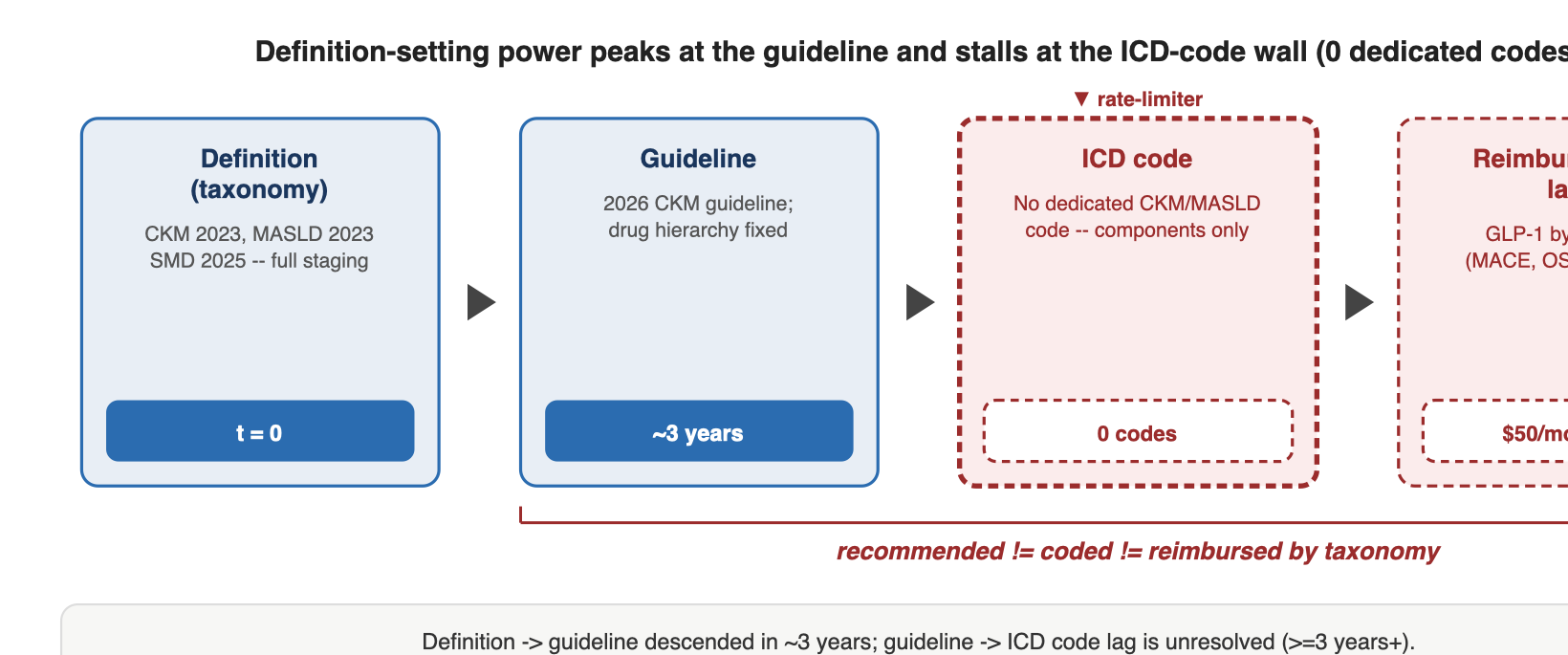
- What. This part traces, layer by layer, how US definition-setting power moves down a four-stage chain — definition (taxonomy) → guideline (COR/LOE) → ICD code / reimbursement → drug-label use context. The finding is a materialization curve that peaks at the guideline layer (stage 2) and drops sharply at the code layer (stage 3).
- So what. Neither CKM nor MASLD has a dedicated ICD code: CKM has to be reconstructed from a set of component codes, while MASLD (K76.0) and MASH (K75.81) are still coded under the old NAFLD/NASH codes. There is no integrated USPSTF grade for CKM. And GLP-1 reimbursement under Medicare opens not through the CKM disease label but only through FDA disease-specific labels (cardiovascular MACE, obstructive sleep apnea / OSA). The narrative that “a new taxonomy is already coded into reimbursement” does not hold.
- Now what. The lag between definition and code is itself the finding — the structural bottleneck of taxonomy hegemony. The definition runs ahead; the code and reimbursement fall behind. Watch three falsifiable markers: a dedicated CKM/MASLD ICD code (≤2029), a CKM-specific HEDIS metric, and whether GLP-1 reimbursement is ever opened by disease stage rather than label.
The five-minute read
Definition-setting power comes down to the guideline — and stops at the code
Earlier parts of this series confirmed that US CKM definition-setting power was promoted in just three years, from the 2023 Presidential Advisory to the 2026 multidisciplinary guideline. This part picks up the downstream layers that were previously deferred behind paywalls and tracks them quantitatively: how far the taxonomy actually descends into ICD codes, reimbursement and quality metrics.
The core finding, stated up front: definition-setting power descends quickly to the guideline layer (stage 2) but stops at the ICD-code and reimbursement layer (stage 3). Neither CKM nor MASLD has a dedicated ICD-10-CM code. GLP-1 reimbursement under Medicare opens not through a “CKM Stage 1 (obesity)” disease stage but only through FDA disease-specific labels — cardiovascular (MACE) and obstructive sleep apnea (OSA). In other words, the claim that “the new taxonomy is already reimbursement-coded” does not hold. Definition runs ahead; code and reimbursement lag. This structural lag is the real bottleneck of taxonomy hegemony — and the existence of the lag is what this part discovers.
The parts are fully coded — the whole is not
The contrast is precise. The components have long been fully coded: obesity E66.x (with BMI Z68.x), type 2 diabetes E11.x, CKD N18.x (by stage N18.1–N18.6), dyslipidemia E78.x. Yet the syndrome as a whole is not coded at all. CKM can only be identified in claims and EHR data by combining component codes; MASLD/MASH still ride the pre-existing fatty-liver codes despite the 2023 renaming. The parts are coded, the whole is not — that asymmetry is the quantitative evidence that “definition leads, code lags.”
| Layer | What the frame reaches | Degree of materialization | Lag |
|---|---|---|---|
| 1. Definition (taxonomy) | CKM Advisory 2023 · MASLD Delphi 2023 · SMD 2025 | Full — naming and staging established | Reference point (t = 0) |
| 2. Guideline | 2026 CKM multidisciplinary guideline (replaces 2013 obesity guideline) | High — promoted within 3 years, drug hierarchy fixed ← the peak | ~3 years (fast) |
| 3-a. ICD code | No dedicated CKM/MASLD code; component codes only | Low — combination / reconstruction only ← the drop | Unresolved (≥3 years+) |
| 3-b. USPSTF | Component grades (obesity, diabetes Grade B); no integrated CKM grade | Partial — combination works, integration not yet arrived | Unresolved |
| 3-c. Quality metric (HEDIS) | KED (eGFR + uACR) exists; CKM-specific under development | Partial — near-proxy only | In progress (1–2 years?) |
| 4. Reimbursement / label | GLP-1 reimbursed only by FDA disease label (MACE, OSA); GLP-1 Bridge = time-limited demonstration | Partial / bypass — label, not taxonomy, is the trigger | Per label |
Reading the curve: definition (1) → guideline (2) descended fast, in ~3 years; guideline (2) → ICD code (3-a) is where the lag widens and stays unresolved; reimbursement (4) bypasses the taxonomy entirely and opens only through individual FDA labels.
Do not conflate the evidence tiers
Three tiers of differing status coexist in this chain: (a) taxonomy and staging = expert consensus; (b) the drug hierarchy (SGLT2i first-line, etc.) = RCT evidence; (c) ICD codes and reimbursement = administrative / policy artifacts, a layer separate from scientific evidence. The automatic inference “the guideline recommended it, so reimbursement opens” is a category error — the code and reimbursement layers are still governed by pre-existing disease codes and individual labels.
Deep dive
1. Definition → guideline (COR/LOE, absorbing the Part 1 deferral)
The drug-recommendation directions of the 2026 AHA/ACC/ADA/ASN CKM guideline (JACC DOI 10.1016/j.jacc.2026.03.056, published 2026-06-09) are confirmed via secondary sources (TCTMD / GuidelineCentral / PharmacyTimes):
- CKD (with diabetes or albuminuria): RAS inhibitors (RASi) plus SGLT2 inhibitors as first-line. If albuminuria persists, add a nonsteroidal MRA (finerenone) or GLP-1-based therapy for cardiac-renal protection. (Quote, ≤150 chars: “RASi + SGLT2i are first-line … persistent albuminuria? consider adding GLP-1 or finerenone.”)
- T2D + CVD / high-risk: cardioprotective glucose-lowering agents (SGLT2i, GLP-1, or both) recommended to improve cardiac and renal outcomes.
- HFmrEF/HFpEF: SGLT2i as first-line GDMT; add GLP-1 when obesity / CKM risk factors coexist; consider finerenone in T2D + CKD.
Deferred item (kept unverified): the exact Class of Recommendation (COR 1/2a/2b/3) and Level of Evidence (LOE A/B-R/C-LD) letter grades for each recommendation remain behind the JACC paywall (HTTP 402/403) and are unconfirmed in this pass as well. The hierarchy and direction (SGLT2i + RASi = first-line; GLP-1 / finerenone = add-on / conditional) are confirmed, but letter grades such as “Class 1 / LOE A” are not fabricated under the no-fabrication rule and are deferred to a deep-read. Notably, within this hierarchy GLP-1 is consistently confirmed as an add-on / conditional agent in CKD, not first-line — which aligns with the reimbursement structure in section 3.
2. Guideline → ICD code (the status of CKM and MASLD coding = no dedicated code)
This is the layer where we directly checked whether definition-setting power descended into codes. The conclusion: both new taxonomies lack a dedicated ICD-10-CM code.
2-1. CKM syndrome — no single code, reconstructed from a code set
Primary document: “Cardiovascular-Kidney-Metabolic Syndrome: Development of an ICD-10-CM Coding Framework.” JMIR Diabetes 2026;1:e91827 (online 2026-06-01). Core (quote, ≤150 chars): “CKM lacks a single code, which hinders standardized stage identification in EHR and claims data.” There is no single billing code for CKM. The authors reconstruct (operationalize) AHA Stages 0–4 by mapping them onto an existing set of ICD-10-CM codes (FY2026 conventions, a hierarchical staging algorithm, co-occurrence rules, lookback thresholds). CKM is identifiable in data only as a combination of component codes — obesity E66, diabetes E11, CKD N18, cardiac I-codes. The gap where the taxonomy failed to become a code is filled by an algorithm (see cross-domain, section 8).
2-2. MASLD/MASH — renamed in 2023, but the ICD is still the old code
Primary sources: UASI coding guide (2026-04-07) and icd10data (FY2026). Core (quotes, ≤150 chars): “ICD-10-CM does not yet recognize MASLD as a distinct diagnosis” / “no distinct ICD-10-CM code for MASH at this time.” Practical coding therefore uses MASLD = K76.0 (fatty liver NEC) and MASH = K75.81 (nonalcoholic steatohepatitis) — the pre-existing NAFLD/NASH codes unchanged. The 2023 Delphi renaming changed societies, labels and literature, but not the billing code — the definition-code gap is real enough that the coding guidance explicitly instructs coders to “code from the ICD classification, not evolving clinical terminology.” (Whether a dedicated FY2027 MASLD/MASH code has been proposed is unverified.)
2-3. The components are fully coded — the contrast is the point
By contrast, the subordinate components have long been fully coded: obesity E66.x (with BMI Z68.x), type 2 diabetes E11.x, CKD N18.x (by stage N18.1–N18.6), dyslipidemia E78.x. So the parts are all coded but the whole (the syndrome) is not — the upper taxonomy has not acquired substance as a diagnosis. This contrast is the quantitative evidence for “definition leads, code lags.”
3. ICD → reimbursement / quality metric (CMS, USPSTF, HEDIS)
3-1. CMS reimbursement — GLP-1 opens by “disease label,” not by CKM
- Structural exclusion: Medicare Part D statutorily excludes drugs used solely for weight loss (since the creation of Part D in 2006). So “obesity (CKM Stage 1)” on its own never opened GLP-1 reimbursement. (ASPE/HHS report.)
- Medicare GLP-1 Bridge (started 2026-07-01): CMS, through a BALANCE model demonstration, provides Wegovy and Zepbound at a $50/month copay to eligible Part D enrollees for the time-limited window 2026-07-01 to 2027-12-31 — Medicare’s first obesity-specific GLP-1 coverage. But this is a time-limited payment demonstration (interim, pending a legislative fix), not standard Part D benefit. (CMS / KFF, 2026.)
- Existing coverage is label-based: Wegovy has been reimbursable under Part D since 2024 for the cardiovascular-risk-reduction (MACE, SELECT-based) indication; Zepbound is reimbursable for moderate-to-severe OSA. The key that opens reimbursement is not the CKM stage but the individual FDA disease label. The taxonomy is not upstream of reimbursement — it is a parallel layer.
3-2. USPSTF — no integrated CKM grade; only component grades
- Prediabetes / T2D screening: Grade B (overweight/obese adults 35–70, reasonable every 3 years). (USPSTF.)
- Obesity in adults: intensive behavioral intervention recommended, Grade B (2018, maintained 2024/2025). (USPSTF.)
- No dedicated USPSTF grade for integrated CKM screening exists — this confirms Part 1’s
unverifiedas an established absence. The current state operates through a combination of obesity, prediabetes and (individual) lipid screening grades; “integrated CKM” grading has not occurred. A formal USPSTF grade for uACR / integrated CKM screening has not arrived (no-fabrication: we do not assert the existence of an integrated grade).
3-3. HEDIS/NCQA — a near-proxy (KED) exists, but the CKM-specific metric is under development
- KED (Kidney Health Evaluation for Patients with Diabetes): an existing HEDIS measure — the rate of eGFR + uACR testing in diabetic patients aged 18–85. This is the closest materialization, already tying the kidney axis of CKM into reimbursement and performance measurement.
- NCQA CKM white paper + three 2025 expert convenings: “Cardiovascular-Kidney-Metabolic Syndrome: Improving Quality of Care and Accountability” explored five domains — ideal CKM care, measures, risk stratification, technology, and payment reform. But a CKM-specific HEDIS measure is not yet finalized (exploring / pilot stage). (NCQA, 2025–26.) The quality-metric layer is a partial materialization: a near-proxy (KED) exists, but the CKM-specific measure is unconfirmed.
4. Quantifying the four-layer chain — materialization and lag by layer
The quantitative takeaway: definition (1) → guideline (2) descended fast, with a ~3-year lag, but guideline (2) → ICD code (3-a) is where the lag widens and stays unresolved. Reimbursement (4) bypasses the taxonomy and opens only through individual FDA labels. Definition-setting power’s materialization is an asymmetric curve that peaks at stage 2 (guideline) and plunges at stage 3 (code). The proposition “definition-setting power equals reimbursement and code” is true only down to the guideline layer; at the code and reimbursement layers, individual labels and pre-existing codes still hold the real power.
5. Verdict table — layer | frame uptake | materialization | lag | open question
| Layer | CKM/MASLD frame uptake | Materialization | Lag | Open question |
|---|---|---|---|---|
| Definition | CKM/MASLD/SMD staging established | ● Full | t = 0 | Naming inflation (Part 0 §7) |
| Guideline | 2026 CKM guideline, drug hierarchy | ● High | ~3 years | COR/LOE letter grades unverified |
| ICD code | Dedicated code absent, combination only | ◐ Low | Unresolved | Whether an FY2027 new code is proposed |
| USPSTF | Component grades only | ◐ Partial | Unresolved | When an integrated CKM grade arrives |
| Quality metric | KED exists, CKM-specific under development | ◐ Partial | 1–2 years? | Whether a CKM HEDIS measure is adopted |
| Reimbursement / label | Label-based (MACE, OSA), Bridge time-limited | ◐ Bypass | Per label | Bridge permanence; stage-based GLP-1 reimbursement |
6. The skeptic’s bottom line
This section inherits the skeptic gate of the source deep-dive.
- Guard against overstating definition-setting power (the key point): the narrative that “the new taxonomy has already reorganized clinical care and reimbursement” is overstated. Measured directly, the taxonomy still holds no real power at the code and reimbursement layers (zero dedicated codes, zero integrated USPSTF grade, GLP-1 reimbursed only by label). The substance of definition-setting power extends to the guideline and clinical-pathway layer; below that, pre-existing disease codes and individual labels govern. Ignoring this lag collapses into the oversimplification “definition = market.”
- Preventing misreading of the reimbursement narrative: descriptions of the Medicare GLP-1 Bridge and quality metrics are a factual account of policy materialization, not an implication for listed pharma revenues (Novo, Lilly, etc.). The Bridge is a time-limited demonstration, not permanent coverage, with a limited population, window and copay. Escalation is maintained.
- Evidence-tier separation: (a) taxonomy and staging = expert consensus; (b) drug hierarchy (SGLT2i first-line, etc.) = RCT evidence; (c) ICD codes and reimbursement = administrative/policy artifacts (a layer separate from scientific evidence). Do not conflate the three tiers — especially the automatic inference “the guideline recommended it, so reimbursement opens.”
- Verdict: proceed-with-caveats (conditional). Basis: (1) the four-layer chain skeleton, the absence of dedicated codes and the label-based nature of reimbursement are confirmed by multiple primary and secondary sources (facts solid); (2) but the individual COR/LOE letter grades are unverified and the FY2027 code proposal is unconfirmed; (3) the reimbursement narrative carries a standing risk of misreading as listed-pharma implications, keeping escalation in place. Not a hold (no factual error or fabrication); not verified-clean (two unverified items plus escalation).
7. What to watch (falsifiable predictions)
- A dedicated CKM/MASLD ICD code: if within 24–36 months (≤2029) ICD-10-CM (or ICD-11) adds a dedicated CKM-staging or MASLD/MASH code, the “definition → code” lag has resolved. If it fails (remaining at combination / reconstruction), CKM stalls at the “guideline layer” — a reimbursement-side re-confirmation of Part 1’s prediction 1.
- Adoption of a CKM-specific HEDIS/MIPS measure: if NCQA moves beyond KED to fold a CKM-integrated measure (stage-based risk stratification, target attainment) into formal HEDIS, the quality-metric layer materializes. If not, CKM is measured only through combinations of individual proxies such as KED.
- GLP-1 reimbursement opening by stage: if, after the GLP-1 Bridge ends (2027-12), a successor codifies the “obesity / CKM stage” itself as a reimbursement criterion, the taxonomy is promoted upstream of reimbursement. If it fails (label-based MACE / OSA / individual indications persist), the taxonomy stays fixed as a parallel layer to reimbursement — a continuation of the section 3-1 observation.
References
- Chan, et al. 2026. “Cardiovascular-Kidney-Metabolic Syndrome: Development of an ICD-10-CM Coding Framework.” JMIR Diabetes 1: e91827 (online 2026-06-01). https://diabetes.jmir.org/2026/1/e91827
- UASI Solutions. 2026. “MASLD vs NAFLD: ICD-10-CM Coding.” (2026-04-07.) https://www.uasisolutions.com/masld-vs-nafld-icd-10-cm
- ICD10Data. FY2026. “K75.81 Nonalcoholic steatohepatitis (NASH).” https://www.icd10data.com/ICD10CM/Codes/K00-K95/K70-K77/K75-/K75.81
- CMS. 2026. “Medicare GLP-1 Bridge (BALANCE model demonstration).” https://www.cms.gov/medicare/coverage/prescription-drug-coverage/medicare-glp-1-bridge
- KFF. 2026. “What to Know About the BALANCE Model for GLP-1s in Medicare and Medicaid.” https://www.kff.org/medicare/what-to-know-about-the-balance-model-for-glp-1s-in-medicare-and-medicaid/
- ASPE / HHS. “Medicare Coverage of Anti-Obesity Medications.” https://aspe.hhs.gov/…/medicare-coverage-anti-obesity-meds.pdf
- USPSTF. “Screening for Prediabetes and Type 2 Diabetes.” https://www.uspreventiveservicestaskforce.org/uspstf/recommendation/screening-for-prediabetes-and-type-2-diabetes
- USPSTF. “Obesity in Adults: Interventions.” https://www.uspreventiveservicestaskforce.org/uspstf/recommendation/obesity-in-adults-interventions
- NCQA. “NCQA Convenes Expert Panel on Cardiovascular-Kidney-Metabolic Syndrome.” https://www.ncqa.org/blog/ncqa-convenes-expert-panel-on-cardiovascular-kidney-metabolic-syndrome/
- NCQA. “NCQA Releases New White Paper on CKM Syndrome.” https://www.ncqa.org/blog/ncqa-releases-new-white-paper-on-ckm-syndrome/
- AHA/ACC/ADA/ASN. 2026. “2026 Guideline for the Prevention, Detection, Evaluation, and Management of Cardiovascular-Kidney-Metabolic Syndrome.” JACC (online 2026-06-09). https://www.jacc.org/doi/10.1016/j.jacc.2026.03.056
- TCTMD. 2026. “AHA/ACC Release First Comprehensive Guideline for CKM Syndrome.” https://www.tctmd.com/news/ahaacc-release-first-comprehensive-guideline-ckm-syndrome
Unverified items (paywalled primary text / independent confirmation failed): (A) individual drug-recommendation COR/LOE letter grades (Class 1 / LOE A, etc.); (B) whether a dedicated FY2027 CKM/MASLD new code has been proposed.
Disclosure
This post is for information and knowledge-asset purposes only. It is not investment advice and not medical advice. The author’s position in any named securities is none (default: no interest). COI note (inherited from the source analysis frontmatter coi): descriptions of the societies and bodies named (AHA, ACC, ADA, ASN) and the regulators (FDA, CMS, USPSTF, NCQA/HEDIS) are stated as facts and neutrally; codes, reimbursement and grades are attributed to the source documents. Descriptions of Medicare GLP-1 coverage expansion (the GLP-1 Bridge) and quality metrics could be misread as implications for specific listed pharma (Novo Nordisk, Eli Lilly, and others), and are here a factual, neutral account of policy materialization — not a revenue implication; quantitative claims are attributed to vendor/author/agency documents. This draft offers no mitigating or advocacy language.
 Uthando Nethemba
Leave a comment