Evidence-first notes on bioscience and medical affairs, at the edge of the clinic and the market. Information only — not investment advice, not medical advice.
The 30-second version
- What. Korea and Asia have not officially imported the upper-level CKM/SMD taxonomy into society guidelines. The only nomenclature they have formally adopted is the MASLD renaming (Korean Association for the Study of the Liver, KASL, position statement 2024-06-27). The framing “Asia has already gone CKM” is refuted — where CKM appears in Korea and China it sits in the research/epidemiology layer (retrospective re-analysis of national cohorts), not in clinical standards.
- So what. Asia’s genuine distinctiveness is not a new disease name but its own diagnostic hardware: lower BMI thresholds (Asia-Pacific overweight BMI ≥23, obesity ≥25), the “lean type-2 diabetes” phenotype, and lean MASLD. These phenotype corrections predate and run orthogonal to the US/European naming war. Transplanting US CKM/PREVENT without re-calibrating these cutoffs risks mis-estimating risk in Asian bodies (an external-validity gate).
- Now what. For Korean Medical Affairs specifically: messaging built on “CKM-guideline-based” claims is premature/inaccurate — CKM is not yet an official Korean society taxonomy. The confirmed levers are the MASLD renaming (KASL 2024) and the long-term-protection drug algorithm (Korean Diabetes Association, KDA 2023). All naming and adoption claims are attributed to the primary society/guideline documents; direct quotes ≤150 characters.
The five-minute read
Adoption splits by layer, not by country
Parts 0–4 dissected the US axis (CKM) and the European axis (SMD/MASLD) of definition-setting power — who names the disease — and its downstream cascade (guideline → reimbursement → label). Part 5 asks a geographic question: does Asia import the products of this naming war, or build its own frame? The deep-research finding is that the binary is the wrong lens. Adoption splits by layer.
- Nomenclature layer: Asia has officially imported only the liver renaming (MASLD) — in Korea, KASL on 2024-06-27. No Korean or Asian society was found in this pass to have adopted the upper-level CKM/SMD staging taxonomy as an official guideline (= unconfirmed, treated as not-adopted).
- Epidemiology layer: in Korea and China, CKM entered first as research and epidemiological re-analysis — papers retrospectively applying the US PREVENT/CKM staging to KNHANES and national cohorts — not as a society standard.
- Diagnostic-threshold (hardware) layer: here Asia is distinct. Lower BMI and waist-circumference thresholds, and the lean-diabetes / lean-MASLD phenotype corrections, have been maintained for more than two decades, and they sit orthogonal to the US/European naming.
So Asia is not “importer vs originator” but a mixed state — selective import of naming, independent retention of diagnostic thresholds. That mix is exactly the practically important point for Korean Medical Affairs, because transplanting US CKM/PREVENT as-is carries a structural risk of mis-estimating risk in the Asian phenotype.
The Asian phenotype — the scientific basis for the distinctiveness
The root reason Asia does not (and cannot) wholesale-import the naming is that the phenotype differs. US CKM/PREVENT and European SMD all use Western anthropometry as their baseline, and that baseline is off for Asia.
- Lower BMI/waist thresholds (WHO Asia-Pacific family): the Korean Society for the Study of Obesity (KSSO) 2022 sets overweight at BMI ≥23 and obesity at ≥25 kg/m² (normal 18.5–22.9), one band below the Western WHO cutoffs (25/30), with abdominal obesity at waist ≥90 cm (men) / ≥85 cm (women). The basis is ethnicity-specific risk curves showing diabetes/CVD risk rising in Asians even below BMI 25.
- Lean type-2 diabetes: Asian T2D is characterized by lower BMI and beta-cell dysfunction preceding insulin resistance. One report holds that more than half of Japanese T2D patients are of normal weight (BMI <25). A design that starts CKM Stage 1 from “excess adipose tissue” may miss lean diabetes at the early-stage window.
- Lean MASLD: MASLD occurs even at normal BMI (Asian <23), and an estimated ~45% of MASLD/NAFLD in Asian cohorts is lean; PNPLA3/TM6SF2/MBOAT7 variants and visceral adiposity/sarcopenia are drivers, and prognosis (about 1.6× all-cause mortality) can be similar to or worse than the obese type.
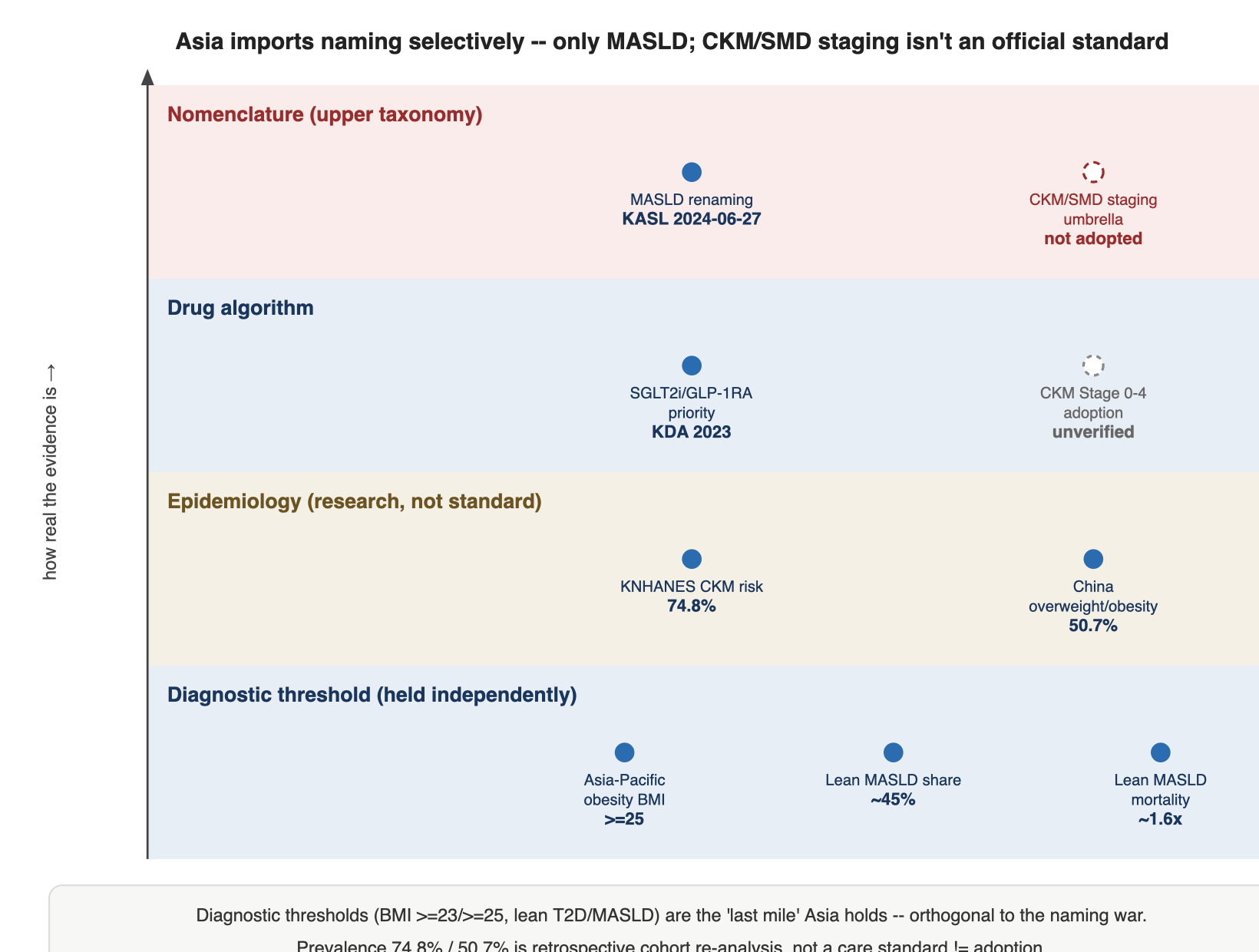
| Layer | Asia / Korea status |
|---|---|
| Nomenclature (upper taxonomy) | MASLD renaming officially adopted (KASL 2024-06-27). CKM/SMD staging umbrella not adopted (unconfirmed in this pass) ← selective import |
| Drug algorithm | SGLT2i / GLP-1RA long-term-protection priority converges with US/EU (KDA 2023) — but this is not a CKM staging adoption |
| Epidemiology | CKM enters as retrospective cohort re-analysis (KNHANES, Chinese national surveys) — research output, not a clinical standard |
| Diagnostic threshold (hardware) | Lower BMI/waist cutoffs, lean T2D, lean MASLD held independently ← the “last mile” Asia keeps |
Orthogonality: Asia’s phenotype corrections predate and run at right angles to the CKM/SMD naming war — whatever upper taxonomy is imported, the cutoffs inside it must be re-calibrated to the local population.
Do not read epidemiology as a standard
The “CKM prevalence 74.8% / 50.7%” figures from KNHANES and Chinese cohorts are researchers retrospectively applying the US definition, not a society care standard. The existence of a prevalence paper must not be misread as “adoption.” And keep the evidence tiers separate: nomenclature (consensus) vs drug recommendation (RCT) vs phenotype threshold (epidemiological risk curves) are three different tiers — Asian BMI cutoffs rest on large observational evidence, not an RCT-validated threshold.
Deep dive
1. Background — is Asia an importer, or does it localize?
The prior parts mapped definition-setting power in the US (single convergence on CKM, Part 1) and Europe (dispersed competition across SMD/MASLD/KDIGO, Part 2). Part 5’s question is geographic: does Asia import these products or build its own? The core finding is that the importer/originator dichotomy breaks down, because adoption splits by layer. Asia has selectively imported one naming (MASLD) while independently retaining the diagnostic thresholds — a mixed state rather than either pole.
2. What this development newly establishes — what Korean societies did and did not adopt
Official adoption confirmed = the liver renaming (MASLD), one item only.
- KASL (liver): a 2023-12 decision to adopt the new terminology → 2024-02 task force → position statement announced 2024-06-27 at The Liver Week 2024. The official Korean term “대사이상 지방간질환” (MASLD) was adopted, retiring NAFLD and the stigmatizing “non-alcoholic.” This is an explicit import-and-localization aligned with the international Delphi (AASLD/EASL/ALEH 2023, Part 0). (Confirmed: Clin Mol Hepatol 2024, PMC11391133 / e-cmh 2024.0467.)
CKM/SMD upper taxonomy = official guideline adoption unconfirmed.
- KDA (diabetes): the 2023 practice guideline prioritizes SGLT2i or GLP-1RA on proven-benefit grounds when ASCVD, heart failure or CKD coexist — i.e., at the drug-algorithm level it converges with the US/EU (organ-protection priority). But there is no confirmed basis that this guideline adopted a “CKM” staging umbrella (Stage 0–4). KDA still layers cardiac/renal protection onto a diabetes-centric frame. (Confirmed drug recommendation: Diabetes Metab J 2023, e-dmj 2774 / unverified: CKM staging adoption.)
- KSSO (obesity): the 2022 obesity guideline maintains independent diagnostic thresholds. A CKM-Stage-1-style repositioning (obesity = stage 1 of a metabolic continuum) was not confirmed.
- Korean Society of Nephrology / KSoLA (lipid-atherosclerosis): KSoLA issued a 2024 secondary-dyslipidemia consensus (PMC11439749), but explicit adoption of a CKM frame was not confirmed in this pass. KDIGO localization / CKM reflection by the Korean Society of Nephrology is likewise unverified.
No-fabrication bottom line: the claim “Korea has adopted CKM” is, on current evidence, an overstatement. What is confirmed is (a) the official import of the MASLD renaming, and (b) international convergence of the drug algorithm (SGLT2i/GLP-1RA organ-protection priority). Adoption of the CKM/SMD upper staging taxonomy into a society guideline is not confirmed. Korea’s CKM sits in the epidemiology layer below.
3. Methodological strengths and limits — the phenotype evidence
Asia’s threshold distinctiveness rests on large observational evidence. The KSSO 2022 lower BMI cutoffs are grounded in ethnicity-specific risk curves (diabetes/CVD risk rising in Asians below BMI 25; confirmed: J Obes Metab Syndr 2022, JOMES uid=1017 / PMC10327686). The lean-T2D phenotype (low BMI, early beta-cell dysfunction; “over half of Japanese T2D at normal weight”) is a synthesis of reviews (confirmed: Diabetes Obes Metab 2025 dom.70060 / Circ J 2026 review). Lean MASLD (~45% of Asian MASLD, PNPLA3/TM6SF2 drivers, ~1.6× all-cause mortality) is confirmed at the review level (Front Gastroenterol 2025 1699508).
The limit is tier: these are strong observational/epidemiological signals, not RCT-validated thresholds. Asian BMI cutoffs are large-scale observational evidence but not an RCT-validated intervention threshold. The strength is that the phenotype correction predates and is orthogonal to the naming war; whatever upper taxonomy is imported, the cutoffs inside it must be re-calibrated to the local population, or PREVENT’s external validity breaks.
4. Neighbouring domains — epidemiology first, societies watching
- Japan: the Japanese Circulation Society (JCS) and Japan Diabetes Society (JDS) have collaborated since 2017 (2020 joint diabetes/CV guideline). But there is no Japanese CKM guideline or staging system; a review (Circ J 2026;90:449–457) states CKM “is still new” without established/disseminated treatment strategies, and calls for domestic validation and refinement of the CKM frame — i.e., a watch-and-validate stage. (Confirmed: J-STAGE CJ-26-0129.)
- China: CKM entered via the epidemiology layer — papers applying CKM staging to national cross-sectional surveys (2010–2019) and multicenter cohorts appear in JACC and JACC: Asia 2025, reporting individual-condition prevalence (overweight/obesity 50.7%, CVD 23.4%, CKD 10.8%, diabetes 11.2%). An official CKM consensus guideline from the Chinese Medical Association was not confirmed in this pass (unverified). (Confirmed epidemiology: JACC 2025.05.030 / JACC Asia 2025.)
- Korea (epidemiology): a KNHANES 2011–2021 re-analysis (61,106 people, PREVENT definition) found about 74.8% of adults carry CKM risk, with stage-specific MACE/mortality analysis. All of this is research/epidemiology output, not a society-standard adoption. (Confirmed: PMC12062855 / PMC11795540.)
Common pattern: in East Asia, CKM arrives not as “society guideline → clinic” but as “national survey/cohort re-analysis → (still) societies watching.” The downstream of naming hegemony must first pass an epidemiological-validation gate in Asia. This is the geographic extension of the Part 1 CDSS hook — the taxonomy enters as a data layer (EHR/census) before it becomes a clinical standard, exposing PREVENT’s external-validity problem when the Asian phenotype correction is not transferred.
5. Commercialization and market context (facts, neutral)
The drug algorithm (SGLT2i/GLP-1RA long-term-protection priority) has already converged internationally in KDA/JDS and elsewhere, so regardless of whether the upper naming is adopted, the Asian prescribing pathway is open. Two facts, stated neutrally, qualify this:
- Asia’s lower BMI thresholds define the target population for GLP-1 obesity indications differently from the West.
- The lean-diabetes / lean-MASLD phenotype suggests that “weight-centric” messaging may fit Asia less well.
The Asian label and reimbursement pathways of the relevant makers (GLP-1 class Novo Nordisk, Eli Lilly; SGLT2i class AstraZeneca, Boehringer Ingelheim; and others) are subordinate to each country’s phenotype correction and reimbursement criteria. Tickers, market caps and investment judgments belong to the investment layer — here only the facts, and this section is escalated to the Principal.
Regional implication (Korea): (1) CKM is not yet an official Korean society taxonomy — “CKM-guideline-based” messaging is premature/inaccurate; (2) the official levers are the MASLD renaming (KASL 2024) and the drug organ-protection recommendation (KDA 2023); (3) when PREVENT/CKM is discussed for Korea, the un-validated Asian phenotype re-calibration must always be stated alongside (external-validity gate).
6. The skeptic’s bottom line
This section inherits the skeptic gate of the source deep-dive.
- Overstatement guard (core): statements of the “Asia has already adopted CKM” type have no basis. The only confirmed official adoption is the MASLD renaming; adoption of the CKM/SMD staging taxonomy into Korean/Asian society guidelines is unconfirmed = treated as not-adopted (no-fabrication).
- Epidemiology ≠ standard: the “CKM prevalence 74.8% / 50.7%” figures from KNHANES and Chinese cohorts are researchers retrospectively applying the US definition, not a society care standard. The existence of a prevalence paper must not be misread as “adoption.”
- Evidence-tier separation (across the series): nomenclature (consensus) vs drug recommendation (RCT) vs phenotype threshold (epidemiological risk curve) are different tiers. Asian BMI cutoffs are large-scale observational evidence, not an RCT-validated threshold.
- Verdict: proceed-with-caveats (conditional). The basis: (1) the factual skeleton — MASLD adoption, the Asian phenotype, the epidemiology-entry pattern, and Japan’s watch stance — is solid, confirmed by multiple primary/secondary sources; (2) but four “official adoption” items (Korean CKM staging, Chinese Medical Association consensus, Korean nephrology KDIGO localization, KSoLA/KSSO CKM incorporation) are unverified (conservatively treated as not-adopted); (3) the listed-pharma Asian-market implication remains escalated. It is not a hold (no factual error/fabrication) and not verified-clean (several official-adoption items remain unverified).
7. What to watch (falsifiable predictions)
- Official Korean CKM formalization (≤2028): if KDA or a multidisciplinary body explicitly adopts CKM staging (Stage 0–4) as a Korean guideline taxonomy, the “not-adopted” verdict is overturned. If it does not hold (staying at drug-algorithm convergence), Asia = non-import of naming with independent thresholds continues.
- An Asia-recalibrated PREVENT/CKM (≤2029): if Korea, China or Japan publishes a CKM staging or risk equation re-calibrated on its own population, the “localization” hypothesis strengthens. If not, Western transplants continue to be used inertially, with external-validity warnings.
- Incorporation of the lean phenotype into taxonomy: if the next Asian guideline explicitly names lean T2D / lean MASLD as a separate stage/threshold, Asian distinctiveness rises into the naming layer. If not, the lean phenotype is handled only implicitly through each country’s cutoffs (BMI 23/25), and the upper naming stays Western-dependent.
8. Series retrospective — the thesis across Parts 0–5
The consistent finding of this series: the proposition that definition-setting power (who names the disease) governs the care standard, reimbursement, label and market holds — but that power flows unevenly across geography and layer.
- Part 0 (map): the starting hypothesis “SMD = Severe/Supramolecular” was absent (refuted); the reality is EAS Systemic Metabolic Disorder (2025). The two axes — US CKM vs European SMD/MASLD — were fixed, with naming inflation (e.g., LMV syndrome) observed.
- Part 1 (US axis): four societies (AHA, ACC, ADA, ASN) converged on CKM (2026 multidisciplinary guideline). The key asymmetry — staging widens the denominator to 90–95% of adults while PREVENT narrows the statin-eligible pool (“diagnose broadly, treat narrowly”). The largest gap = the absence of the liver.
- Parts 2–4 (Europe, drugs, mechanism): Europe is dispersed competition — EAS SMD explicitly enrolls the liver into staging, EASL MASLD holds the liver axis, KDIGO is the global standard for the kidney axis. Europe’s enrollment of the liver — which the US left out — is the decisive difference between the two axes. Drugs (GLP-1/SGLT2i/resmetirom) get their market boundary from which naming they attach to, and the top of the definition → guideline → ICD/reimbursement → label chain is the society taxonomy.
- Part 5 (Asia): Asia is not a full importer of this naming war. It imports naming only selectively (MASLD) and keeps the last mile — the diagnostic threshold (lower BMI, lean diabetes/MASLD) — independently. The point where definition-setting power is transplanted but then stops is precisely this Asian phenotype cutoff.
Through-line: the US is single convergence, Europe is dispersed competition, Asia is selective import plus threshold independence. In all three regions the real battleground is not the “new disease name” headline but the staging cutoffs, risk equations and reimbursement codes behind it (the taxonomy edition of the GLP-1 series’ “headline vs the real bottleneck” discipline). And just as the enrollment of the liver split the US from Europe, whether the phenotype is re-calibrated is the axis that splits the West from Asia.
References
- Korean Association for the Study of the Liver (KASL). 2024. Position statement on new MASLD nomenclature (The Liver Week 2024, 2024-06-27). Clinical and Molecular Hepatology. https://pmc.ncbi.nlm.nih.gov/articles/PMC11391133/ · https://www.e-cmh.org/journal/view.php?doi=10.3350/cmh.2024.0467
- Korean Society for the Study of Obesity (KSSO). 2022. Clinical practice guidelines for obesity (Asia-Pacific BMI thresholds). Journal of Obesity & Metabolic Syndrome. https://www.jomes.org/journal/view.html?uid=1017&vmd=Full · https://pmc.ncbi.nlm.nih.gov/articles/PMC10327686/
- Korean Diabetes Association (KDA). 2023. Clinical practice guidelines for diabetes (SGLT2i/GLP-1RA organ-protection priority). Diabetes & Metabolism Journal. https://www.e-dmj.org/journal/view.php?number=2774
- Japanese Circulation Society review. 2026. “Cardiovascular-Kidney-Metabolic (CKM) syndrome — a Japanese perspective.” Circulation Journal 90 (5): 449–457. https://www.jstage.jst.go.jp/article/circj/90/5/90_CJ-26-0129/_html/-char/en
- KNHANES 2011–2021 CKM re-analysis (PREVENT definition, 61,106 adults). https://pmc.ncbi.nlm.nih.gov/articles/PMC12062855/ · https://pmc.ncbi.nlm.nih.gov/articles/PMC11795540/
- China CKM epidemiology (national surveys / multicenter cohorts). Journal of the American College of Cardiology 2025. https://www.jacc.org/doi/10.1016/j.jacc.2025.05.030
- Lean MASLD in Asia (review). Frontiers in Gastroenterology 2025. https://www.frontiersin.org/journals/gastroenterology/articles/10.3389/fgstr.2025.1699508/full
- Korean Society of Lipid and Atherosclerosis (KSoLA). 2024. Secondary dyslipidemia consensus. https://pmc.ncbi.nlm.nih.gov/articles/PMC11439749/
Unverified items (paywalled primary text / independent confirmation failed, treated conservatively as not-adopted): (A) Korean society (e.g., KDA) official adoption of CKM staging (Stage 0–4) as a guideline taxonomy; (B) an official Chinese Medical Association CKM consensus guideline; (C) explicit CKM reflection in Korean Society of Nephrology KDIGO localization; (D) explicit “CKM” taxonomy incorporation into KSoLA/KSSO guidelines.
Disclosure
This post is for information and knowledge-asset purposes only. It is not investment advice and not medical advice. The author holds no position in the named securities. COI note (inherited from the source analysis frontmatter coi): descriptions of the societies named (KASL, KDA, KSSO, Korean Society of Nephrology, KSoLA, JCS, JDS, and the US/European societies) and the listed pharma (GLP-1 class Novo Nordisk, Eli Lilly; SGLT2i class AstraZeneca, Boehringer Ingelheim; and others) are stated as facts and neutrally, with no mitigating or advocacy language. Quantitative claims — reclassification, prevalence (74.8% / 50.7%), lean-MASLD ~45%, ~1.6× mortality — are attributed to the society/guideline documents, cohort re-analyses and review articles cited, not to manufacturer marketing figures. Society-guideline writing-committee sponsorship and individual-author conflicts must be checked separately against the primary disclosures.


Leave a Reply