Evidence-first notes on bioscience and deep tech, at the edge of the lab and the market. Information only — not investment advice. All revenue, capacity, market-share, valuation and price figures are attributed to each company’s earnings release (press release / SEC 8-K / 10-Q), BNEF survey, CnEVPost aggregation or trade press. Company claims, institutional statistics and market estimates are separated. Announced capacity is not shipped product, and a lab cell is not a manufactured one — these distinctions are marked inline.
The 30-second version
- What. The paradox of the energy-storage commercial landscape is that the chemistry that drives the lab-metric headlines (QSE-5 844 Wh/L, Naxtra 175 Wh/kg, iron-air 100h) is separate from the chemistry that actually won at the GWh / $/kWh outcome layer. The only outcome-layer winner is LFP: BNEF’s 2025 average pack price is $108/kWh, of which LFP $81/kWh vs NMC $128/kWh, with the lowest observed LFP cell at $36/kWh (BNEF). CATL held 39.2% of the 2025 EV-battery market and CATL+BYD combined 55.6% (CnEVPost) — the incumbent cost/scale moat is deepening, not eroding.
- So what. The capital-market narrative is driven instead by pre-/low-revenue next-generation pure-plays, but their commercial displacement of the incumbent (Part 0 hypothesis b) is unsupported by current data. QuantumScape is at pilot stage with a first license/billing revenue of $11M and a net loss of $100.8M; Solid Power’s revenue fell −49% and it has pivoted from cell-maker to electrolyte supplier. Amprius is the one next-gen name with real revenue (Q1’26 $28.5M) but in a drone/defence niche, not standard EV/grid displacement. The through-line: the real bottleneck is not lab energy density but gigafactory manufacturability and $/kWh.
- Now what. The sharpest proof of that through-line came not from a lab but from a factory ramp: Northvolt, a European champion that raised roughly $12B, failed at scale-up — factory utilization near ~5%, losses of roughly $100M/month, and bankruptcy in Sweden (2025-03-12) — announced capacity is not shipped product. Long-duration energy storage (LDES, hypothesis c) shows early evidence of a separate market — Form Energy’s Xcel 300MW/30GWh iron-air project is explicitly for a Google datacenter — but this is announcement-stage, not built, and round-trip efficiency and measured $/kWh remain unverified. Verdict: proceed-with-caveats.
The five-minute read
The chemistry that drives the headlines vs the chemistry that has revenue
The paradox of the storage commercial landscape is that the chemistry pulling the lab-metric headlines is separate from the chemistry that has actually won at the GWh / $/kWh outcome layer. The outcome-layer winner is LFP alone: BNEF’s 2025 average pack was $108/kWh (−8% year-on-year, −93% versus 2010), and within it LFP ran $81/kWh against NMC’s $128/kWh, with the lowest observed LFP cell at $36/kWh and pack at $50/kWh (stationary storage; BNEF). CATL shipped 464.7 GWh of EV batteries in 2025 (+35.7%), a 39.2% share, and CATL+BYD together 659.5 GWh, 55.6% globally (with the broader Chinese camp near ~69%; CnEVPost). That scale/cost curve is the substance of the incumbent moat.
Yet the story the capital markets follow is written by pre-/low-revenue next-generation pure-plays. QuantumScape logged its first license/customer billing revenue of $11M in Q1 2026 but a net loss of $100.8M and remains at pilot (Eagle Line). Solid Power’s revenue fell −49% to $3.1M as it pivoted from cell manufacturing to sulfide-electrolyte supplier. Only Amprius, on a silicon anode, posted real revenue (Q1’26 $28.5M, 2.5x; FY2025 $73M, 3x) — but into a drone / UAS / defence / light-EV niche where energy density outranks cost.
The real bottleneck is the gigafactory, and Northvolt proved it
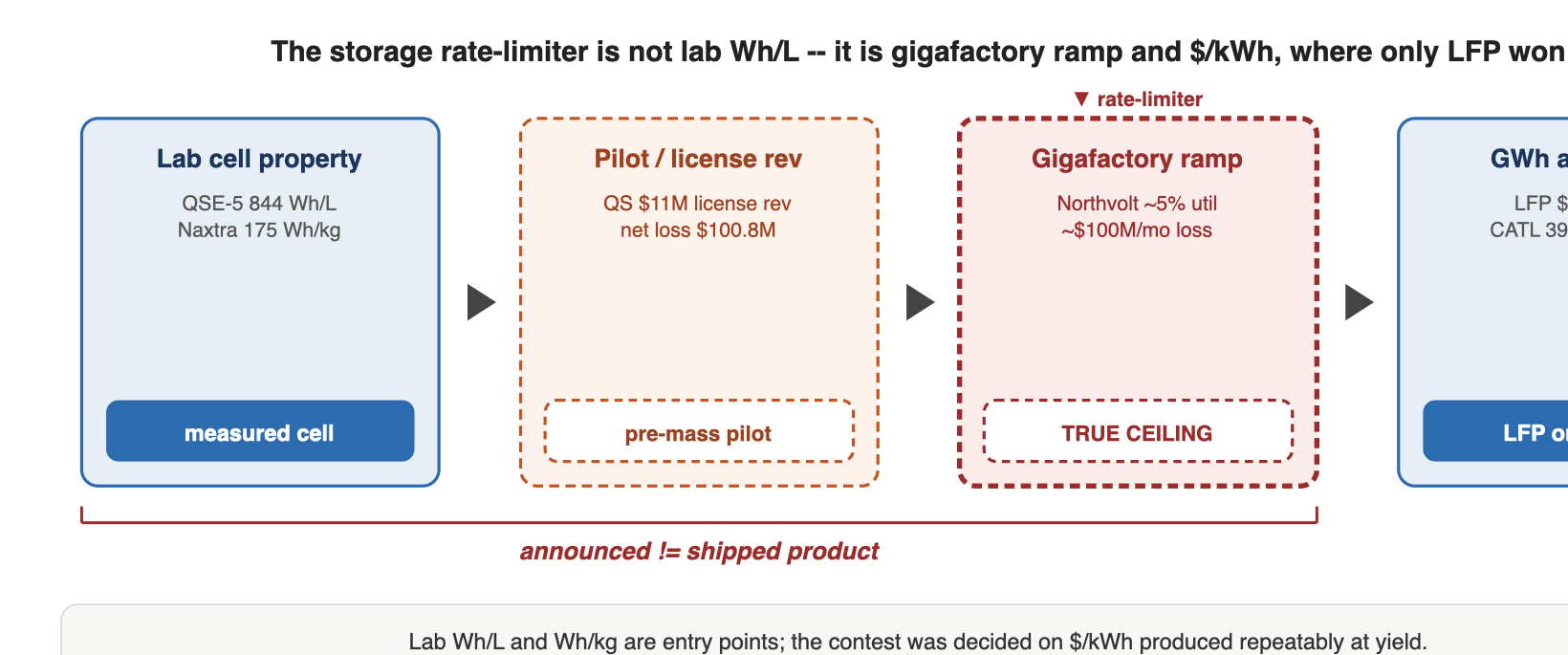
The firm’s recurring lens — “the headline is the starting point; the real bottleneck is elsewhere” — resolves the storage case cleanly. The headline reads “chemistry war,” but the bottleneck is singular: gigafactory manufacturability and $/kWh at the outcome layer. Northvolt demonstrated this most brutally: a European champion that raised roughly $12B died not in the lab but at the ramp — utilization near ~5%, losses of roughly $100M/month, a lost €2B BMW contract (two-year delay), and debts of roughly $5.8B. This is the extreme case of “announced capacity is not shipped product,” and it is the sharpest outcome-layer counterexample in the series.
| Chemistry / role | Company (listed/private) | 2025–Q1’26 commercial position (attributed) | Status |
|---|---|---|---|
| LFP/NMC incumbent | CATL (300750.SZ) | EV 464.7 GWh (+35.7%), 39.2% share; storage cells 30.4%; cell sales 661 GWh; capacity 772 GWh (+321 GWh under construction); Q1’26 revenue RMB 129.131B (+52.45%) | Mass-producing / dominant |
| LFP/NMC incumbent | BYD (002594.SZ) | Combined with CATL 659.5 GWh, 55.6% globally (Chinese camp ~69%) | Mass-producing / #2 |
| Solid-state | QuantumScape (QS) | Q1’26 first license/billing revenue $11M, net loss $100.8M, liquidity $904M; Eagle Line pilot installed, QSE-5 first production; Murata/Corning backing Cobra separator equipment; FY’26 EBITDA-loss guidance $250–275M | Pilot (pre-mass) |
| Silicon-anode | Amprius (AMPX) | Q1’26 revenue $28.5M (2.5x), net loss $5.0M, GM 20%; FY’25 $73M (3x); FY’26 guidance ≥$130M; SiCore into drone/UAS/defence and light-EV niche | Mass-producing (niche) / near-breakeven |
| Solid-state electrolyte | Solid Power (SLDP) | Q1’26 revenue+grant $3.1M (−49%), net loss $13.0M, liquidity $435.3M; SK On pilot-line site acceptance; sulfide electrolyte supplied to Samsung SDI / BMW (JEA); $130M direct offering | Pivoted to electrolyte supplier |
| LDES iron-air | Form Energy (private) | Series F $405M (2024-10, T. Rowe Price, GE Vernova; cumulative >$1.2B); Form Factory 1 (Weirton WV, 550,000 sqft); first commercial pilot 1.5MW/150MWh (Great River Energy, MN, targeted end-2025); Xcel 300MW/30GWh (for a Google datacenter) announced | First commercial pilot / early |
| (Bankruptcy case) | Northvolt (private) | Chapter 11 (US 2024-11-21), Swedish bankruptcy (2025-03-12, largest in modern Swedish industrial history); utilization ~5%, ~$100M/month loss, €2B BMW contract lost (2-year delay), debts ~$5.8B; assets acquired by Lyten | Failed (at the outcome layer) |
Deep dive
1. Background — the landscape and the falsifiable question from Part 0
Part 0 posed the central falsifiable question of this series as three competing hypotheses, and Part 5 translates the commercial and manufacturing evidence back onto it: (a) the LFP moat holds through this decade while next-generation chemistries differentiate into use-case niches; (b) next-generation chemistry (solid-state / Na-ion) displaces the incumbent at scale; (c) LDES creates a separate multi-day market rather than competing with Li-ion. The through-line the whole series tests is that the storage headline metrics (Wh/L, Wh/kg, hours of duration) are the entry point, while the decisive contest happens at the outcome layer — GWh manufacturability and $/kWh. This closing part reviews the commercial terrain, adjudicates the Part 0 question, and then retrospects the six-part arc against the firm’s through-line.
2. What this synthesis establishes — position by company (all attributed)
- CATL / BYD (incumbents, outcome-layer winners): the only camp that has actually demonstrated GWh and $/kWh in storage. CATL’s ~40% single-firm share and the Chinese camp’s ~69% are the product of cost, yield and supply-chain integration. LFP at $81/kWh (lowest $36/kWh cell) is the falsification benchmark next-generation must clear. Notably, the company mass-producing Na-ion (Naxtra) is also CATL — even the next generation is carried by the incumbent.
- QuantumScape (solid-state, the narrative): the Q1’26 first license revenue is a milestone, but it is license/billing, not cell-sales revenue ($11M), against a $100.8M net loss. Eagle Line is a pilot, not mass production, with the Cobra separator process backed by Murata/Corning equipment investment. QS still stands at the outcome layer between “publish a property → pilot → GWh mass production.”
- Amprius (silicon-anode, real revenue in a niche): ★ the one next-gen name with real revenue and near-breakeven (FY’26 adjusted-EBITDA target ≥$4M). But this is silicon anode, not solid-state, and the market is drone / UAS / defence / light EV, where energy density outranks cost — an empirical instance of Part 0 hypothesis (a)’s “next-gen holds a specific niche.”
- Solid Power (pivot): revenue −49%, business model shifted from cell manufacturing to sulfide-electrolyte supply and licensing. Rather than mass-produce its own cells, it embeds into the Samsung SDI / BMW / SK On ecosystem as a materials supplier — a signal that the solid-state value chain is fragmenting into “materials/licensing” rather than “finished cells.”
- Form Energy (LDES, separate market): the first commercial pilot (1.5MW/150MWh) is still early, and the much-discussed 300MW/30GWh Google-datacenter project is announced, not commissioned or contract-executed. Series F ($405M) and the GE Vernova collaboration are capital/partner signals, but round-trip efficiency and measured $/kWh are unverified (deferred, §3 / Part 3).
- Northvolt (failure): ★ the sharpest demonstration of the outcome-layer bottleneck. It collapsed not in lab or chemistry but at ramp, manufacturing yield and capital burn — the extreme of “announced capacity is not shipped product.” The European cell-independence narrative broke at the GWh outcome layer.
★ Valuation flag (skeptic catch): Form Energy’s valuation figures are internally inconsistent across sources — roughly $1.95B (primary post-Series-F estimate) versus roughly $3.3–3.42B (secondary-demand estimate, late-2025 to early-2026). The two numbers differ in nature (primary issue price vs secondary-market estimate) and cannot be reconciled into a single valuation; the company is private and unaudited, so neither figure is asserted as enterprise value — both are flagged as unverified. This is isomorphic to the ATTR series’ refuted $65.4M market-size claim: verify the internal consistency of vendor/secondary numbers first.
3. Method — the strength and limits of the evidence (BNEF, filings, aggregation)
The commercial financials in this synthesis are strong-evidence: revenue, income, liquidity, capacity, market share and $/kWh are drawn from each company’s 8-K/10-Q, the BNEF survey and CnEVPost aggregation. Three distinctions carry the analysis. (1) Announced ≠ shipped: CATL’s 772 GWh is nameplate capacity, distinct from its 661 GWh of actual cell sales; Form’s 300MW/30GWh is an announcement. Northvolt is the counterexample — it died at ~5% utilization, not at nameplate. (2) Lab ≠ manufactured: QS’s 844 Wh/L and Naxtra’s 175 Wh/kg are cell/sample properties, short of GWh mass production and automotive qualification. (3) License revenue ≠ cell-sales revenue: QS’s $11M is license/billing, not product revenue. The limits: next-generation performance-in-use ($/kWh in the field, cycle-life reproduction, round-trip efficiency) is largely unverified and deferred to later reconciliation passes.
4. Neighbouring domains — datacenter power, firm power and critical minerals
- Computing-power (datacenter 24/7): Form Energy’s Xcel 300MW/30GWh (=100h duration) iron-air project is explicitly for a Minnesota Google datacenter. The AI-24/7 narrative of the computing-power series (“power is the bottleneck”) is being physically realized as storage demand — a real contract signal that LDES targets the multi-day firming that Li-ion (~2–4h) cannot cover. But announced ≠ built.
- Energy-reactor (SMR firm power): LDES (multi-day firming) and SMR (always-on baseload) compete for the same “always-on datacenter/grid power” demand. Northvolt’s ramp failure is isomorphic to a reactor’s first-of-a-kind (FOAK) construction-cost overrun — the same outcome-layer bottleneck.
- Materials (critical minerals): the substructure of the LFP moat is the Li/Co/Ni supply chain. The commercial logic of CATL Naxtra (Na-ion) and Form iron-air is itself de-dependence on critical minerals (crust-abundant elements). Chemistry competition is supply-chain competition — isomorphic to the energy-reactor HALEU bottleneck, where material supply is a rate limiter separate from regulation and physics.
5. Commercialization and competitive context — gigafactory economics as the moat
- The $/kWh learning curve (BNEF 2025): average pack $108/kWh (−8% YoY), −93% versus 2010; China average $84/kWh (−13%), with North America and Europe at +44% and +56% premiums. The drivers are wider LFP adoption, oversupply, price competition and low input prices; ★ rising metal prices were absorbed by LFP switching, long-term contracts and hedging rather than passed into cell/pack prices (BNEF). Cost decline is a composite of chemistry choice (LFP) + manufacturing scale + supply-chain integration, not a single-property improvement.
- Manufacturing yield and utilization (the Northvolt counterexample): nameplate is not shipment. Northvolt died at ~5% utilization and ~$100M/month loss; CATL’s 772 GWh capacity (321 GWh under construction) is also nameplate and must be read separately from its 661 GWh of sales. The bottleneck for Western cell independence is not chemistry IP but yield, capital and ramp execution.
- Chemistry cost separation (a Part 0 unverified item, now resolved): the LFP $81 vs NMC $128/kWh split, and the lowest cell $36 / pack $50 (LFP stationary), previously a second-hand citation, is now confirmed by BNEF’s primary release. LFP’s cost advantage is roughly $47/kWh at the pack level — the quantitative anchor for the outcome-layer threshold solid-state and Na-ion must clear.
- TRL frame: the incumbent LFP/NMC gigafactory is at commercial maturity; solid-state is at pilot (QS) or materials-supplier pivot (SLDP); silicon-anode is commercial in a niche (Amprius); LDES iron-air is at first-commercial-pilot with unverified field performance (Form). The gating layers are manufacturability and cost, not lab energy density.
- Company statements here are limited to neutral, source-attributed description. Competitive positioning is not a buy/sell signal. QS and SLDP are pre-/low-revenue pure-plays whose share prices are sensitive to pilot/license news; Northvolt’s bankruptcy is a stated fact. Form Energy’s valuation is private, unaudited and internally inconsistent (flagged unverified).
6. The skeptic’s bottom line — verdict proceed-with-caveats
- Announced ≠ shipped: CATL 772 GWh nameplate and Form 300MW/30GWh are announcements/capacity, not shipment. Northvolt is the counterexample to that gap.
- Lab ≠ manufactured: QS 844 Wh/L and Naxtra 175 Wh/kg are cell/sample properties, short of GWh mass production and automotive qualification.
- License revenue ≠ cell-sales revenue: QS’s $11M is license/billing, not product revenue.
- Niche ≠ displacement: Amprius’s real revenue is a drone/defence niche, not standard-EV displacement.
- Vendor/secondary valuations can be internally inconsistent: Form’s $1.95B vs $3.3–3.42B differ in nature and cannot be resolved into one figure (flagged, private and unaudited — isomorphic to the ATTR $65.4M refuted claim).
- Cross-claim ≠ head-to-head: QSE-5 (Wh/L), Naxtra (Wh/kg) and Form (duration) differ in unit and use-case; no superiority ranking is asserted. QS and SLDP are pre-/low-revenue and price-sensitive to pilot/revenue news — statements here are factual and neutral, not security implications.
Verdict: proceed-with-caveats. At the outcome layer the LFP moat, incumbent scale and the $/kWh curve are firmly confirmed by financials. But (b) next-generation commercial displacement is unsupported (QS pilot, SLDP pivot), (c) LDES is announced-not-built with unverified efficiency, Amprius’s real revenue is a niche, and Form’s valuation is internally inconsistent and unaudited — these four caveats belong at Tier-1 prominence.
7. What to watch (falsifiable)
- P1 (a vs b decider): if QS’s Eagle Line→Cobra separator demonstrates automotive-qualified GWh yield and $/kWh in the ~$100s range in 2027–2028, evidence shifts toward (b) displacement; if the “five years out” roadmap slips again, or QS stays at materials/licensing like SLDP, hypothesis (a) — LFP moat holds — is reinforced. (Check: QS / Samsung SDI / Toyota mass-production releases.)
- P2 (c decider): if Form’s iron-air pilot (1.5MW/150MWh) and the Xcel 300MW/30GWh disclose round-trip efficiency and measured $/kWh and actually execute a datacenter 24/7 firming contract (built), hypothesis (c) — separate LDES market — strengthens, confirming the always-on-power contest with computing-power and energy-reactor. If it stays at announcement or underperforms on efficiency, (c) weakens. (Check: Great River / Xcel commissioning and performance data.)
- P3 (incumbent cost-curve persistence): if BNEF observes further pack-price decline (wider LFP adoption) in 2026, the LFP moat and (a) deepen; if input-cost inflation is passed through and prices rebound, the alternative reading — that the cost decline was oversupply-transient rather than structural learning — is reinforced. (Check: BNEF 2026 survey.)
8. Series close (Part 0–5) and the firm through-line
The energy-storage series traced the firm’s proposition — lab cell-property headlines vs GWh outcome-layer bottlenecks — across the storage domain: landscape (Part 0) → solid-state (Part 1) → Na-ion/LFP/alternative chemistry (Part 2) → LDES (Part 3) → manufacturing/supply-chain (Part 4) → commercial/synthesis (Part 5). Three through-line conclusions:
- The real bottleneck is gigafactory manufacturability and $/kWh, not lab energy density. Northvolt raised roughly $12B and died at the ramp (~5% utilization), not in the lab; QS and SLDP are stuck at pilot/pivot at the manufacturing-transition step, not on chemistry. LFP alone won at the outcome layer (grid ~90%, $81/kWh). Headline properties (844 Wh/L, 175 Wh/kg, 100h) are entry points; the contest was decided on $/kWh produced repeatably at yield.
- There is no single all-conquering chemistry; the terrain flows toward use-case niche differentiation (hypothesis a). Solid-state → premium EV, Na-ion → low-cost/low-temperature and grid, LDES → multi-day/datacenter, silicon-anode → drone/defence. Part 0’s premise — that no chemistry simultaneously wins the four-way trade-off (density × cost × life × safety) — is observed directly in the commercial terrain.
- Even the next generation is carried by the incumbent. The firm mass-producing Na-ion is CATL; the one supplying solid-state materials to Samsung SDI/BMW is Solid Power (via its pivot). The outcome-layer winners (mass production, supply chain) absorb the next generation’s value chain as well.
Position in the firm through-line: energy-storage is the materials-and-energy instance of the firm’s through-line, “the real bottleneck is the outcome layer.” Isomorphic to GLP-1 (mechanism headline vs hard outcome), computing-power (chip performance vs power/datacenter) and attr-cm (modality ranking vs background-therapy threshold), the storage bottleneck is lab Wh/L vs GWh $/kWh. This series’ adjudication — current data best fits hypothesis (a) — feeds the knowledge-index and convergence-ledger as the signal “lab-property headline vs GWh outcome-layer bottleneck — storage-domain corroboration.”
References
- QuantumScape (QS). Q1 2026 SEC 8-K / material-event report (first license/billing revenue $11M, net loss $100.8M, Eagle Line pilot). https://www.stocktitan.net/sec-filings/QS/8-k-quantum-scape-corp-reports-material-event-a0d8b2797996.html
- Amprius Technologies (AMPX). “First Quarter 2026 Financial Results and Recent Business Highlights” (revenue $28.5M, FY’26 guidance ≥$130M). ir.amprius.com/…/first-quarter-2026-financial-results
- Solid Power (SLDP). “Solid Power Reports First Quarter 2026 Results” (revenue+grant $3.1M, −49%; electrolyte-supplier pivot). BusinessWire. businesswire.com/…/Solid-Power-Reports-First-Quarter-2026-Results
- CnEVPost. 2026. “Global EV battery market share 2025” (CATL 39.2%, CATL+BYD 55.6%). https://cnevpost.com/2026/02/04/global-ev-battery-market-share-2025/
- BloombergNEF. “Lithium-ion Battery Pack Prices Fall to $108 per Kilowatt-Hour Despite Rising Metal Prices” (pack $108/kWh; LFP $81 vs NMC $128; lowest cell $36). about.bnef.com/…/lithium-ion-battery-pack-prices-fall-to-108
- Northvolt. “Northvolt files for bankruptcy in Sweden” (2025-03-12; ramp failure, ~5% utilization). https://northvolt.com/articles/northvolt-files-for-bankruptcy-in-sweden/
- Form Energy. “Form Energy Secures $405M in Series F Financing to Expand Iron-Air Battery Business and Operations” (Series F, T. Rowe Price, GE Vernova). formenergy.com/…/form-energy-secures-405m-in-series-f-financing
- Utility Dive. “Iron-air battery developer / long-duration storage — Form Energy collaboration (GE Vernova)” (LDES, datacenter context). utilitydive.com/…/form-energy-collaboration-ge-vernova/730633
Disclosure
This post is for information only and is not investment advice. It does not constitute a recommendation to buy or sell any security.
COI note: this post describes listed companies (QuantumScape QS, Amprius AMPX, Solid Power SLDP, CATL 300750.SZ, BYD 002594.SZ, ESS Tech GWH) and private companies (Form Energy, Northvolt [bankrupt]) in a descriptive, neutral context. Every revenue, income, liquidity, capacity, market-share, valuation and price figure is attributed to each company’s earnings release (press release / SEC 8-K / 10-Q), the BNEF survey, CnEVPost aggregation or trade press; company claims, institutional statistics and market estimates are separated. Announced capacity is not shipped product, and a lab cell is not a manufactured one, as marked inline. Valuation and revenue figures for private companies are often unverified — Form Energy’s valuation in particular is internally inconsistent across sources (~$1.95B primary vs ~$3.3–3.42B secondary) and is flagged as private, unaudited and unverified. Quantitative claims are attributed to the vendor, company or aggregator. QS, AMPX and SLDP are pre-/low-revenue pure-plays whose share prices are sensitive to pilot/license news, and Northvolt’s bankruptcy is a stated fact; all such statements are strictly neutral and are not buy/sell implications for any security. The author holds no position in, and has no financial interest in, the companies named.


Leave a Reply