Evidence-first notes on bioscience and deep tech, at the edge of the lab and the market. Information only — not investment advice, not medical advice.
The 30-second version
- What. The headline for the GLP-1 class is efficacy (about −20% weight, about −20% cardiovascular events). But the real rate-limiting step for population-level access is manufacturing physics: peptide API synthesis, and below it the true ceiling — aseptic fill-finish plus auto-injector assembly. The physical evidence is that Novo Holdings acquired the contract manufacturer Catalent for $16.5B to secure this exact capacity — a downstream step that sits below the API-synthesis burden (solid-phase peptide synthesis, SPPS, with a process mass intensity around 13,000 kg of waste per kg of peptide).
- So what. Two forces move this bottleneck, but neither erases it. (1) Oral small molecules (orforglipron) are a manufacturing-physics switch — standard organic synthesis bypasses the three SPPS burdens (repeated coupling cycles, solvent load, cold chain) and the aseptic fill-finish / device step entirely. (2) AI generative design moves the design and discovery bottleneck; it does not remove the manufacturing bottleneck. A bottleneck that moves is not a bottleneck that disappears.
- Now what. Read manufacturing physics (coupling cycles, PMI, lead times, the $16.5B acquisition) as multi-source verified fact, but treat per-dose cost (COGS) as unverified independent estimate, and treat “AI cures the bottleneck” as design-layer evidence only — there is no AI-designed GLP-1 approved drug yet. The population benefit of this class is gated at the bottom by how many sterile-filled, device-assembled doses can physically be made.
The five-minute read
Below the efficacy headline, the real rate-limiter is “the physics of making the molecule”
Earlier parts of this series covered pharmacology (Parts 0–2) and commercial and clinical cost (Parts 3–4). But a drug that takes off −20% of body weight still delivers zero population outcome if it cannot physically be made in enough quantity. The 2022–25 shortages were not only a demand shock; they reflected the fundamental low productivity of peptide manufacturing. Applying this firm’s recurring lens — “the bottleneck lies elsewhere” — to bio-manufacturing: while the headline points at efficacy, the actual rate-limiting steps sit in (1) API synthesis (low-yield, high-waste SPPS), (2) aseptic fill-finish (the true ceiling), and (3) auto-injector device assembly.
The true ceiling is aseptic filling and the needle, not the chemistry
Contrary to intuition, the binding constraint is often not the drug substance. As one trade report puts it, fill-finish capacity is frequently “the real ceiling of supply” rather than the chemistry (Drug Discovery News, 2025). New aseptic lines are bound not by capital but by qualification time — validation, regulatory inspection, process validation — a multi-year process. At peak demand, fill-finish lead times exceeded one year, and final-assembly equipment lead times ran 18–24 months (Pharmaceutical Technology; Ensera). The clearest physical evidence of this ceiling is financial: Novo Holdings acquired Catalent for $16.5B (completed December 2024), after which Novo Nordisk acquired three fill-finish sites for $11B, explicitly to scale Wegovy supply (pharmaphorum; Pharmaceutical Technology). These figures are company and press attributions.
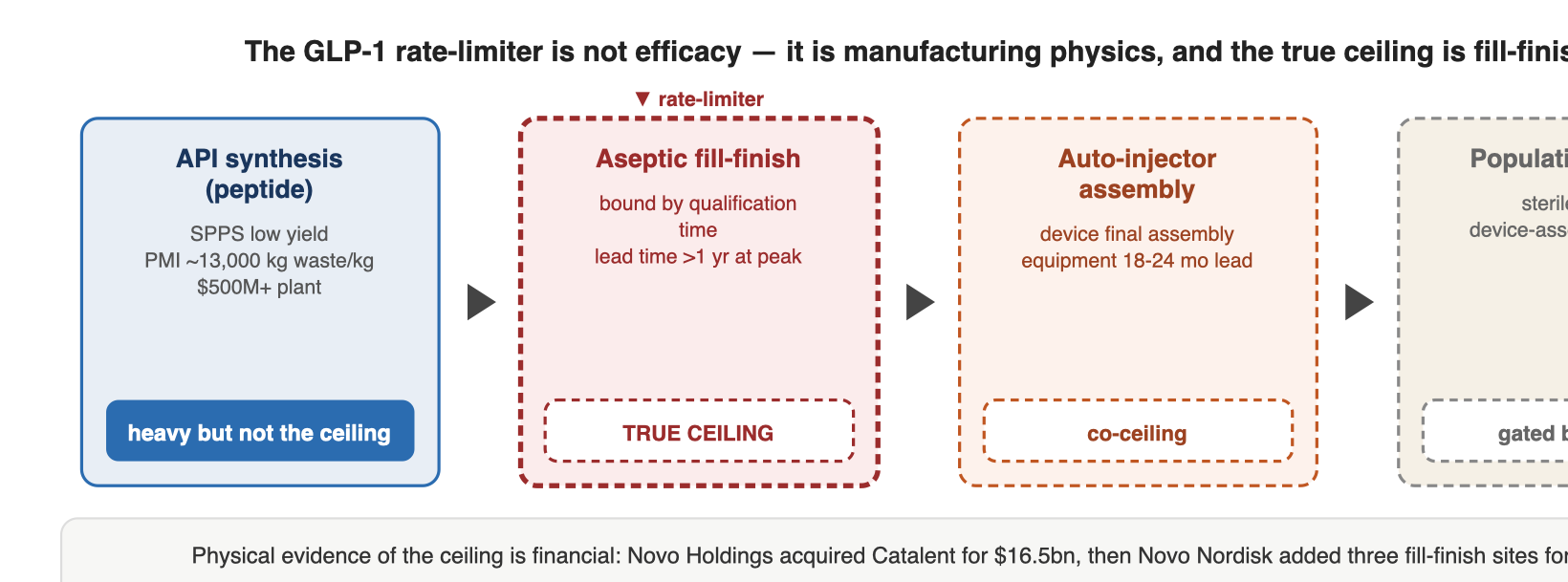
| Bottleneck stage | Rate-limiting factor | Does new tech move it? |
|---|---|---|
| API synthesis (peptide) | SPPS low yield, high waste (PMI ~13,000), high capex ($500M+ plant) | Green chemistry / continuous processing lowers PMI (pilot stage) |
| Aseptic fill-finish | Line qualification time (lead time 1 year+) | The true ceiling — capex, validation, regulation; AI irrelevant |
| Auto-injector device | High-precision assembly, per-device dedicated lines (18–24 months) | Oral route bypasses it; design improvements early |
| Design / discovery | Candidate sequence and target search | The one layer AI actually moves (no GLP-1 approved drug yet) |
Two exits: the oral small molecule and AI design — but neither erases manufacturing
The oral small molecule orforglipron is a manufacturing-physics switch: as a non-peptide it is made by standard organic synthesis, so it bypasses the three SPPS burdens and the aseptic fill-finish / device step entirely (tablet compression, blister packing). The trade-off is efficacy below the injectables (Part 2). AI generative design, meanwhile, moves the design and discovery bottleneck — but it does not touch aseptic fill-finish or device qualification, which are rate-limited by capex, time and regulation. That is the skeptic axis of this part: the bottleneck moves; it does not disappear.
Deep dive
1. Background — the thesis: the real rate-limiter is manufacturing physics
Parts 0–2 covered efficacy and safety, Parts 3–4 covered commercial and clinical cost. This part shifts the question from “how much efficacy?” to “how, and how much of, that molecule can physically be made.” Part 3 examined the economic bottleneck (price and payer); Part 5 examines the physical bottleneck beneath it, and where AI and continuous manufacturing move that bottleneck. Verification status: VERIFIED (23 confirmed / 0 refuted / 3 unverified).
2. What this establishes — API synthesis: SPPS physics, hybrid recombinant, and the small-molecule difference
Core (verified): approved GLP-1 agents are peptides, made by SPPS or hybrid recombinant routes; SPPS is a low-productivity process generating roughly 13,000 kg of waste per kg of peptide. An oral small molecule such as orforglipron is standard organic synthesis, so its manufacturing physics is fundamentally different (a scalability advantage) — the manufacturing basis for the “access thesis” of Part 2.
- SPPS physics — confirmed (multi-source): semaglutide (31 amino acids) and tirzepatide (39 amino acids) are made by SPPS, needing more than 30–40 coupling cycles followed by purification and chemical modification (Drug Discovery News, 2025). Each cycle repeats coupling → wash → deprotection → wash, consuming large volumes of solvent (mainly DMF, around 39%). The process mass intensity (PMI) is around 13,000 — roughly 13,000 kg of waste per 1 kg of peptide (J. Org. Chem. 2024; DDN 2025). Purification (RP-HPLC) can take longer than synthesis, and a commercial-scale plant runs $500M+ (DDN). Low yield, high waste and high capex are the physical rate-limiter at the API step.
- Hybrid recombinant route — confirmed: Novo produces semaglutide via a hybrid — a GLP-1 precursor backbone made by recombinant yeast (S. cerevisiae) fermentation, then SPPS extension of the terminal tetrapeptide, attachment of a C-18 diacid linker, and condensation coupling and purification (ScienceDirect 2024). Fermentation favors large-scale backbone production but still needs downstream chemical modification and purification — “recombinant means infinite scale” is not accurate. Generics and compounders tend toward full-synthesis SPPS (C&EN 2025).
- The fundamental small-molecule difference — confirmed: orforglipron is a non-peptide small molecule — approved by the FDA on 2026-04-01 as Foundayo, described as the first non-peptide small-molecule GLP-1 receptor agonist (AJMC 2026). Being standard organic synthesis, it can be made at any qualified plant, scaled up over days to weeks, needs no refrigeration, and simplifies global distribution — thereby bypassing the three SPPS burdens (repeated coupling, solvent, cold chain). The caveat: its efficacy is below the injectables (Part 2: ATTAIN-1 12.4% versus tirzepatide about 20%) — a trade-off between manufacturing scalability and efficacy.
- COGS is an unverified tier: figures such as semaglutide manufacturing cost “~$20–40/dose” and small-molecule “dollars or cents per dose” are independent blog estimates, not company data (TrimRx; wholebodyjournal). The direction (small molecule far below peptide) is physically plausible, but the absolute per-dose cost is undetermined — reported as unverified rather than fabricated.
3. Fill-finish and device — “the true ceiling is not chemistry but sterile filling and the needle”
Core (verified): the actual supply ceiling is aseptic fill-finish plus auto-injector assembly, not the API. New lines are bound not by capital but by qualification time, spanning years. Novo’s $16.5B Catalent acquisition is the physical evidence of this bottleneck.
- Fill-finish as the real ceiling — confirmed (multi-source): fill-finish capacity is often the true ceiling of supply, not the chemistry (DDN 2025). Aseptic filling lines are a multi-year process of capital plus qualification — validation, regulatory audit, process validation (Pharmaceutical Technology). At peak demand, fill-finish lead times exceeded one year and final-assembly equipment lead times ran 18–24 months (Pharm Tech; Ensera).
- Downstream migration of the device bottleneck — confirmed: the true competitive bottleneck migrated downstream, from aseptic cartridge filling toward high-precision pen-device assembly, functional testing and validation. Because semaglutide and tirzepatide each use their own proprietary auto-injector, each device requires its own manufacturing line, regulatory approval and quality oversight (Pharm Tech). “Making the drug” and “making the injector” are separate bottlenecks.
- Novo–Catalent $16.5B — confirmed (company / press): Novo Holdings acquired Catalent for $16.5B (completed December 2024), after which Novo Nordisk acquired three fill-finish sites in Italy, Belgium and Indiana for $11B, explicitly to scale Wegovy supply (pharmaphorum; Pharmaceutical Technology 2024). DDN summarized this as a pharma company buying a CMO for $16.5B solely to secure fill-finish capacity — a monetary measure of the aseptic-filling bottleneck. EU approval and US antitrust review ran in parallel (BioSpace).
- The oral bypass — confirmed: oral small molecules bypass aseptic fill-finish and device assembly entirely (tablet compression, blister packing). Lilly pre-stocked roughly $1.5B of orforglipron before launch (DDN) — being a small molecule, it can be mass-produced and inventoried in advance (harder for peptide injectables due to cold chain and shelf life).
4. Compounding chemistry — why it was a quality and safety issue (manufacturing view)
Core (verified): the end of compounding, separate from the market closure of Part 3, was a manufacturing-quality problem of salt form, dose accuracy and impurities. The FDA’s 1,150 adverse-event reports are the physical evidence.
- Salt-form problem — confirmed (FDA): some compounders used semaglutide sodium or acetate salts rather than the approved base form — a different active ingredient whose safety and efficacy are unproven (FDA). The same “semaglutide” in a different salt form is a different molecule — an identity problem of manufacturing chemistry.
- Dose accuracy — confirmed (FDA): patients drawing doses by hand from vials led to concentration variance and overdose — the FDA received reports of 5–20× the intended dose (nausea, vomiting, hospitalization). The auto-injector’s fixed-dose precision was removed by compounding — the core of the safety problem (FDA 2024-07 dosing-error alert).
- Adverse-event scale — confirmed (FDA): 1,150 adverse-event reports linked to compounded semaglutide/tirzepatide (as of 2025-07-31) — GI events, syncope, dehydration, and hospitalization for pancreatitis and gallstones (FDA). Some involved unverified additives such as B12, L-carnitine and NAD.
- Manufacturing versus market — confirmed: Part 3 read the closure of the legal compounding pathway (end of 503A discretion, removal of 503B bulks) as a market and access axis. Part 5 reads its manufacturing justification — the absence of validated salt, dose, impurity and additive control. The two axes are two sides: closure is warranted on quality grounds but a headwind for CKM access (low-cost supply disappears), consistent with Part 3 §7.
5. Cross-domain — AI design, continuous manufacturing, and the firm’s other axes
Core (verified / forecast, separated): AI moves the design and discovery bottleneck (early-stage evidence); continuous manufacturing and green chemistry improve SPPS physics (pilot). But neither directly solves the downstream physical bottleneck of aseptic fill-finish and device qualification (§3) — the bottleneck moves, it does not disappear.
- AI de novo peptide / protein design — confirmed (early evidence): generative models design novel sequences and structures — Generate Biomedicines (Chroma diffusion model), RFdiffusion, AlphaFold 3, and the 2025 PepTune (masked diffusion jointly optimizing binding, solubility and permeability) (RSC ChemComm 2026 review). The first AI-designed drug has entered the clinic — Insilico’s rentosertib (ISM001-055), with target (TNIK) and molecule designed by generative AI, reaching Phase 2a with 60 mg once-daily FVC +98.4 mL versus placebo −20.3 mL (Nature Medicine 2025-06, N=71, idiopathic pulmonary fibrosis). Caveat: this is a small molecule for IPF, not a GLP-1, and what was verified is design and discovery, not manufacturing scale-up. There is no AI-designed approved drug in the GLP-1 class yet.
- Continuous manufacturing and green chemistry — confirmed (pilot): approaches to lower SPPS PMI (~13,000) include liquid-phase (LPPS), continuous flow and MCSGP purification, cutting solvent — one manufacturer reported a 25% solvent reduction and 50% DMF substitution (ACS Green Chemistry 2025). Wash-elimination SPPS cut waste by up to 95%, using only 10–15% of base (Nature Communications 2023). The FDA has encouraged continuous manufacturing for small molecules, but peptide continuous manufacturing is still pilot to early-commercial (CordenPharma’s Swiss site targets H1 2028). The physics improvement is real but is not yet the protagonist that resolved the shortage — that protagonist remains conventional capex and fill-finish expansion (§3).
- Firm cross-axis links:
- Computing / AI: generative-model design connects directly to the firm’s AI/ML axis — but “AI solves the bottleneck” is limited to the design layer. Manufacturing physics (aseptic filling, qualification) is rate-limited by capex, time and regulation, not AI — the bio version of the computing series’ “the bottleneck lies elsewhere.”
- Materials / process engineering: SPPS solvents and resins, continuous-flow reactors, and small-molecule polymorph control are the materials and chemical-process axis. The oral small molecule’s scalability advantage is essentially a chemical-process problem, not a peptide-biology one.
- Economics / policy (inherited from Part 3): aseptic fill-finish capacity is the physical gate on access; combined with payer policy (Part 3), it sets the speed of CKM diffusion.
6. The skeptic’s bottom line (rubric — analysis-standards §3)
Verdict: proceed-with-caveats (conditional) — not verified-clean, not hold.
- Basis: the manufacturing physics (coupling cycles, PMI ~13,000, lead times, $16.5B) is robust and multi-source confirmed. But two overstatement risks require conditional progress. (1) The “AI solves the manufacturing bottleneck” hype: what AI moves is design and discovery (rentosertib is a small molecule for IPF, not a GLP-1), not aseptic fill-finish or device qualification. The physical bottleneck is rate-limited by capex, time and regulation — the bottleneck moves, it does not disappear (§5). (2) The COGS per-dose figure is an independent blog estimate (undetermined) — do not cite “small molecule cents/dose” as if it were evidence. Only the direction (small molecule far below peptide) is physically plausible.
- Essential caveats (at publication): (1) manufacturing cost (COGS) is an unverified tier — not company data. (2) “AI drug” is design-layer evidence, not manufacturing-scale evidence, and there is no directly-applied AI-designed GLP-1 approved drug. (3) Continuous manufacturing and green chemistry are pilot / early-commercial — the protagonist that resolved the shortage remains conventional capex expansion (§3). (4) Statements on the manufacturing advantage of listed pharma, CDMOs and AI companies must be neutral and attributed, not misread as security implications.
- Why not hold: the manufacturing physics and regulatory facts are transparent and multi-source confirmed, with no sign of concealment. Conditional: publishable when the four caveats above are met.
7. Three falsifiable predictions
- [Small-molecule switch] If oral small molecules such as orforglipron supply at scale without shortage after launch (the $1.5B pre-stock realized), “small molecules bypass the manufacturing bottleneck” is confirmed; if raw-material or purification bottlenecks recur even for small molecules, “not a peptide-only problem” is confirmed.
- [AI design] If an AI-designed incretin / peptide enters IND or clinical trials in 2027–29, “AI moves the GLP-1 design bottleneck” is confirmed; if design remains AI while manufacturing stays conventional, “AI is limited to the design layer” (§6) is confirmed.
- [Continuous manufacturing] If peptide continuous manufacturing / green SPPS significantly lowers PMI at commercial scale, improving COGS and lead times, “physical bottleneck eased” is confirmed; if it stays at pilot and shortages recur, conventional capex remains the only solution.
8. CKM framing and series synthesis (across Parts 0–5)
Manufacturing is the physical precondition of CKM outcomes. The CV and renal hard outcomes of Part 1 (SELECT, FLOW) and the payer coverage of Part 3 are all realized at population scale only if the molecule is physically made in sufficient quantity. Aseptic fill-finish capacity (§3) is the most-downstream rate-limiting step of population outcome even after KDIGO 2026 elevates GLP-1 to a CKM pillar (Part 1). The manufacturing scalability of the oral small molecule — even with efficacy below the injectables — has the potential to ease the physical bottleneck of CKM diffusion on the access side.
Series synthesis (the lens running through Parts 0→5): the computing five-part series’ framing — “there is a real bottleneck next to the headline” — applied across the whole GLP-1 series was the skeleton here. Part 0 (efficacy headline, tirzepatide −20%) → Part 1 (the real signal is not weight but CV, about two-thirds weight-independent, and all-cause mortality −20%) → Part 2 (the frontier bottleneck is not maximum weight-loss % but lean-mass loss, tolerability and durability) → Part 3 (not duopoly win/lose but access = price and payer as the rate-limiter) → Part 4 (the clinical cost behind the weight-loss % = lean-mass loss, ~50% discontinuation, rebound) → Part 5 (the most-downstream physical bottleneck of all of it = API, aseptic filling, device). Six parts repeat one proposition at different layers: the headline (efficacy) is not the ceiling but the starting point, and real population benefit is the product of the several bottlenecks below it (pharmacology, safety, access, manufacturing). In this firm’s CKM axis, GLP-1 remains the representative case where, even after efficacy is proven, the bottleneck keeps moving elsewhere.
References
- Drug Discovery News. 2025. “GLP-1 Manufacturing Challenges: Peptide Synthesis, Formulation and Supply Chain.” https://www.drugdiscoverynews.com/glp-1-manufacturing-challenges-peptide-synthesis-formulation-and-supply-chain-17288
- ScienceDirect. 2024. “Two-step SPPS and Inclusion-Body Route to Semaglutide.” https://www.sciencedirect.com/science/article/abs/pii/S1046592824000494
- Chemical & Engineering News (C&EN). 2025. “The Looming GLP-1 Drug Off-Patent Manufacturing Question.” https://cen.acs.org/pharmaceuticals/Looming-GLP-1-drug-patent/103/web/2025/12
- ACS Green Chemistry. 2025. “Next-Generation Peptide Manufacturing: Green Chemistry and Sustainable Development.” https://www.acs.org/green-chemistry-sustainability/green-chemistry-nexus/articles/next-generation-peptide-manufacturing-green-chemistry-and-sustainable-development.html
- Journal of Organic Chemistry. 2024. “Process Mass Intensity (~13,000) in Peptide Synthesis.” https://pubs.acs.org/doi/10.1021/acs.joc.3c01494
- Nature Communications. 2023. “Total Wash Elimination in Solid-Phase Peptide Synthesis.” https://www.nature.com/articles/s41467-023-44074-5
- Pharmaceutical Technology. “Overcoming Fill-Finish Capacity Bottlenecks in Automated Pen-Injector Assembly Lines.” https://www.pharmtech.com/view/overcoming-fill-finish-capacity-bottlenecks-in-automated-pen-injector-assembly-lines
- Ensera. “The Impact of GLP-1 Demand on the Autoinjector Supply Chain.” https://www.ensera.com/thinking/the-impact-of-glp-1-demand-on-the-autoinjector-supply-chain/
- pharmaphorum. 2024. “Novo Completes $16.5B Catalent Takeover.” https://pharmaphorum.com/news/novo-completes-165bn-takeover-catalent
- Pharmaceutical Technology. 2024. “Novo Nordisk to Acquire CMO Giant Catalent for $16.5B.” https://www.pharmaceutical-technology.com/analyst-comment/novo-nordisk-to-acquire-cmo-giant-catalent-for-16-5bn/
- FDA. “Dosing Errors Associated with Compounded Semaglutide/Tirzepatide.” https://www.fda.gov/drugs/human-drug-compounding/fda-alerts-health-care-providers-compounders-and-patients-dosing-errors-associated-compounded
- FDA. “FDA’s Concerns with Unapproved GLP-1 Drugs Used for Weight Loss.” https://www.fda.gov/drugs/drug-alerts-and-statements/fdas-concerns-unapproved-glp-1-drugs-used-weight-loss
- AJMC. 2026. “FDA Approves Lilly’s Oral GLP-1 Orforglipron (Foundayo) for Obesity.” https://www.ajmc.com/view/fda-approves-lilly-s-oral-glp-1-orforglipron-for-obesity
- Nature Medicine. 2025. “Rentosertib (ISM001-055), an AI-Designed TNIK Inhibitor, in Idiopathic Pulmonary Fibrosis (Phase 2a).” https://www.nature.com/articles/s41591-025-03743-2
- RSC Chemical Communications. 2026. “Generative AI for Peptide Design (review).” https://pubs.rsc.org/en/content/articlehtml/2026/cc/d5cc04998a
Disclosure
This post is for information only and is not investment advice, and not medical advice. Treatment decisions should always be made with your own clinician.
COI note: this post describes listed pharmaceutical companies (Novo Nordisk NVO, Eli Lilly LLY), contract manufacturers / CDMOs (Catalent, CordenPharma, WuXi) and AI design companies (Generate Biomedicines, Insilico) in a descriptive, neutral context. Company IR and press figures (for example the $16.5B and $11B acquisitions) are attributed as company data; independent analyses (techno-economic and green-chemistry papers) are attributed as estimates; press figures carry the outlet name. Per-dose manufacturing cost (COGS) is an unverified independent estimate, not company data, and is not cited as evidence. “AI solves the bottleneck” refers to design-layer evidence only, not manufacturing-scale evidence, and there is no AI-designed GLP-1 approved drug. Statements on manufacturing capacity and competitive advantage are factual, neutral descriptions and are not buy/sell implications for any security. The author holds no position in, and has no financial interest in, the companies named.


Leave a Reply