Evidence-first notes on bioscience and deep tech, at the edge of the lab and the market. Information only — not investment advice, not medical advice. All reduction and editing-efficiency figures are attributed to the sponsoring trial or company; many are company press releases or conference presentations rather than peer-reviewed data (noted inline). Safety events are attributed to the regulator or the primary source.
The 30-second version
- What. In-vivo gene editing injects the editor (a nuclease, base editor or prime editor, as mRNA or DNA) directly into the patient so the target organ — almost always the liver today — is edited inside the body. On the headline metric it has already arrived: VERVE-102 (Lilly/Verve) lowered PCSK9 up to 88% and LDL-C up to 62% in Phase 1b (company data), Intellia nex-z cut serum TTR ~87% at 36 months (company/press release), and CTX320 (CRISPR Therapeutics) reduced Lp(a) up to ~73% in humans in a Phase 1 readout (company, not peer-reviewed).
- So what. The headline (magnitude of knockdown) is close to solved; the real bottlenecks are elsewhere — delivery (LNP is essentially liver-only), safety, the complete absence of any hard clinical outcome, and irreversibility. A permanent, single-dose DNA edit cannot be re-dosed or undone, which makes the safety bar structurally higher than for any chronic drug — an asymmetric risk. In-vivo editing has zero hard outcomes (MACE, mortality) to date; every figure above is a biomarker/surrogate.
- Now what. In late 2025 that bottleneck surfaced in the clinic for the first time: in Intellia’s Phase 3 MAGNITUDE program a participant developed a Grade 4 liver-enzyme/bilirubin rise and later died, and the FDA placed the trials on hold. The company attributes the direct cause of death to septic shock (infection), stated as not related to the liver event; editing causality is not established and must not be read as “editing killed the patient.” The FDA holds have since been lifted (MAGNITUDE-2 January 2026, MAGNITUDE March 2026) with added liver-monitoring mitigations.
The five-minute read
Two stages of editing — and why this series tracks the in-vivo one
Clinical gene editing splits into two stages. Ex-vivo editing (removing a patient’s cells, editing and selecting them, then reinfusing — Casgevy/exa-cel, Prime Medicine’s PM359) has already reached approval and NEJM. But ex-vivo is, in practice, a transplant procedure: it needs marrow harvest, myeloablative conditioning (busulfan) and cell manufacturing. This series tracks the next step — in-vivo editing, injecting the editor into the body so the target organ (primarily the liver) is edited directly.
From a cardio-kidney-metabolic (CKM) vantage the headline is best-in-class. Against the paradigm built by the Lp(a), finerenone and GLP-1 work in this series — “manage chronic disease with lifelong daily therapy” — in-vivo editing proposes “treat once and stop.” A single intravenous dose has lowered PCSK9 up to 88% and LDL-C up to 62%, with effect persisting to 18 months (company data). That is the promise. The question this series asks is what stands between that promise and a genuine hard-outcome therapy.
The headline is nearly solved; the bottleneck is delivery, safety and irreversibility
The firm’s recurring lens — “the headline is the starting point; the real bottleneck is elsewhere” — applies cleanly here. Knockdown magnitude is at or beyond siRNA/ASO levels. What is not solved: delivery (lipid nanoparticles, LNP, home almost exclusively to hepatocytes, so extrahepatic tissue remains out of reach), immunogenicity and liver toxicity, the inability to re-dose or reverse a permanent edit, and very-long-term durability. And there is no hard outcome — no cardiovascular or mortality endpoint has been read for any in-vivo editing program.
In October–November 2025 that risk profile turned fatal for the first time in the clinic. In Intellia’s Phase 3 MAGNITUDE / MAGNITUDE-2 program a participant met a predefined safety threshold with a Grade 4 liver-enzyme and total-bilirubin rise; Intellia paused dosing on 27 October 2025, the FDA placed the trials on hold on 29 October 2025, and the participant died on 5 November 2025. The company’s later position is that the direct cause of death was septic shock (an infection), with the CEO stating it was “not related to the liver event,” while acknowledging the liver toxicity itself was treatment (nex-z) related (a Hy’s-law-type signal). An independent regulatory or autopsy adjudication of edit-versus-death causality has not been published — the causality remains unverified, and the honest position is neither “editing killed the patient” nor “unrelated.”
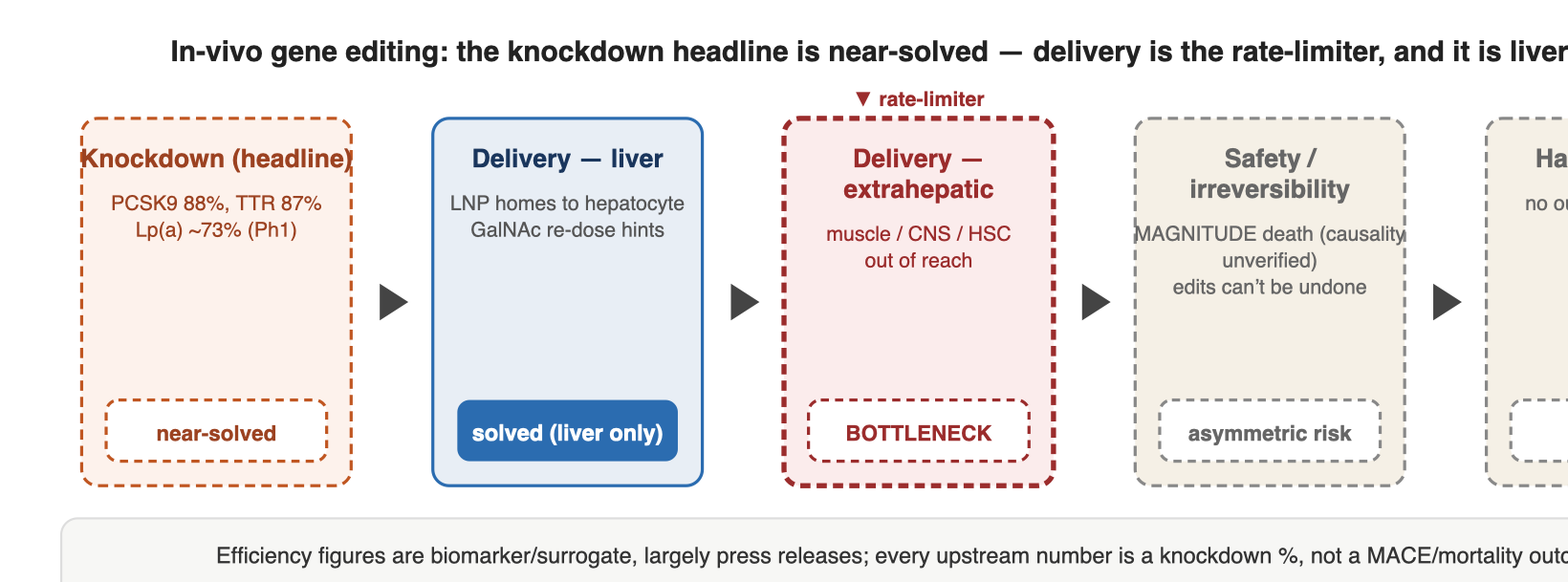
| Layer | Status (2026-07) | Verdict |
|---|---|---|
| Knockdown / editing efficiency (headline) | PCSK9 88%, LDL-C 62%, TTR 87%, Lp(a) ~73% (human Ph1), Z-AAT 84% — demonstrated (company/press release) | Near-solved |
| Durability | Persistence observed to 18–44 months; permanence expected mechanistically but not confirmed very-long-term | Promising, unproven long-term |
| Hard outcome (MACE, mortality) | Zero — no outcome trial started or read | Bottleneck |
| Delivery (liver) | Solved by LNP; GalNAc hints at re-dosing | Liver-limited |
| Delivery (extrahepatic) | Unsolved (muscle, CNS, hematopoietic) | Bottleneck |
| Safety / irreversibility | MAGNITUDE death and hold (causality unverified; death attributed to septic shock; holds lifted Q1 2026); VERVE-101 ALT/platelet event; permanent edits cannot be re-dosed or undone | Top bottleneck |
Deep dive
1. Background — four modalities across delivery vehicles
In-vivo editing spans four modalities on a precision spectrum, all currently delivered mostly by LNP to the liver.
- CRISPR nuclease (double-strand break → knockout, the bluntest, indel risk): Intellia nex-z (NTLA-2001), liver TTR knockout, LNP, Phase 3 MAGNITUDE (★ hold, since lifted); Intellia lonvo-z (NTLA-2002), liver KLKB1 knockout, Phase 3 HAELO (H1 2026 readout signaled).
- Base editing (single-base change, no cut): VERVE-102 (Lilly/Verve), liver PCSK9, GalNAc-LNP, Phase 1b Heart-2; VERVE-201 (Lilly/Verve), liver ANGPTL3, GalNAc-LNP, Phase 1b Pulse-1; BEAM-302 (Beam), liver SERPINA1 PiZ→normal correction (not a knockout), LNP, Phase 1/2 heading to pivotal (H2 2026).
- Prime editing (search-and-replace, rewriting a short sequence, the most precise): Prime PM577, liver ATP7B H1069Q correction (Wilson disease), universal-liver LNP — preclinical; IND/CTA signaled H1 2026. In-vivo prime editing has not entered the clinic as of July 2026.
- In-vivo CAR-T (not editing — transient mRNA expression, included as a contrast modality): Capstan CPTX2309, targeted tLNP delivering anti-CD19 CAR mRNA to CD8 T cells; acquired by AbbVie (up to ~$2.1B, June 2025 — an earlier draft’s “Amgen” was an error, corrected). MagicRNA HN2301, EnC-LNP, early clinical (lupus, NEJM report N=5).
Four distinctions matter. (1) Precision spectrum: nuclease (knockout only, bluntest) < base editing (single base, no cut) < prime editing (arbitrary short sequence, most precise). Higher precision widens the range of addressable variants from “off” to “fix” — Beam’s BEAM-302 and Prime’s PM577 correct rather than knock out, qualitatively different from the lipid-knockout programs. (2) Permanence vs transience: nuclease/base/prime editing change DNA permanently (truly “once = forever,” but non-reversible and non-redosable); in-vivo CAR-T is transient mRNA and, in principle, re-dosable — the word “one-shot” carries two different meanings. (3) Delivery decides tissue: today’s clinical in-vivo editing is almost entirely liver (LNP homes there; GalNAc reinforces it via ASGPR). Extrahepatic tissue (muscle, CNS, blood) is the fundamental constraint confining indications to lipids, amyloid and liver-metabolic disease; AAV has largely retreated on dose/immunogenicity/redosing grounds, leaving LNP dominant. (4) Ex-vivo boundary: Prime’s PM359 (chronic granulomatous disease, NEJM December 2025) is prime editing but ex-vivo (autologous HSC edit plus busulfan transplant).
2. What this landscape establishes — disclosed results, durability and safety (trial/company-attributed)
Principle: reduction figures, editing efficiencies and safety events are reported as in the source; biomarker/surrogate results are separated from any hard endpoint (there are none yet); and cross-program comparisons are not head-to-head.
- Intellia nex-z (NTLA-2001) — CRISPR nuclease, liver TTR knockout (direct CKM contact: myocardium). Phase 1 ATTR-CM (cardiomyopathy), N=36 (50% NYHA III, 31% variant): at 36 months (n=9) mean serum TTR fell 87% (mean absolute 22.9 µg/mL), longest follow-up 44 months (cut-off 2025-08-23, press release 2025-11-10). 24-month clinical markers (NT-proBNP, hs-TnT, 6-minute walk, NYHA) “stable or improved” in 69–85%; a post-hoc mortality of 3.9 vs 12.7 per 100 person-years against a matched historical control. All single-arm, non-randomized, historically controlled — not a hard-endpoint RCT. ★ Serious safety event: the Phase 3 MAGNITUDE/MAGNITUDE-2 event described above (Grade 4 liver enzymes/bilirubin → FDA hold 2025-10-29 → death 2025-11-05; direct cause attributed to septic shock, causality unverified; FDA holds lifted MAGNITUDE-2 2026-01, MAGNITUDE 2026-03 with monitoring, short-course steroids, and exclusion of pre-existing liver abnormality / EF <25%). A nuclease-intrinsic genomic risk has separate peer-reviewed support (Jasin, Mol Cell 2025: Cas9 double-strand break → megabase loss-of-heterozygosity ~5%).
- Intellia lonvo-z (NTLA-2002) — CRISPR nuclease, liver KLKB1 knockout (hereditary angioedema). Phase 2: single 50 mg → monthly attack rate down 77% (wk1–16) / 81% (wk5–16) vs placebo, with 8 of 11 completely attack-free (press release 2024-10-24). Phase 3 HAELO readout signaled H1 2026, US launch planned 2027.
- Verve VERVE-102 — base editing, liver PCSK9, GalNAc-LNP (direct CKM contact: lipids). Phase 1b Heart-2 (N=14, HeFH/CAD): single IV dose → PCSK9 up to 88% down, LDL-C up to 62% down (0.6 mg/kg mean LDL-C 53%), persisting to 18 months (company/PRNewswire; peer review now upgraded — NEJM 2026-05, NEJMoa2601283). No treatment-related SAEs and no clinically significant ALT/platelet change in early data. ★ Prior-generation VERVE-101 safety event: in Heart-1 the sixth participant (0.45 mg/kg) had an asymptomatic Grade 3 transient ALT rise plus thrombocytopenia → enrollment paused 2024-04; cause presumed the LNP vehicle, prompting an ionizable-lipid swap plus added GalNAc, i.e. the switch to VERVE-102. (A separate cardiovascular event in Heart-1 was reportedly adjudicated unrelated; the precise attribution is [unverified].)
- Verve VERVE-201 — base editing, liver ANGPTL3 (→ LDL-C plus triglycerides), GalNAc-LNP. Phase 1b Pulse-1, first dose 2024-11, in refractory hypercholesterolemia / HoFH.
- Beam BEAM-302 — base editing, liver SERPINA1 PiZ correction (not knockout), for alpha-1 antitrypsin deficiency. Phase 1/2, N=29: single 60 mg → circulating AAT 94% correctly folded, toxic Z-AAT down 84%, mean AAT 16.1 µM (above the 11 µM protective threshold), no SAE/DLT to 75 mg. Pivotal entry H2 2026, with an FDA-agreed accelerated-approval path on an AAT biomarker (company, 2025).
- CRISPR Therapeutics CTX320 — in-vivo CRISPR knockout of LPA (Lp(a)), LNP. Phase 1 human readout: Lp(a) reduced up to ~73% (company presentation 2026-01, not peer-reviewed). Companion program VERVE-301 (Verve/Lilly, LPA) is preclinical. This is the correct attribution for in-vivo Lp(a) editing — CTX320 / VERVE-301 — not any other program.
- Prime PM577 — prime editing, liver ATP7B H1069Q correction (Wilson disease), in-vivo but preclinical: mouse ⁶⁴Cu-PET showed hepatic copper normalization (AASLD 2025-11); IND/CTA signaled H1 2026, clinical data 2027.
- In-vivo CAR-T (not editing) — Capstan CPTX2309 (targeted tLNP anti-CD19 CAR mRNA to CD8 T cells for B-cell autoimmunity), Phase 1 started 2025-06, acquired by AbbVie (up to ~$2.1B, 2025-06-30 — the earlier “Amgen” label was an error, refuted/corrected). MagicRNA HN2301: in five lupus patients, functional CAR-T generation, B-cell depletion and reduced disease activity (NEJM report, NEJMc2509522).
3. The CKM contact — “one procedure, lifelong lipid lowering”
This is where the series meets the Principal’s CKM/Medical-Affairs axis directly. The Lp(a) work established “lower more, for longer, to reduce events”; in-vivo editing answers with the extreme of durability (permanence).
| Target | Program | Lipid effect (company data) | Relation to the Lp(a)/existing-drug work |
|---|---|---|---|
| PCSK9 | VERVE-102 (Lilly) | LDL-C up to 62% down, 18-month persistence | A permanent version of the PCSK9 mAb (evolocumab) / siRNA (inclisiran) — removes adherence as a variable |
| ANGPTL3 | VERVE-201 (Lilly) | LDL-C + TG (ongoing) | A permanent version of evinacumab (HoFH) / ASO, extending to the triglyceride axis |
| LPA / Lp(a) | CTX320 (CRISPR Tx); VERVE-301 (preclinical) | Human Ph1 up to ~73% down | Lp(a) siRNA/ASO (olpasiran, pelacarsen) = “suppress, dosed periodically” vs in-vivo editing = “permanent knockout, non-redosable” — the decisive difference. CV outcomes: zero |
| TTR (myocardium) | nex-z (Intellia) | — (amyloid) | ATTR-CM is a CKM heart-failure phenotype; first case of a myocardial phenotype improved via liver editing (but under hold) |
Guideline linkage: PCSK9/LDL-C lowering sits on the established causal axis of the ESC/EAS dyslipidemia and 2018 AHA/ACC cholesterol guidelines (LDL causality, unlike Lp(a), is outcome-proven). So in-vivo PCSK9 editing is a “target validated, means (permanent editing) novel” structure — lower target risk than Lp(a) (“neither target nor outcome proven”), higher means (safety) risk.
4. Neighbouring domains — AI editor design and nanomaterial delivery
- AI/ML: guide design, off-target prediction and base-editor protein engineering increasingly couple protein language models and structure prediction (a contact point with the firm’s bio-foundation-models series).
- Materials / nanotech: LNP ionizable-lipid and GalNAc-ligand chemistry is the rate-limiting step for extrahepatic targeting and for any re-dosing possibility — the VERVE-101→102 lesson (an ionizable-lipid swap plus GalNAc) is a materials-chemistry decision as much as a biology one.
5. Commercialization and competitive context
- Maturity (TRL frame): knockdown efficiency is demonstrated (roughly TRL 6–7 on the biomarker), but hard-outcome maturity is early (TRL 4–5 equivalent) because no outcome trial exists. The gating layers are delivery, safety and irreversibility, not efficacy.
- Intellia (NTLA): nex-z (ATTR-CM/PN) and lonvo-z (HAE) are the most advanced (Phase 3); the MAGNITUDE hold and death dominate the near-term narrative, with holds lifted Q1 2026 under liver-monitoring mitigations. HAELO readout signaled H1 2026.
- Verve / Eli Lilly (LLY): Verve was acquired by Lilly (2025); VERVE-102 is now “Lilly’s PCSK9 base editor” (PRNewswire), with VERVE-201 (ANGPTL3) and VERVE-301 (Lp(a), preclinical) behind it.
- Beam (BEAM): BEAM-302 (AATD) heading to pivotal H2 2026 on an accelerated-approval biomarker path — the leading “correction” (not knockout) program.
- Prime Medicine (PRME): in-vivo prime editing (PM577, Wilson) still preclinical; the precision leader has not yet entered the in-vivo clinic.
- CRISPR Therapeutics: CTX320 delivered the first human in-vivo Lp(a) knockdown readout (~73%, company, not peer-reviewed).
- Capstan / AbbVie: AbbVie acquired Capstan (up to ~$2.1B, 2025-06) — in-vivo CAR-T (CPTX2309), a contrast modality (transient mRNA, not editing). The earlier “Amgen” attribution was an error and is corrected.
- Company implications are limited to neutral, trial-attributed description; competitive or efficacy-ranking statements are not buy/sell signals. Deal terms (Capstan/AbbVie, Verve/Lilly amounts and conditions) are [unverified] in detail.
6. The skeptic’s bottom line
- Biomarker ≠ outcome: every reduction figure is a surrogate; in-vivo editing’s hard outcome count is zero.
- Press-release skew: nex-z myocardial data, VERVE-102, BEAM-302 and CTX320 latest numbers are largely company presentations or conference posters; peer review is partial (nex-z NEJM 2024 early; VERVE-102 NEJM 2026; CTX310/ANGPTL3 NEJM 2025; PM359 NEJM 2025; MagicRNA NEJM). Treat accordingly.
- Do not adjudicate a death that is not adjudicated: the MAGNITUDE death is attributed by the company/PI to septic shock and stated not related to the liver event; the edit-versus-death causality has no published regulatory/autopsy adjudication. It can be called neither “editing killed the patient” nor “unrelated” — unverified is the honest state.
- Irreversibility = asymmetric risk: a drug can be stopped; an edit cannot be undone or re-dosed. The safety threshold is structurally higher than for any chronic medicine.
- Neutral-framing note: to prevent misreading listed-company (NTLA, BEAM, PRME, LLY, CRSP) implications as security signals.
7. What to watch (falsifiable)
- P1: within 24 months, the first in-vivo editing program to start a CV/renal hard-outcome RCT will be PCSK9 (Lilly/Verve), ahead of ANGPTL3, Lp(a) or TTR. (Falsified if another target enters outcomes first.)
- P2: the final MAGNITUDE regulatory conclusion will converge on LNP/delivery-related liver toxicity or comorbidity, and nuclease off-target (genomic cutting) is unlikely to be confirmed as the primary cause. (Falsified if off-target genomic damage is confirmed primary.)
- P3: through 2028, no program will read a Phase 2 efficacy result for extrahepatic (muscle, CNS) in-vivo editing — delivery is the rate limiter. (Falsified by any extrahepatic Phase 2 efficacy readout.)
- Also watch: whether any in-vivo editing program ever converts a knockdown biomarker into a hard outcome; and whether the FDA holds, now lifted, stay lifted through the Phase 3 readouts.
References
- Intellia Therapeutics. 2025. “Intellia Provides Update on MAGNITUDE Clinical Trials.” Investor release (FDA hold, safety event). https://ir.intelliatx.com/news-releases/news-release-details/intellia-therapeutics-provides-update-magnitude-clinical-trials
- Intellia Therapeutics. 2025. “Positive Longer-Term Phase 1 Data of Nexiguran Ziclumeran (nex-z) in ATTR Amyloidosis with Cardiomyopathy.” GlobeNewswire, 10 November 2025 (TTR 87%; 36-month data). globenewswire.com/…/nex-z-longer-term-phase-1-data
- CGTLive. 2025. “Patient Treated in Intellia TTR Amyloidosis Gene-Editing Trial Dies” (death 2025-11-05; septic-shock attribution). https://www.cgtlive.com/view/patient-treated-trial-intellia-transthyretin-amyloidosis-gene-editing-therapy-nex-z-dies
- Verve Therapeutics. “Positive Initial Data from the Heart-2 Phase 1b Trial of VERVE-102” (PCSK9 88%, LDL-C 62%). Investor release. vervetx.gcs-web.com/…/heart-2-phase
- CGTLive. “Verve Moves on Second-Gen Cardiovascular CRISPR Therapy VERVE-102; VERVE-101 Adverse Events.” https://www.cgtlive.com/view/verve-moves-on-second-gen-cardiovascular-crispr-therapy-verve-102-adverse-events
- Beam Therapeutics. “Compelling Updated Clinical Data” for BEAM-302 (AAT correction; Z-AAT 84%). Investor release. investors.beamtx.com/…/compelling-updated-clinical-data
- Prime Medicine / Sharma et al. 2025. Ex-vivo prime editing PM359 in chronic granulomatous disease. New England Journal of Medicine. NEJMoa2509807. https://www.nejm.org/doi/full/10.1056/NEJMoa2509807
- MagicRNA / correspondence. 2025. In-vivo CAR-T (HN2301) in systemic lupus erythematosus, N=5. New England Journal of Medicine. NEJMc2509522. https://www.nejm.org/doi/full/10.1056/NEJMc2509522
- VERVE-102 peer review. 2026. New England Journal of Medicine. NEJMoa2601283 [confirmed upgrade from press release].
- CTX310 (ANGPTL3) peer review. 2025. New England Journal of Medicine. NEJMoa2511778 [confirmed]. CTX320 (Lp(a) ~73%) human Phase 1 is company-presented (2026-01), not peer-reviewed [attributed].
Disclosure
This post is for information only and is not investment advice, and not medical advice. Treatment decisions should always be made with your own clinician.
COI note: this post describes listed and private gene-editing companies (Intellia NTLA, Beam BEAM, Prime PRME, CRISPR Therapeutics CRSP, Verve [acquired by Eli Lilly, LLY], AbbVie ABBV, and their sponsored trials) in a descriptive, neutral context. Every knockdown and editing-efficiency figure is attributed to the sponsoring company or trial; many are company press releases or conference presentations rather than peer-reviewed data, and are labeled as such. Safety events (the Intellia MAGNITUDE death and FDA holds, the VERVE-101 ALT/platelet event) are attributed to the regulator or the primary source. The MAGNITUDE death’s direct cause is attributed by the company/PI to septic shock (infection); the edit-versus-death causality is not independently adjudicated and is stated as unverified — it must not be framed as “editing killed the patient.” Quantitative claims are attributed to the vendor, author or preprint/press release. Competitive and efficacy-ranking statements are factual, neutral descriptions and are not buy/sell implications for any security. The author holds no position in, and has no financial interest in, the companies named.


Leave a Reply