Evidence-first notes on bioscience and deep tech, at the edge of the lab and the market. Information only — not investment advice, not medical advice.
The 30-second version
- What. In-vivo gene editing is not one technology but a precision spectrum: nuclease (double-strand break, random indels — a “knockout” tool) → base editing (single-base substitution, no double-strand break) → prime editing (“search-and-replace” that can install all 12 point mutations plus small indels). Precision and applicability rise monotonically from left to right — but clinical maturity runs in the opposite direction: the most precise modality (prime editing) is the least clinically mature, still preclinical in vivo, while the bluntest (nuclease) is in Phase 3.
- So what. “More precise” does not mean “no off-target.” Each modality generates a different kind of off-target: nuclease produces large deletions and chromosomal rearrangements (often at the on-target site); base editing adds bystander editing plus Cas9-independent random DNA and large-scale RNA off-target caused by the deaminase itself; prime editing is lowest but carries nicking / reverse-transcription–specific errors. There is no single tool that catches all of them.
- Now what. There is a detection blind spot: most standard off-target assays are double-strand-break–dependent, so they are optimized for nuclease and largely cannot see base/prime-specific off-target events. A company statement of “no off-target detected” may reflect the limits of the method rather than the safety of the edit — “not detected” is not the same as “not there.” Read “knockout” and “correction” as qualitatively different problems, and never read “precise” as “safe.”
The five-minute read
“Knocking out” and “correcting” are different problems
The prior part of this series framed in-vivo editing as a precision spectrum rather than a single, uniform technology. This part decomposes that spectrum at the mechanistic level. The blunt tool — a nuclease — makes a double-strand break that the cell repairs imprecisely, leaving insertions and deletions that break a gene. That is enough to switch a gene off (loss-of-function). But turning a faulty sequence back into a healthy one (correction) is a qualitatively harder problem that only the precise modalities can solve. Lipid-lowering knockout programs (a PCSK9, TTR and KLKB1 knockout) are all “switch-off” jobs; correcting SERPINA1 (the alpha-1 antitrypsin PiZ variant) or ATP7B (Wilson’s disease) are “fix-it” jobs.
Precision rises, clinical maturity falls
The paradox at the center of this part is that the ranking by precision and the ranking by clinical maturity are inverted. Nuclease editing — the least precise — is on the in-vivo clinical frontier (Phase 3). Base editing is in early clinical testing (Phase 1b). Prime editing — the most precise, the widest in applicability — has, as of mid-2026, not started in-vivo clinical testing; its lead in-vivo program is preclinical. Half of the reason prime editing is not yet in the clinic is not precision at all, but delivery: fusing a reverse transcriptase makes the editor large and harder to package and express. That handoff — from precision to delivery — is the subject of the next part.
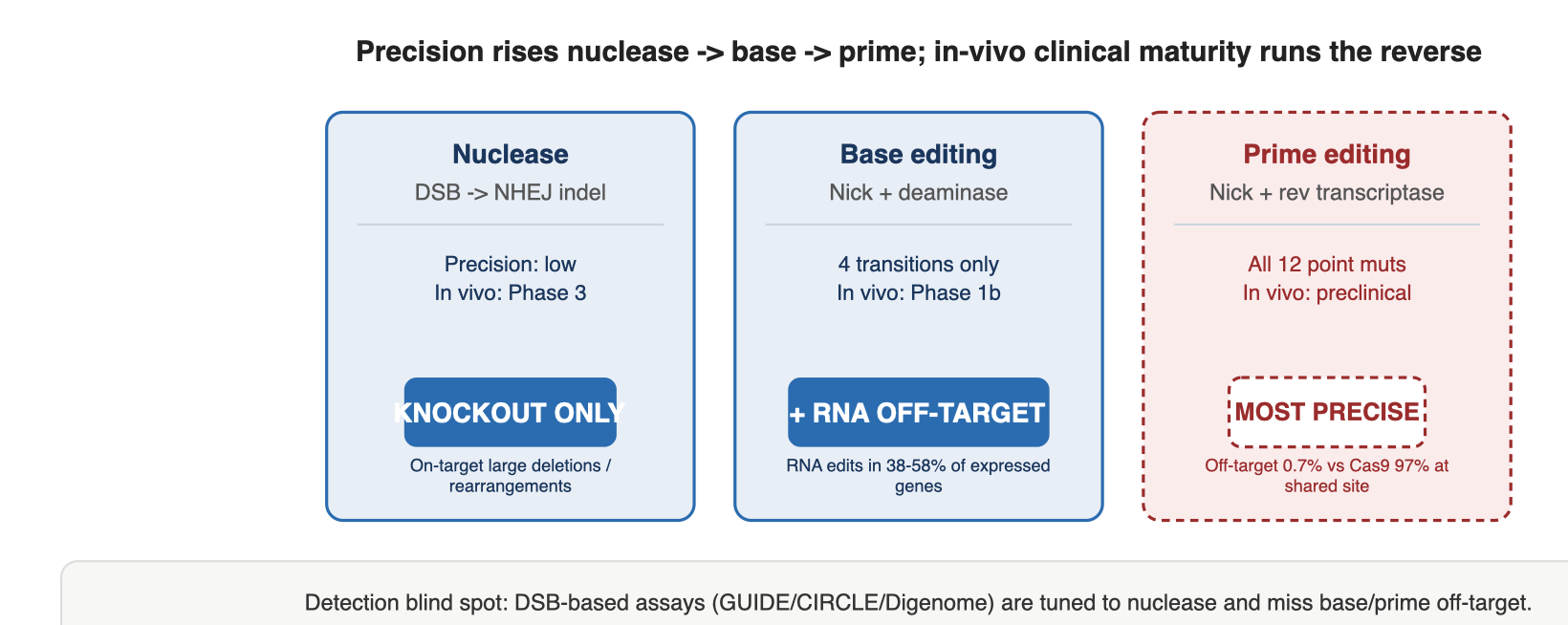 base -> prime; in-vivo clinical maturity runs the reverse” width=”1640″ height=”654″ style=”width:100%;height:auto;max-width:820px;” />
| Nuclease | Base editing | Prime editing | |
|---|---|---|---|
| Mechanism | Double-strand break → NHEJ indel | Single-base substitution (nick, no break) | Re-write (nick + reverse transcriptase) |
| Precision / scope | Low — random indel; knockout only | High — 4 transitions + knockout (iSTOP / splice) | Highest — all 12 point mutations + small indels |
| Characteristic off-target | Large deletions, rearrangements, chromothripsis (often on-target) | Bystander + Cas9-independent DNA + large-scale RNA | Lowest (dual hybridization check) |
| In-vivo clinical maturity (mid-2026) | Phase 3 frontier | Phase 1b | Preclinical |
The detection blind spot
Most standard off-target assays use the double-strand break itself as their signal, so they are tuned to nuclease editing and largely miss the off-target events that are specific to base and prime editing. When a company evaluates a base editor with a nuclease-era tool and reports “no off-target,” the negative result may say more about the method’s field of view than about the edit. “Not detected” is not evidence of “not there” — a point that recurs across this series whenever a headline claim rests on a surrogate or a single assay.
Deep dive
1. Background — nuclease, the blunt instrument, and the collateral damage of cutting
Mechanism. Cas9 makes a double-strand break (DSB) at its target. The cell repairs it mainly by non-homologous end joining (NHEJ), which is imprecise and leaves insertions and deletions (indels). The result is a frameshift, a premature stop codon, and loss of protein function. A nuclease is, in essence, a “breaking” tool: the TTR– and KLKB1-targeting programs knock out a target protein in the liver by exactly this route.
A structural risk beyond bluntness. The problem is not only the randomness of the indel. Kosicki et al. (Nat Biotechnol 2018) reported that DSB repair by CRISPR-Cas9 can produce large deletions of many kilobases and complex rearrangements at the target site. Later literature extends the list to loss-of-heterozygosity, chromosomal translocation, chromothripsis, and whole-chromosome loss (Nat Commun 2025 review). The key point: much of this damage occurs not at off-target sites but at the on-target site — the place that was cut exactly as intended — a risk that standard off-target screens are prone to miss.
“DNA breaks frequently resolving into deletions extending over many kilobases” — Kosicki et al., Nat Biotechnol 2018 (nature.com/articles/nbt.4192, 2018).
Implication. A nuclease (a) can only knock out and (b) carries the DSB-intrinsic risk of structural variation. On-target DSB collateral damage tends to present as a delayed / clonal risk rather than acute toxicity — a mechanistic timescale distinct from an acute liver-enzyme rise. Whether that framing explains any specific in-vivo safety event, however, remains a hypothesis and is unverified.
2. Base editing — single-base precision, and three distinct off-target axes
Mechanism. The base editor established by the David Liu lab substitutes a single base without a DSB. A Cas9 nickase (which cuts only one strand) is fused to a deaminase that chemically changes a base on the non-target strand exposed by the R-loop. Two types:
- CBE (cytosine base editor): C•G → T•A (Komor et al., Nature 2016).
- ABE (adenine base editor): A•T → G•C (Gaudelli et al., Nature 2017).
Core constraint — transitions only, no transversions. Together CBE and ABE can install only the four transitions (C→T, T→C, A→G, G→A); transversions (purine↔pyrimidine) and insertions/deletions are not possible (PMC7503568 review). This sets the ceiling on applicability — a substantial fraction of pathogenic single-nucleotide variants cannot be corrected by base editing alone. (A commonly cited “about one-third correctable” figure circulates, but the primary source is [unverified]; see the verification log.) Base editing can also be used for knockout — by installing a stop codon (iSTOP) or disrupting a splice site. A base-editing lipid program (using an ABE to disable PCSK9) is exactly this: “a base editor whose job is a knockout.”
Three off-target axes — different in kind from the nuclease case:
- Bystander editing (near on-target): the deaminase changes not just the one target base but homologous bases within an editing window of roughly 5 bp. If several Cs (or As) sit in that window, unwanted neighbor edits arise. Mitigation: narrowed-motif deaminases such as eA3A (engineered APOBEC3A), which prefers a tighter motif (TCR>TCY>VCN) (Gehrke/Joung, Nat Biotechnol 2018, nbt.4199).
- Cas9-independent DNA off-target: even without guidance from the gRNA, the deaminase randomly deaminates single-stranded DNA. Zuo et al. (Science 2019) showed that a CBE induced genome-wide C→T single-nucleotide variants in mouse embryos — a class that does not disappear when the gRNA is changed, and that standard nuclease off-target screens do not catch.
- Transcriptome-wide RNA off-target: the deaminase edits not only DNA but also RNA. Grünewald/Zuo et al. (Nature 2019) reported that an rAPOBEC1-based CBE caused tens of thousands of C→U RNA edits in human cells (frequencies 0.07–100%, in 38–58% of expressed genes). ABEs likewise cause A→I RNA editing. Mitigation: SECURE variants and similar.
“tens of thousands of C-to-U edits … in 38–58% of expressed genes” — Grünewald/Zuo et al., Nature 2019 (nature.com/articles/s41586-019-1161-z, 2019).
Implication. Base editing removes the DSB collateral damage of nuclease editing and is more precise, but the deaminase itself opens new off-target axes (random DNA + large-scale RNA). RNA editing is transient (RNA is turned over), so its clinical meaning differs from DNA off-target — but the safety of large-scale expressed-gene editing remains an open area. Crucially, these three axes are mostly invisible to nuclease-era off-target tools (see section 4): base editing carries its own detection blind spot regardless of any delivery-related event.
3. Prime editing — re-writing (the most precise), but still preclinical in vivo
Mechanism. Prime editing (Anzalone et al., Nature 2019) is “search-and-replace.” A Cas9 nickase is fused to a reverse transcriptase, and a pegRNA (prime editing guide RNA) carries the edit. The nickase nicks one strand, and the pegRNA template directs the reverse transcriptase to write the new sequence directly. No DSB, and no donor DNA, is required.
The peak of precision and applicability. Prime editing can install all 12 point mutations (4 transitions + 8 transversions) plus small insertions/deletions (PMC7296174 review) — beyond the transition-only ceiling of base editing. Its applicability is therefore the widest (knockout plus every kind of correction).
Why its off-target is structurally lowest. Relative to Cas9 editing, prime editing requires two extra DNA-hybridization checks (pegRNA spacer binding plus primer-binding-site binding). Anzalone et al. reported that at an off-target site sharing the same protospacer, Cas9 edited 97% while PE2 edited only 0.7% (Nature 2019). Off-target suppression is, in other words, built into the mechanism.
But the decisive immaturity — no in-vivo clinic yet. As of mid-2026, prime editing has not entered in-vivo clinical testing. Prime Medicine’s lead in-vivo program (an ATP7B/Wilson’s-disease editor) is preclinical (normalization of liver copper on ⁶⁴Cu PET in mice, reported at a late-2025 meeting; an IND/CTA was signaled for the first half of 2026). The prime-editing program that has reached the clinic is ex vivo, not in vivo. The price of precision is that (a) the editor is large — the reverse-transcriptase fusion strains lipid-nanoparticle packaging and expression — and (b) efficiency is lower and needs more optimization. This is the extreme of the precision-versus-maturity inversion.
4. Off-target assessment — “what you cannot see” differs by modality
Off-target assessment has two stages: nomination (candidate listing) and confirmation (targeted deep sequencing). Nomination tools fall into a few families that list different sites (Frontiers Genome Editing 2021 comparison):
| Tool | Principle | Setting | Strength / limit |
|---|---|---|---|
| GUIDE-seq | dsODN tag inserted at cellular DSBs, then sequenced | In-cell | Physiological context / DSB-dependent → suits nuclease, unsuitable for base & prime |
| CIRCLE-seq | Detects cut sites in purified genomic DNA in vitro | In-vitro | High sensitivity (~180,000-fold enrichment vs prior in-vitro) / many false positives, no cell context |
| Digenome-seq | Sequencing of in-vitro genomic cleavage | In-vitro | Unbiased, quantitative / no cell context |
| DISCOVER-seq | Pulldown of endogenous repair factor (MRE11) | Cellular, in-vivo capable | Applicable in vivo / DSB-dependent |
The core gap — the tools do not track the modality. Most of the tools above use the DSB (the cut) as their signal. They are therefore optimized for nuclease off-target and largely miss the base/prime-specific off-target events from section 2 (bystander, Cas9-independent DNA, RNA). Base editing needs a separate family (clonal whole-genome sequencing, orthogonal R-loop induction, Detect-seq–type assays).
The “not detected = safe” trap. Failing to find off-target is not evidence of its absence. In particular, if a company evaluates a base editor with a nuclease-era tool and announces “no off-target,” it may be because the detection method cannot see that class of event. This is the same structure as the surrogate-versus-outcome and press-release-bias caveats elsewhere in the series — the price of precision (prime immaturity) and the detection blind spot (base editing) together weaken the “precise = safe” narrative of in-vivo editing.
Precision-versus-applicability trade-off, summarized. Precision (minimizing off-target and collateral damage) and applicability (the range of correctable variants) rise together (nuclease < base < prime). But deliverability, efficiency and clinical maturity fall in the opposite direction — the baton this part hands to the next (delivery). Half the reason prime editing is not in the clinic today is not precision but delivery.
5. Verdict — one-line reading
Precision and applicability improve from left to right (nuclease → prime), but in-vivo clinical maturity is furthest ahead on the left. “The most precise modality is the least mature” is the inversion at the heart of this axis, and each modality’s off-target is of a different kind, so the three cannot be compared with a single tool. Neutral commercial mapping: nuclease is associated with Intellia; base editing with Beam and Verve (Verve acquired by Eli Lilly); prime editing with Prime Medicine — a technical mapping, not a ranking of companies or securities.
6. The skeptic’s bottom line
- Do not equate “precise” with “safe.” Base editing removes the DSB collateral damage, but the deaminase opens new off-target axes (random DNA + tens of thousands of RNA edits). A gain in precision is not automatically a gain in safety.
- The detection blind spot. Nuclease-era off-target tools (GUIDE / CIRCLE / Digenome / DISCOVER) largely cannot see base/prime-specific off-target. A company statement of “no off-target detected” may reflect a limit of the method; a negative claim without a stated method warrants the demonstration-gap caveat.
- On-target is not harmless. Nuclease large deletions and chromosomal rearrangements arise at the exact target site — the risk can persist even when the off-target screen passes.
- The price of precision is immaturity. The most precise modality, prime editing, is preclinical in vivo. Do not misread “prime is superior” as a clinical reality — the maturity ranking is the reverse.
- Escalation stands. The modality spectrum could be misread as a ranking of the listed companies (Intellia, Beam, Verve [Lilly], Prime Medicine); it is a technical trade-off, not a security signal.
7. What to watch — three falsifiable predictions
- P1 (detection gap): among in-vivo base-editing programs disclosing off-target data over the next 24 months, peer-reviewed material that explicitly assesses Cas9-independent DNA or RNA off-target will be less common than nuclease off-target assessment (a nuclease bias in tools and regulatory expectation). Falsified if base-specific off-target assessment becomes standardized and is reported at parity or better.
- P2 (maturity inversion): prime editing’s first in-vivo clinical dosing will start later than base editing’s, and far behind nuclease (already Phase 3 in mid-2026) — the precision order and the clinical-entry order stay inverted. Falsified if in-vivo prime editing enters the clinic ahead of base-editing programs.
- P3 (knockout first): the disclosed clinical efficacy of in-vivo editing will, for now, come from “knockout” targets (PCSK9, TTR, KLKB1, ANGPTL3) ahead of “correction” targets (SERPINA1, ATP7B) — knockout demands less precision, widening the modality choice. Falsified if a correction program reads out late-stage efficacy before a knockout program.
8. Framing — the baton to the delivery part
The conclusion of this part is that precision alone cannot rank the modalities. A large part of why prime editing — the most precise — is not yet in the clinic is delivery, not precision: the reverse-transcriptase fusion enlarges the editor and makes lipid-nanoparticle packaging, hepatocyte expression and efficiency harder. Base editing joined the same lipid-nanoparticle trajectory as nuclease because delivery was solved. In other words, the factor that actually orders the modality spectrum is the “deliverability / efficiency” axis — the subject of the delivery part (lipid nanoparticle vs AAV, GalNAc, liver targeting, re-dosing, extrahepatic tissue). And because delivery decides tissue (today almost entirely liver), off-target discussion cannot be separated from delivery either.
References
- Kosicki, M., K. Tomberg, and A. Bradley. 2018. “Repair of double-strand breaks induced by CRISPR-Cas9 leads to large deletions and complex rearrangements.” Nature Biotechnology 36: 765. https://www.nature.com/articles/nbt.4192
- Review. 2025. CRISPR structural variation and genome integrity. Nature Communications (s41467-025-62606-z). https://www.nature.com/articles/s41467-025-62606-z
- Grünewald, J., R. Zuo, et al. 2019. “Transcriptome-wide off-target RNA editing induced by CRISPR-guided DNA base editors.” Nature 569: 433. https://www.nature.com/articles/s41586-019-1161-z
- Gehrke, J. M., and J. K. Joung, et al. 2018. “An APOBEC3A-Cas9 base editor with minimized bystander and off-target activities (eA3A).” Nature Biotechnology 36: 977. https://www.nature.com/articles/nbt.4199
- Review. Base editing / prime editing (transition-only constraint, conversion scope). PMC7503568. https://pmc.ncbi.nlm.nih.gov/articles/PMC7503568/
- Comparison of off-target assessment methods. 2021. Frontiers in Genome Editing 3: 673022. https://www.frontiersin.org/journals/genome-editing/articles/10.3389/fgeed.2021.673022/full
- Review. Prime editing — DSB-free, all 12 conversions. PMC7296174. https://pmc.ncbi.nlm.nih.gov/articles/PMC7296174/
- Additional foundational milestones cited in text: Komor et al. 2016 (CBE), Gaudelli et al. 2017 (ABE), Zuo et al. 2019 (Science; Cas9-independent genomic C→T), Anzalone et al. 2019 (Nature; prime editing establishment). Company/program figures (VERVE-102, BEAM-302, PM577 and the ⁶⁴Cu PET preclinical data) are attributed to the respective company/trial disclosures and remain, at the program level, [unverified] for quantitative in-vivo off-target.
Disclosure
This post is for information only and is not investment advice, and not medical advice. Treatment decisions should always be made with your own clinician.
COI note: this post describes listed gene-editing companies (Intellia Therapeutics NTLA, Beam Therapeutics BEAM, Prime Medicine PRME, Verve Therapeutics — acquired by Eli Lilly LLY) and technologies attributed to their originating researchers (base and prime editing from the David Liu lab, among others) in a descriptive, neutral context. Mechanistic and off-target quantities are attributed to the relevant peer-reviewed papers; company pipeline figures are attributed to the trial or company materials, and press-release claims are labeled as such. The precision spectrum (nuclease < base < prime) is a technical trade-off and is not a ranking of companies or securities; in-vivo clinical maturity in fact runs in the opposite direction. Program-level in-vivo off-target quantification is largely undisclosed and is marked [unverified] rather than inferred. The author holds no position in, and has no financial interest in, the companies named.


Leave a Reply