Evidence-first notes on bioscience and deep tech, at the edge of the lab and the market. Information only — not investment advice, not medical advice. Delivery-performance figures (editing efficiency, knockdown) are largely company, conference or preclinical (NHP/mouse) data and are attributed as such in the text; safety events are attributed to regulatory/source documents and unresolved causality is kept unverified.
The 30-second version
- What. In in-vivo gene editing the true bottleneck is not the editing enzyme (Cas9, base editor, prime editor) but the delivery vehicle — delivery is the rate-limiting step. Lipid nanoparticles (LNPs) coat themselves in apolipoprotein E (ApoE), which binds the hepatocyte LDL receptor (LDLR), so on IV dosing roughly 80–90% of an LNP localizes to the liver. This hepatotropism is an intrinsic material property, not a design choice.
- So what. Because delivery physics point at the liver, essentially every in-vivo editing program now in the clinic targets a liver-expressed protein (PCSK9, ANGPTL3, TTR, AAT, kallikrein). The concentration of indications in the liver is therefore a physical consequence of delivery, not of target biology. On almost every axis of editor delivery LNP beats AAV (transient expression, unlimited payload, redosing, no pre-existing immunity, days-not-weeks manufacturing); AAV’s only remaining edge is extrahepatic tropism (muscle, CNS, retina), and even there editing is blocked by AAV’s own constraints. Intellia has for the first time shown clinically that an editing therapy can be redosed (serum TTR fell a median 52% at a low dose, then 90% after a 55 mg redose) — but this proves only that redosing can add more editing, not that it can reverse or restore decayed durability.
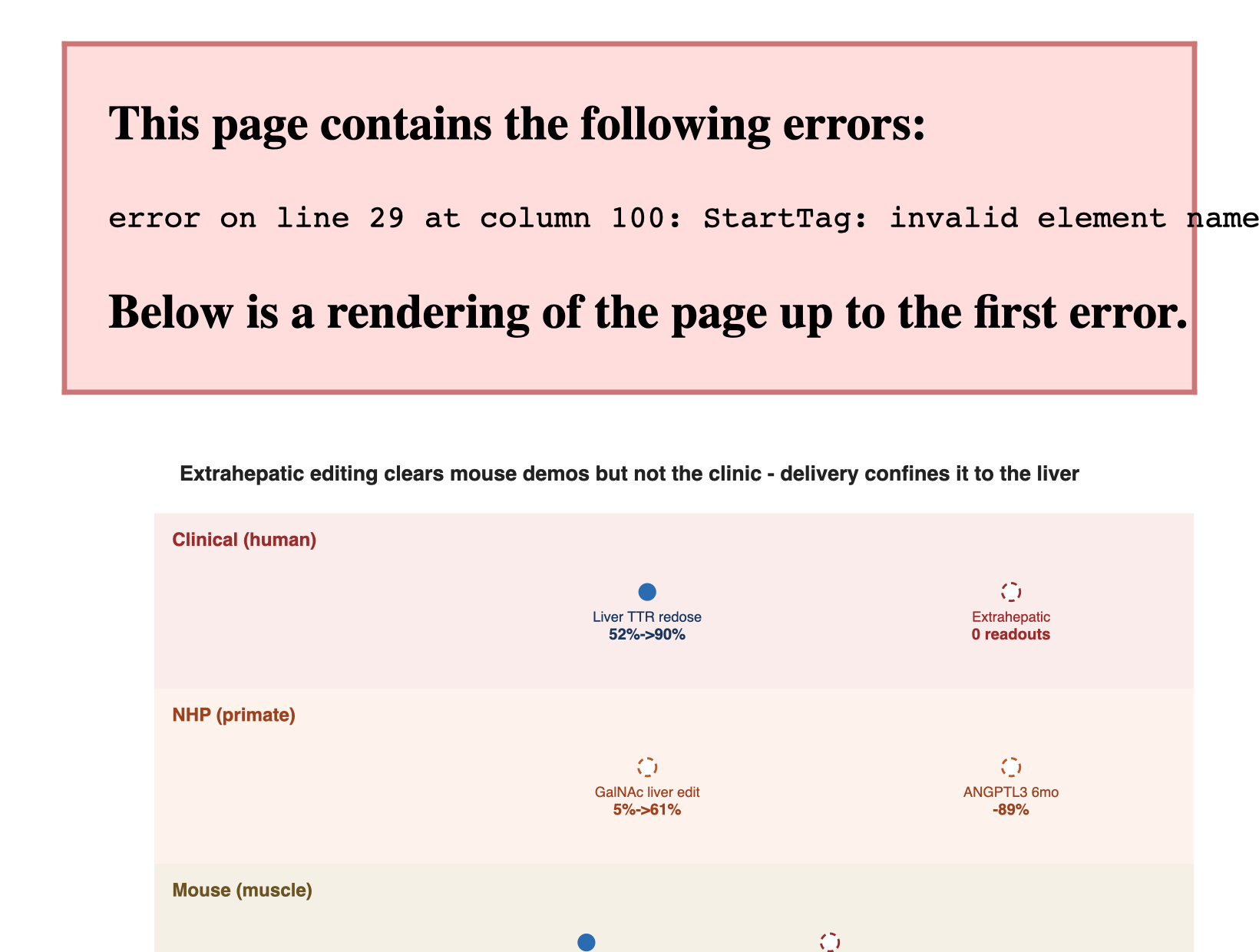
- Now what. Read the delivery axis honestly: there are zero clinical efficacy readouts for extrahepatic in-vivo editing. Muscle, CNS and blood remain out of range — all extrahepatic data are preclinical and mostly in mice (muscle ~10% by intramuscular injection, under 1% intravenous, ~40% Cas9 protein restoration with SORT-LNP), not NHP and not clinical. LNP hepatotoxicity (VERVE-101 ALT, the Intellia MAGNITUDE death, causality unconfirmed) remains the structural companion risk of concentrating payload in the liver.
The five-minute read
Delivery, not the enzyme, is the rate-limiting step
Part 1 of this series dealt with the precision–efficiency trade-off across editing modalities (nuclease, base, prime). Part 2’s thesis is simpler: the real bottleneck in in-vivo editing is not “what does the cutting” but “where it gets delivered.” However precise the mRNA/gRNA of an editing enzyme is, no editing happens unless it reaches the cytoplasm of the target cell intact. And the fact that, as of mid-2026, essentially every in-vivo editing program in the clinic targets the hepatocyte is not a coincidence — it is because the delivery vehicle dictates the indication.
Two delivery axes compete. LNP (lipid nanoparticle: transient mRNA expression, natural liver tropism, redosing potential) and AAV (adeno-associated virus: durable DNA expression, immunogenicity, no redosing, payload ceiling). Clinical in-vivo editing has converged on LNP while AAV has largely retreated. This part decomposes why that convergence happened — and why the same convergence forces the field to pay for it in the currency of liver-only indications plus hepatotoxicity exposure.
Why the liver — the physics of LNP
An intravenously injected LNP adsorbs ApoE from the blood; ApoE binds hepatocyte LDLR and the particle is internalized. Liver tropism is thus an intrinsic property of the material, and without optimization roughly 80–90% of an LNP localizes to the liver (attributed to review). Verve’s second-generation GalNAc-LNP adds an N-acetylgalactosamine ligand that engages the hepatocyte-specific asialoglycoprotein receptor (ASGPR) as a second route; in LDLR-deficient NHPs this raised liver editing from 5% to 61% with ANGPTL3 protein down up to 89% out to six months (Nat Commun 2023, Verve — NHP/company preclinical, not the source of clinical editing efficiency). LNP delivers mRNA, so the enzyme is expressed briefly and then cleared — transient expression minimizes off-target accumulation, which is a precision advantage even though it is an efficiency disadvantage.
| Axis of editor delivery | LNP | AAV | Verdict (in-vivo editing) |
|---|---|---|---|
| Tissue tropism | Liver (ApoE→LDLR, ~80–90% hepatic) + GalNAc→ASGPR | Serotype-dependent (liver, muscle, CNS, retina) | Mixed — LNP strong in liver / weak extrahepatic; AAV extrahepatic tropism is its only edge |
| Expression profile | Transient (mRNA) → off-target minimized | Durable (DNA) → off-target accumulates | LNP favored for editing |
| Payload capacity | Effectively unlimited (large editors OK) | ~4.7 kb (base/prime editor needs splitting) | LNP favored |
| Redosing | Possible (low immunogenicity; Intellia clinical proof-of-concept) | Not possible (neutralizing antibodies) | LNP favored |
| Pre-existing immunity | None (synthetic lipid) | ~30–60% of population (AAV8 45.6%) | LNP favored |
| Manufacturing | Days (mRNA + lipid synthesis) | Weeks (cell culture + purification) | LNP favored |
| Hepatotoxicity | VERVE-101 ALT; MAGNITUDE death (causality unconfirmed) | Different toxicity profile | LNP’s top-tier bottleneck |
| Extrahepatic clinical editing | Muscle IV <1% (preclinical); SORT mouse only | Muscle/CNS tropism but editing blocked by constraints above | Unresolved on both sides |
Why indications cluster in the liver
Extrahepatic tissues (muscle, CNS, blood) remain clinically unsolved for in-vivo editing, and that is the root reason programs are confined to PCSK9, ANGPTL3, TTR, AAT and KLKB1 — all liver-expressed. The answer to “why is everything a lipid, amyloid or hepatic-metabolic disease?” is not target biology but delivery physics. Liver-expressed proteins are simply the lucky case where the target sits where the LNP naturally goes; muscular (DMD), neurological and blood diseases are out of range until delivery is solved.
Deep dive
1. Background — the two delivery axes
LNP and AAV are the two vehicles that carry an editing enzyme into a cell in vivo. AAV is the original gene-therapy vector, but for in-vivo editing it has retreated for four reasons detailed in section 3. LNP has become the mainstream. The central claim of this part is that this is not a fashion but the logical consequence of delivery physics: the vehicle, not the enzyme, is rate-limiting, and the vehicle’s biodistribution therefore sets the boundary of what can be treated.
2. LNP — liver, transient expression, redosing, hepatotoxicity
- Why the liver (physics). IV-dosed LNP adsorbs ApoE, which binds hepatocyte LDLR; ~80–90% localizes to the liver without optimization (attributed to review). A blessing for liver disease, a curse for everything else.
- GalNAc upgrade (second generation). Verve’s GalNAc-LNP adds a ligand for hepatocyte-specific ASGPR (a receptor with high hepatocyte expression, rapid endocytosis, surface recycling). In LDLR-deficient NHPs, liver editing rose from 5% to 61% with off-target editing minimal and ANGPTL3 protein down up to 89% out to six months (Nat Commun 2023, Verve — NHP/company preclinical). VERVE-102 carries this GalNAc-LNP and enters hepatocytes via a dual LDLR-or-ASGPR route, sharing the same gRNA and a similar ABE mRNA with VERVE-101 but changing only the vehicle (AHA/Circulation abstract, Verve).
- Transient expression = the safety logic. Because LNP delivers mRNA, the enzyme is expressed briefly and cleared, whereas AAV’s durable DNA expression lets the enzyme persist and accumulate off-target edits. As the design principle goes, the DNA change is permanent but the enzyme that makes it need only be present briefly — that asymmetry is the core of LNP-based editing.
- Hepatotoxicity (the bottleneck). LNP’s liver concentration is two sides of one coin with hepatotoxicity. VERVE-101 (Heart-1) showed asymptomatic transient Grade 3 ALT elevation plus thrombocytopenia, halting enrollment in April 2024; the cause was presumed to be the LNP vehicle, prompting the switch to VERVE-102 with a changed ionizable lipid plus GalNAc. Separately, an Intellia MAGNITUDE participant died after Grade 4 liver-enzyme and bilirubin elevations (FDA hold); LNP-related hepatotoxicity is a leading candidate but causality remains unconfirmed [unverified]. GalNAc has refined intrahepatic targeting, but as long as payload concentrates in the liver, hepatotoxicity stays a structural companion risk.
3. AAV — durable expression, immunogenicity, no redosing, payload ceiling
- Payload capacity. The AAV genome is about 4.7 kb; SpCas9 (~4.1 kb) plus gRNA, promoter and regulatory elements barely fit. Base and prime editors are larger fusion proteins that do not fit a single AAV — dual-AAV splitting, trans-splicing or compact Cas orthologs are needed, all of which cut efficiency. LNP has essentially no size constraint, favoring large editors such as prime editors.
- Durable expression → genotoxicity. AAV expresses the enzyme stably and long-term, so off-target and chromosomal-abnormality risk accumulates with time. Editing needs to happen once; a persistent enzyme is pure downside.
- No redosing (neutralizing antibodies). The first dose induces strong anti-capsid immunity, neutralizing any subsequent dose — AAV editing is effectively fixed as a single administration.
- Pre-existing immunity. Naturally acquired neutralizing antibodies are common, so roughly 30–60% of the general population has pre-existing immunity (serotype/age/geography dependent); a global study reported AAV5 34.8% and AAV8 45.6% (hemophilia cohort, attributed). Many patients are excluded from dosing at the outset — a barrier LNP does not have.
In short, AAV cannot hold large editors, keeps the enzyme too long, can only be given once, and cannot even be given to a large fraction of patients. Convergence on LNP is the logical result. AAV retains established extrahepatic tropism (CNS, retina, muscle) and remains standard for gene supplementation — this is role differentiation, not full exit.
4. Extrahepatic tissue is unsolved — the quantitative case
This is the key skeptic point. Extrahepatic in-vivo editing (muscle, CNS, blood) is clinically unsolved.
- Muscle (quantitative). Skeletal-muscle LNP editing has made preclinical progress but efficiency is low: Kenjo et al. (2023) reported ~10% DMD exon-45 skipping by intramuscular (IM) injection in humanized mice; Mochida et al. (Dec 2025) reported ~10% in muscle and satellite cells. Critically, intravenous dosing yields under 1% exon skipping (about 10× lower than IM) — systemic dosing is still swallowed by the liver (80–90% hepatic). One favorable signal: LNP outperformed AAV for satellite-cell targeting (mRNA detection 19.4% vs 5.0%, CRISPR Medicine News, mouse).
- SORT / targeting strategies (preclinical). The Siegwart group’s SORT (Selective Organ Targeting) tunes helper-lipid charge to change serum-protein adsorption and reroute LNP to lung, spleen or muscle. One preclinical report (bioRxiv 2025) restored ~40% of Cas9 protein in skeletal muscle despite an immune response — but this is entirely mouse/preclinical with no clinical validation. Extrahepatic delivery is a materials problem (ionizable-lipid pKa, helper-lipid charge, ligand), not an editor problem.
- Bottom line. There are zero clinical efficacy readouts for extrahepatic in-vivo editing. The narrative that “extrahepatic delivery is about to be solved” is exactly the demo-gap case (preclinical vs clinical): the data are preclinical and mostly murine.
5. Redosing and durability — LNP’s hidden card
There is a paradox. In-vivo editing is sold as a therapy that needs no redosing because it permanently changes DNA. So why does redosing matter? Two reasons: (1) dose-to-effect — if a single dose falls short of the editing target, a second dose can raise the edited fraction; and (2) correction of durability decay — if edited cells turn over or very-long-term knockdown wanes. AAV forecloses both options (neutralizing antibodies); LNP keeps them open thanks to low immunogenicity.
Clinical proof-of-concept. Intellia has, for the first time, shown clinically that a gene-editing therapy can be dosed twice: three participants at a low dose (0.1 mg/kg) had a median 52% reduction in serum TTR at day 28, and after a 55 mg redose reached a 90% reduction — an additive PD effect (Intellia IR / CGTlive). Intellia views its nex-z program as not requiring redosing, but the point is that the redosing capability of the LNP platform itself is now a clinically demonstrated asset, a “dose-to-effect” option AAV structurally cannot have.
But the asymmetry remains. Redosing can add more editing, but it cannot reverse an edit already made. If durability turns out to be “too strong” (an unexpected long-term signal), redosing is powerless — this irreversibility risk is the subject of Part 4. LNP’s redosing capability mitigates only the under-effect direction of risk, not the excess/adverse direction. The 52%→90% proof-of-concept is a low-dose-then-high-dose additive design; it proves editing can be increased, not that decayed durability can be restored (a separate question, kept unverified).
6. The skeptic’s bottom line
Verdict: proceed-with-caveats (conditional). Keep the following caveats at Tier-1 prominence:
- All extrahepatic data are preclinical, mostly mouse. Muscle 10% (IM), under 1% (IV) and SORT 40% protein restoration are neither NHP nor clinical. Extrahepatic in-vivo editing clinical efficacy = zero. The “extrahepatic is about to be solved” story is a demo-gap (preclinical vs clinical).
- GalNAc figures are company/NHP. The 5%→61% and 89% knockdown are Verve NHP preclinical (Nat Commun), not direct evidence of clinical editing efficiency. Clinical knockdown (e.g. PCSK9 88%) is handled separately in Part 3.
- The redosing proof-of-concept is a low-to-high additive design. Intellia’s 52%→90% proves the principle that redosing adds editing, not that redosing restored decayed durability. No over-generalization.
- Hepatotoxicity causality is unconfirmed. VERVE-101 ALT is “LNP presumed”; the MAGNITUDE death is documented alongside comorbidities and is unverified. Neither “LNP is safe” nor “LNP kills” can be asserted.
- Escalation maintained. Statements about the delivery-platform standing of listed companies (Intellia NTLA, Beam BEAM, Prime PRME, Eli Lilly LLY [Verve], Amgen AMGN [Capstan]) must not be misread as security implications.
7. Neighbouring domains
- Materials / nanotech. Ionizable-lipid pKa, helper-lipid charge (SORT) and GalNAc-ligand chemistry are the rate-limiting physics of tissue targeting. Extrahepatic delivery is a materials problem, not an editing problem.
- AI / ML. The LNP composition space (ionizable lipid × helper × PEG × ligand) is combinatorially explosive; barcoded-LNP screening plus ML prediction is one way to explore it (a point of contact with the firm’s bio-foundation-models thread).
8. What to watch — falsifiable predictions
- P2-1. Through 2028, no program reads out clinically meaningful extrahepatic (muscle, CNS, blood) in-vivo editing efficiency (e.g. muscle protein restoration ≥15%) above the NHP stage — SORT/targeted LNP stays preclinical. (Falsified by any extrahepatic in-vivo editing clinical efficacy readout.)
- P2-2. The primary vehicle of any commercialized in-vivo editing therapy is overwhelmingly LNP; AAV-based in-vivo editing is unlikely to be approved first (AAV differentiates into gene supplementation and extrahepatic tropism). (Falsified by an AAV-based in-vivo edit approved first.)
- P2-3. The first commercial use of LNP redosing is a “dose-to-effect” (topping up under-editing) context, not “durability correction.” (Falsified if redosing for durability-decay correction enters a label/approval first.)
References
- Musunuru, K., et al. 2023. “GalNAc-lipid nanoparticles enable non-LDLR-dependent hepatic delivery of a CRISPR base-editing therapy.” Nature Communications 14. 5%→61% NHP liver editing; ANGPTL3 protein down up to 89%. https://www.nature.com/articles/s41467-023-37465-1
- Related NHP base-editing data (PMC mirror). PMC. https://pmc.ncbi.nlm.nih.gov/articles/PMC10185539/
- VERVE-102 abstract (dual LDLR/ASGPR hepatocyte uptake; same gRNA, similar ABE mRNA as VERVE-101). Circulation 150 (suppl. 1): 4139206. https://www.ahajournals.org/doi/10.1161/circ.150.suppl_1.4139206
- “Advancing gene editing: the role of lipid nanoparticles in CRISPR delivery.” 2024. Drug Target Review. Transient vs durable expression; manufacturing days vs weeks. https://www.drugtargetreview.com/article/188056/advancing-gene-editing-the-role-of-lipid-nanoparticles-in-crispr-delivery/
- AAV redosing / immunogenicity review. 2025. Gene Therapy. https://www.nature.com/articles/s41434-025-00573-2
- AAV seroprevalence (global; AAV5 34.8%, AAV8 45.6%, hemophilia cohort). PMC. https://pmc.ncbi.nlm.nih.gov/articles/PMC11253686/
- Intellia. 2024. “Positive clinical proof-of-concept data on redosing” (NTLA-2001: TTR median 52%→90% additive PD). Investor release. https://ir.intelliatx.com/news-releases/news-release-details/intellia-announces-positive-clinical-proof-concept-data-redosing
- CGTLive. 2024. “Intellia successfully redoses CRISPR gene-editing therapy NTLA-2001.” https://www.cgtlive.com/view/intellia-successfully-redoses-crispr-gene-editing-therapy-ntla-2001
- CRISPR Medicine News. “Delivery of gene-editing components to skeletal muscle using lipid nanoparticles” (Kenjo 2023 IM ~10%; Mochida 2025 muscle/satellite; IV under 1%; satellite mRNA 19.4% vs AAV 5.0%). https://crisprmedicinenews.com/news/delivery-of-gene-editing-components-to-skeletal-muscle-using-lipid-nanoparticles-a-game-changer-for/
- SORT-LNP skeletal muscle Cas9 protein restoration ~40% (preclinical, mouse). 2025. bioRxiv. https://www.biorxiv.org/content/10.1101/2025.05.12.653518.full.pdf
- SORT (Selective Organ Targeting) foundational work. PNAS 118. https://www.pnas.org/doi/10.1073/pnas.2109256118
Disclosure
This post is for information only and is not investment advice, and not medical advice. Treatment decisions should always be made with your own clinician.
COI note: this post describes listed and private gene-editing/delivery companies (Intellia NTLA, Beam BEAM, Prime PRME, Verve [acquired by Eli Lilly LLY], Capstan [acquired by Amgen AMGN]) and their sponsored trials and preclinical data in a descriptive, neutral context. Company GalNAc-LNP performance figures (5%→61% editing, NHP ~80% PCSK9, 89% ANGPTL3 knockdown, etc.) are attributed to company/conference/preclinical (NHP, mouse) sources and are noted as not peer-reviewed where applicable. Safety events (VERVE-101 ALT, the Intellia MAGNITUDE death) are attributed to regulatory/source documents and causality is kept unverified. Statements about delivery-platform standing are factual, neutral descriptions and are not buy/sell implications for any security; no assertion that “LNP is safe/dangerous” or that “AAV is dead” is made. The author holds no position in, and has no financial interest in, the companies named.


Leave a Reply