Evidence-first notes on bioscience and deep tech, at the edge of the lab and the market. Information only — not investment advice, not medical advice.
The 30-second version
- What. In-vivo gene editing is now reproducing, in a permanent, single-dose form, the “lipid biomarker lowering” that siRNA/ASO drugs already established. Two programs have reached peer review: VERVE-102 (PCSK9 base editing; NEJM, May 2026) and CTX310 (ANGPTL3 nuclease editing; NEJM, Nov 2025). A third, CTX320 (Lp(a)/LPA nuclease editing, CRISPR Therapeutics), has shown up to a 73% reduction in the dose-escalation phase of a human Phase 1 trial per company disclosure — full dataset and peer review are not yet released; the next-generation VERVE-301/CTX321 assets remain preclinical.
- So what. The differentiator is not the magnitude of lowering — on that surrogate, editing is at best on par with siRNA/ASO. It is irreversibility: editing changes DNA permanently and cannot be re-dosed or withdrawn, whereas siRNA/ASO (the Lp(a)-series drugs — olpasiran, pelacarsen, lepodisiran) are repeat-dosed and can simply be stopped. All numbers here are biomarkers (LDL-C, triglycerides, ANGPTL3, Lp(a)). Reduction percentages from company Phase 1 materials are attributed as such.
- Now what. The hard bottleneck is unchanged: there are zero cardiovascular hard-outcome (MACE) data for any in-vivo lipid-editing program. For PCSK9/LDL the target is outcome-validated by prior trials, but the modality (permanent editing) is not; for Lp(a) even the target’s outcome benefit is still unconfirmed. “Bigger lowering” must not be read as “clinical superiority,” and “editing beat siRNA” is not a claim this evidence supports.
The five-minute read
The “permanent, one-shot” edition of the Lp(a) story
The prior Lp(a) work in this series reached two conclusions: first, that lowering the Lp(a) biomarker is a solved game — siRNA/ASO drugs already achieve roughly 80–100% reductions; and second, that the real bottleneck is translating that lowering into MACE, which stays unproven until large outcome trials read out. In-vivo gene editing reproduces exactly this structure across the whole lipid axis, but in a permanent, single-dose modality. The headline (magnitude of lowering) is close to solved; the real bottleneck is irreversibility, no re-dosing, and the absence of outcome data.
Three questions organize this part: (1) how far in-vivo editing of PCSK9 and ANGPTL3 has come (answer: into peer review); (2) whether a clinical in-vivo Lp(a) editing program actually exists (answer: yes, CTX320); and (3) whether “edit once” is even the right frame for a chronic disease (irreversibility cuts both ways).
Two programs in peer review, one in human data, the rest preclinical
PCSK9 — VERVE-102 (base editing). A single base substitution silences hepatic PCSK9; because there is no double-strand break, indel risk is lower than with a nuclease. Delivery uses Verve’s GalNAc-LNP; Eli Lilly acquired Verve in 2025, so it is now described as “Lilly’s PCSK9 base editor.” In the Phase 1b Heart-2 trial (NEJM, May 2026; NEJMoa2601283; 147 screened, 35 dosed), a single infusion produced a dose-dependent mean PCSK9 reduction of 51% (0.3 mg/kg) to 88% (1.0 mg/kg) and a mean LDL-C reduction up to 62% (1.0 mg/kg), durable to 18 months, with no treatment-related serious adverse events.
ANGPTL3 — CTX310 (nuclease editing). Knocking out ANGPTL3 lowers LDL-C and triglycerides at once. CTX310 (CRISPR Therapeutics; CRISPR/Cas9 nuclease, LNP) reported Phase 1 data at AHA 2025 with simultaneous publication in NEJM (Nov 8, 2025; NEJMoa2511778; N=15) — the most mature peer review among in-vivo lipid editors. At the top dose, mean reductions were ANGPTL3 −73% (max −89%), triglycerides −55% (max −84%), and LDL −49% (max −87%), with no treatment-related serious adverse events and no ≥Grade 3 transaminase changes in this dataset.
Lp(a) — CTX320 (nuclease editing). Here the modality is fundamentally different from the Lp(a)-series siRNA/ASO drugs: those suppress apo(a) production and are repeat-dosed, whereas CTX320 permanently knocks out the LPA gene in a single, non-re-dosable treatment. Preclinically (nonhuman primate, Circulation 2023 abstract) a single dose reduced Lp(a) by a Day-14 mean of 94%, sustained to Day 224. Clinically, per company disclosure, “CTX320, targeting LPA, has demonstrated reductions of up to 73% in the dose-escalation phase of the clinical trial” (CRISPR Therapeutics, Jan 12, 2026) — but the full dataset, N, durability, safety detail and peer review are not yet public. A next-generation asset, CTX321, carrying a roughly 2x-potency guide RNA, remains preclinical/IND-enabling, as does Verve’s VERVE-301 Lp(a) program.
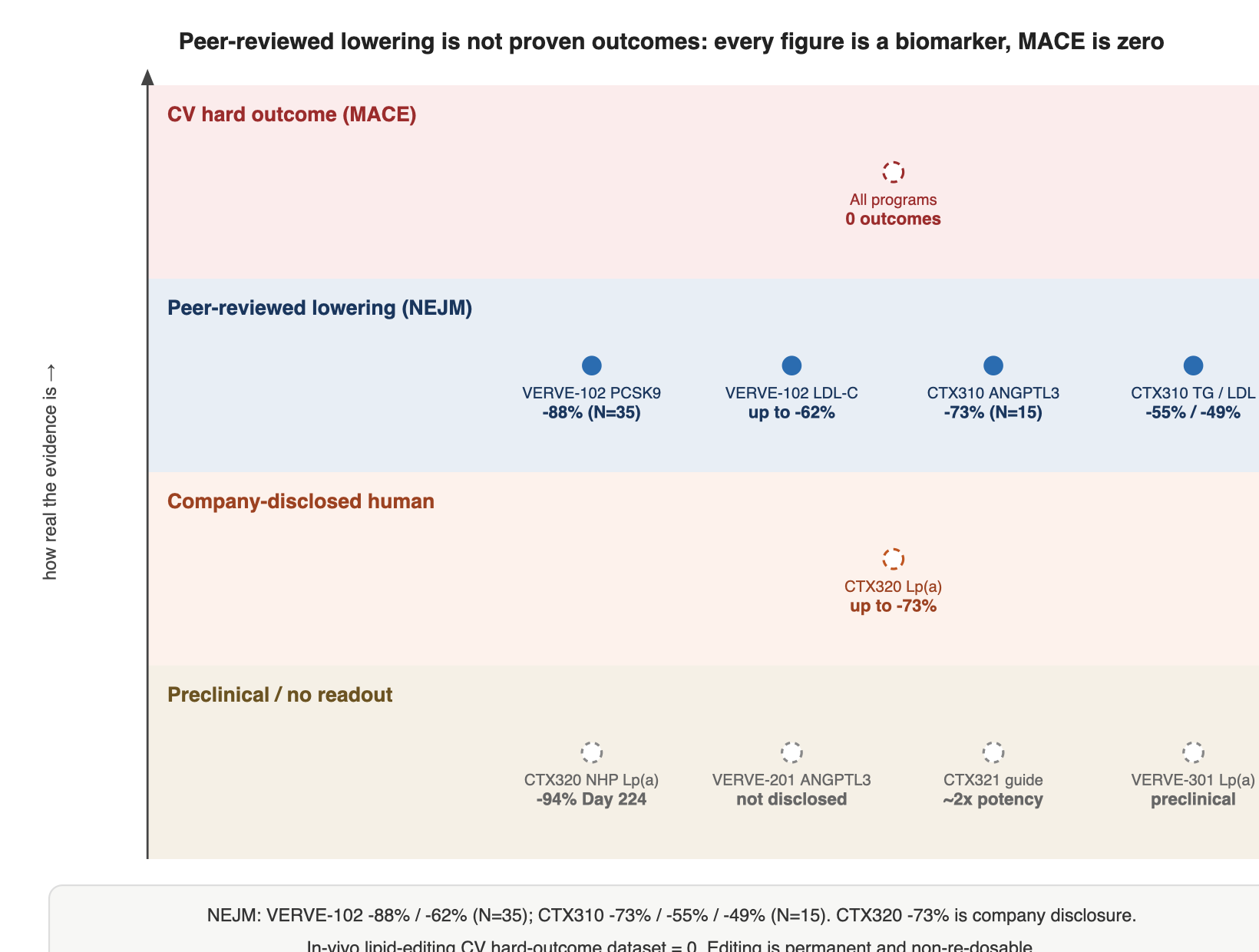
| Program (attributed) | Lowering (per source) | Evidence maturity | Read |
|---|---|---|---|
| PCSK9 / VERVE-102 (base editing) | PCSK9 51–88% ↓, LDL up to 62% ↓, durable 18 mo | NEJM peer review (N=35) | Lowering demonstrated / 0 CV outcomes |
| ANGPTL3 / CTX310 (nuclease) | ANGPTL3 −73%, TG −55%, LDL −49% (mean, top dose) | NEJM peer review (N=15) | Lowering demonstrated / 0 CV outcomes |
| ANGPTL3 / VERVE-201 (base editing) | Not disclosed | Phase 1b ongoing (first dose Nov 2024) | Data awaited [unverified] |
| Lp(a) / CTX320 (nuclease) | Human up to 73% ↓ (dose-esc, company disclosure); NHP 94% (Day 224) | Human = press release; preclinical = abstract | Clinical program confirmed to exist / full data awaited |
| Lp(a) / CTX321, VERVE-301 (next-gen) | ~2x-potency guide (CTX321) | Preclinical / IND-enabling | Awaited |
| CV hard outcome (all programs) | — | Entirely unproven | The bottleneck |
Irreversibility — the double-edged core
The editing sales pitch (“one-and-done, lifelong”) cuts both ways in a chronic disease. Lipid disorders are managed over decades, and if a safety signal emerges with an siRNA/ASO drug, you stop it and the target recovers. Editing cannot be stopped: an unexpected long-term signal — off-target effects, over-correction, or an unknown phenotype from complete ANGPTL3/PCSK9 loss — has no reversal mechanism. Non-re-dosability is therefore not a convenience but a structural safety asymmetry that no amount of lowering magnitude removes.
Deep dive
1. Background — the lipid axis and why editing is being applied to it
PCSK9, ANGPTL3 and LPA are three of the best-genetically-validated lipid targets. PCSK9 loss-of-function carriers have low LDL-C and low cardiovascular risk; ANGPTL3 loss lowers both LDL-C and triglycerides; and elevated Lp(a) is a genetically causal, largely treatment-refractory cardiovascular risk factor. The pharmacology has advanced from monoclonal antibodies (evolocumab, alirocumab; evinacumab for ANGPTL3) to repeat-dosed nucleic-acid drugs (inclisiran siRNA for PCSK9; olpasiran, lepodisiran siRNA and pelacarsen ASO for Lp(a)). In-vivo gene editing is the next modality on the same targets — with the distinguishing property that it aims to make a single, permanent change to the hepatocyte genome.
2. What this landscape newly establishes
Relative to the earlier landscape in this series, three things move from “press release / unverified” to “confirmed”:
- VERVE-102 (PCSK9 base editing) reached NEJM peer review (NEJMoa2601283, May 2026). Phase 1b Heart-2, open-label single-ascending-dose in heterozygous familial hypercholesterolemia or premature coronary disease: 147 screened, 35 dosed (Apr 2024–Jan 2026). Single infusion, mean PCSK9 −51% (0.3 mg/kg) to −88% (1.0 mg/kg), dose-dependent; mean LDL-C reduction by dose 9% / 44% / 45% / 33% / 51% / 62% (0.3 → 1.0 mg/kg); durable to 18 months; no treatment-related serious adverse events. Lilly plans to begin Phase 2 enrollment (efficacy/dose-finding) by the end of 2026 — still a biomarker endpoint.
- CTX310 (ANGPTL3 nuclease editing) reached NEJM peer review (NEJMoa2511778, AHA 2025-11-08 late-breaker; N=15). Top dose: ANGPTL3 −73% (max −89%), triglycerides −55% (max −84%), LDL −49% (max −87%); well tolerated, no treatment-related serious adverse events, no ≥Grade 3 transaminase changes in this dataset. A Phase 1b (severe hypertriglyceridemia; refractory hypercholesterolemia) is ongoing with an update guided to H2 2026.
- CTX320 (Lp(a)/LPA nuclease editing) resolves the previously open question of whether a clinical in-vivo Lp(a) editing program exists — it does. Preclinical NHP (Circulation 2023 abstract 17013): single dose, Day-14 mean 94% reduction sustained to Day 224. Clinical: Phase 1 ongoing in elevated-Lp(a) patients; per company milestones the dose-escalation phase showed up to 73% reduction. The full dataset, N, durability and safety detail remain unpublished, with a program update guided to 2026.
≤150-character direct quote (verbatim): “CTX320, targeting LPA, has demonstrated reductions of up to 73% in the dose escalation phase of the clinical trial.” (CRISPR Therapeutics, Jan 12, 2026)
3. Method — strengths and limits, and the ANGPTL3 modality contest
ANGPTL3 is the one target where an in-vivo modality contest is set up: CTX310 (nuclease knockout, NEJM data, N=15) versus VERVE-201 (single-base base editing, GalNAc-LNP; Pulse-1 Phase 1b, first dose Nov 2024; no public efficacy readout as of this writing [unverified]). In principle base editing generates fewer off-target and indel events than a nuclease; but because ANGPTL3 is a target one wants to switch off entirely, the “bluntness” of a nuclease is relatively less disadvantageous here. Current data maturity favors CTX310 — but maturity of lowering is not the same as an advantage in safety or outcomes.
Two structural limits apply to all of these programs. First, delivery: every program relies on LNP (or GalNAc-LNP) hepatocyte delivery, so the safety of the delivery vehicle is inseparable from the edit. Second, the readouts are single-arm, small-N Phase 1 biomarker studies; 18 months (VERVE-102) and 224 days (CTX320 NHP) are not evidence of a lifelong effect — permanence is a DNA-level expectation, not a clinically-followed multi-year fact.
4. Neighbouring domains — delivery chemistry and guide-RNA design
What separates “permanent” from “repeat-dosed” is ultimately delivery chemistry: a single GalNAc-LNP dose for editing versus repeat GalNAc conjugates for siRNA. This is the same durability-engineering axis explored in the Lp(a) series. And CTX321’s “roughly 2x-potency guide RNA” is a product of in-silico sequence optimization — a hook to the bio-foundation-models thread, where protein language models are being coupled to off-target prediction and base-editor engineering. Editing does not escape the delivery and design constraints that govern the whole oligonucleotide field; it inherits them.
5. Commercialization and competitive context
- TRL / maturity: VERVE-102 (PCSK9) and CTX310 (ANGPTL3) are at Phase 1 with peer-reviewed biomarker data (roughly TRL 6, clinical proof-of-concept on a surrogate); CTX320 (Lp(a)) is at Phase 1 with company-disclosed human biomarker data; VERVE-201, CTX321 and VERVE-301 are preclinical/early clinical. No program has a cardiovascular outcome trial underway.
- Editing camp (listed): CRISPR Therapeutics (CRSP) runs three in-vivo lipid programs (CTX310/320/321); Verve — acquired by Eli Lilly (LLY) in 2025 — runs VERVE-102/201/301; Intellia (NTLA) and Beam (BEAM) are also active in in-vivo editing. Deal-size specifics for the Lilly–Verve transaction are [unverified] here.
- siRNA/ASO camp (listed): the Lp(a) series covered Novartis (pelacarsen), Amgen (olpasiran), Eli Lilly (lepodisiran) and Silence Therapeutics, which are already in Phase 3 outcome trials — i.e., a full generation ahead of editing on outcome evidence, while editing may hold an adherence/durability edge on the surrogate.
- Company statements here are limited to neutral, source-attributed description. Program comparisons are factual and are not buy/sell implications for any security. “Bigger lowering” is not “clinical superiority,” and modality maturity is not modality victory.
6. The skeptic’s bottom line
- Biomarker ≠ outcome: PCSK9 88%, ANGPTL3 73%, Lp(a) 73% are all surrogates. The in-vivo editing CV hard-outcome dataset is zero. For PCSK9/LDL the target is outcome-validated by guidelines, but the modality (permanent editing) is not; for Lp(a) even the target is outcome-unconfirmed.
- Peer review vs press release are mixed: VERVE-102 and CTX310 are in NEJM (high confidence). But CTX320’s human 73% rests on a single company milestones sentence — N, dose, durability and safety detail are undisclosed. Do not treat “73% ↓” as a settled performance figure. VERVE-201 has no data at all.
- Irreversibility is an asymmetric risk: in a chronic disease, non-re-dosability is both the sales point and a structural safety threshold. A prior in-vivo editing serious event (a death and hold in a separate program, causality unconfirmed) is a reminder that this asymmetry can materialize clinically.
- Equal lowering ≠ clinical superiority: the closeness of nuclease (CTX310/320) and base-editing (VERVE-102/201) lowering must not be translated into “modality superiority” — off-target, durability and safety are the deciding axes, and they are not yet settled.
- Framing: read this as “lowering is (peer-reviewed) done, and an Lp(a) editing program exists in the clinic,” not as “editing has won.” The bottleneck — outcomes and the price of irreversibility — is entirely unresolved.
7. What to watch
- The 2026 CTX320 Lp(a) update — whether the human single-dose maximum lowering converges around ~70% (consistent with the disclosed 73%) or reaches the NHP ~90% range, and what the safety and durability detail shows.
- Which lipid-editing program first opens a cardiovascular/renal hard-outcome RCT — the shortest regulatory path is PCSK9 (VERVE-102/Lilly), where the target is already outcome-validated.
- The ANGPTL3 modality contest — whether VERVE-201’s first disclosed lowering overlaps the CTX310 range (making lowering non-discriminating) so that differentiation shifts to off-target/safety.
- Any long-term follow-up that begins to test whether “permanent” editing is durable and safe over years — not just 18 months.
References
- Verve Therapeutics / Eli Lilly investigators. 2026. “VERVE-102 (PCSK9 base editing), Heart-2 Phase 1b.” New England Journal of Medicine (NEJMoa2601283). PCSK9 up to −88%, LDL-C up to −62%, durable to 18 months (N=35). https://www.nejm.org/doi/full/10.1056/NEJMoa2601283
- CRISPR Therapeutics investigators. 2025. “CTX310 (ANGPTL3 nuclease editing), Phase 1.” New England Journal of Medicine (NEJMoa2511778; AHA 2025-11-08). ANGPTL3 −73%, TG −55%, LDL −49% (mean, top dose; N=15). https://www.nejm.org/doi/full/10.1056/NEJMoa2511778
- Eli Lilly / PR Newswire. 2026. “A single dose of Lilly’s PCSK9 base editor VERVE-102 reduced PCSK9 by up to 88% and LDL-C by up to 62% with durable effects.” Company press release (figures attributed to sponsor). PR Newswire release
- CRISPR Therapeutics. 2025. “Positive Phase 1 clinical data for CTX310 (ANGPTL3).” GlobeNewswire, Nov 8, 2025. GlobeNewswire release
- CRISPR Therapeutics. 2026. “Strategic priorities and anticipated 2026 milestones” — CTX320 (LPA) up to 73% reduction in the dose-escalation phase; CTX321 next-generation guide. GlobeNewswire, Jan 12, 2026 (company disclosure, not peer-reviewed). GlobeNewswire release
- CRISPR Therapeutics investigators. 2023. “CTX320 (in-vivo LPA editing), nonhuman primate.” Circulation 148 (suppl. 1): abstract 17013. Single dose, Day-14 mean 94% Lp(a) reduction sustained to Day 224 (preclinical). https://www.ahajournals.org/doi/10.1161/circ.148.suppl_1.17013
- ClinicalTrials.gov. “VERVE-201 (ANGPTL3 base editing), Pulse-1 Phase 1b.” NCT06451770 (first dose Nov 2024; efficacy readout [unverified]). https://clinicaltrials.gov/study/NCT06451770
Disclosure
This post is for information only and is not investment advice, and not medical advice. Treatment decisions should always be made with your own clinician.
COI note: this post describes listed biotech/pharma companies — CRISPR Therapeutics (CRSP), Verve Therapeutics (acquired by Eli Lilly, LLY), Intellia (NTLA), Beam (BEAM), and the siRNA/ASO camp (Novartis, Amgen, Silence Therapeutics) — and the trials they sponsored, in a descriptive context. All lowering percentages are attributed to the sponsoring Phase 1/1b trials or company materials, with peer-reviewed sources (VERVE-102 NEJM, CTX310 NEJM) explicitly separated from company press releases (CTX320 dose-escalation). Every figure in this post is a biomarker (LDL-C, triglycerides, ANGPTL3, Lp(a)); none is a hard outcome (MACE), and the in-vivo editing cardiovascular-outcome dataset is zero. Editing (permanent, non-re-dosable) is distinguished from siRNA/ASO (repeat-dosed) throughout. Competitive and program-comparison statements are factual, neutral descriptions and are not buy/sell implications for any security. The author holds no position in, and has no financial interest in, the companies named.


Leave a Reply